Tributes often focus on discoveries that rewrote textbooks or earned international awards when a scientist’s death makes global headlines. Jane Goodall, who passed away this year, had all of those.
Yet her most enduring contribution to the ecological movement may be her conviction that hope is not a feeling, but a tool.
READ: A primatologist inter pares
Goodall modelled a civic practice that the world urgently needs to scale: persistent, emotionally intelligent engagement with both science and society.
Communities
In an era when young people hear more about climate doom than possibilities, her decades-long investment in what she called “reasons for hope” offered more than comfort. It offered strategy.
To many, hope might sound abstract or naïve. To Goodall, it was the opposite: grounded, practiced, and deliberate. Not a wish, but a discipline. Not passive optimism, but an invitation to act.
This matters for conservation because the work has shifted. We are no longer only protecting what is intact; we are restoring what is damaged.
Across Africa, Latin America, Europe and beyond, successful conservation rarely comes from top-down directives alone.
It grows from relationships: between species, between communities and landscapes, and between generations working toward a future they can imagine together.
Peace
Goodall’s science anticipated this long before conservation policy caught up. She understood that ecological resilience and social resilience are inseparable.
Her choice to name the chimps she studied, rather than number them, was not sentimentality. It was a statement about what conservation requires: relationships, not transactions.
It was a rejection of the idea that nature exists only as data, or that living beings are interchangeable units on a spreadsheet. Goodall treated ecosystems as communities, not collections of objects.
That insight still challenges us. Without connection, there is no stewardship. Without stewardship, there is no restoration that lasts.
Goodall’s thinking resonates deeply with UN frameworks that recognize the interdependence of ecological and human systems. She understood that progress on biodiversity depends on equity, education, and peace.
Participation
Environmental resilience, in her view, begins with civic resilience. A reforested hillside or a protected watershed can be undone in a single generation if local commitment collapses. Conservation is infrastructure, but so is trust.
This is why her signature phrase, “Think globally, act locally,” endures. Though coined decades earlier by René Dubos, Goodall gave the idea a working method.
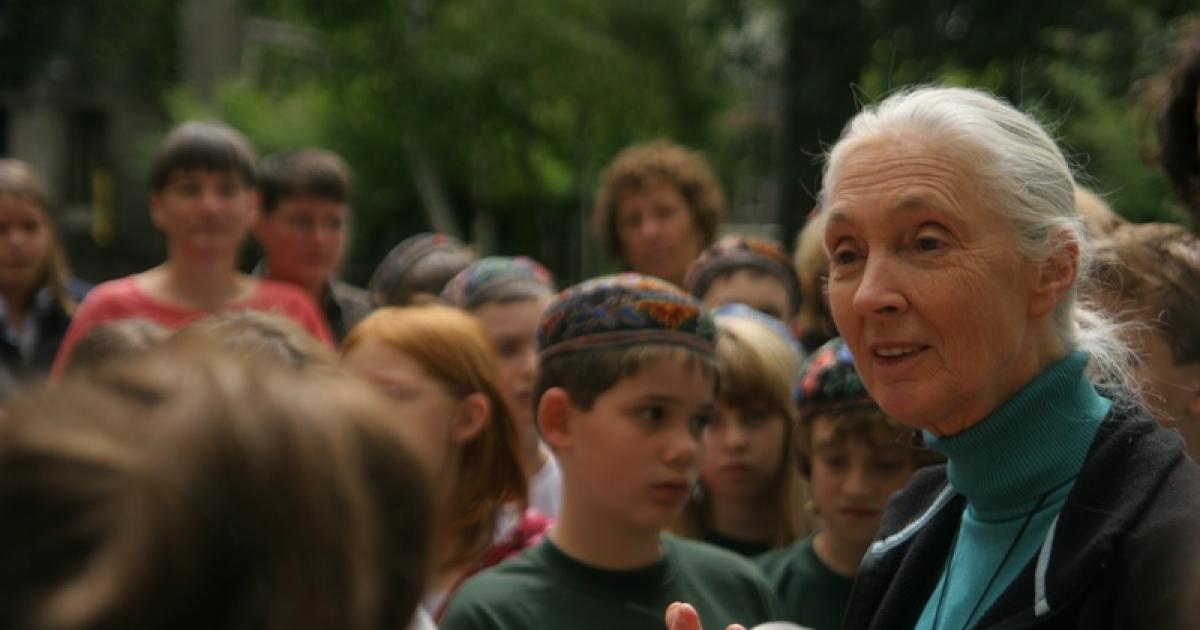
Through Roots & Shoots, she built a global architecture of local stewardship: young people restoring habitats, monitoring species, planting trees, and linking small acts of care into a shared planetary fabric.
It was conservation scaled by participation.
Commitment
And it worked because people saw themselves as part of the landscape, not apart from it. In many ways, she anticipated a form of ecological multilateralism built from the ground up, restoration networks that succeed because communities choose to remain engaged long after a headline fades.
That mindset is increasingly rare in systems dominated by quarterly metrics and election cycles. But it may be the foundation for long-term survival.
No adaptation strategy can succeed if citizens no longer believe their efforts matter. No restoration project endures without public will.
Her legacy, then, is not only in chimps behavior or habitat protection. It is in the invisible systems she worked to stabilise: belief, commitment, narrative.
Pragmatic
These, too, are ecological systems. They decay when neglected and strengthen through use. Pragmatic hope, she reminded us, is civic infrastructure. It must be maintained like any bridge, any watershed, any emergency response plan, because if it collapses, so will everything built upon it.
In the face of climate injustice, biodiversity loss, and widening social fractures, Goodall’s example calls us to repair not only ecosystems but the human capacity to believe in repair itself.
What we continue to notice, even when progress feels slow, may yet be the truest measure of whether her hope endures.
In this climate-fatigued era, her message feels newly urgent: think globally, act locally, and act together. Sustaining pragmatic hope, like sustaining peace or restoring a forest, is not the work of a moment. It is the work of a lifetime. And she has already shown us how to begin.
This Author
Dr Sadaf Mehrabi is a postdoctoral research associate in the Department of Civil, Construction and Environmental Engineering at Iowa State University. Her work focuses on public trust, climate risk perception, and environmental narratives.