Think of a loincloth as an act of diplomacy. The beautiful, fact-crammed catalogue accompanying the British Museum’s Hawaii exhibition (until 25 May) explains that the malo loloa, a long loincloth made of barkcloth, was a metaphor for Hawaii forming alliances. When, just over two hundred years ago, the young King Liholiho (known as Kamehameha II) and Queen Kamāmalu sailed from Hawaii to Britain, seeking protection from the Crown, they were unfurling the malo.
It was a significant, doleful expedition. Before setting sail, the queen delivered a lament in front of a crowd – ‘O soil, farewell’ – with a clenched fist and a slapping of the chest. They took with them more than a hundred pigs, thirty goats and eleven trusted advisers. The voyage lasted 153 days, during which one adviser died. On arrival, the delegation was vaccinated against smallpox, taken to Osborne’s Hotel near Charing Cross and supplied with warm socks. While waiting for an audience with George IV, they attended a Whitsunday service at Westminster Abbey and the races at Epsom, and watched Pizarro from the royal box at Covent Garden, a balloon flight at White Conduit Gardens and, at Drury Lane, Rob Roy MacGregor. They also visited the British Museum. And then they died of measles. She was 22; he was 26.
Strange to be remembering these deaths just as the United Kingdom loses its measles elimination status. For their return to Hawaii the bodies were placed in English coffins, a sight so novel that the ritual mourning which had begun at the appearance of the ship was briefly stilled.
Some appealing likenesses of the party were made in London. A lithograph shows the queen in an empire-line dress with puffed sleeves. Another shows them filling the royal box at Drury Lane with unaccustomed alertness. The elegant warmth of these pictures is outshouted by the savage racism of cartoons by Cruikshank, which put the lie to anyone who thinks satire automatically tends towards the progressive. Melon-grinning, bulging-eyed people with prehensile toes spout gibberish. No surprise that back then, too, it was put about that the incomers ate dogs.
Like the exhibition, the catalogue – edited by the lead curator, Alice Christophe – tussles to quell Anglocentric assumptions that might be thought second cousins to this Neanderthal rhetoric. Co-stewarded with Hawaiian scholars and practitioners, the exhibits are given their titles in Hawaiian as well as English. Some unusual attitudes are voiced: one essay reports on the gratitude ‘our Māori cousins of Aotearoa New Zealand’ expressed to the Hawaiians for ‘taking care’ of Captain Cook.
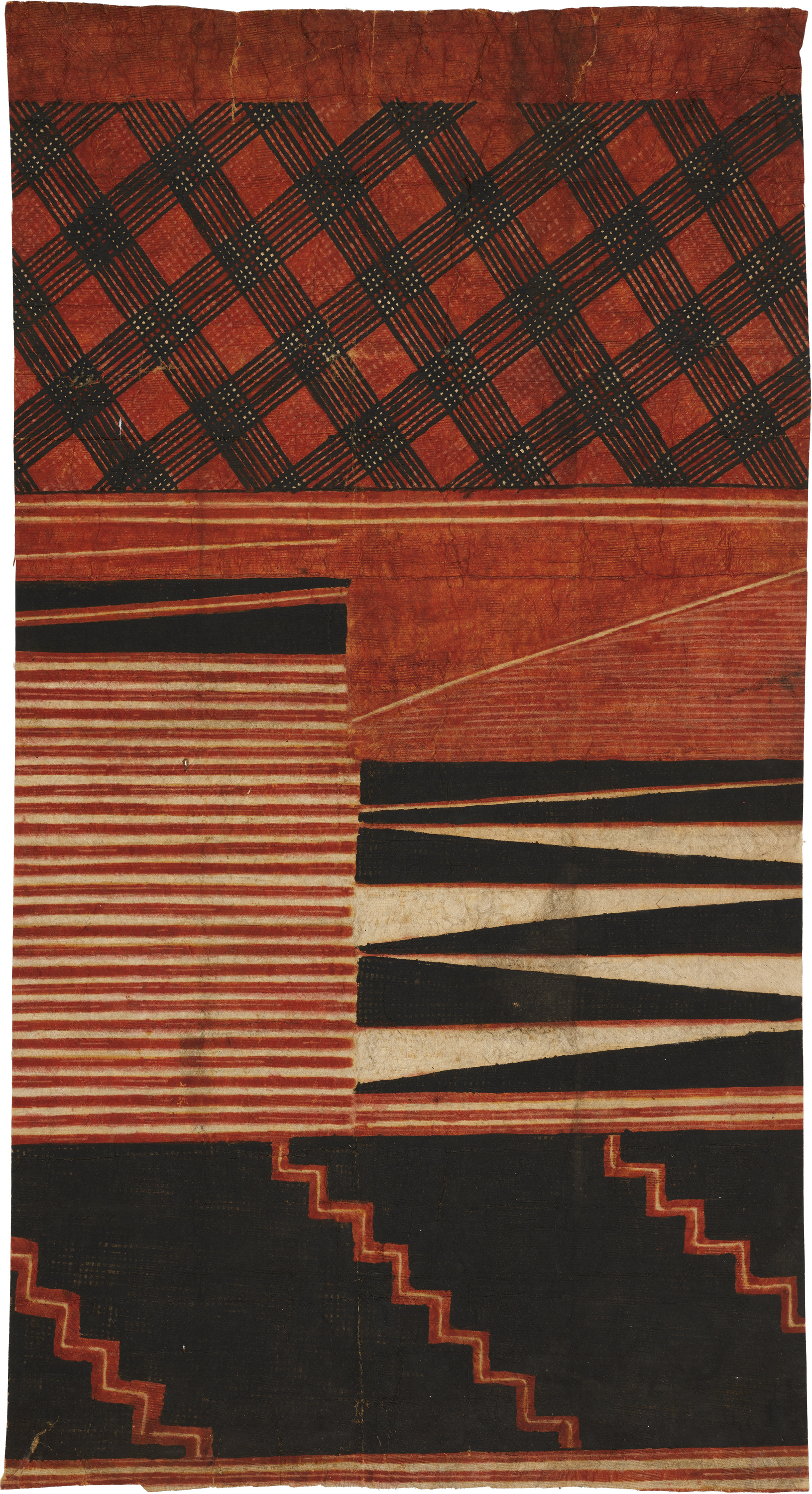
Kapa (late 19th century).
There is no dispute about the magnificence of what some will consider specimens and others sacred items. A saffron and rust-coloured feather cape more than five feet long; feathered discs with pearl-shell centres like eyes, used by 21st-century dancers to dazzle their audience; fish-hooks made of bone and wood; a basalt mirror; a whale-tooth ivory pendant; a patterned water container made from a gourd. There’s no dispute either about the clarity with which changes of garments reveal the evolving relationship between the two nations. Liholiho’s regalia was part-British, part-Hawaiian; an 1850s watercolour shows a man in a loincloth and waistcoat. A sonic equivalent of such mingling and alteration can be heard in the mixed rhythms of Stephen Sondheim’s Pacific Overtures, which captures a history of influence in a number dedicated to the bowler hat.
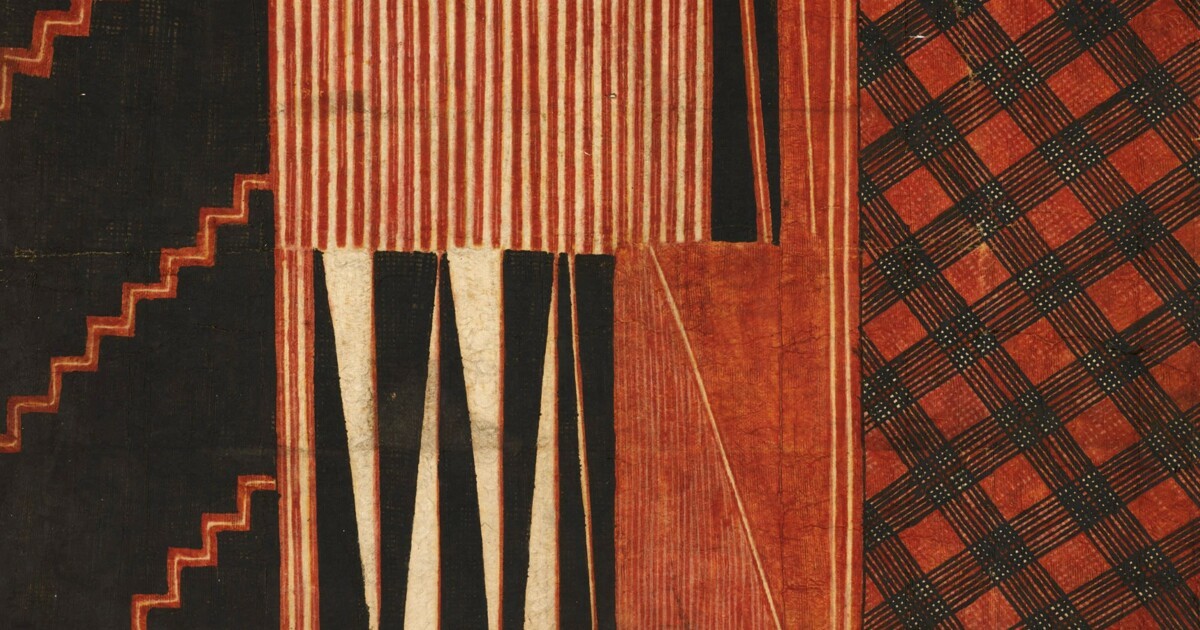
Traditional fabrics bring unifying stories. The most distinctive Hawaiian material, kapa or barkcloth, was wonderfully versatile, used for skirts, bedsheets and, according to one story, the sky. Paper mulberry could be beaten on stone or a wooden anvil to a delicate thinness; the sound of hammering carried across an island. Skirts were made with perfumed dyes so that the scent rose from their layers. Less so after the arrival of Protestant missionaries, who thought kapa coverings insufficient and sewing a more suitable occupation for young women than anvil-bashing.
For years I bragged about my familiarity with one piece of kapa: the king of Hawaii’s bedsheet. It was one of the wonders that Bruce Chatwin displayed in his tiny London flat when I was editing his early books. It has only now been pointed out to me by a textile expert that the cloth was unlikely to have lasted in such good nick if it was used as a bedsheet; it was more likely a room divider. This doesn’t diminish its beauty. Pale ginger, patterned with leaping fish, it might have been a Matisse, vaulting over centuries and continents.
At the British Museum, alongside the rich kapa, patterned with dots and zigzags, stripes and scallop shapes, are tricoloured hats made of rattan reed and rootlets woven into helmets, snug to the head with beak-like crests, filigree on the outside, bristling inside. One shows the touching adjustments made to accommodate a small head. A catalogue essay about traditional weaving techniques describes practitioners as ‘living vessels of “ike kupuna” (ancestral knowledge)’. This, at first, seems close to a Western notion: Virginia Woolf’s evocation of memory as a seamstress. Yet, for Woolf, an underling was at work, binding together present and past; Hawaiians believe that everyone is descended from a weaver.