In bed , John Berger was once asked by a lover: who’s your favourite painter? Caravaggio, he replied. There are two kinds of desire, according to Berger: the desire to take and the ‘desire to be taken’. Caravaggio painted the second kind. The desire ‘to lose oneself’, ‘the most abandoned, the most desperate’ form of wanting: this is what Caravaggio put on the canvas. Bernard Berenson – usually so sober, so discerning – stood in front of the Martyrdom of St Matthew in San Luigi dei Francesi and was all at sea: ‘I am at a loss to know where I am, how I got there, and what I am seeing.’ Caravaggio was a criminal, and criminals seemed to like him. His Nativity with St Francis and St Lawrence was cut out of its frame in Palermo by mafiosi; a shady Swiss dealer was ready to slice the canvas into pieces, the better to sell on the black market, until he unrolled it and (reputedly) burst into tears. It’s impossible to be cool about Caravaggio.
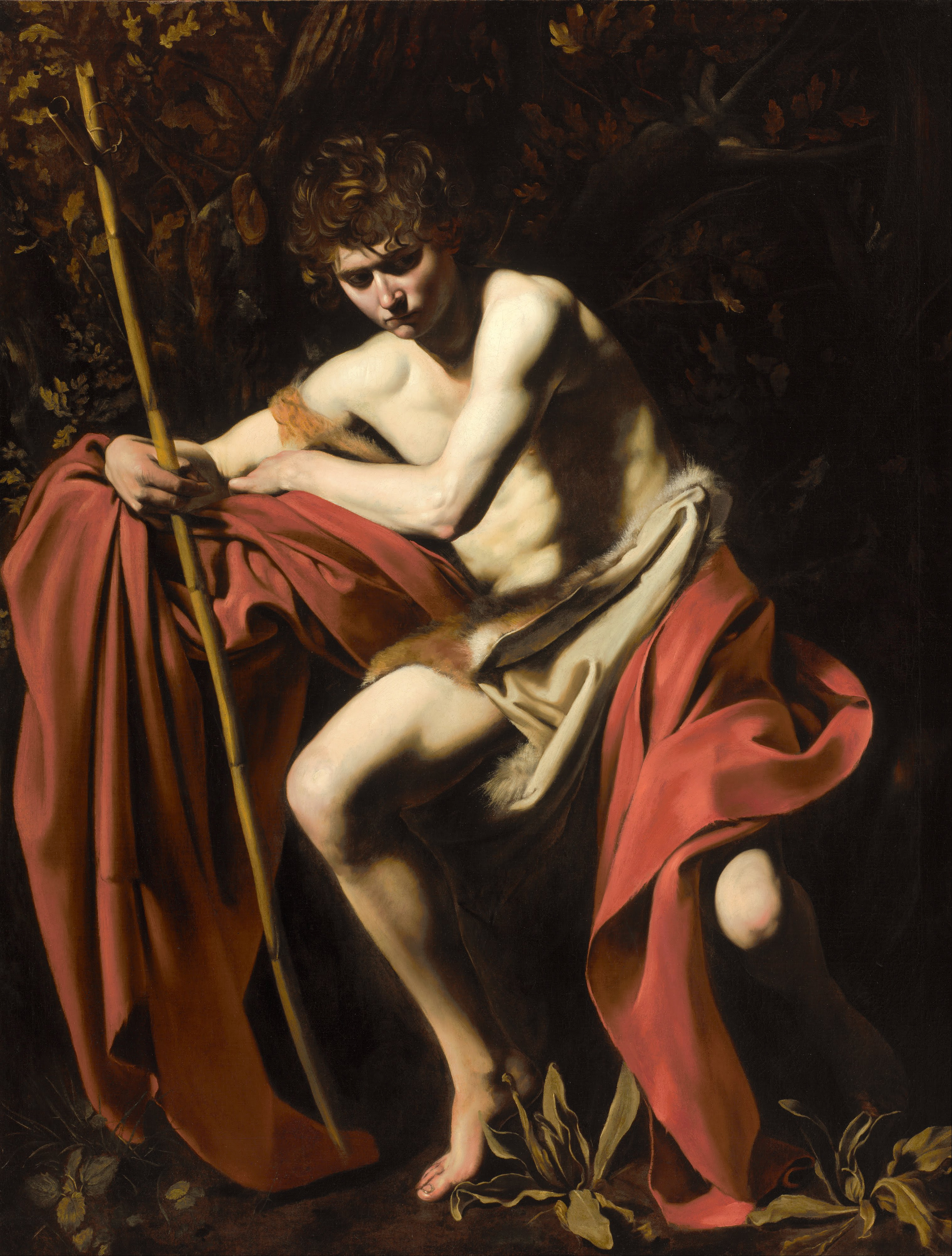
‘St John the Baptist in the Wilderness’ (1604-5)
His paintings unnerve us as they unnerved their Baroque viewers. Caravaggio didn’t draw but painted directly onto the canvas. He invented a dramatic, overpowering chiaroscuro, a spotlit style he used to freeze the worst moments of his subjects’ lives in paint. There are so many decapitations, a frankly weird number of decapitations. Large parts of his canvases, especially those made towards the end of his short career, are black: empty space, crumbling walls, desolate streets; the action crowded into a corner. He used friends, apprentices and sex workers as models, and didn’t flinch from painting their desperation; there is the compromised eroticism of the teenage boys he made over into Cupid or (worse) John the Baptist, boys appealing and appalling in equal measure. He murdered a man and fled Rome, but whether in Naples or Sicily or Malta – he was on the run, a bounty on his head – his patrons still loved him. Or thought they did, until they actually saw the paintings they had commissioned, and then sold them off in a hurry. His style was hugely influential, remarkably so for a painter who left no drawings, trained no apprentices, and who spent his later career stabbing people and being stabbed. In July 1610 he died, probably alone, in the malarial beach town of Porto Ercole, aged 38.
Much has been made of Caravaggio’s obvious sympathy with the poor, his turning of the Roman tavern and the Neapolitan street into the settings for high religious art. But he didn’t really paint the street. He painted the horrible, dingy interior of his studio. Giovanni Pietro Bellori, the 17th-century art historian, described it: Caravaggio positioned his figures ‘in the darkness of a closed room, placing a lamp high so that the light would fall straight down’. His models really were poor, but they were acting: a beautiful prostitute as the Virgin, an artist’s apprentice as Bacchus. There were props, too: costume wings borrowed from another painter; Caravaggio’s own sword dangling in a prostitute’s hand (her name was Fillide Melandroni, and she did once try to slash the face of a rival – the paintings may have been staged, but it wasn’t all pretend). Annibale Carracci took a look at Fillide as Judith Beheading Holofernes and didn’t think much of it: ‘I don’t know what to say except that it is too natural.’ Perhaps he was troubled by Fillide’s nipples showing through her white dress.
There was plenty of poverty in Baroque Rome, and plenty of men: at the start of the 17th century, there were only seventy women for every hundred men in this city of clerics, soldiers, bodyguards, servants. Caravaggio painted the swaggering, violent young men who terrorised Romans in these years. He was one of them, brandishing a dagger outside San Luigi dei Francesi, with ‘a thin black beard, black eyes with bushy eyebrows, dressed in black, in a state of disarray, with threadbare black hose’. The writer Tommaso Garzoni described a typical day in the life of these young men, known as bravi: ‘they swagger out of the house, make a circuit of the piazza, and, with four companions, make themselves master of the field.’ They bullied other men, harassed women and ended the day at the brothel, where they stole the women’s shoes for a laugh. They were sgherri, swaggerers, or bulli, rascals; one described himself to a Roman court as someone who ‘wanders for pleasure and for war’. In a tavern, Caravaggio ordered a plate of artichokes, four cooked in butter and four in olive oil. He asked the waiter which were which and the waiter told him to smell them. Caravaggio hit him across the face with a plate and called him a becco fottuto, a ‘fucked-over cuckold’. It was one of his favourite insults. He was regularly stopped for carrying a weapon on the streets late at night. When a member of the police asked him if he had a licence to carry a sword, he told him he could shove it up his ass.
In his twenties, Caravaggio made his name by painting this violent, chaotic world. The bravi were wanderers, men of no fixed address and no fixed occupation: off-duty soldiers maybe, who had kept hold of their weapons; armed guards between jobs; men as likely to be thieves as knights. And they were beautiful. They dressed in unlined, loose fabrics, the better to flex their muscles; they maintained extravagant handlebar moustaches. They wore long black capes to flourish and to parry dagger thrusts with; they adorned their caps with black and white and pink ostrich feathers, because, as a scornful contemporary wrote, their ‘senses change easily just as a feather moves in the wind’. Caravaggio painted them in one of his earliest Roman pictures, The Cardsharps (1594). At the front of the picture is a young man, the feathers on his cap trembling with the tension of the dupe unfolding before us. Caravaggio used the same model for the trickster and for the young aristocrat being tricked: how easily fortunes could turn. Bellori wrote that, while painting The Fortune Teller, Caravaggio ‘called out to a gypsy woman who chanced to be passing in the street and, taking her to his lodgings, he portrayed her in the act of telling fortunes’. In this picture, another young bravo is being duped, all of his masculine performance – those enormous puffed sleeves, dapper black cap and cloak, sword at the hip – undone by a pretty woman. The poet Gaspare Murtola looked at the painting and wondered: ‘Who is the greater sorceress, the woman, who dissembles, or you, who painted her?’
Both The Cardsharps and The Fortune Teller were sold through a dealer, rather than being produced on commission. Caravaggio made his own market for a kind of painting that hadn’t really existed before. With these pictures of Roman street life, he invented what would later be called genre painting: an unhelpful term intended to encompass scenes of drinkers in taverns, card players, gypsies. But before this was a style it was Caravaggio. Federico Borromeo, the reforming archbishop of Milan, disdained both the art and the life (but then he would), claiming that Caravaggio
never did anything else, even though he was good at his art, apart from depicting tavern keepers, and gamblers, or gypsies who read palms, or beggar barons and porters, and the unfortunates who sleep in the squares at night, and he was the happiest man in the world when he painted a hostel with people eating and drinking in it. This mirrored the way he dressed, which was just like his artworks.
Bellori said of Caravaggio that once he ‘had put on a suit of clothes, he would never change it until it was falling off him in rags’.
It was the painters who came after Caravaggio who churned out dozens of these tavern and street scenes, hardening their visual language into a genre. They painted stock characters from the theatre, from the commedia dell’arte, from opera, from popular songs and ballads. Patrons loved these paintings and hung them in their palazzos. Caravaggio, on the other hand, depicted his bravi and cardsharps and gypsies in all the drama of their makeshift lives; you can sense, in the intensely focused gaze of the older cardsharp, that his entire fortune rests on this trick coming off. There are holes in the tips of his gloves, better to feel the surface of the marked cards. The stakes could not be higher. This is what has been called the pauperismo of Caravaggio’s painting and celebrated as his realism. ‘He does not depict the underworld for others,’ Berger wrote. ‘His vision is one that he shares with it.’ But later painters traded the human drama of poverty, one Caravaggio knew intimately, for a kind of picaresque.
Elizabeth Currie’s Street Style draws our attention to fashion and dress in Caravaggio’s paintings, and in those of his followers, and connects them to the wider range of media – especially printed albums and encyclopedic texts – that depicted the lives of the poor in Rome. Currie makes us notice details we might miss or not know how to read: the flouncing feathers on the caps of the bravi; the sheer veils worn by Roman noblewomen; the voluminous cloaks of the gypsy women (to help them steal chickens, according to contemporaries). The book deepens our understanding of street life paintings and gives a glimpse of what fashion meant to ordinary people. Rome – like much of early modern Europe – was a place where clothes mattered a great deal. A Roman law of 1561 stated, for example, that debtors must wear a green beret and Jewish men a yellow one; one of 1631 that gypsy women ‘must lay down their Gypsy dress, or rather destroy it so that it is no longer suitable for such use’. Sex workers were banned from wearing the fashionable lenzuolo, the long sheer veil worn by Roman noblewomen, who were themselves prohibited from wearing the zimarra, an over-gown with chic hanging sleeves, often constructed from silk or embroidered with glimmering metal thread, which was popular with sex workers.
The poor might own only one or two outfits, and so were ‘as likely to be identified by their dress’, Currie writes, ‘as by their facial features or where they lived’. The idea that people could be read through clothing was reinforced by print culture and theatre. Costume books, geographical encyclopedias, printed sheets showing people at their different occupations, popular comedies: all were precise about dress. In costume books from the 1560s, gypsy women were uniformly depicted with a heavy cloak knotted at the shoulder, bare feet, ankle bracelets, a headscarf and a baby in arms. Beggars were shown in piled-up rags, often with visible patching, the outlines of the body masked or deformed by a great mass of shoddy fabric. Just as Rome confined Jews to the ghetto and sex workers to the Ortaccio, the pope tried to confine beggars to certain neighbourhoods. The visual culture of printed albums and genre paintings reflected and made this social world, where marginalised people were increasingly identified and categorised and restricted in their movement and dress.
Sex workers understood better than anyone that to undermine the rules of dress was deeply erotic. They knew that to appear at the window dressed as a man – or, even better, in a nun’s habit – guaranteed more clients. (A tantalising Venetian print allowed the viewer to lift a courtesan’s skirt to reveal breeches underneath.) Early modern writers were obsessed with this kind of deception: with sex workers dressed as men; with beggars who ate soap to look like they were foaming at the mouth, the better to attract alms; with fake pilgrims. Understanding all this helps us to appreciate the context for Caravaggio’s paintings, but it doesn’t explain them in the same way that knowing the language of dress helps us to understand the innumerable genre paintings that came after him. Caravaggio didn’t think in terms of types. The gypsy woman he called in off the street is a person: alluring, knowing, a little desperate.
For Caravaggio, clothing was not primarily about meaning, not primarily a language. Clothing allowed him to paint the drama of touch – of sensation. When ‘fur and skin, rags and hair, metal and blood’ meet in Caravaggio’s painting, Berger wrote, ‘their contact becomes an act of touching.’ The feather that grazes Cupid’s thigh in Amor Vincit Omnia. The splitting laces on the Virgin’s crimson dress in The Death of the Virgin, dramatising the swelling of her body after death. The frayed habit of St Francis in Meditation: the shoulder patched with a light-coloured scrap of fabric, somehow more raw-looking than if it were bare flesh. The pitiful communion of lamb’s fleece and red cloth in the Beheading of St John the Baptist, a detail more violent than the blood that spills onto the street. What we are drawn to is Caravaggio’s rendering of the intimacy between flesh and world, simultaneously seductive and repellent.
Caravaggio was already famous in his twenties, reputed to be the best painter in Rome, and so art historians have long speculated why it was that so many of his pictures were rejected by the patrons who commissioned them. In the case of his Death of the Virgin, commissioned for Santa Maria della Scala, Giulio Mancini would later write that the Virgin was nothing but ‘a dirty prostitute from the Ortaccio’ and Caravaggio’s lover to boot. But it’s not just that. It’s that the Madonna, whoever she is, is so unnervingly dead. Her body is unmistakably a bloated corpse. The painter Carlo Saraceni, commissioned to replace Caravaggio’s picture, better understood the brief: his Virgin, pretty and pale, is ascending into a heaven of golden clouds and putti instrumentalists. Not a hint of rigor mortis.
Another artist, Giovanni Baglione, scoffed that ‘the people made a great fuss’ of Caravaggio’s Madonna of Loreto, with its pilgrim couple kneeling before the Virgin, the filthy soles of their feet pressed up against the picture plane. But its patron, who had commissioned it for a private chapel, didn’t want it. Was it because Lena, who modelled as the Virgin, was a sex worker? She modelled for Caravaggio’s bizarre Palafrenieri Madonna, too. It shows the Virgin holding the Christ child balanced on her feet while they stamp on a snake, watched over by St Anne. This too was taken down by the confraternity that commissioned it. Were the Virgin’s breasts too prominent? Derek Jarman, who made a film about Caravaggio in 1986, remarked that he was ‘knocking the saints out of the sky’. Certainly the Palafrenieri St Anne has never known heaven. Roberto Longhi, one of Caravaggio’s great 20th-century critics, thought that the painting might as well show any ‘peasant woman killing a viper in a barn’.
Writing in the 17th century, the art historian Joachim von Sandrart remarked that Caravaggio and his roguish friends lived by the motto ‘nec spe, nec metu’: without hope, without fear. And it’s true that in his painting Caravaggio is totally uninterested in hope, even disdainful of it. That bleakness is difficult, confronting. It makes a stark contrast to the work of his rival in Rome, Annibale Carracci, whose sugary Assumption of the Virgin forms the altarpiece of the Cerasi Chapel in Santa Maria del Popolo. Caravaggio was commissioned to paint canvases for the side walls of the chapel – The Conversion of St Paul and The Crucifixion of St Peter – so the comparison is inevitable. Just look at Carracci’s Madonna: she’s sweet, she’s fresh faced, she’s boring; the men are handsome and do a lot of stagey gasping. Everything looks freshly laundered. It smells good up there, like new babies. It doesn’t require faith to believe in Carracci’s heaven – just dumb hope. But Caravaggio knew that hope and faith were different things. Faith meant looking at life, its beauty and its darkness, right now in the miserable present, and believing. It meant Paul on his back, arms flung out, soft belly exposed, at the mercy of his horse, in surrender: to the force of faith, rendered by a delicately lifted hoof and a shaft of light.
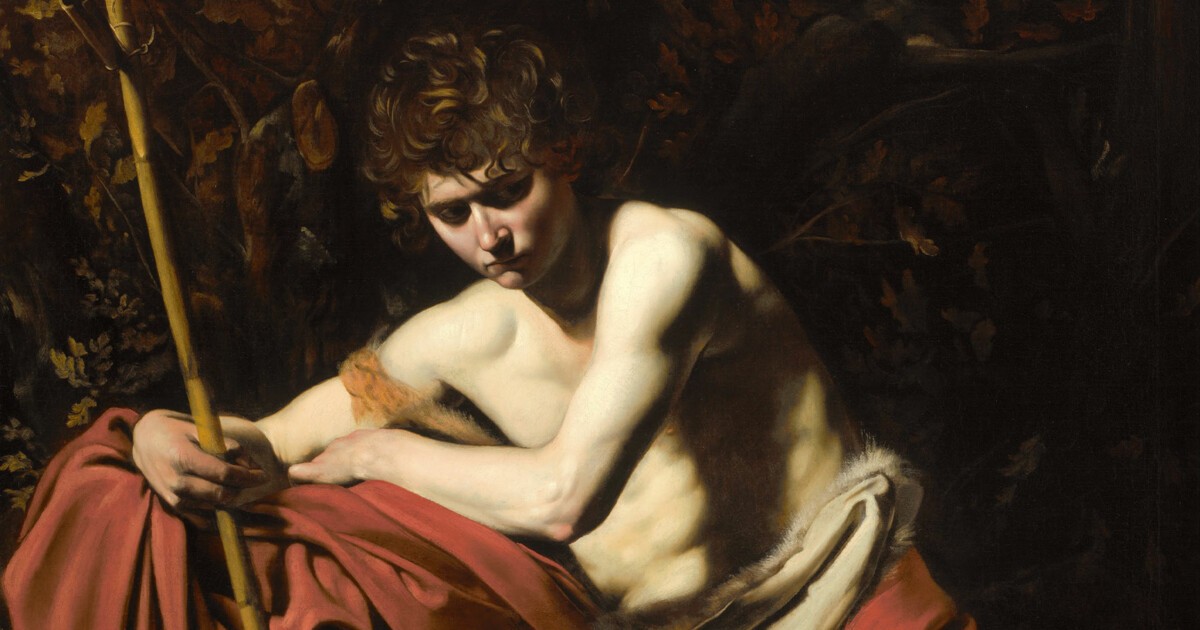
Maybe that’s why Berger found himself talking about Caravaggio in bed. He wasn’t the only one. Sydney Freedberg wrote that Caravaggio ‘translates into his act of art the lover’s experience of seeing and touch, which he has galvanised at that very instant where, in a living situation, seeing would be turned into touching’. Clothing is critical at this moment when seeing turns into touching. Roman sex workers knew this when they dressed as nuns and stood framed in their windows, enticing clients with the fantasy of the instant when the habit would be drawn back. Much has been made of the weird eroticism of Caravaggio’s sickly Bacchus, or the jaded Cupid of Amor Vincit Omnia. But when I think of Caravaggio painting desire, when I think of the lover’s seeing turning into touching, I think of his religious paintings. Look at his St John the Baptist in the Wilderness. Yes, the model is beautiful – he was one of Caravaggio’s favourites – and that helps, of course. But it’s really that fur: the soft, cream-coloured camel fur spilling out of his drapery, cradled by it, drawing us not only to its softness but to the darkness beyond. His toenails are filthy. You can have pleasure, Caravaggio tells us, but not without a measure of disgust – not without a little pain, a little dirt, a little blood. Caravaggio refused to sentimentalise sex, just as he refused to sentimentalise faith. He painted the surrender involved in both, if you’re doing it right.
Clothing, for Caravaggio, worked in the same way as his chiaroscuro, dramatising disclosure and reticence, attraction and concealment. Caravaggio exploits dress not so much as a language, but as a way of posing the question: what is it we’re most susceptible to? A scrap of fur? A feather on a thigh? Hard, burnished armour? Maybe it was from Lena and Fillide that he learned how to solicit using the surfaces of things. We are drawn to Caravaggio because he reflects back to us something about ourselves that we hardly understand. That is what he paints in his Narcissus. The young man, with his gorgeously puffed white sleeves, his patterned velvet doublet, his golden curls, is as handsome a Roman boy as could be wished for. But it’s that bare knee that gets me. Spotlit by one of Caravaggio’s burning lamps, it is grotesque and horribly exposed, like all of our most disturbing desires – like all the parts of ourselves that we can barely look at. The pool is black, its surface a mirror. At the end of his essay on Caravaggio, Berger wrote that ‘sexuality promises, as nothing else can, momentary completion.’ But in Caravaggio’s paintings such completion is only ever promised. Just like his beautiful Narcissus, we are forever looking.