One of Joseph Wright of Derby’s favourite subjects was Vesuvius erupting by night, which he painted more than thirty times. The drama and peril of the scene attracted him, but he was also drawn to extreme manifestations of light and dark: lava, fire, lightning, smoke. He found that lava in particular could be difficult to paint, because it needed to look fluid, not stiff and static. ‘I have therefore illuminated the ground over which the lava is about to pass very strongly,’ he explained to a friend in 1794 as he worked on a new Vesuvius picture,
set fire to the plants & raised a fresh smoak wch here & there passes across the Lava … I have also increased the quantity & brilliancy of ye smoak wch arises from the upper surface of the lava, so that the centre of the picture is more lighted up & the general effect much improved – I have added the forked lightning wch ever attends the dark smoak.
At this late period, a few years before his death, Wright was still engrossed by lighting effects he had depicted for three decades. He trained as a portrait painter in the 1750s and continued to paint the nobility and gentry throughout his career, but he made his name with a series of ‘candlelights’, dramatic nocturnal pictures he exhibited in London between the mid-1760s and his departure to Italy in 1773. The National Gallery’s small, focused exhibition presents eleven remarkable early candlelights alongside the mezzotint reproductions Wright commissioned (until 10 May). The charisma of the grandest pictures – natural philosophers demonstrating in the glow of a lamp or candle; a shaggy-haired alchemist lit up by a burst of phosphorus – helps to explain why he began painting night pieces. The 1760s was the first decade in which public exhibitions were held in London, establishing an artistic culture that rewarded painters of spectacle. Wright’s pictures, which appeared to ‘burn on the wall’, in Matthew Craske’s phrase, drew crowds. It was a matter of treatment as well as subject. Tenebrism, the 17th-century Caravaggist method of illuminating figures and details against a deeply shadowed background, was admired by connoisseurs, but little practised or understood by Wright’s British contemporaries. Mastering nocturne painting, being able to replicate the way skin glowed in warm or cool light or colours changed in the dark, was a means for the young artist to distinguish himself.
Wright learned the method from pictures and reproductions, but he also conducted his own experiments with light and shadow. In Derby, his hometown, he worked in two adjoining rooms, one naturally lit, in which he painted, the other with its windows darkened so that he could model the scenes he depicted. As early as 1766, he discovered that he could layer highly reflective silver or gold leaf beneath pigment to intensify the way painted objects glowed. In A Blacksmith’s Shop (1771), one of a series of pictures he produced of ironworkers labouring by night, the white-hot lump of iron that illuminates the smiths’ faces conceals a thin strip of gold, the showier metal hidden beneath the plain.
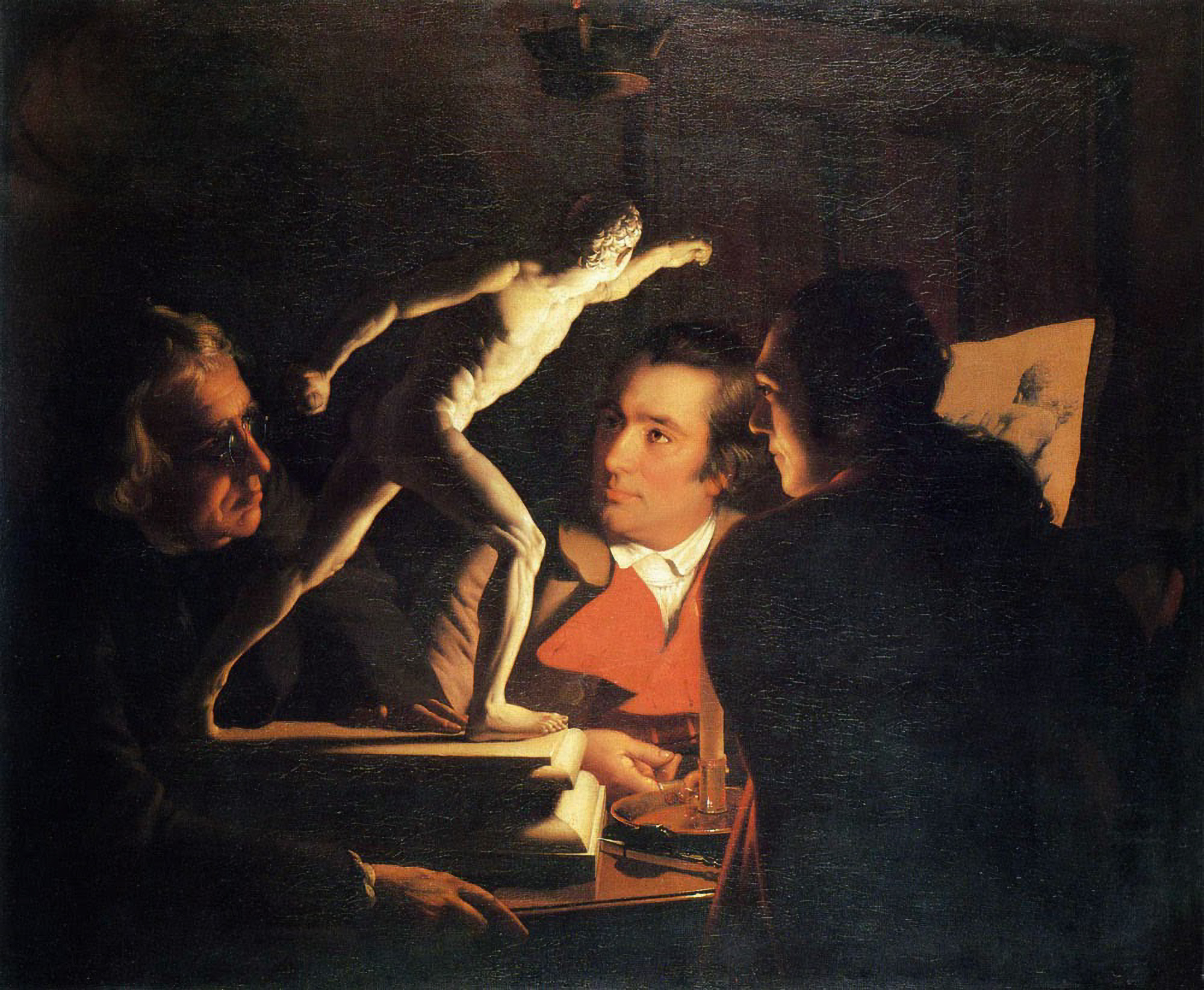
‘Three Persons Viewing the Gladiator by Candlelight’ (1765).
He also experimented with the conventions of the candlelight tradition. In 17th-century tenebrist painting, the light source is often obscured by a shadowy figure or object, making its radiance spill out around the edges. Wright liked to do this where he could (‘I always conceal the cause where I can do it naturally,’ he wrote in 1783), but in his art it has the surprising effect that almost anything can appear to emit light. In Two Boys Fighting over a Bladder (c.1767-70), the translucent pig’s bladder that one boy is trying to wrestle from the other glows like a paper lantern, seeming to be lit from within rather than behind. In An Experiment on a Bird in the Air Pump (1768), which shows spectators gathered to watch a bird being temporarily deprived of oxygen, the light appears to be coming from a murky, evil-looking vitrine of liquid containing an animal organ, in which you can just see the wobbly refraction of a candle flame. The wittiest effect may be in Three Persons Viewing the Gladiator by Candlelight (1765), the first picture that Wright exhibited. Three figures sit studying a model of the Borghese Gladiator. The third, silhouetted with his back to us and obscuring the candle flame, is a self-portrait: the artist shown blocking his own light source.
Wright’s predecessor for candlelights in Britain was the 17th-century Dutch painter Godfried Schalcken, who had worked in London in the 1690s. Thanks to Horace Walpole’s Anecdotes of Painting in England (1762), Schalcken was known in Wright’s time for dimly lit, erotic scenes, which were considered both indelicate and artistically glib, reliant on obvious visual tricks. (Walpole reported that Schalcken had once burned William III’s fingers with tallow during a portrait session.) Wright’s early candlelights, as if to scotch the lingering association, are dazzlingly sharp and bright, with none of Schalcken’s suggestive boudoir fuzziness. The illuminated boy’s face in Two Boys Fighting is livid, flaming red, his nose and lips highlighted to make them look damp and teary; gripped in his fist, a clump of the other boy’s hair is lit so precisely that individual strands glow like filaments. In A Girl Reading a Letter with an Old Man Reading over Her Shoulder (c.1767-70), a scene that could have a predatory erotic charge – the old man looming, adjusting his spectacles to get a better look – instead appears forensically unsexy. Wright’s candlelight catches on unkempt fingernails and swollen, ruddy knuckles. A Philosopher Giving that Lecture on the Orrery in which a Lamp is Put in Place of the Sun (1766), a conversation piece centred on a mechanical model of the solar system, goes a step further and makes light its subject. The lamplit orrery was supposed to be operated in the dark, to allow spectators to observe miniature eclipses and planetary shadows: light, Wright seems to be saying, is information, not a trick.
Some kinds of light, though, as Burke had argued ten years before in A Philosophical Enquiry into the Origin of Our Ideas of the Sublime and Beautiful (1757), didn’t help people to see. Like darkness, light at its most powerful could disorientate, overpower, blind the senses. Wright’s contemporary viewers associated his night pieces with a kind of sublime unclarity, a glare or glitter that obscured as much as it illuminated. In 1781, the poet William Hayley described what it was like to look at them:
Like Meteors darting through the gloom of Night,
His sparkles flash upon the dazzled sight;
Our eyes with momentary anguish smart,
And Nature trembles at the power of Art.
Confronted with one of the Vesuvius paintings, a critic for the General Advertiser admitted to being ‘dazzled and confounded’: ‘The vision is so powerfully attached to the principal object that it cannot wander over the beauties of the whole.’
What is being described is a feeling of being out of control. In the late 18th century, fashionable picturesque landscapes allowed viewers to ‘wander over’ them at will, linger on congenial features and skip over others – effectively, to construct the scene as much as respond to it. The moonlit pictures Wright started exhibiting in the early 1770s, alive with what Judy Egerton has called a ‘weird glitter’, throw the eye off. In A Blacksmith’s Shop, the molten glow of the iron bar pitches the arched space on the left into a darkness so heavy you can barely discern the horse in the shadows. White sparks float distractingly on the picture’s surface. The moonlit chamber in The Alchymist in Search of the Philosopher’s Stone (1771), in which an astonished old man kneels before a radiant alembic of phosphorus, is a riot of objects and signals. The centre of the composition is too bright; the corners are gloomy and unreadable; everything is messy and confused, from the jumbled glass and earthenware vessels and dog-eared manuscripts to the cracking plasterwork. The vivid white substance in the alembic dazzles the eye, but the light it gives out is in a sense the wrong light: it doesn’t illuminate what it should. The alchemist has discovered phosphorus, but by accident, and instead of recognising its importance he is praying he may be close to the real prize, the secret of turning lead into gold. The painting is about blindness, superstition, irrational seeking – things ‘opposite to the real interests of human society’, as the literary critic Thomas Warton put it in 1774, but at the same time darkly interesting, ‘the parents of imagination’.
Wright was a melancholic who suffered from protracted periods of depression. His ‘malady’, he wrote to Hayley in 1783, meant that every year he ‘dragged over four months without feeling a wish to take up my pencil’. From the late 1760s, he was drawn to solitary, contemplative scenes and characters, subjects that reflected his growing distaste for polite society. Some of his most remarkable pictures are about the intrinsic loneliness of nocturnal activity, of thinking and working while others sleep. An Earthstopper on the Banks of the Derwent (1773) is about a communal pastime, the local foxhunt, which Wright imagines from an outsider’s perspective: the earthstopper’s job was to fill up foxholes overnight so the fox had nowhere to hide the following day. The picture’s surface is uneven, the paint applied in thick little swirls and scrapes, producing a landscape that ‘feels’ the way it looks: rugged, off-putting. Every element in it – the earthstopper busy with his spade; the pensive-looking horse waiting in the shadows; the bare blasted tree – seems the saddest, loneliest version of itself. The effect is as much a study of a mood as of a human figure, or of the way a figure can be swallowed up by a mood. In A Philosopher by Lamplight (1769), an outdoor scene in which a reclusive old man inspects a human skeleton, the agoraphobic effect is almost worse. The sheer quantity of darkness in the picture – the philosopher’s lamp irradiates the bottom half, but in the top section there’s only a feeble moon, partially hidden by cloud – points to the fact that tenebrism wasn’t merely a strategic way of using chiaroscuro to create three-dimensionality. The gloom is darkness as darkness, not darkness as a context for light and shape.
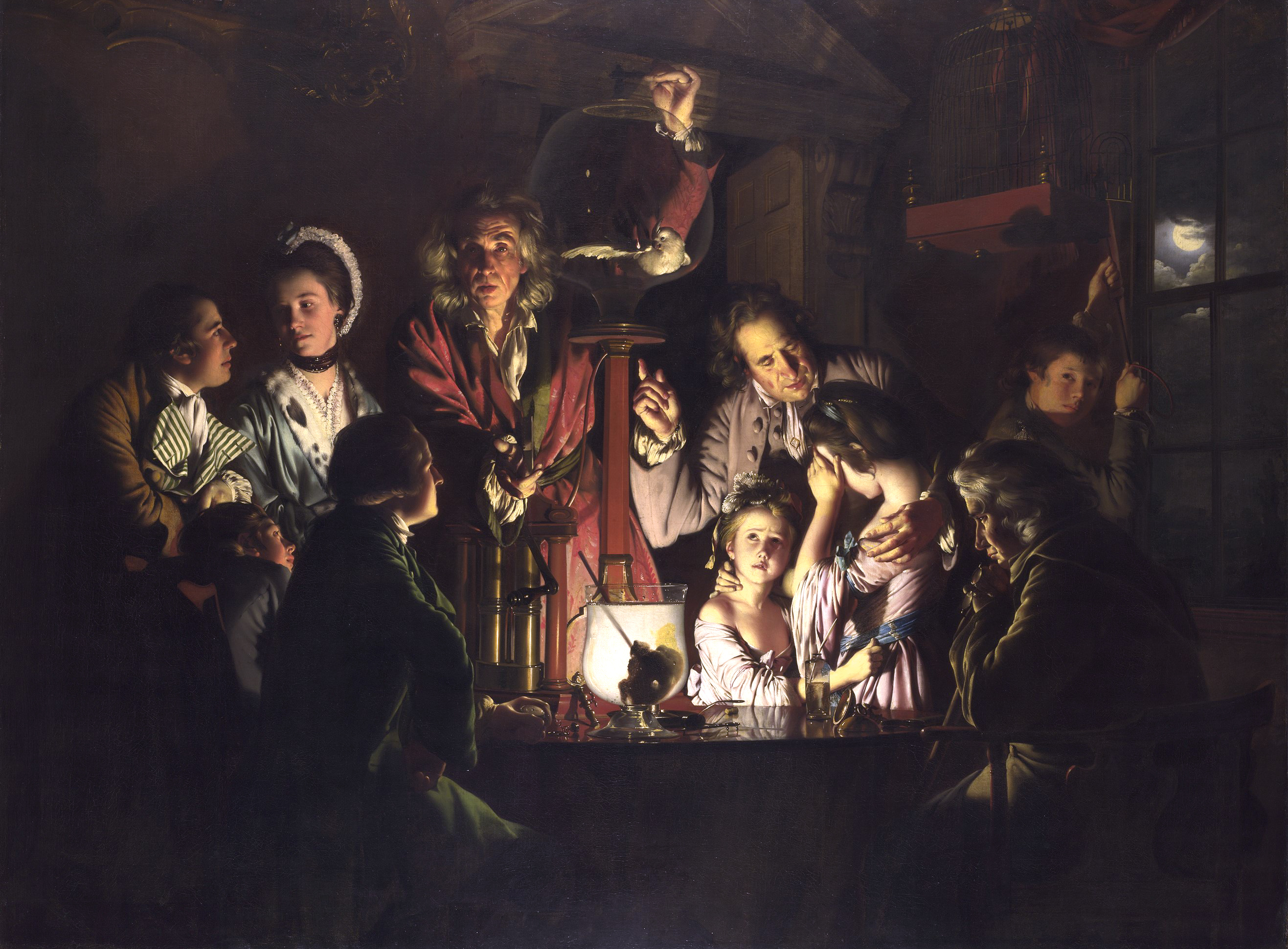
‘An Experiment on a Bird in the Air Pump’ (1768).
Late 18th-century writers often observed that the loneliest place to be was in a crowd. Even Wright’s most sociable candlelight pictures contain male and female figures – usually male – who look as if they would rather be alone. In A Blacksmith’s Shop, there is a seated man, lost in thought and staring at the ground, careless of the noise and sparks and the fearful-looking children. He is a version of a similar figure in the earlier Experiment on a Bird in the Air Pump, a painting that seems to depict polite society at its most clubbable. Ten people gather round the table on which the pump is mounted, interacting in pairs or small groups. Two distressed girls are being reassured by their father that the bird in the pump’s receiver will survive; the demonstrator, pointing a finger, seems to be issuing instructions to the silhouetted man holding a stopwatch, orchestrating the right moment to open the valve; on the left, some sort of one-way flirtation is happening between a snappily dressed man and the stoic-looking woman next to him. Each interaction is in some way inflected or contextualised by every other; the bird, struggling to breathe, serves to remind us that nothing exists in a vacuum. The odd man out is the shadowy figure in the right foreground. Resting his chin on his hands, he seems transfixed by the vitrine and the floating animal organ it contains, but we know he is thinking rather than looking, because his spectacles are dangling in his hands. He is barely in the room: the sight of the dead flesh, a vanitas motif, has taken him somewhere else altogether.