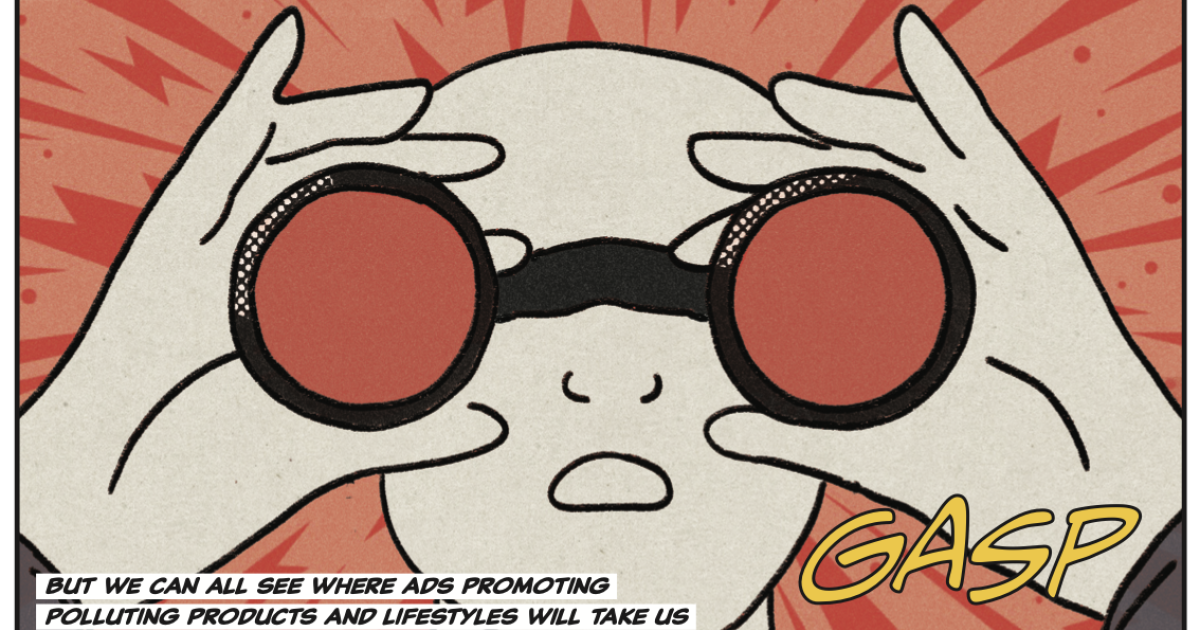
Humanity at this moment in history can sequence the human genome, cure novel diseases, and even monitor the Amazon’s health from orbit.
At the same moment billions of dollars are still being pumped into advertising fossil fuel-related industries, from budget city-break flights to the latest tank of an SUV ‘conquering’ natural settings.
This contradiction lies at the heart of the new multimedia campaign from the Ministry for the Climate Emergency. We Can is a comic‑book and animation series that asks bluntly: if we can achieve miracles, why are we still promoting destruction?
Grassroots
Last month’s global climate summit, COP30, held in Belém, Brazil — in the heart of the Amazon — was meant to mark a turning point. It ended in disappointment.
While some adaptation funding for vulnerable countries was increased, COP30 failed to deliver a binding roadmap to phase out fossil fuels. The final agreement omitted explicit mention of oil, coal and gas.
Critics and scientists voiced alarm but decades of climate disinformation and fossil‑fuel influence have hardened into institutional inertia.
What COP30 made clear is this: global talks and voluntary pledges are hitting their limit. Without challenging the structures that normalise pollution, the odds of living up to climate science are stacked against us.
In the wake of COP30’s failure, grassroots actions become more urgent. The We Can campaign argues that while global diplomacy stalls, local and societal shifts remain possible - starting with advertising.
Control
The campaign draws a direct analogy between fossil‑fuel ads and harmful marketing that societies once accepted without question.
Professor Kevin Anderson, a climate scientist working with the universities of Manchester, Uppsala and Bergen, puts it succinctly.
“We can precisely measure the level of carbon dioxide in the atmosphere, we can measure with considerable accuracy the damage being inflicted on the Amazon rainforest.
"But for some reason we seem incapable of stopping promoting those technologies and those companies that are actually causing that damage. It’s time that we stopped the adverts for fossil fuel companies.”
The logic is simple. We have the science. We know the cost. What we lack is the political and cultural will. So let’s start with what we can control.
Radical
The idea of banning high‑carbon advertising is no longer abstract, a pipe dream. Across Europe and the UK, local authorities are rewriting the rules.
Stockholm city council recently adopted a fossil‑fuel advertising ban to take effect from summer 2026. The ban covers all city‑owned ad space, including for air travel, fossil‑fuel cars and fuel companies.
The City of Edinburgh banned adverts for fossil‑fuel cars, cruise holidays, commercial flights and other high‑carbon products on council‑owned spaces in May 2024.
Other municipalities such as Hackney in London and Sheffield have also introduced bans or restrictions on high‑carbon advertising within council‑controlled advertising spaces.
These local policies demonstrate that advertising bans - once considered radical - are becoming mainstream tools for cutting demand for polluting products.
Protect
It’s not just about limiting misleading adverts — it’s about reshaping how society sees consumption.
Andrew Simms, the campaign co‑director and contributor to The Ecologist, explains: “Humans have cracked problems once thought impossible — from saving lives with penicillin, and sequencing our own genome to probing the planet’s health from space.
"But we seem unable to stop promoting the fossil fuel pollution that is simultaneously wrecking human health and the Earth’s climate.
"People will still travel and drive, but ending adverts for polluting products would remove millions of unnecessary, harmful and polluting journeys — just as banning tobacco ads cut smoking and saved lives.
"If we’re capable of such amazing, complicated scientific breakthroughs, we should be able to take one of the simplest steps to protect public health and the climate and stop advertising pollution.”
Satellites
People will still be able to travel, drive and fly, but this would stop ads creating and increasing demand for polluting choices where it didn’t already exist.
It’s about refusing to glamorise destruction. It’s about removing the unconscious pressure to consume high-carbon services and normalising lower‑impact alternatives.
For many, the failure of COP30 to commit to a fossil‑fuel phase‑out didn’t come as a surprise. For decades, fossil‑fuel interests have wielded power - often behind the scenes - shaping not only policy but public perception.
We Can flips the script. It argues that change doesn’t need to wait for grand diplomatic deals. It can begin in our cities, on our streets, across billboards and bus shelters. By removing the constant marketing pressure to fly, drive, pollute - we can begin to align culture with climate reality.
If humanity can send telescopes to the edge of the solar system, chart the secrets of our DNA, and monitor planetary health from satellites - we can also choose not to advertise our way into extinction.
This Author
Liam Killeen is a deliberative democracy researcher and works with the Badvertising campaign.
The Badvertising campaign aims to stop advertising fueling the climate emergency by implementing a tobacco-style ban on ads for cars, airlines and fossil fuel companies. www.badverts.org - it is a collaboration between the New Weather Institute and Adfree Cities.