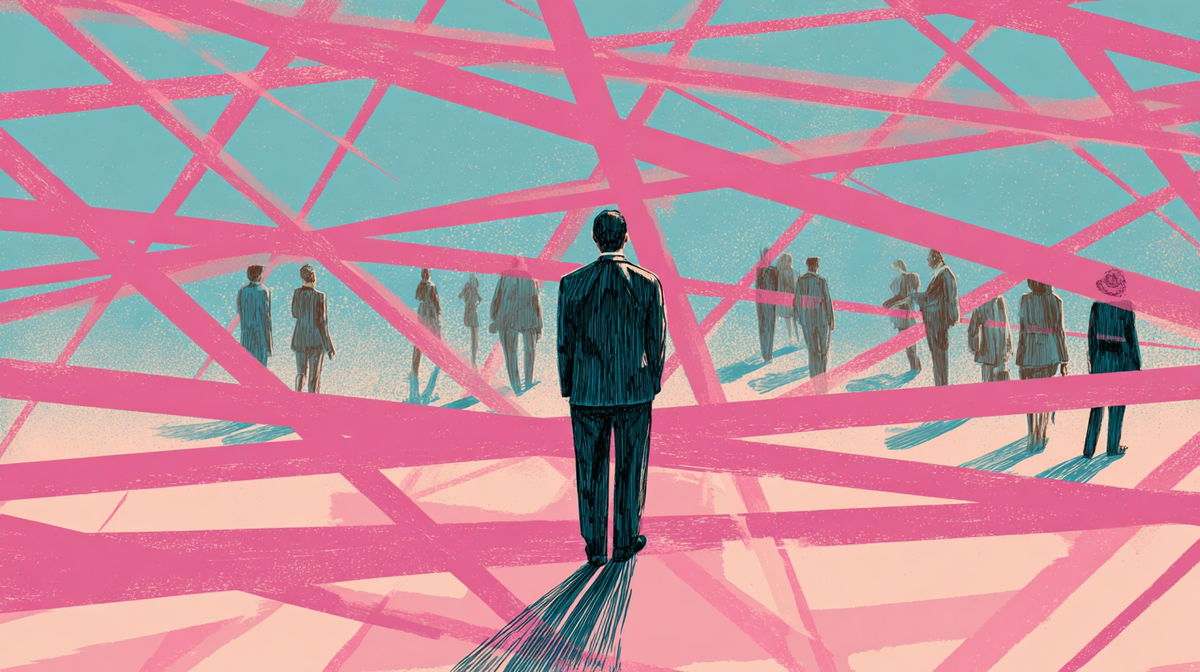
- Unpredictability as power: The greatest threat to global stability is not any single act of aggression but the condition of permanent unpredictability, which paralyses democratic governments and rewards those willing to exploit confusion.
- Anomie goes geopolitical: Durkheim’s concept of normative collapse, originally applied to industrial societies, now describes an international order in which citizens and governments alike no longer know what the rules are.
- Fear versus anxiety: Known threats mobilise populations and strengthen alliances, but formless uncertainty produces withdrawal, disengagement, and the slow erosion of collective agency.
- Europe’s institutional mismatch: EU institutions were designed for a predictable world of stable alliances and fixed rules — not for an era in which the primary task of governance has shifted from optimisation to survival.
- Legibility as democratic defence: The antidote to chronic disorientation is not more military spending, but politics that restores legibility — honest communication with citizens about what can and cannot be controlled.
In February 2025, JD Vance stood before the Munich Security Conference and lectured European leaders about their failure to protect free speech. A year later, in the same hotel, Marco Rubio urged those same leaders to join the United States in renewing “the greatest civilization in human history.” Between those two speeches, the Trump administration had kidnapped the president of Venezuela, threatened to annex Greenland, imposed tariffs on NATO allies, and struck Iran’s nuclear facilities. European officials arriving in Munich this month did not know which America they were meeting. And that confusion was not incidental.
Analysts have spent the past year cataloguing threats to the international order. They have counted warheads, measured defence budgets, and tracked the erosion of multilateral institutions. These are necessary exercises, but they miss something essential. The most destabilising force in global politics today is not any single act of aggression or withdrawal. It is the condition of permanent unpredictability itself. We cannot reduce this problem to a simple symptom of disorder but this is rather an instrument of power wielded, consciously or not, by those who benefit from the paralysis it produces.
Sociology has a term for what happens to people when the rules governing their world become unintelligible. Emile Durkheim called it “anomie”: a state in which norms dissolve and individuals lose the capacity to orient themselves within a shared moral framework. Durkheim was writing about industrial society in the 1890s, but the concept maps disturbingly well onto the experience of populations in 2026. When the President of the United States can invoke NATO’s founding principles on Monday and threaten a NATO member’s territory on Tuesday, the normative universe in which citizens and governments operate ceases to be navigable. People do not simply disagree about the rules. More importantly, they no longer know what the rules are.
This matters far more than most foreign-policy discussions acknowledge because public fear does not operate the way strategic analysts assume. Fear of a known enemy produces mobilisation. Populations rally, governments arm, and alliances tighten. The Cold War demonstrated this for 40 years. But fear of the unknown — fear born of an inability to predict what comes next or from where the threat will emerge — produces something altogether different. It produces withdrawal. Citizens disengage from public life. Governments hedge rather than commit. Alliances weaken because nobody can calculate the cost of commitment when the environment changes daily.
Smart, Progressive Thinking on the Big Issues of Our Time
Join 20,000+ informed readers worldwide who trust Social Europe for smart, progressive analysis of politics, economy, and society — free.
Unpredictability rewards the ruthless
Unpredictability does not empower the brave. It hands the advantage to the ruthless because those willing to exploit confusion hold a structural advantage over those trying to maintain coherent policy in the face of it. Putin understood this long before Trump made it American doctrine. The Kremlin’s “firehose of falsehood” strategy — its practice of flooding the information space with contradictory narratives — was never about convincing anyone of a particular truth. It aimed to make the truth itself seem unattainable, so that populations would give up trying to distinguish signal from noise and retreat into private life.
What is new is that the same logic now operates at the level of the international system itself. When the Munich Security Report 2026 describes the current moment as an era of “wrecking-ball politics,” it is describing an epistemic condition in which the capacity of institutions to process information and produce coherent responses has been overwhelmed.
Anxiety, unlike fear, has no object. You cannot fight anxiety the way you fight an enemy. You can only endure it, and endurance without purpose eventually becomes resignation. This is the sociological danger that foreign-policy analysts consistently underestimate. The threat is not only that the liberal order will be replaced by an authoritarian one. There is a deeper emerging threat because the very idea of order, the expectation that the world can be made legible and that collective action can produce predictable results, will erode to the point where democratic publics stop believing in their capacity to shape events.
There are early signs that this is already happening. Across the European Union, public trust in institutions has declined because those institutions have become associated with impotence. The EU’s response to every crisis of the past decade — from migration to Covid to Ukraine to Greenland — has followed the same rationale: that leaders express concern, convene summits, issue communiqués, and then defer to Washington, which may or may not respond, and if it does, may reverse itself within weeks. This is not dysfunction in the ordinary sense because the system operates exactly as designed in an environment for which it was never designed. European institutions were built for a predictable world in which allies remained allies, rules remained rules, and the primary task of governance was optimisation rather than survival.
Disorientation is the real democratic emergency
What would it mean to take the sociology of uncertainty seriously in foreign policy? It would mean recognising that the damage being done to democratic societies is not primarily material. It is cognitive and emotional. Populations are not being impoverished by the current disorder, at least not yet. They are being disoriented. And disoriented populations make poor democrats. They become susceptible to strongmen who promise clarity, to conspiracy theories that offer false coherence, and to withdrawal from the public sphere that is the precondition of self-governance.
The antidote is not more defence spending or better strategic documents. It is politics that restores legibility, and this new approach may manifest itself by telling citizens honestly what the situation is, what can and cannot be controlled, and what their role in shaping it might be. That may sound modest. But in an age of chronic uncertainty, honesty about the limits of knowledge is itself a radical act of democratic leadership.
Help Keep Social Europe Free for Everyone
We believe quality ideas should be accessible to all — no paywalls, no barriers. Your support keeps Social Europe free and independent, funding the thought leadership, opinion, and analysis that sparks real change.
Social Europe Supporter
— €4.75/month
Help sustain free, independent publishing for our global community.
Social Europe Advocate
— €9.50/month
Go further: fuel more ideas and more reach.
Social Europe Champion
— €19/month
Make the biggest impact — help us grow, innovate, and amplify change.