
For decades, the world has viewed conflict in the Middle East through a familiar lens: the price of oil, the range of missiles, and the sterile language of deterrence. But the most dangerous threshold in the current war may lie elsewhere. The infrastructure that keeps civilians alive by providing water, power, and sanitation is now a target of American airpower.
On Saturday, Iranian Foreign Minister Abbas Araghchi accused the United States of striking a freshwater desalination plant on Qeshm Island, saying the attack disrupted water supplies to 30 villages. Major outlets have reported the accusation, though independent verification remains limited. Bahrain, in turn, has accused Iran of damaging a desalination plant in a drone attack, suggesting that water infrastructure may already be entering the cycle of retaliation.
The old cliche says that in the Middle East, oil is power. That may still be true for markets and states. But oil cannot hydrate a child, keep a hospital sanitary, or prevent disease when sewage systems fail. Water does that.
If water infrastructure is now considered a military target, whether deliberately or through reckless escalation, then the region is entering a far more dangerous phase of war. International humanitarian law gives special protection to drinking water installations and supplies as objects indispensable to civilian survival, meaning that striking desalination infrastructure would face an exceptionally high legal bar—one that would require it to be an extraordinarily valuable military target as well.
In practice, however, civilians do not experience a distinction between abstract legal terms like “collateral damage” and “deliberate targeting.” They experience the impact when the taps stop.
That risk is especially grave in the Persian Gulf, where desalination is not a backup system but the backbone of daily life. The International Energy Agency notes that desalinated water supplies most daily water needs in countries including Qatar, Kuwait, Bahrain, Oman, and Saudi Arabia. A World Bank report similarly notes that nearly 44 percent of global desalination capacity is concentrated in the Gulf Cooperation Council market.
That concentration has created a vulnerability of extraordinary scale. These plants are technically complex, dependent on specialized parts and skilled operators. They are also highly energy-intensive, which means that a strike on the grid, fuel supply, or associated logistics can shut down water service just as effectively as a direct hit on the plant itself. And because supply is centralized, a successful strike, sabotage operation, or cyberattack against a small number of facilities can produce a humanitarian crisis affecting millions.
Kaveh Madani, the director of the United Nations University Institute for Water, Environment, and Health, has warned that the reported strike on Qeshm should be understood as a regional alarm bell. As he points out, millions across the Middle East depend on desalination, and any damage to water infrastructure, intentional or accidental, creates a dangerous precedent. Once civilian water systems are exposed in war, the argument over motive starts to matter less than the result. People lose access to drinking water, and an already unstable region moves one step closer to a preventable humanitarian crisis.
This is why the reported strike on Qeshm, if confirmed, would set a dangerous precedent—a phrase that, in this context, is not diplomatic filler. Once one side attacks, or is seen to attack, water infrastructure, the threshold drops for everyone else. Targets once considered too sensitive to touch can start to look like a pressure point. In a region where coercion often works through asymmetry and civilian vulnerability, that shift matters enormously.
The danger is not limited to direct military strikes. Analysts have also warned about sabotage, cyberattacks, and contamination involving water-management facilities. The risk is clear: Water systems fail as networks, not as isolated structures. Disable the electricity, fuel, roads, communications, or chemical inputs that keep them running, and clean water can disappear without anyone ever bombing a water plant outright.
Once that happens, the breakdown spreads fast. Pumping falters. Chlorination becomes erratic. Sewage treatment degrades. Hospitals lose reliable sterile water. People begin storing unsafe water in unsafe ways. Rumors outrun facts. Panic-buying begins. The poor suffer first, and hardest.
The Persian Gulf has lived for decades with the illusion that technology solved its natural scarcity. Hydrocarbon wealth made it possible to turn seawater into drinking water and build modern cities in one of the driest regions on Earth. But desalination was always costly. For years, plants have discharged hot, hypersaline brine, along with chemical residues from the treatment process, back into Gulf waters, putting additional pressure on already stressed coastal and marine ecosystems.
In peacetime, that was an ecological problem. In wartime, it could become something much worse. Strikes on desalination facilities, fuel systems, petrochemical plants, or nuclear sites could add acute pollution and contamination to a marine environment that was already vulnerable, making the Gulf not just a battlefield, but a damaged life-support system.
Iran’s vulnerability is even more acute because the country entered this war with a water system already under severe strain. Its crisis did not begin with the first missile strike. It was already pushing the country toward systemic failure. Earlier analysis warned that decades of dam-building, river diversion, groundwater over-extraction, politically driven industrial expansion, and corruption had turned water mismanagement into a national security threat.
Earlier uprisings in provinces such as Khuzestan and Chaharmahal and Bakhtiari took place where water shortages and contentious transfer policies had already added to public frustration. The crisis had also reached Tehran, where wells were failing, reservoirs were shrinking, and taps in parts of the capital were running dry as officials warned of a possible “Day Zero,” when supply could no longer meet demand. War is hitting an already brittle system in Iran, one that cannot survive direct attack or industrial contamination.
If refineries, petrochemical plants, or major fuel infrastructure are struck, the danger is not limited to energy shortages or blackouts. Oil products, toxic chemicals, and fire-suppression runoff can contaminate soils, surface water, and aquifers, compounding scarcity with pollution. In a country already struggling with depleted groundwater and weak environmental governance, those effects can linger long after the bombing stops.
When refineries, fuel depots, or storage facilities burn or rupture, petroleum products, toxic residues, and firefighting chemicals can seep into soil, drain into rivers and canals, and eventually contaminate groundwater. The result is not just less water, but dirtier and more dangerous water.
After black, oil-tainted rain fell over Tehran this weekend following the depot fires, the public-health risk became even more immediate, as soot, acidic compounds, and petroleum residues can worsen asthma and other respiratory illness, irritate eyes and skin, and wash toxic pollutants onto roofs, streets, and into already fragile water supplies.
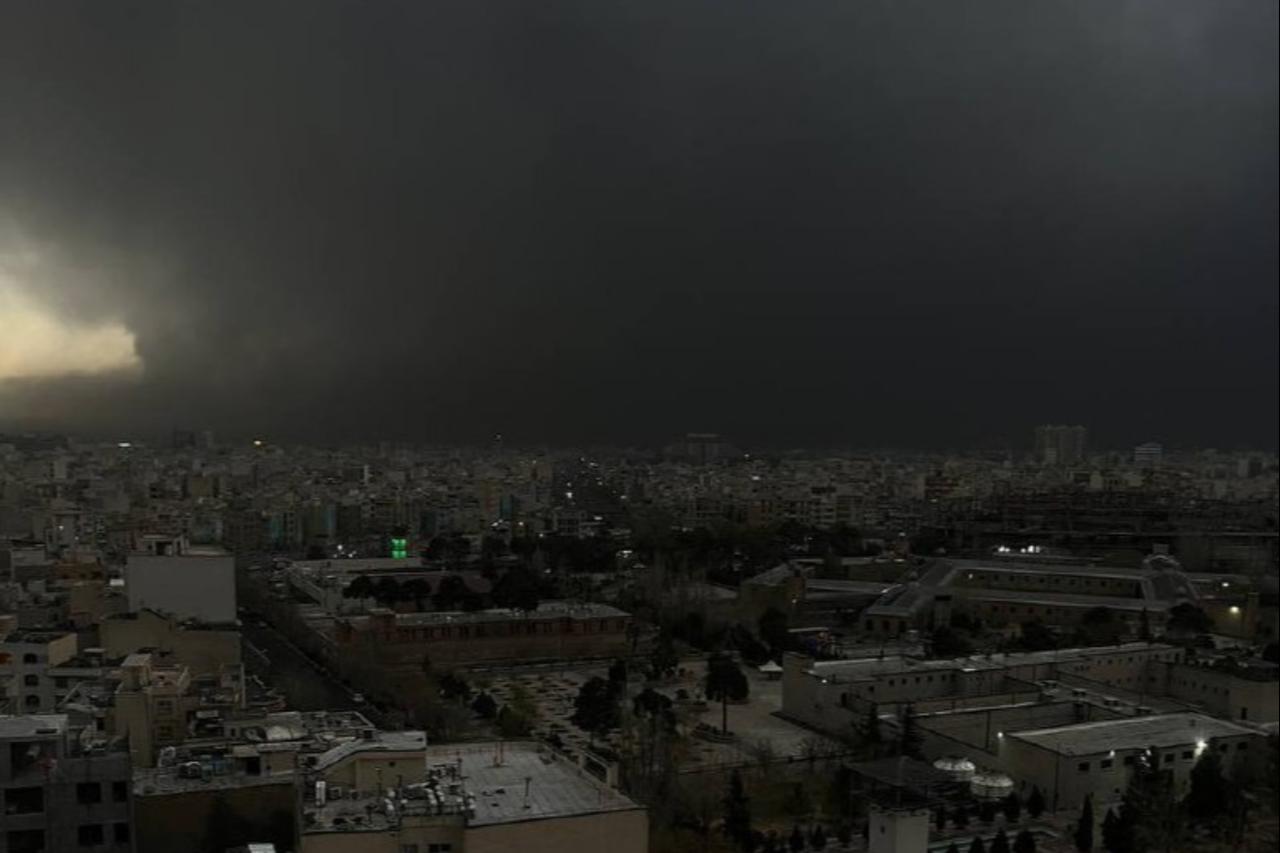
That is what makes the Qeshm allegation so consequential even before full verification. It tells us what is now possible in this war. Once water infrastructure enters the realm of acceptable targets, the region’s civilian operating system begins to look alarmingly exposed. International humanitarian law prohibits attacks on objects indispensable to the survival of the civilian population, including drinking water installations and supplies. But law matters only when belligerents fear consequences. In prolonged wars, restraint tends to decay faster than legal principle.
The prospect of nuclear targets brings other risk to the table. Not every strike on a nuclear-related site would produce a Chernobyl-scale disaster. Reuters, citing experts and the International Atomic Energy Agency, reported that attacks on enrichment and conversion facilities such as Natanz, Fordow, and Esfahan are more likely to create localized chemical hazards than mass radiological fallout. But the same reporting makes clear that an attack on Iran’s operational Bushehr reactor would pose a much more serious danger, including possible radiological contamination of Persian Gulf waters. For neighboring states that rely heavily on desalinated Gulf water, that is not a technical concern. It is a direct human security threat.
Even if scenarios for the downfall of the Islamic Republic eventually materialize, this war will make Iran’s recovery harder. Decades of bad water governance, environmental destruction, and institutional decay had already brought the country close to systemic failure. War now threatens to deepen that damage through infrastructure loss, industrial contamination, energy disruption, and public health decline.
Political change, if it comes, will not magically erase those burdens. It will inherit them. The next government, whatever form it takes, will be trying to repair a country whose water, energy, and environmental systems had already been badly mismanaged and then further broken by war.