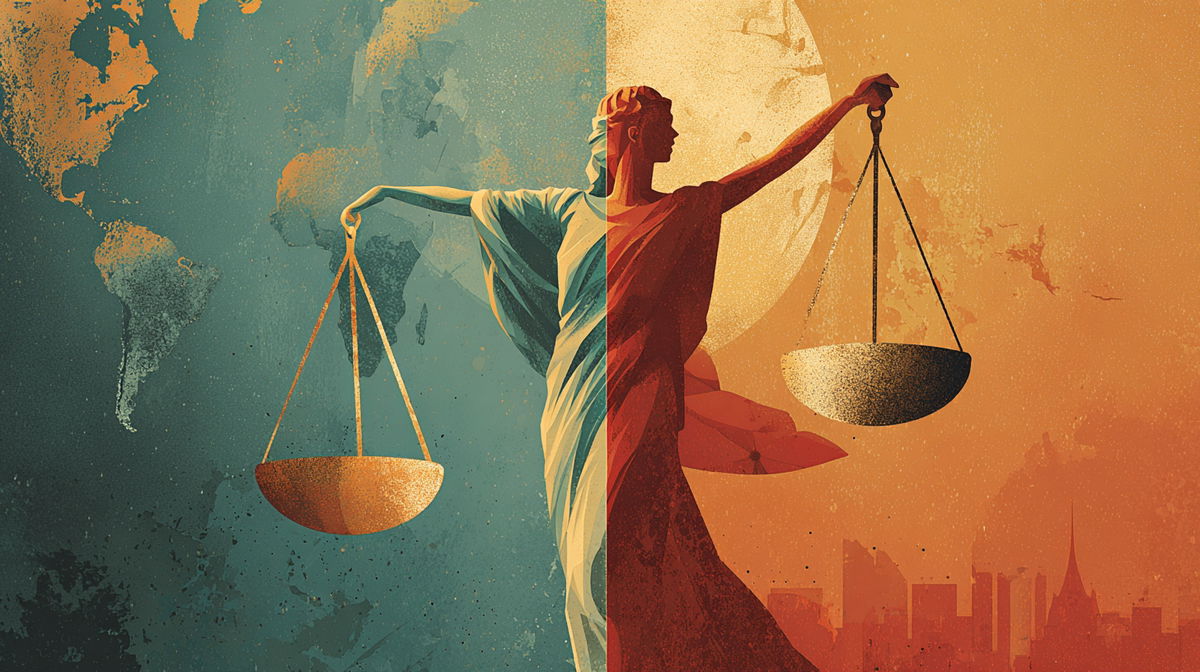
- Faith, not force, sustains the system: International law has no global police — it depends on states believing in shared rules, and that belief is now collapsing under the weight of selective enforcement.
- The Ukraine–Gaza contrast is corrosive: Western governments mobilised legal institutions with unprecedented speed to condemn Russia’s invasion of Ukraine but largely fell silent over the assault on Gaza, teaching the world that some victims matter more than others.
- The Global South is complicit too: Latin American governments championed democratic solidarity on paper but abandoned Venezuela’s people in practice, shielding an authoritarian regime behind the doctrine of non-intervention.
- Venezuela’s tragedy exposes the core contradiction: Sovereignty is meant to protect people, yet the international system consistently prioritises the prerogatives of states over the dignity of human beings — whether the threat crosses a border or comes from within.
- Restoration demands symmetry: Rebuilding legitimacy requires holding all perpetrators accountable — allies and adversaries alike — and recalibrating the foundational bargain so that protecting populations carries as much weight as protecting borders.
International law has always rested more on faith than force. Unlike domestic law, it lacks a global police; its influence depends on states believing in, and voluntarily abiding by, shared rules. Today, that faith is faltering. The lofty principles of the post-1945 order — sovereign equality, universal human rights, the rule of law — ring hollow when major violations are rationalised in the language of law itself.
Nietzsche warned that a moral order dies not when attacked from outside, but when it loses legitimacy in the eyes of its believers. International law now faces just such a crisis of belief. If enough countries conclude the “rules-based order” is really a tool of power, not a restraint on it, the result will be not anarchy overnight but something in some ways worse: a cynical shell — treaties and courts still in place, yet devoid of moral authority.
This crisis came into sharp relief with the United States’ recent intervention in Venezuela. On 3 January 2026, US special forces seized Venezuelan leader Nicolás Maduro in a unilateral operation. The UN secretary-general, António Guterres, warned that the raid “constitute[d] a dangerous precedent,” stressing the imperative of “full respect — by all — of international law”. The Organization of American States likewise urged all actors to “fully respect international law and the applicable inter-American legal framework”, calling for de-escalation, civilian protection, and a Venezuelan-led return to constitutional order.
International law experts were blunt: the US attack was a flagrant violation of the UN Charter’s ban on force — “an act of aggression that endangers civilians and tears apart the guardrails of international law,” as Amnesty International’s secretary-general put it. Human-rights organisations warned that Washington’s move, besides being illegal, would encourage copycat breaches of the rules elsewhere.
Smart, Progressive Thinking on the Big Issues of Our Time
Join 20,000+ informed readers worldwide who trust Social Europe for smart, progressive analysis of politics, economy, and society — free.
The point is not just that one powerful state broke the rules. It is that this episode dramatised a pattern of selective respect for law — by both the Global North and South — that is corroding the system’s credibility. Western governments often sanctify international law in rhetoric until it constrains their own interests. Meanwhile, leaders in the Global South rightly decry those hypocrisies, yet too often practise their own, shielding allies or themselves from accountability when it is politically or economically inconvenient. This double standard threatens to hollow out international law into a façade: a “rules-based order” where the rules bend or break depending on who violates them.
A tale of two crises
Consider the contrast between Ukraine and Gaza. Russia’s full-scale invasion of Ukraine drew near-universal condemnation as an illegal war of aggression. Western nations rallied behind Ukraine in explicitly legal terms, and international justice moved with unprecedented speed: the International Criminal Court (ICC) issued an arrest warrant for Russia’s president over the deportation of Ukrainian children. Yet when it came to the Israeli assault on Gaza in 2023, that zealous legal energy was nowhere to be found. As one Palestinian human-rights advocate noted, international law was “eagerly used” to defend Ukrainians but “reduced to mere footnotes and suggestions” in response to Gaza’s plight.
Whatever one’s views of those conflicts, the perception globally was clear: some lives appear to matter less than others, depending on the usual trinity of politics, religion, and geography. This is more than a moral stain; it is a structural wound. If the West invokes “rules” to punish foes but excuses or ignores similar breaches by friends — or by itself — it teaches the world that law is just politics by other means. From arming coups and proxy wars during the Cold War to tolerating allies’ abuses today, Western powers have often treated international law as optional. The Trump era merely made this explicit, embracing a “might makes right” ethos over multilateral norms. Each instance — Iran, Iraq, Yemen, Gaza, and others — chips away at the expectation of even-handed law. For many outside the West, “rules-based order” has become a cynical punchline.
Yet, the Global South has played its own part in this erosion. Take Latin America’s response to Venezuela’s implosion. The region has a proud tradition of legal idealism: as far back as 1948, Latin American states proclaimed that human rights derive from the very fact of personhood, not statehood, and in 2001 all Organisation of American States (OAS) members agreed “the peoples of the Americas have a right to democracy and their governments have an obligation to promote and defend it.” On paper, sovereignty in the inter-American system is not absolute; it is conditioned on respecting democracy and human rights. Venezuela’s own 1999 constitution even gives citizens the right to disavow any regime that violates democratic norms or human rights.
When Venezuela spiralled into authoritarianism and humanitarian catastrophe under Maduro, many of those lofty principles evaporated. Rather than unite to pressure Caracas to change course, too many Latin American governments chose silence or half-measures. Some were bought off by petrodiplomacy: for years, Venezuela’s subsidised oil — the PetroCaribe programme — effectively purchased political cover from smaller countries that feared losing cheap fuel. Others were swayed by ideological solidarity or a reflexive aversion to “intervention,” rooted in the region’s bitter history of foreign meddling. Even after Maduro brazenly defied a 2024 election result and intensified repression, neighbours remained divided: a few leftist allies congratulated him, while others hemmed and hawed without committing to serious collective action. Latin America’s own doctrine — that sovereignty is no licence for tyranny — was treated as optional when principles grew politically expensive.
This was more than a diplomatic failure; it was a moral failure. Latin American leaders often, and rightly, slam US or European violations of international law. But some of those same leaders looked away as a kindred regime in their neighbourhood jailed, tortured, and drove into exile millions of its people. They defended the sanctity of non-intervention and national sovereignty — understandable given the bitter history of Yankee interference — but in doing so they abandoned the equally vital idea that sovereignty exists to serve people, not vice versa.
Venezuelans noticed the betrayal. Opposition figures pleaded with regional governments to end the “neutrality” charade, pointing out that sitting on the fence was itself a choice — one that cost human lives. Indeed, by late 2024, roughly 7.9 million Venezuelans had fled their country’s misery, a diaspora of historic proportions and the largest ever in Latin America. Yet “the community of nations” offered Venezuelans mostly speeches about inviolable sovereignty, while the very rights sovereignty is supposed to guarantee were trampled underfoot. The lesson, again, was that legality in practice is a posture, not a discipline.
Sovereignty’s unanswered question
Venezuela’s tragedy forces a blunt question: if a government destroys its citizens’ lives and liberties, do outsiders simply shrug because borders are sacrosanct and “not intervening” is the supreme rule? The current international system leans towards yes. The UN Charter is built around respect for state sovereignty, prohibiting force except in self-defence or when authorised by a paralysed Security Council. That shield against aggression is vital, especially for weaker nations. But who is that sovereignty protecting when the threat comes from a regime against its own people?
The double standards of both North and South are feeding a dangerous collapse of the law’s credibility. If international rules are enforced and global outrage ignited when a border is crossed by tanks, but not when a tyrant massacres his own people, what message does that send? It suggests that the system still cares more about the prerogatives of states than the dignity of human beings. That impression is not lost on global publics. The result is a kind of nihilism about norms. As compliance with international law comes to be seen as capricious or selective, fewer actors feel bound to honour it. We risk a downward spiral: law as mere realpolitik theatre. And when “the rule of law” starts to look like an elite illusion — a political tool rather than a shared commitment — citizens will gravitate towards anyone who promises to “fix it,” even if that means strongman rule or the shredding of constitutional norms. Legitimacy shifts from values to brute effectiveness. We have seen this before in history, and it does not end well for democracy or human rights.
To restore faith in international law, nothing less than a systemic course correction is required. Sovereignty must remain a shield against external aggression, but it cannot remain an absolute shield for abuses that shock the conscience. The foundational bargain needs recalibration so that protecting populations from mass atrocities carries as much weight as protecting borders. All states, North and South, have already endorsed that principle on paper. It is time to live up to it in practice.
That means strengthening global and regional mechanisms that hold all perpetrators accountable — not just the vanquished or the pariahs. It means the Global South heeding its own doctrines of democratic solidarity instead of deferring to “non-interference” when a neighbour’s people are bleeding. It means Western powers applying the same legal yardsticks to allies as to adversaries — no more strategic exemptions when it is an inconvenient friend committing the war crime. And it means giving real voice and recourse to the individuals whom the system ultimately exists to serve. International law’s purpose, at its core, is to protect human beings — not to provide impunity for governments. There is no utopian alternative waiting in the wings.