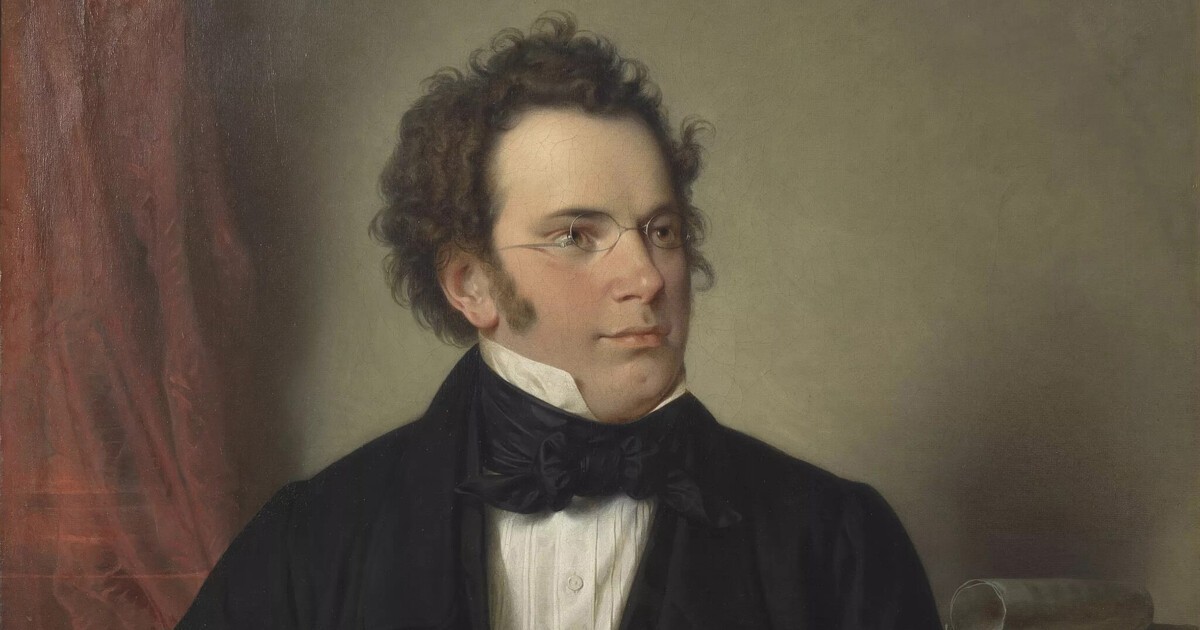
Had Franz Schubert been asked how he had come to write the song ‘Am Meer’ – he, who had never seen the sea and whose knowledge of it was limited to hearsay and the stylised depictions of painting and literature – he might have answered as, a hundred years later, Maurice Ravel answered, when a friend teasingly asked him how, since he never got up before ten thirty, he had come to write, in Daphnis and Chloe, an evocation of the dawn: ‘It was simple – I used my imagination.’ In the uses of the musical imagination, Schubert was unsurpassed in his generation: it was his way to a kind of freedom, his escape from an uncommonly constricted life.
Reality was harsh. Vienna was filthy, overcrowded, disease-ridden. In 1800, life expectancy at birth for a man was forty. Schubert made it to 31. Born in 1797, on the kitchen floor of a one-room apartment, he was the thirteenth child of fifteen, ten of whom died in infancy. His mother died when he was fifteen. His father – a schoolmaster, modestly successful, upright, thrifty, living well a life of which little was to be expected – outlived him. His first music lessons were with his father (violin) and his brother (piano). When he was eight, he was sent to the local choirmaster for instruction in singing, counterpoint and organ. At eleven, he won a place as a chorister in the Imperial Chapel, entering the Stadtkonvikt, Vienna’s elite boys’ boarding school, where he received the best musical and general education the city had to offer and where his composition teacher was Antonio Salieri, then in his sixties, the grand old man of Viennese music, who had briefly taught Beethoven and would teach Liszt. At sixteen, returning home at the end of his schooling, he made desultory efforts at finding a job as a schoolteacher. When these failed, he set out to establish himself as a freelance composer, a precarious existence, dependent on the support of his family and the generosity of friends. At 25, he contracted syphilis. Six years later he succumbed to typhoid fever, his physical resistance drastically undermined by his condition and the debilitating treatments he had received for it.
Nothing much happened to Schubert. He never had a steady job. He didn’t marry or have children. He had no love relationships before he caught syphilis, and afterwards they were out of the question. Beyond the odd trip to Linz and Graz, he had no experience of the world beyond Vienna. Yet the life of his imagination was free-ranging, boundless, strange, at times terrifying. Between the ages of 13 and 31, he wrote more than a thousand works and claimed a place beside Haydn, Mozart and Beethoven as one of the greatest composers of the European classical tradition. The gift was immense, the creative profusion unprecedented, the promise magnificent, the curtailment brutal.
After his death, the idea of him as a sort of innocent took hold: a natural, untutored genius, like Milton’s Shakespeare, warbling his native woodnotes wild, careless of the musical gems he strewed about him. In the reminiscences of his friends, he figured as absent-minded, cuddly (he was only five foot – podgy, bespectacled), shy, impractical, lovable. The story of his ‘Unfinished’ symphony came to symbolise the tragedy of his unfinished life (he wrote two movements and put them in a drawer, later giving the manuscript to his friend Josef Hüttenbrenner, whose brother, Anselm, sat on it until 1865). When 20th-century research turned up the medical facts, the received portrait gave place to a darker, more troubled Schubert, perhaps bipolar, declining into obesity and alcoholism. In the 1980s, circumstantial evidence of his homosexuality raised the question as to whether he had caught syphilis from a man or from a woman.
In line with this new biographical chiaroscuro, critical appraisal moved the centre of his achievement away from the canon of favourite lieder, the more light-hearted chamber music, the three popular symphonies and the shorter piano pieces to the works of his last years, and especially of 1828, the year in which he died. The expressive intensity of these pieces – among them Winterreise, the last three piano sonatas and the C major string quintet – invited the construction in them of a late style, as though, by positing an internal telos to the oeuvre, the jagged abridgement of so extraordinary a creative life might be blunted, and the work rounded out, brought to a conclusion. But we should be wary of this.
Schubert knew that his life was blighted, that sooner or later he would die of his disease, but he didn’t know when. In his last year, his career picked up: beyond his reputation as the composer of songs, dances, piano duets and the occasional mass, he was attracting attention for his chamber music (string quartets, piano trios, a string quintet); Ignaz Schuppanzigh, Vienna’s leading violinist, had begun to take a serious interest; in March, a testimonial concert was devoted exclusively to Schubert’s music; he’d come close to having an opera produced and his C major symphony performed; significant negotiations were underway with German music publishers; in November, two weeks before he died, he began lessons in counterpoint with Simon Sechter, Vienna’s acknowledged specialist. He didn’t expect to die just yet.
Few young composers can have had more formidable precursors, oppressively close in time and place. Vienna was the city of Mozart (who had died five years before Schubert was born), of Haydn (who overlapped him by twelve years) and of Beethoven, who, for almost the entire span of Schubert’s composing career, lived just down the road. They never met, though there is evidence that Beethoven knew something of the younger composer’s work. Schubert revered Beethoven above all others and saw himself as his successor. He was 26 years his junior, but he outlived him by only a year, so it’s easy to slip into thinking of him as Beethoven’s direct contemporary, an intercalary youngster nestling within the father’s capacious embrace. Had Schubert lived even another decade, he would have pulled free of Beethoven, established himself internationally and entered into creative conversation with the next generation of composers – Mendelssohn, Schumann, Chopin, Liszt, Wagner. As it was, though he wrote copiously in all the major forms except the concerto, his immediate influence was confined to the lied, and it took the rest of the century and the good offices of Mendelssohn, Schumann and, especially, Brahms for the full range of his work to become known.
The neglect of swathes of Schubert’s music during his lifetime was an artefact of his precociousness. That none of his nine symphonies was performed, nor any of his four operas, nor his piano sonatas, was not unusual: Beethoven’s first symphony was performed when he was 29, Schumann’s when he was 30 and Brahms’s when he was 43. The first decades of the 19th century were a time of institutional change. The role of church and court as primary sources of employment and patronage was on the wane, but the new dispensation of commercial publishing and the public concert had yet fully to evolve. In this respect, Vienna was especially backward; though famous throughout Europe for its private musical culture, during Schubert’s lifetime it had no dedicated concert hall or orchestra. Opportunities for public performance were hard to come by.
Without a job at court and given his social background, Schubert had no access to the higher aristocratic patrons who subsidised Beethoven, and, as a freelance composer disinclined to teach an instrument, he had few ways to earn a living. He must have felt the odds were against him, but there’s a good case to be made that circumstance and temperament had conspired to limit his options in exactly the manner required for him to flourish. For Schubert was never without enthusiastic appreciation for his music, first among his family, then among his circle of friends and, beyond them, in the drawing rooms of the city, where a culture of amateur music-making thrived. The burgeoning Viennese middle classes enjoyed playing string quartets and piano trios, piano and guitar music, singing and dancing. Public life was hazardous. Under the repressive diktats of the Metternich regime, you had to be careful what you said and did, and the turn inwards to the domestic sphere was a natural consequence. There were spies and informants everywhere. Schubert himself was denounced for seditious talk and arrested, along with his friend Johann Senn. Senn was deported; Schubert was released. Music remained out of reach of the secret police.
In the years after he left school, Schubert sought the company of poets, artists and philosophers rather than musicians. He was the group’s resident composer, recognised for his brilliance and much cherished as the provider of musical diversion. If he was to be Beethoven’s successor, he must master the big compositional forms, but while he was about this, he could make money selling to publishers the songs and dances he was writing for his friends. His inspiration flowed naturally in these channels; he wrote effortlessly, turning out as many as four or five songs a day or jotting down in the morning dances that he had improvised at the piano the evening before. It was a protected environment, providing support, status, local success and feedback. Within this Gemeinschaft he came to maturity as a composer and it gave him advantages that early success in the wider world (in the Gesellschaft) might have deprived him of, above all the freedom to experiment, to go where his imagination took him, untrammelled by the demands of an employer or the taste of concert audiences.
Schubert’s imagination was unusually literary. Words released music in him: poems about desire, love, loss, solitude, the longing for rest; narrative ballads; philosophical poems; theological poems; poems about death; poems about nature; poems about the paranormal. Schumann reckoned that had he lived long enough, Schubert would have set the whole of German literature to music. The so-called parlour song as Schubert found it was a humble creature, largely neglected by his predecessors, adapted to the musical standards of amateurs: straightforward melodies of limited vocal range with simple accompaniments for piano or guitar. While still a teenager, Schubert so deepened and widened the structural and expressive properties of this form as, in effect, to create a major new genre, opening up a seam that would yield musical riches for centuries after his death, an achievement for which it is hard to find a parallel in the history of European classical music. As the inventor of the lied as we now think of it, Schubert was also its supreme exponent, his output unsurpassed for range and variousness, for what it uncovered in the remoter zones of human feeling.
He rapidly sophisticated the character of the parlour song, taking it well beyond the capabilities of the amateur singer and pianist. Two of his most popular hits in Vienna – ‘Gretchen am Spinnrade’ and ‘Erlkönig’ – required professional musicians. There were talented singers in his social circle, notably the opera singer Johann Michael Vogl, but Schubert would often sing and play his songs himself. He had a nice voice and was a good pianist, but one wonders what these renditions must have sounded like. The technical demands of the song cycles Die schöne Müllerin and Winterreise were especially great. Yet nowhere does one sense the singularity of his talents more acutely than in the angle between the very simplest of his songs and the models on which they were based. Schubert was no snob. As a young composer he was a fan of Johann Zumsteeg and Carl Zelter, the leading songwriters of the day, and for the rest of his life he would continue to write songs suitable for amateurs. In the best of these songs (‘Du bist die Ruh’, say, or ‘Dass sie hier gewesen’ or ‘Der Abendstern’ – there are so many!) the constraints of the form elicited from him a music of differences, of the finest possible discriminations of feeling, as if the depth of penetration were proportionate to the narrowness of the creative beam.
The calibre was there from the start. Take ‘Das Rosenband’, a setting of a poem by Friedrich Klopstock and one of Schubert’s earliest songs:
I found her in Spring shade,
There I bound her with garlands of roses:
She did not feel it and slumbered.I looked at her; with this look
My life hung on her life:
I felt it but knew it not.Speechless, I lisped to her
And rustled the rose garlands:
Thus, she awoke from her slumber.She looked at me; with this look
Her life hung on my life,
And all about us was Elysium.
Central to Klopstock’s poem is the idea of unconsciousness. The young woman, asleep, does not feel the poet bind her with roses; the poet senses his connection to the young woman but does not ‘know’ it; the lovers are described not as being ‘in’ a state of bliss but as ‘surrounded’ by it; they are, in Hardy’s phrase, ‘selves unseeing’. Setting the poem eighty years after Schubert, Richard Strauss overrode these delicacies of sentiment in favour of an outpouring of ecstatic love (the young man’s), pulsing with sensuality and the rush of the blood. His setting – Fragonard to Schubert’s Watteau – scaled up the expressive range to the fully operatic: what’s the point of bliss, it seems to ask, if you can’t know it to the full?
Where Strauss’s music, like the poet of Browning’s ‘Two in the Campagna’, plucks the rose and ‘loves it more than tongue can speak’, Schubert’s holds back, a state of fragile hesitancy (the lovers’ lives ‘hang’ on each other’s) implied by the use of transient interrupted cadences in the harmonies underlying the simple melody. The song is pale, slender, undernourished. Hovering at the edge of bliss, it is suffused with what Wittgenstein, in a notebook entry, called ‘the pathos of the happy lover’.
The ‘tuneful melody’ (Hans Keller’s formulation) of ‘Heidenröslein’ – another very early song and one of his most famous – has that uncanny Schubertian quality of appearing always to have existed, as if, rather than composing it, Schubert had borrowed it from a shared folk tradition. Here, it is the song itself that is unknowing. The music’s ingenuousness stands in a relation of high ambiguity to Goethe’s far from ingenuous poem. Since Schubert wrote four other songs that day – 19 August 1815 – it would seem unlikely that he spent long calculating the almost dizzying semantic oscillations of ‘Heidenröslein’, yet the exquisite play of ‘inadvertent’ irony in this little song, the hinted note of archness in its artlessness, do not strike one as the inspiration of a moment.
Schubert’s songs, dances and piano duets were written for a community mainly of young people, who enjoyed them as part of their language of social exchange: in casual encounter, friendship, flirtation, courtship, love. Songs such as ‘Das Rosenband’ or ‘Heidenröslein’ were not just listened to but lived. We must imagine the scene: a young woman at the piano, a young man singing, passing the time on a lazy afternoon or a long evening after dinner. Leafing through a volume of songs, they light on ‘Heidenröslein’. If they register the subject of the song at all – a rape allegory – they do not acknowledge it to each other, for they are living in a city where a young woman’s prospects could be ruined by sex and a young man’s end in an early death.
Schubert’s early songs still cleave to the words they set. The effect of ‘Heidenröslein’ depends on the curious dissonance between the butter-wouldn’t-melt tune and the cynicism of Goethe’s little ballad. Meanwhile, the music of ‘Das Rosenband’ is a limpid medium for Klopstock’s words, sensitively commenting on and interpreting them. Music and poetry here find an equilibrium, typical of the best of the parlour songs that Schubert first encountered, but which, increasingly, his use of the form for wide-ranging invention and experiment would unbalance. Received opinion takes it for granted that in the greatest songs of the tradition inaugurated by Schubert, music and poetry achieve an ideal symbiosis. It’s a convenient assumption that glosses over the oddities of the genre as Schubert developed it, particularly the anomaly of using imaginatively dense poems as the pretext for imaginatively dense pieces of music, as if musical and poetic semantics were not by nature radically discontinuous.
‘The essential condition of music,’ Charles Rosen wrote at the conclusion of an illuminating analysis of a pair of Schubert songs in The Frontiers of Meaning (1994), ‘is its proximity to nonsense.’ A less mischievous way to make the same point would be to say that the meaning of music is, in essence, underdetermined. The number of possible settings of any one poem will, in principle, be limitless. Schubert, Schumann and Wolf all set Goethe’s ‘Kennst du das Land?’ from Wilhelm Meister, a magical and enigmatic poem not obviously suited to musical treatment. The three songs are, naturally, quite different from one another, and one would be hard put to say in what way any of them, however compelling as music, channels the meaning of the poem.
In his 1912 essay ‘The Relationship to the Text’, Arnold Schoenberg implicitly acknowledged the tendency of great songs to ingest and metabolise the poems they set when he explained that for years he had enjoyed Schubert’s lieder without ever taking in what they were about, and that, when he did bother to look at the words, they were no surprise to him, since he had intuited them all along. Leaving aside the daffiness of this last claim, the point he was making about the relative importance of music and words in the lied is surely correct, at any rate from the listener’s perspective: many of the most memorable lieder live in our imaginations as pieces of music, not as intoned poetry. We are so used to thinking of the process of songwriting (not, that is, the songwriting of a singer-songwriter – an altogether different thing) as setting a poem to music, the song in some sense an interpretation of the poem, that we fail to see how, in many instances, the process reverses itself and the poem becomes just one possible interpretation of the music rather than its progenitor. As an example, in the transition from Heine’s poem ‘Am Meer’ to Schubert’s song, we move from one powerful semantic field to another so distinctive – as music – that the poem is left behind, cast off like the shell of a previous instar. Indeed, Schubert’s song is no longer concerned with the poem that inspired it but opens itself to all the yet unwritten poems it might engender, all the poems that might set its music to words. And just as there are any number of possible musical settings for a given poem, so there are any number of possible poetic settings for a given song.
Schoenberg follows his admission that he had paid less than close attention to the words of Schubert’s songs with the perhaps more radical revelation that, ‘inspired by the sound of the first words of the text’, he had composed many of his own songs ‘straight through to the end without troubling myself in the slightest about the continuation of the poetic events, without even grasping them, in the ecstasy of composing’. So why bother with the words at all? Why not simply use the poem as a point of departure, a catalyst for a purely musical composition? Or, at any rate, why not substitute vocalise for the words? Just to imagine the singer of ‘Am Meer’ replaced by a violin or an oboe reminds us that the song without words is no more than a pretty conceit, and, if the song is unthinkable without the human voice, then it is axiomatic that it must be heard to utter words and to do so with unquestioned commitment to meaning. What the voice is singing may be swallowed up by the music, but that it is singing with an urgent intention to speak to us is how we know that the song is alive.
It is easy to forget that when Schubert wrote his songs, the public lieder recital did not exist. The nearest thing to it was the so-called Schubertiades – private song fests organised by his friends. The songs that were performed publicly in his lifetime were included in potpourri programmes that happily juxtaposed music from different genres. As late as 1854, Eduard Hanslick, Vienna’s dominant music critic, could dismiss as absurd the idea of devoting a whole concert to songs (though he did make an exception for song cycles). But by the end of the century, the lieder recital had become a central rite in European and American musical culture. What had originated as music for a community of amateurs had morphed into high art and a necessary accomplishment for all professional singers. Much of the repertoire took strongly to the new environment. Many of Schubert’s songs thrive on a modern concert platform: robust, straightforward songs, often strophic, with blanket piano figurations and beautifully shaped melodies, among them some of his most well-known – ‘Die Forelle’, ‘Der Musensohn’, ‘An Sylvia’ and so on. But others, transplanted from their sheltered domestic habitat into the limelight of the professional concert, have fared less well, because of their fragile simplicity, their nuance, their strange interiority. To sing and play through one of these songs at home is not to perform it. On the spur of the moment, one may discover an inadvertent refinement, momentarily opening a channel through which the music speaks with unaffected directness. One hears this sometimes in the informality of a school concert, where two young amateurs play and sing. Such occasions are moving because the musicians are not altogether aware of what they have achieved; they are selves unseeing, like the lovers in ‘Das Rosenband’.
In Heinrich von Kleist’s ‘Über das Marionettentheater’ (1810), the presence in art of grace is understood as vitiated by knowingness. The marionettes, having no mind, move with a grace that a human dancer might never achieve. Against the flawless instinctive parrying of a performing bear, an experienced fencer cannot prevail (‘We see that in the organic world, as thought grows dimmer and weaker, grace emerges more brilliantly and decisively’). At the baths, a 15-year-old boy, unselfconsciously lifting his foot to dry it, fleetingly calls to mind the Spinario, the Greek statue of a boy removing a thorn from his foot. The notion that innocence of effect is intrinsic to grace speaks directly to Schubert’s more elusive songs, but the passing felicities of amateur musicians, like the boy’s gesture, cannot be reproduced at will and would not survive transposition to the challenging conditions of a professional concert. For that, you need technique, but technique so often comes with knowingness, and knowingness is mortal to songs like ‘Das Rosenband’ and ‘Heidenröslein’.
The question of self-awareness is of central interest to Christian Gerhaher, one of the most accomplished singers of the present time and one of the most thoughtful. In Lyrical Diary, he ruminates on his experience as a lieder singer, with special reference to the works of Schubert, Schumann and Mahler. Much of the book is devoted to detailed points of interpretation and vocal technique, a granularity that is likely to recommend itself to other lieder singers rather than to the general listener. But Gerhaher is also deeply absorbed by larger questions, such as the persona of the lieder singer and the nature of voice. One can only imagine what he would say to Schoenberg’s confession. For, as a professional singer, his position is asymmetrical to the listener’s (and, judging by Schoenberg’s experience, at least some composers). Between the singer and listener stands the song, a kind of black box, and what the singer puts in is not altogether what the listener takes out. Since the singer has no access to the song except through the words, and since he cannot sing the words as though they were only partially intelligible, the possibility that the listener may be less than fully aware of them is of no account to the singer. If Arnold is in the audience, he must be made to understand.
The role of the lieder singer is bewildering. To sing the words with conviction, he must inhabit them, or, at any rate, appear to do so. But who exactly is he? Gerhaher keeps coming back to this. Where the opera singer identifies with a theatrical character, it’s a mistake, Gerhaher says, for the lieder singer to impersonate a role (‘I think lieder are principally not intended to be understood in the same way as drama’; ‘The identification of the singer with his role … is to be avoided’). Above all, he must not impersonate himself, for ‘allowing one’s own life and sensibility to flow into the performance of a role or a song has no compelling effect on the listener.’ But if he must subordinate his own identity, who then is he to be? In answer, Gerhaher gropes towards an ideal of detachment. He speaks of the lied’s ‘tendency towards abstraction’, and suggests at one point that this is best served by a ‘universalised sound’. This may seem to raise as many problems as it solves, and it’s easier here to join Gerhaher in what he objects to than what he proposes.
In a lieder recital it is not unusual to feel that the persona of the singer is that of a Lieder Singer, a recognisable character, faintly uncomfortable in his skin, not quite knowing what to do with his body – one hand on the grand piano, or with hands tented, fingertips touching, at the level of the diaphragm, unsure how far to go with thespian gesture, his face a canvas for unnatural expressive contortion. Perhaps, if it were attainable, a cool sobriety, such as Gerhaher imagines, dedicated to allowing the music to communicate itself without interference from personal feeling, would be preferable to this. But the most moving singers in the history of song have surely been those who dumbfound us with presence (‘Gesang ist Dasein’ – Rilke), singers whose voices subvert the decorum of the concert hall by speaking of things beyond technique and before lexical meaning. As Lorca has it in ‘Theory and Play of the Duende’, ‘here we care nothing about ability, technique, skill. Here we are after something else.’ Whether one thinks one has encountered this in any particular singer, on any particular occasion, will be intensely subjective. The best examples I can think of are the 1939 recording of Die schöne Müllerin by Aksel Schiøtz, or pretty much anything by Fritz Wunderlich.
Gerhaher’s most interesting chapter, for the general listener, is devoted to Winterreise and it is here that his aversion to expressive self-indulgence and a false thespianism is most telling. He dislikes Winterreise’s status as one of the sacred cows of the classical music scene. He relates that for many years he shied away from performing it and that when he did take it on, he tried his best to release it into a new lightness. He is especially exercised by the tendency of modern interpretations to conflate the persona of the protagonist with the person of the singer.
Brahms thought that great poetry was not improved by music. For his two song cycles, Die schöne Müllerin and Winterreise, Schubert turned to his contemporary Wilhelm Müller, a second-order poet, whose work, had it not been for Schubert, would have been remembered as a footnote to the tradition of the German Romantic lyric. In Winterreise, the relative mediocrity of the poems only emphasises the musical gold into which Schubert spun them, as though the monochrome light of the poetry has passed through the prism of Schubert’s imagination and been scattered into an array of 24 separate colours. But too often in performance, the singer allows the persona of the protagonist to dominate, with the unfortunate effect of re-homogenising this wonderful variety, of overlaying musical difference with a uniform vocal and theatrical tone. Gerhaher’s interesting commentary on Winterreise centres on an effort to rescue the individual songs from merger within such a unifying dramatic conception. He fixes these ideas in a striking and memorable image, seeing each song as a separate ‘stele’, a physically distinct and inviolate musical entity.
It’s not clear what destination Schubert had in mind for Winterreise. The only performance of it in his lifetime was when he himself played and sang it through for some of his friends, who were for the most part disconcerted by it. At 75 minutes – one of the longest song cycles in the repertoire – it makes uncompromising demands on performers and audiences alike, and in 1828 there was no obvious home for it. Though Schubert was ambitious – his eye fixed on success in the big public forms of mass, symphony and opera – and could write music on demand with a facility and amenability equal to any composer (agreeable and brilliant music well adapted to the culture of public performance that grew up after his death), his imagination naturally turned inwards, to the purely speculative, so that he can sometimes seem more like a poet or philosopher than a composer.
I first got an inkling of this when I was seventeen and met Schubert properly for the first time. Until then, my experience of his music had been limited to the shorter piano pieces, a handful of songs, the three popular symphonies and cursory encounters with some of the chamber music. Now, as a music student in Graz, I found myself confronted by D784, the second of three piano sonatas in A minor. My teacher, Walter Kamper, belonged to the generation of Austrian pianists (including Jörg Demus, Paul Badura-Skoda, Walter Klien and, most notably, Alfred Brendel) who did much to raise public awareness of Schubert’s piano sonatas, and I think Kamper gave me D784 as an antidote to Chopin, to whom I was perhaps overattached. Where Chopin wrote with an intimate understanding of and consideration for the natural physical disposition of the player – the integration of back, arms, hands and fingers – Schubert, it seemed, wrote music first and piano music second, and if it came to a decision between a compositional idea and the convenience of the hand, there was no question as to which should take precedence.
I had come across this in Beethoven, of whom even the more technically approachable sonatas would have passages that blocked one’s path. As for D784, Schubert reserved the most uncomfortable writing for the final bars of the work: a furious fortissimo canon in octave triplets. True, a passage like this would have been more easily negotiated on the pianos Schubert composed for – the Viennese fortepiano had a particularly light action, far lighter than that of a modern grand piano. But the fact that he had to write a simplified version of his song Erlkönig suggests that its notoriously unforgiving piano part was causing problems. Rosen called it ‘the most painful of all octave passages to execute’ and it is hard to imagine how Schubert himself would have played it: he was no virtuoso and, being only five foot, must have had very small hands.
As a piece of early industrial hardware, the fortepiano was delicate by our standards, yet somewhat feverish of timbre. It had a wide expressive range, capable of a gentle, diaphanous cantabile, bright, dry, sparkling passagework and, when played fortissimo, a hyperactive, slightly crazy rattle and clatter, as much noise as tone, especially in the bass. It lent itself to extremes of sensitivity and excitability, and it could at times sound positively ugly. It was this over-the-top, not entirely seemly character that successive piano manufacturers worked to temper and civilise.
Where the virtuoso tradition of piano writing, from Mozart via Hummel to Chopin, Liszt and beyond, sought to tame the instrument’s wilder traits, Beethoven and Schubert embraced its uncouth nature for expressive purposes, taking ugliness itself into the permissible acoustic and emotional spectrum. As a case in point, D784 is stretched across a wide dynamic frame, from ppp to ff, with abrupt and startling contrasts – sometimes from bar to bar – between the lyrical and the percussive, song and declamation, the eirenic and the agitated, the inflamed and the demulcent, the soothing and the clamorous, as though the music were intent on modelling a phenomenology of inner experience, the way thoughts, feelings and body states succeed one another without transition. It isn’t an altogether comfortable piece to listen to any more than it is to play, and in this respect it is not an outlier. Aspects of Schubert’s style continue to challenge our understanding and response: the vagabondage of his tonal schemes (daring sorties via proscribed routes into foreign territory, and ingenious homecomings); startling segues; the crashing of modal gears between major and minor; the alternation of cries and whispers, trance and turbulence, unparalleled melodic beauty and distressing harshness; and then that famous and puzzling loquacity which Schumann called ‘Himmlische Länge’, always translated as ‘heavenly lengths’, as though tactfully to avoid the word ‘longueurs’.
There’s a disposition in some of Schubert’s greatest music that is oblivious of our comfort, content to be unacceptable, not bothered to accommodate us, its attention absorbed by the things that interest it. In 1971, what struck me about D784 was its technical awkwardness and expressive intensity. What strikes me now is its compositional imagination. A cursory glance at the piano works of his direct contemporaries throws the strength and originality of Schubert’s writing into sharp relief. The sonatas of Hummel and Weber, for example, veer about under the impetus of a rootless virtuosity – so many notes to so little purpose, piano music in search of a style. The refractory inconveniences of Schubert’s writing have nothing to do with pianistic virtuosity, in which he showed no interest. In the place of empty flourish and display he built austere, unadorned structures, models of thematic parsimony. The first movement of D784 is skin and bones, with only the beautiful second subject offering creaturely warmth. One might read the movement as a study in the juxtaposition of inorganic and organic matter – the second subject and its associated music like plant life clinging to rock. Structurally, the vertical axis is heavily preferred to the horizontal, so that, rather than flowing, the music moves in blocks. It shows a deep preoccupation with pairs, binary symmetries, mirrorings. It spends much time interrogating the interval of a third. It seems to listen to itself with a curious, attentive intelligence.
The unsociable aspect of Schubert’s larger-scale piano music – the sonatas, the Grand Duo, the Wanderer Fantasy – confronts the performer with a choice: whether to tone down and temper the uncouthness and ameliorate the length, or to go with them. The case of D960, the last of the sonatas, is paradigmatic. The first movement is long, and its introversions do not encourage momentum. The repeat mark at the end of the exposition might be safely ignored, as tends to be the modern practice with repeats in sonata movements with lengthy expositions, except that here there are first and second-time bars which clearly indicate that Schubert wanted the repeat. Moreover, the material of the first-time bar is new and shocking: a sudden and ugly outburst. Without the repeat, the transition from the second-time bar to the development section is magical and elegant. This has been irresistible to most pianists, for not only does it avoid the unseemliness (the embarrassment even) of the first-time bar but shortens the piece by six or seven minutes, and, if the movement is played at a fluent tempo, it becomes quite digestible for an audience with trains to catch. Some pianists have taken a different view, notoriously Sviatoslav Richter, whose performance of this movement was 40 per cent longer than the average (a full ten minutes longer than Brendel’s, and almost twice as long as Arthur Rubinstein’s) owing to his stygian tempo and his playing of the repeat. In his later years, Richter preferred to give piano recitals in a darkened auditorium, with only a standard lamp next to the piano as lighting, and to play from the music, altogether as though he were in his own home rather than on a public stage. Like the music itself, he seemed oblivious of any audience. It was simply a matter of the pianist and the piece, Richter and Schubert, solus cum solo. Brendel is said to have thought his interpretation of D960 absurd.
Schubert’s expansiveness is often understood as garrulous, when paradoxically it could be seen as a facet of his frugality, his love of spinning music out of the simplest of materials (the side of his genius that showed an affinity with Haydn). He likes to strip down the number of variables in a piece, while running the remainder through a series of permutations. There’s even a tendency in his writing towards the algorithmic. Many of his six hundred plus songs have accompaniments that are generated out of one or two keyboard figurations, as though the music were being left to run itself (this is perhaps what Robin Holloway was thinking of when he wrote of Schubert ‘sleepwalking’). You can often tell something quite fundamental about his music by looking at its patterning on the page. Take the song ‘Die Stadt’, a particularly striking example from his last year. Or his very early song ‘Meeres Stille’, a setting of a poem by Goethe. The graphic character of this little song is immediately intelligible – 32 bars of arpeggiated minims supporting the simplest of melodies. The poem is about a becalmed sea, and the procession of gently rippling chords is clearly meant to suggest this, while the emotional burden of the poem is carried by the rhythmically shifting harmony moving through the chordal medium as a wavelet moves through water. Even before one has heard the song, the score has, in a sense, depicted it.
It is the speculative abstraction of Schubert’s music (Holloway has called it ‘geometric’), above all the astonishing fertility of his imagination in creating a world of unique musical organisms from simple stem cells, that was to draw so many composers to his work as a source of learning and inspiration. Giving the young Richard Strauss advice that he perhaps hadn’t asked for, Brahms told him to study Schubert’s eight-bar melodies. The composers of the Second Viennese School saw him as a precursor, a kindred spirit. Schoenberg routinely sent his pupils back to the songs. Berg claimed a lineage between Schubert’s tunes and the melodic contours of atonal music. When Elliott Carter went to study with Nadia Boulanger, he found that her favourite teaching resource was the treasure trove of Schubert’s piano dances. Webern arranged a set of them for orchestra. Schubert wrote around five hundred dances for the piano: German dances, Ländler, waltzes, Ecossaises – utterly simple little pieces, often only sixteen bars long. In them, we recognise style as a generative principle, a force able to multiply, as it were limitlessly, ever new variations of a tiny musical lifeform. The excitement of these miniatures lies in the image they project of fecundity born of constraint.
In an especially grumpy moment, Schubert wrote that there was no such thing as happy music. Much in his work might seem to contradict this, but, like the evenings he spent singing and dancing with his friends, its gaieties and high spirits could only keep darker thoughts at bay for so long. The shot silk shimmer in his music of major and minor modes suggests the lability of thought, whereby a happy certainty can turn, at the drop of a semitone, into sadness or misgiving. He was not given to ecstasy and there are few if any equivalents in his output to Schumann’s ‘Er, der Herrlichste von allen’, Strauss’s ‘Zueignung’ or Berg’s ‘Die Nachtigall’.
In the history of musical melancholy, a special place is reserved for Schubert. If Bach’s music embraces the wretchedness of the human condition (‘Ich elender Mensch’) it does so within the context of an unshakeable faith in the joy of redemption and the balm of divine compassion. Whatever sadness there is in Beethoven is lifted off the shoals of despondency by a tide of blessedness. And if, for ten minutes, Haydn looked into the void, he could muffle the existential detonation with the cotton wool cladding of Christian cosmogony. Such respect as Schubert paid to religion was shown up as lip service by his music. His masses – well-behaved, dutifully pious – rise to the occasion with intelligence and a cheerful demeanour, but their wheels spin free of the way of the spirit. The poles of his secular imagination are not Heiligkeit and Unheiligkeit but Heimlichkeit and Unheimlichkeit. Where his music offers us comfort (in the adagio of the C major string quintet, for example), it does so as a parent to a child who knows that its disappointment is unconsolable.
In his notebooks, Adorno raised an eyebrow at Schubert’s proclivity for the tavern. When asked to write a tribute to Schubert for a Viennese newspaper on the occasion, in 1928, of the hundredth anniversary of his death, Berg deplored his adoption by the Viennese tourist industry. There was an intellectual snobbery here that missed the essential importance to Schubert’s art of its embeddedness in the mess of ordinary life. More than perhaps any other composer, he seems one of us, a ‘composing mortal’ (in Auden’s phrase). He left little documentary record of his inner life; the hundred or so letters that survive are mostly about day-to-day things. But, curiously, this has the effect of bringing him closer to us, opening up a space for our imaginations to fill.
It was in this spirit that I found myself thinking of Schubert when reading Anne Carson in the LRB (6 March 2025):
Let’s start with life, your life. There it is before you – possibly a road, a ribbon, a dotted line, a map – let’s say you’re 25, then you make some decisions, do things, have setbacks, have triumphs, become someone, a bus driver, a professor, a pirate, years pass, maybe in a family maybe not, maybe happy maybe not, then one day you wake up and you’re seventy. Looking ahead you see a black doorway. You begin to notice the black doorway is always there, at the edge, whether you look at it or not … A minute ago you were 25. Then you went ahead getting the life you want. One day you glanced over from 25 to now and there it is, the doorway, black, waiting.
Just when Schubert was busy getting the life he wanted, it was foreclosed. At 25, looking ahead he saw not his life before him ‘like a road, a ribbon, a dotted line, a map’, he saw the black doorway. ‘I feel I am the wretchedest, most unhappy creature in the world,’ he wrote to his friend Leopold Kupelwieser. ‘Picture a man whose brightest hopes have come to nothing, to whom the joys of love and friendship can offer only the greatest pain … “My peace has gone, my heart is heavy,” so might I now sing every day, for every night I go to bed hoping that I shall not wake again, and each morning only brings back the grief of the day before.’
Literature can only gesture towards the black doorway: Wilfred Owen’s ‘profound dull tunnel’, the ‘small unfocused blur’ which stays ‘just on the edge of vision’ in Larkin’s ‘Aubade’. Sterne burlesqued it, marking the death of Yorick with a black page. Painting has late Goya, the Rothko Chapel. How does music represent the black doorway and, beyond it, the ‘total emptiness for ever’? Haydn imagined it as a fortissimo octave unison: the cosmic void before Creation, a conception which so impressed the 19-year-old Schubert that he copied it at the opening of his fourth symphony, the so-called ‘Tragic’. A hundred years later, Berg marked the murder of Marie, in Wozzeck, with two terrifying unison crescendos on the note B, one of the most shattering passages in music, and which Gérard Grisey surely referenced in the series of unison crescendos at the heart of ‘Quatre chants pour franchir le seuil’ (‘Four Songs for Crossing the Threshold’), his 1998 meditation on death.
Schubert had always been interested in the uses of unison, but in his later music – notably, the Grand Duo and the B flat piano sonata – empty octaves acquire a dark, enigmatic significance. The rondo finales of these two works are long and manic. The themes come around like carousel horses but there’s a nightmarish edge to the fairground gaiety, as if the music were locked into an endless circularity. In the Grand Duo, the thickness of the piano duet texture gives the music the character of an infernal machine (nowhere better realised than in the performance by Richter and Benjamin Britten at the 1965 Aldeburgh Festival). At intervals in this Totentanz, we are flung out of the vortex into an empty space, defined by unison octaves sustained in long note values, within which fragments of the rondo theme are tossed to and fro between the duet partners, like a desperate exchange between two exhausted people trying to catch their breath before careening onwards again.
The octave unisons in the Grand Duo prefigure the unsettling octave unisons in the D960 rondo, written four years later (and one of the very last things Schubert composed). But the more immediate precursor of this movement was the C minor impromptu written a year earlier. There, the function of the opening octave (also on G) only becomes clear at the end of the piece, when it quietly reappears, with the effect of underlining the dominant-tonic progression around which the whole piece is draped like flesh on a skeleton. In the D960 rondo, the skeleton structure is more elaborate, and the movement is as perfect an example as any in Schubert’s output of the Möbius continuity between pure compositional abstraction and dense signification. The elegance of the conception – its wit and thrift – is breathtaking, in that the harmonic progression that structures the whole movement also structures its primary thematic material.
The fp octave unison on G at the opening of the movement hits us from left field. Following suddenly upon the final B flat tonic chord of the scherzo, it sounds dissonant, jarring, disorientating, with no clear harmonic function, until, with the start of the barrel organ rondo theme, we recognise it as the dominant of C minor. No sooner have we clocked this than the theme has modulated to B flat, as the bass slips from G to G flat to F and then to the home key. This sequence of events is repeated eight times in the course of the movement, and each occasion reminds us that the harshly struck octave is a foreign body, made of different stuff from the rest of the music. First a semibreve in length and subsequently a dotted minim, it obtrudes through the texture of quavers, semiquavers and triplets, like a rock in a stream or bone through flesh. Its function is rupture, disruption, interruption, over and over wrenching the music out of its groove to return it back to its beginning again.
The movement traps us in a loop of re-enactment. The way out comes when we least expect it. On the ninth return, the octave unison, no longer marked fp, loses its force. Ever obedient to the unison’s command, the rondo theme starts up again, only to falter and peter out, stopped in its tracks by an astonishing change: the unison that interrupts it has given way, sinking a semitone to G flat. The theme staggers back to its feet, but it is broken, winded, knackered, hobbling and limping forwards. When the unison falls another semitone to F, the theme seems tentatively to revive, recast around the dominant seventh of B flat. The music pauses for a moment, then heads home in an exuberant dash for the final double bar.
The mirroring of the cadential sequence (G, G flat, F, B flat), in the shape of the rondo as a whole and of the rondo theme, may be read in symbolic terms as a movement from tension to release, from anxiety to relief, from fear to reassurance, restlessness to repose. In the many reiterations of the theme, we experience this subliminally, since the music is too fast for us to be actively aware of it. But on the last page of the sonata, when the unison falls and then falls again, we experience a systemic collapse followed by a dawning hope. It’s as if the music gives up the struggle. Ordered to keep going forever round the carousel of feeling, it says ‘I can no more’ and sinks, and in this sinking, this exhaustion, we realise that what we thought was the ground was not in fact the ground, but rather a level maintained by effort and tension; that the incessant and bullying unisons on G which we took to be irreducible substratum – the rock in the stream, the bone showing through the flesh, the unnegotiable substance of the Real – is frangible, pliable, capable of softening, capable of give. And this softening, this giving way, this sinking below the bedrock, while at first understood as failure, offers a possible release. When the music reaches the dominant seventh on F and pauses, it has, as it were, arrived at another doorway, this time not a black doorway but an opening towards a new, hitherto unimaginable place, and after a moment of hesitation, it passes through this doorway and makes its escape.