At the age of fifteen, Chantal Akerman sneaked into a screening of Jean-Luc Godard’s Pierrot le fou. She was in the habit of skipping school with her friends and the cinema was one of their preferred hangout spots. But until that moment, Akerman had thought of it as a place for flirting and kissing, which were ‘the same thing as dancing’. She hadn’t heard of Godard but liked the film’s title. She discovered something more enticing than flirting: ‘I knew there was someone there in front of me and I had to be present, too. [The film] required me to exist.’ The experience was unrepeatable. Every film to come would be ‘less good than Pierrot le fou’. This is the story Akerman repeated, and was often asked to repeat, throughout her life, as if it might provide the key to understanding how a high school and film school dropout, whose parents had no interest in cinema, might at the age of 24 make Jeanne Dielman, 23, quai du Commerce, 1080 Bruxelles (1975).
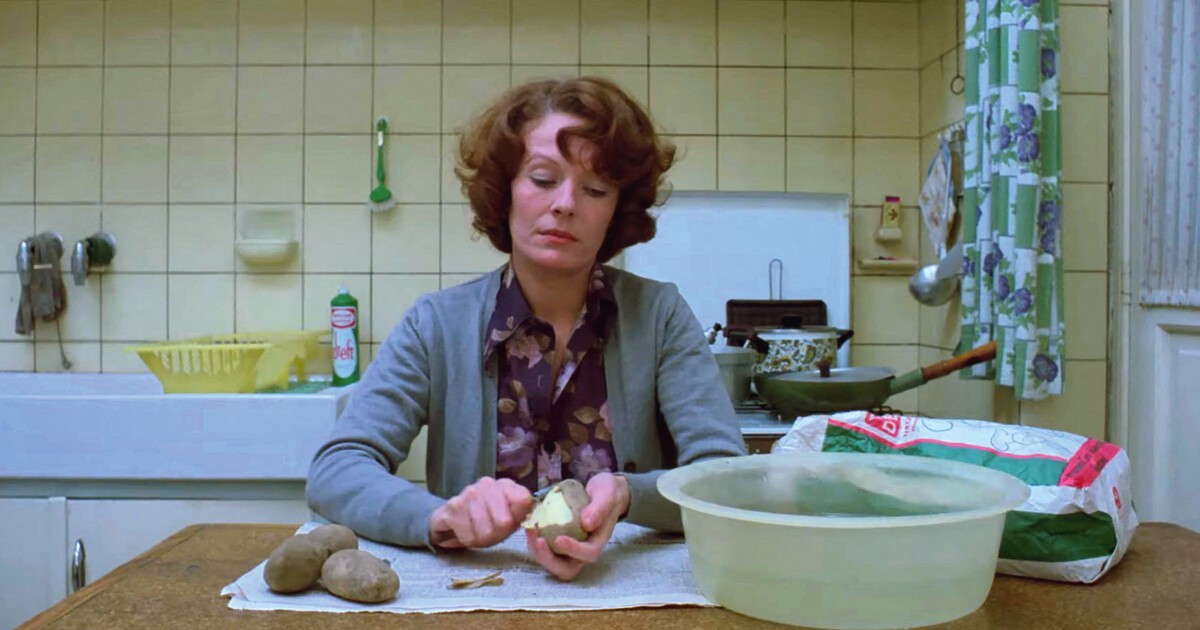
Until recently, most people had their first encounter with Akerman in the classroom. The rise of the women’s movement coincided with that of film studies and Akerman’s films were disseminated and dissected by women film professors. Early feminist film journals claimed her work as the embodiment of a feminist counter-cinema. You only need to see a still from Jeanne Dielman – of its middle-aged protagonist, played by Delphine Seyrig, wearing a housecoat and doing domestic tasks – to understand why. The film came out in the same year as Laura Mulvey’s essay ‘Visual Pleasure and Narrative Cinema’, and just as the Wages for Housework campaign was taking off on both sides of the Atlantic.
In the early 1970s, Akerman had attended meetings in Paris of the Psych et Po research group, organised by Antoinette Fouque, who co-founded the Mouvement de libération des femmes. She was invited to join the crew of Fouque’s first feature film – a response to Freud’s essay ‘The Psychogenesis of a Case of Homosexuality in a Woman’ – in which a teenage girl falls in love with her father’s mistress, played by Seyrig. Rushes for the unfinished film show Akerman holding a clapperboard for Scene 15, but neither the cinematographer, Babette Mangolte (who would shoot Jeanne Dielman), nor Akerman are mentioned in Fouque’s account of the film: they had walked off the set in protest at the dogmatic approach of Fouque and her feminist collaborators.
In 1975, Akerman appeared on a French television programme to promote a women’s film festival in Paris. Later, she made a point of refusing invitations from feminist, gay and lesbian, and Jewish film festivals – this may be the only recording of her speaking with other women about a ‘woman’s cinema’. Akerman is slouching on a sofa, along from Marguerite Duras; they are separated by Duras’s handbag and a packet of cigarettes, which Akerman chain-smokes, bringing her palm to cover her face each time she inhales. She is both self-assured and adolescent: she plays with her watchstrap and her shoe and looks rather disengaged. Her answers are straightforward. To the interviewer’s question about her use of an all-woman crew for Jeanne Dielman, she answers that girls often don’t get hired and that, being less experienced, they don’t try to challenge her experiments. The interviewer asks her to summarise Jeanne Dielman, forgetting its title for a second time:
It starts in the evening when Jeanne makes dinner for her son, so she puts the potatoes on to boil, and, after a while, the doorbell rings, and a man comes in so she goes into a room with him, she comes out of the room with him, he gives her money, she puts it in a soup tureen, she turns off the potatoes, she sets the table, her son arrives, she eats with him, she gets him to recite the poem he’s learning for school, she goes out for a walk with him, she goes to bed. The next morning, she gets up, she makes him breakfast, she goes to wake him up, she gives him pocket money, she makes the bed, she cleans the house, she goes shopping, she comes back, she eats, she leaves … In the afternoon, she buys him some things he needs, she has a coffee, she comes back, a man arrives etc. So, she always does things in the same order, without ever messing up. There are no gaps in her life, meaning there’s no anxiety, there are no hollow moments, everything is very, very compact. She knows, for example, that in the morning, when she puts on her dressing gown, she knows that she’s going to start with the top button and finish with the bottom button, which means she has no worries, that’s her life, it runs smoothly, without any problems.
A third participant, Liliane de Kermadec, interrupts, arguing that Jeanne, in fact, has nothing but worries, that her routine is just a way of masking them. Akerman defends her interpretation, but allows that others are equally valid. Seyrig interjects: as a young woman, she argues, Jeanne might have thought that having a husband and child and keeping house would bring her happiness. This is too much interpretation for Akerman, who wants to continue her plot summary. Things start to go awry for Jeanne when she forgets to turn off the light after a visit from a client and has to double back on herself. The next morning she wakes up too early, meaning she has an unscheduled hour to fill. Akerman doesn’t spoil the ending – which, at the film’s première at Cannes a month later, would cause Duras to shout: ‘That woman is mad!’ Seyrig had to tug at Akerman’s skirt to stop an argument from breaking out.
In her native Belgium and adopted France, distribution for Akerman’s films was never certain. Recognition came from a few appreciative programmers, cinephiles and critics. Cahiers du cinéma was slow off the mark, fluffing its first interview with Akerman (a faulty tape recorder) and dismissing the second as ‘a bit too personal’. But the magazine soon made up for its neglect, publishing an essayistic review of Jeanne Dielman that read the film through a psychoanalytical lens (repetition, compulsion, the uncanny). Several interviews and essays followed and Akerman became the magazine’s house autrice, alongside Duras. One month, each woman was said to ‘see herself as the privileged, and, in a way, sole spectator of her film’; the next, they both made ‘a cinema for everyone, a popular cinema. And if Duras, or Akerman, doesn’t entirely manage to reach the popular public for whom they make films, that is because the “popular” no longer goes to the cinema.’
Something close to a ‘popular’ Akerman was visible last year, when Jeanne Dielman was shown in cinemas across the UK. After it was judged Sight and Sound’s ‘Greatest Film of All Time’ in 2022 Akerman suddenly became vastly better known (the poll is run every ten years; the previous winner was Vertigo). The BFI capitalised on this by releasing two DVD volumes including around half of her films and BFI Southbank hosted a full retrospective. After more than one sold-out screening of Jeanne Dielman last year I overheard departing cinemagoers complaining that they would never get back those three hours, but Akerman would not have been offended by this. If they didn’t feel the time pass, then it had been ‘stolen’. Other viewers sized Akerman up against Andrei Tarkovsky, Béla Tarr. I heard one man listing to his female companion the sequences Akerman had lifted from 2001: A Space Odyssey (Akerman knew that audiences, in particular their male members, had ‘many resources to protect themselves’ from Jeanne Dielman). Women compared Jeanne’s gestures, like her way of peeling potatoes, to those of their mothers and grandmothers. Other viewers obsessed over the age of Jeanne’s son – he is played by a 25-year-old – or the fact that he sleeps on a sofa bed in the living room. But most of the discussions centred on the climactic event that Akerman had refused to mention in the television discussion. What is the expression on Jeanne’s face just before she murders her client? Is it an orgasm? Or was that with the previous client? In some ways it seems even harder now ‘to feel the film and not just understand it’, as Akerman wished. Its ambiguity is what makes it fascinating.
‘I don’t know everything about myself,’ Akerman told Cahiers du cinéma in 1977. ‘I’m just making assumptions.’ In interviews she spoke as both an insider and an outsider with regard to her work, oscillating at times between self-deprecation and grandiosity. On Jeanne Dielman, for instance: ‘When I made the film, I didn’t think I was going to have an impact. Now I can analyse its almost philosophical meaning; how, with a woman washing dishes, I almost managed to talk about all of humanity.’ Although she often responded to questions with anecdotes and talked about the role of chance and the necessity of pragmatism, Akerman was a fine theorist of her own work. She couldn’t understand why she was seen as an ‘intellectual’ filmmaker, but she has left a rich glossary with which to talk about her films. And if most readings of her work fall into the identitarian categories to which she objected, it is in part because she spoke compellingly on these subjects. It might help to bear in mind an early warning from Cahiers du cinéma: ‘Taking Chantal Akerman at her word can lead to disastrous results.’
Oeuvre écrite et parlée begins with a memo of just a few words on Akerman’s first film, Saute ma ville (1968), and ends with a ‘note d’intention’ (a director’s statement) for a project left unfinished at the time of her death in 2015. The first two volumes bring together, in chronological order, Akerman’s writings: entire novels; scripts, many of them unrealised; preparatory documents; dialogue lists; dossiers de presse; letters; and extensive interviews. There is no distinction between the écrite and the parlée because Akerman herself wouldn’t have made one. All this material comes from the archives of the Fondation Chantal Akerman, which was established after her death. The film critic Cyril Béghin, who edited the volumes, had his pick of the archives, but much has been lost, and there is almost no personal correspondence, no diaries. The third volume contains a theoretical essay by Béghin, which guides the reader through the mass of material. Critics and academics will be grateful to him for establishing a reliable timeline for her work and life: errors about both have been repeated too often.
Akerman was the daughter of immigrants. Her father, Jacob, was born in the Jewish district of Kraków in 1919. The family left for Danzig in 1923, where they remained for a year. The restoration of Polish sovereignty after the First World War had led to pogroms and they considered moving to Palestine, but at the port in Marseille, Mosjek Akerman, Jacob’s father, ran into a friend who warned that the ‘malaria and swamps and mosquitoes and rocks’ made it unsuitable for young families. He recommended Belgium, which had often served as a temporary stop for Eastern European Jews emigrating overseas. The Akermans settled in Brussels. During the Nazi occupation, the family went into hiding and Jacob’s sisters were taken in by nuns. But he continued to go to work making leather goods and refused to wear the yellow star. Akerman liked to tell an anecdote about the time an SS officer sat down next to her father on the tram, ‘despite his Jewish nose’. The officer got off first. Asked why this story appealed to her, she replied: ‘I like little things like that.’
Akerman often said that she made films to fill the ‘hole’ created by her mother’s refusal, or inability, to share her history: ‘to fill the silence, or cover up words that were not said, or words that are said to hide others’. Natalia Leibel was born in Tarnów in 1927. In 1939, after the Nazis invaded, the city’s entire Jewish population was deported. The Leibel family tried to hide: Natalia’s parents and maternal grandfather were soon discovered and sent to Auschwitz, where they were murdered on arrival, but Natalia managed to remain hidden with three aunts and her maternal grandmother until 1944, when they too were discovered. They survived Auschwitz, and the march west to Germany after liberation. Natalia’s aunts were careful to chew up what little food they had before giving it to her, to ensure it was digestible: ‘People started eating anything they could find … and they died. All that suffering, and they died afterwards, at the liberation.’
When Natalia finally told this story, in 2003, Akerman was there with her camera to capture it. Or was it that the camera gave her the courage to start the conversation? Akerman’s first recording was of her mother ‘entering a high-rise and opening a letterbox’, and her last film, the documentary No Home Movie (2015), shows Natalia’s final years. But Akerman’s repeated statement that her mother was unable to talk about her past wasn’t quite true. Every ‘little thing’ Akerman could extract from her mother served as material for her work. She was delighted when she learned that her grandmother had been a painter, even when all Natalia could say about the work was ‘c’était des très grandes toiles’ – very large canvases.
Jacob and Natalia were married in 1948. In Belgium, they went by the Frenchified names of Jacques and Nelly. On the birth of their first daughter, they asked a cousin for an exemplary French name, ‘so that if anything happens we won’t have to change it’. He suggested Chantal. The family name could stay: ‘Akerman is fine. Akerman could be German, Flemish or even a brand of champagne.’ Mosjek, who spoke only Polish and Yiddish, lived with them. To please him, Jacques and Nelly sent their daughter to a Jewish school, save for a brief period when, aged seven, she stopped eating and they decided to send her to boarding school in Switzerland. Asked years later why she had stopped eating, Akerman replied: ‘Maybe because I didn’t want to cost my father and mother anything, or maybe I didn’t like it, or maybe not eating was a way of rebelling against the sacrificed generation … You don’t have the right to rebel against the sacrificed generation. They’ve already sacrificed enough as it is.’
At Akerman’s funeral, a cousin recalled that she began to read Sartre and detective novels at the age of twelve. Where she found books and how she chose them is unclear: Akerman said that the house she grew up in was devoid of books and records. She remembered enjoying nouveaux romans, which she read against the grain: ‘I could visualise the characters and completely identified with them. I felt like they were describing my life.’ After Mosjek’s death, her parents sent her to a non-religious school in a fancy part of Brussels. The student newspaper from 1963 contains a brief description: ‘Good at maths, weak at Latin. Hobby: reading. Future plans: literary critic.’ Yet around the same time a teacher marked one of Akerman’s essays with the comment ‘style populaire’. Because her parents were immigrants, Akerman took particular care to write correct French and the criticism haunted her. Decades later, in a radio interview, she realised why: ‘When you attack language, you’re attacking the mother.’ It’s perhaps not surprising that the voice of her two semi-autobiographical novels – Ma Mère rit (translated into English as My Mother Laughs) and Une famille à Bruxelles (translated as A Family in Brussels) – slips between that of the narrator and that of her mother, often in the same sentence, without a change in pronouns. The mother tongue was already present in one of Akerman’s early and most celebrated films, News from Home (1976), in which she overlays long, static shots of New York with the letters she received from her bereft mother back in Belgium: banal details of her small world, which Akerman reads in voiceover, and which are often drowned out or made unintelligible by the sounds of the road or the subway.
In the short film Lettre de cinéaste (1984), commissioned for television by the Institut national de l’audiovisuel, Akerman, lying in bed, speaks directly to the camera: ‘If I make films, it’s because I didn’t dare take up the challenge of writing.’ Was this insecurity or false modesty? When Akerman sought funding for Jeanne Dielman – presenting it as though it were a project in development, when, in fact, it had already been shot and invited to Cannes – the script was dismissed as a nouveau roman. The prototype for Jeanne Dielman, a screenplay called Elle vogue vers l’Amérique, is included in Oeuvre écrite et parlée. The detailed description of the flat’s interior, which closely resembles the set dressing for Jeanne Dielman, was that of her parents’ home: ‘glossy tiles in a brighter shade of white’, ‘modern and functional furniture’, a glass coffee pot, a fireplace with fake logs, vases placed on doilies, nesting tables. This is where the nouveau roman influence ends. The woman of the title has left her husband and tells her neighbour Marie: ‘I’m free … I have visitors, they give me money, I’m what you call a kept woman, a whore.’ Jeanne and Marie grow closer as they become more aware of the patriarchal and capitalist forces operating against them. And there is a happy ending. On the final page, Marie kisses Jeanne; Jeanne learns she has won the lottery; and Marie’s husband leaves on a boat trip, waved off by his children, Marie and Jeanne. Akerman was candid about the failure of the script: it was ‘a series of scenes that illustrated ideas’, and the comparison between marriage and prostitution was too obvious. She knew the film wouldn’t work, she said, when she realised she couldn’t imagine the way the characters were dressed.
After finishing school, Akerman spent three months studying film in Brussels before dropping out. She funded Saute ma ville by selling fake shares on the Antwerp diamond exchange. She was briefly caught up in the events of 1968 but couldn’t take going on marches or ‘sticking things to walls’ seriously. She moved to Paris, where she became involved in theatre and went to hear Levinas discuss the Torah each week at the École Normale Israélite Orientale and Deleuze and Lacan lecture in Vincennes. Saute ma ville had some success on Belgian television, prompting Akerman to return to Brussels. But her hopes of making more films there were quashed when the government intervened over a funding application: she wanted to make a film about a girl who kills her parents with poisoned orange juice after finding them in a post-coital embrace.
Akerman responded by going to America. She was 21 and had ‘fifty words of English and fifty dollars in my pocket’. In New York, she took in work by Philip Glass, Robert Wilson, Richard Foreman and Yvonne Rainer. Babette Mangolte introduced her to the celluloid experiments of Stan Brakhage and Hollis Frampton, Andy Warhol and Michael Snow. At Chelsea’s Elgin Theatre, they watched Snow’s La Région centrale on a loop: ‘a three-hour film about a landscape with stones, blue and grey, and all the possible camera movements over this landscape … I have never been so moved, so enthusiastic: because it is language itself, without interference, without any identification possible.’ Akerman completed two films in New York, using the money she saved from her job as a booth girl at a gay porn cinema (men coming to see gay movies didn’t always check their change, or wait around for it). The first, Hotel Monterey, is an hour-long silent documentary about a ‘welfare hotel’ where Akerman herself had sometimes stayed. La Chambre, a short self-portrait, begins with three rotations of a 360° panoramic shot that slowly completes itself. It could not have been made without exposure to the work of Snow and others. But Snow taught her something about narrative too: she compared the suspense in his films to Hitchcock.
Akerman also began work on what would have been her first non-fiction film (though she was adamant that ‘there is only fiction’). Hanging Out Yonkers was an ambitious project about a ‘rehabilitation and prevention’ centre for adolescents and she envisioned wide distribution in Europe, with the possibility of both a cinematic and television version. Only 44 minutes of silent rushes remain: most of the footage was left on the subway. Akerman wanted the film to begin with a survey of Yonkers. The Black part of it was ‘a ghetto, where people are condemned to remain unless chance or a tremendous effort on their part overturns this almost fatal situation’; the white part, she said, had the feeling of The Birds. Perhaps because of her mistrust of groups, Akerman was particularly interested in the centre’s group therapy, which is documented, albeit from a distance, in the rushes. Most characteristic of her later work are what would have been four extended monologues in which young people describe their neighbourhoods, their families, what led them to drugs, their perceptions of the centre and their hopes for the future.
The transcripts were translated into French by Akerman and mirror the style of her own spoken and written language: no complex punctuation; repetition; disordered syntax; sudden jumps from one subject to the next. The film theorist Ivone Margulies calls these passages ‘blocs de texte’; others have described them as ‘naked’ and ‘unilateral’. The bloc de texte in Jeanne Dielman is often the first time an audience encounters Akerman’s humour. Jeanne is reading aloud a letter from her sister in Canada. Her tone is dispassionate and doesn’t change as she goes from descriptions of the snow and driving lessons to a line imploring her to remarry: ‘A beautiful woman like you shouldn’t remain alone.’ Seyrig thought she should smile at this part, but Akerman told her to concentrate on the form and rhythm. She wanted the delivery to be ‘psalmodic’, like the repetitions of the prayers she’d heard at the synagogue as a young child. There was ‘something about my sentence structures’, she thought, that came from Yiddish and Polish. ‘The balance of a sentence in French is important, but here I break that … again, not on purpose.’ Her first instinct was to correct this imbalance, but she thought better of it.
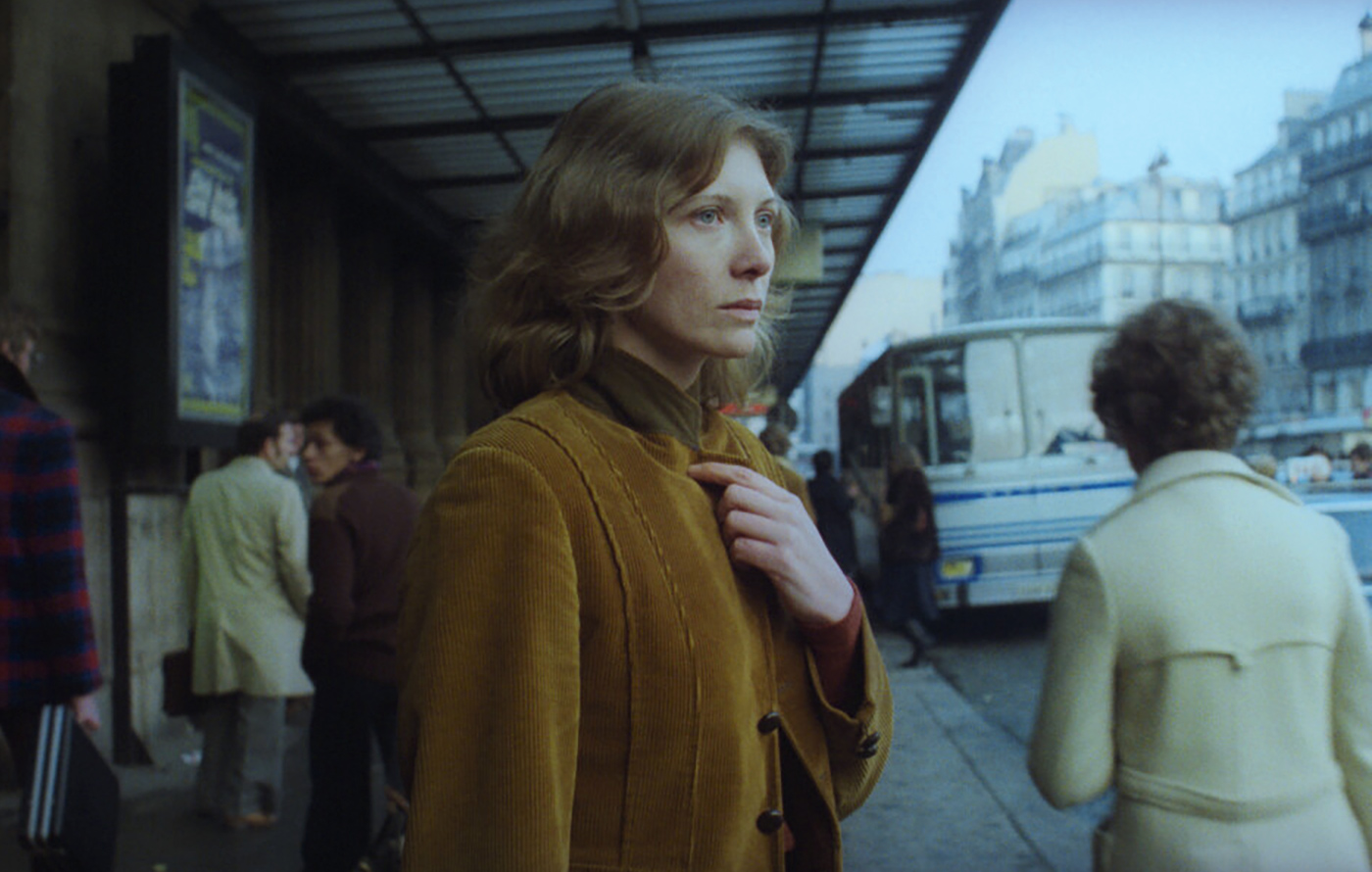
‘Les Rendez-vous d’Anna’ (1978).
The bloc de texte monologue comes into its own in her third feature film, Les Rendez-vous d’Anna (1978), which marks the first appearance of Akerman’s actrice fétiche, Aurore Clément. At times Akerman rejected biographical interpretations of the film and at other times encouraged them. It concerns a woman filmmaker, a second-generation Holocaust survivor, who, like Akerman, sometimes sleeps with women. Anna takes a train from Paris to Essen, then to Cologne, to tour her new film, but a note in Oeuvre écrite et parlée – intended for the producers and the crew – instructs that nothing in the film should ‘contribute to the myth of cinema’ but ‘the lights of a cinema going out in front of or behind her’. The film records the dead time between screenings, the half-empty hotels and odd encounters, emphasising the spaces Anna moves through: stations, trains, hotel rooms, bits of towns. After the film’s release, Akerman agreed to appear in a documentary about trains and cinema. The producers probably didn’t get what they bargained for. Akerman is shown sitting in a cart, which appears to be bumping along some train tracks (a green screen), as she free-associates:
Childhood and love are two of cinema’s big subjects. And children love trains because of the rocking motion which reminds them of their mothers. The sensual aspect of a train resembles the cinema, or when you’re close to your mother. The train is a permissive space. There are transgressive things you’d only ever do on a train that you sometimes allow yourself to do in a cinema.
She giggles when the producer asks what she is referring to. In Les Rendez-vous d’Anna, Anna changes trains in Brussels and reunites with her mother. They decide to share a hotel room. Naked in bed with her mother (played by Lea Massari, only twelve years Clément’s senior), Anna tells her in stilted detail about having slept with a woman: ‘For some reason I thought of you.’
Because Anna is only ever passing through, she has the kinds of encounter that transience makes possible. Strangers, dissatisfied with their lives, confide in her (Akerman called them ‘des Madame Bovary hommes ou femmes’). One man invites her to his young daughter’s birthday party and regales her with his life story (the history of his house, his intimacy with his wife before she left him for a Turkish man, his loneliness), which somehow merges into an account of 20th-century Germany history (‘1933 … the war … the peace … the reconstruction’). He doesn’t mention the Holocaust. Anna stands on the grass, listening, visibly cold but attentive.
In interviews for the film’s release, Akerman wondered if filmmaking hadn’t allowed her to fulfil the ‘vocation for exile’ she described Anna as having:
Since Jeanne Dielman … I’m always being invited to festivals. I always have an excuse to leave, but I can also refuse to go … I think this can be explained by my Jewish background. I don’t have a sense of belonging to the land; on the contrary, I feel that I am only attached to the ground where my feet are. And, even then, it’s often a little shaky.
Les Rendez-vous d’Anna was badly received. The French considered it overly stylised, and compromised by its production: some of the funding had come from Gaumont, which was known for its highly conventional films de scénaristes (screenwriters’ films). Godard had been badmouthing Les Rendez-vous d’Anna as ‘un film de Gaumont’ since its première, even though his Ici et ailleurs (1976) was a Gaumont production. It was a year later that Akerman first met her ‘hero’. Godard asked her to take part in a series of interviews he was conducting with other filmmakers. In the recording, he asks Akerman to describe the way she spends her time. Her seemingly innocent reply – ‘I get up early in the morning and try to write’ – triggers a series of rebukes, as Godard demands to know why she writes instead of taking photographs. ‘But in the end, won’t the film consist of taking photographs?’ Perhaps she had touched a nerve: as Chris Marker once pointed out, cinema ‘allowed Godard to be a novelist’. Even after Akerman moves on to her notion of fixed and inscribed images, Godard still wants to catch her out: he chastises her for using a word associated with writing (inscrire) to talk about cinema.
Yet Godard was one of the few filmmakers who might have understood Akerman’s predicament. He too had a fraught and changing relationship with narrative, and found himself constantly reflecting on his earlier work. Akerman liked her early films better than Godard did his, but the success of Jeanne Dielman cast a long shadow. The cult status of the film, particularly among feminists, had become so great that, decades later, her great aunt (who lived at 23 quai du Commerce) was still receiving fan mail. Whatever she did was judged through the prism of Jeanne Dielman. Akerman’s friends and collaborators have always maintained that she didn’t set out to shock audiences – whether with the murder in Jeanne Dielman or the twelve-minute lesbian sex scene in her first feature, Je, tu, il, elle (1974) – and didn’t think of her films as very radical. But she couldn’t do things by halves. If she was going to be accused of being too close to literature, or pandering to the industry, her inclination was to double down on the perceived offence.
After the commercial failure of Les Rendez-vous d’Anna, she decided that her films’ limitations were the result of her writing style. She adapted two novels by Isaac Bashevis Singer, The Manor and The Estate, both written in Yiddish, which follow several interconnected families in Poland at the end of the 19th century. She found in them the roots of ‘all the spiritual and intellectual ideas that triumphed in the modern era’, the elements of the ‘great epics of cinema, from Gone with the Wind to The Godfather’. But in Singer’s work she also felt she had uncovered what could have been her family history: the history ‘of this postwar generation whose parents threw themselves wholeheartedly into oblivion’.
Her ambition was to make two three-hour films and ‘eight or nine’ hours of television based on the novels. This wouldn’t be cheap and she knew she wouldn’t get that sort of funding in Europe. In her director’s statement she describes reading Singer’s books ‘feverishly and greedily’; hiding her copies when her friends came round in case they disappeared; dropping their titles into conversation, only to see other people’s eyes light up, too. She had obtained Singer’s blessing and even visited him in Miami. (Her account of their meetings betrays some bewilderment at his intimate questions but, as a fan, she let it go.)
In the books – and in the script written with her longtime friend and collaborator Eric de Kuyper – we can recognise Akerman’s preference for declarative sentences, for equanimity, no matter the event described, and a stable aesthetic distance from the characters. Her scripts leave out much of the material in the books and are just as concerned with love affairs and partner-swapping as with religious belief and modernity. There were problems with the process: Akerman was worried about the stories looking ‘folksy’; she didn’t like the countryside and she certainly didn’t like filming it – ‘because there are no lines’. Perhaps inevitably, the project failed. Akerman diagnosed the problem: producers in Hollywood didn’t want to give her money because they didn’t want to remember ‘that they had once been poor little Polish tailors’. They echoed what her father had told her whenever she asked about her history: ‘Enough with these old stories.’
The failure of the Singer project was especially difficult because, up until that point, Akerman had believed that she could make commercial films if she wanted to. The smaller films that came next bear traces of the Singer adaptations in their proliferation of characters and romantic entanglements. Toute une nuit (1982), a film that plays with Hollywood clichés, is harder to characterise than the earlier films, in large part because of the absence of autobiographical themes (except for the appearance of Nelly Akerman, smoking outside a house, while a voice off-screen calls ‘maman, maman, maman’). When I try to encourage people to watch it, I say that the film is like having sex and being betrayed at the same time. In Akerman’s words: ‘We dream of a dazzling feeling that will burn us, consume us. But, if this feeling conjures up an image, it looks like throwing oneself into the other person’s arms.’ The film takes place over a single sweaty summer’s night, as frustration and restlessness slip into eroticism, betrayals and impulsiveness. The colours are sumptuous, charged: midnight blues, the yellows of streetlamps, the reds of jukeboxes and low-cut evening dresses. Akerman wanted to convey what she called the ‘incestuous chain’ of desire among her small group of friends in Brussels. It couldn’t have been filmed in Paris: she wanted to capture Brussels’s straight lines; Paris, like the countryside, had too many curves.
The idea for Toute une nuit came by chance. Akerman had discovered some old notes and was interested in the form the notebook suggested: if each printed line was treated as a cut, then the prose turned into fragments. In his essay, Béghin notes that a traditional script for the film exists, but he thought it more helpful to include the lists Akerman made for it: a dialogue list, a list of attitudes (an attitude being ‘between gesture and posture, between physical action and psychological suggestion’) and a list of sequences – all with their black lines. Between two lines, a scene’s entire dialogue could be: ‘I’m hot, I’ve drunk too much. How hot it is. Why did I drink so much. Stop me from drinking. I’m scared’ or ‘What a beautiful night, why don’t we go out?/Now?/Yes! Let’s go!/Let’s go into town, let’s go dancing./Yes.’
Akerman once said that ‘everything was already there’ in her first film, Saute ma ville. As in Pierrot le fou, it ends with its character blowing herself up, and this is too often interpreted as Akerman foreshadowing her own suicide. She also referred to the film as ‘burlesque’ and Chaplinesque, and later said that it ‘bordered on the psychiatric … it was pathological.’ She knew it was a good film, although she couldn’t bear to rewatch the manic dance she performs in it. This is what had upset her about Duras’s pronouncement at Cannes: ‘I’m afraid of madness. Very afraid. I know a thing or two about it. I don’t like it. I think for Marguerite, it must have had something romantic about it. Not for me.’ In her autobiographical essay ‘Le Frigidaire est vide. On peut le remplir’, Akerman describes herself as ‘a child who doesn’t have the right to explode’, but goes on: ‘In 1984, everything changed. I sang so loudly that I exploded. Since then, I explode from time to time.’ The ‘explosion’ was a breakdown that led to a diagnosis of bipolar disorder. She didn’t directly address this in her work until much later, in 2009, in a multiple projection video installation called Maniac Summer, which included ‘images of everyday life and their destruction’. She had been inspired by a physicist’s lecture about the ‘human shadows’ created on walls in Hiroshima by radiation from the atomic bomb.
It’s unfashionable to talk about Akerman’s condition, perhaps because bipolar disorder is thought to be the preserve of psychiatry rather than psychoanalysis, and so isn’t as amenable to the type of analysis her work normally attracts. And it still feels too sensitive, even though she talked about it in interviews. But we can’t avoid the fact that, if Akerman’s is a bedroom cinema, it might well be because she spent months at a time in bed. And if it’s also a manic, joyful cinema, this might be indebted to her highs. During the prolific period that followed her breakdown, she made Letters Home, a feature-length video based on Rose Leiman Goldemberg’s play about Sylvia Plath and her mother; a review in Cahiers du cinéma praised Akerman’s ability to capture the ‘time of madness’ and the way the rhythm of the film ‘follows the meanderings of the heroine’s mind’. In the early 1990s, Akerman’s line about her process was either, ‘It took me three or four seconds. There was nothing to correct,’ or, ‘It took me four hours. There was nothing to correct.’
Although family history, Nelly’s in particular, often found its way into Akerman’s films, their starting points were usually something small, a chance encounter. In 1981, three years before her breakdown, Akerman told Jeanne Moreau that she was interested in making a comedy but felt she needed a co-writer. Moreau suggested she talk to Jean Gruault, who had co-written Jules et Jim. Akerman procrastinated, still bruised by the rejection of the Singer project, but when she finally called Gruault, ‘he spent half an hour telling me that he had bought frozen fish, because he really believes in frozen food, and with the fish he was going to make rice: a whole story like that.’ She realised they were a good match: ‘It’s exactly the kind of thing I love … because what I don’t like is when the French try to be witty, and he wasn’t trying to be witty, it was really flat humour, which suits me perfectly.’
Having previously renounced the use of music, considering it ‘pornographic’, Akerman, with Gruault’s encouragement, made the project a musical: the lyrics came to her in a flash. The song titles include ‘Puisque l’amour est plus fort que tout’, ‘Robert Camembert/La Vierge Marie’ and ‘Voilà notre Roméo’. The orchestration included synth and frantic strings; there were slow, acoustic numbers and even a muzak track. Akerman pitched Golden Eighties as a ‘tender, frenetic’ film about ‘love and commerce’, inspired by her mother, who was always ‘made-up and well dressed’. Nelly had worked in a mall, which was the perfect location for Akerman: ‘A space where everyone watches everyone else … Everything is a spectacle. Characters move like heroes … the shop windows and dressing rooms appearing like stages.’
Akerman hustled: first, she was given some Belgian money with which to make a short ‘proof of concept’; she turned this into a feature film, Les Années 80, which captured the audition process for Golden Eighties. ‘At your age, heartbreak won’t last’ are the first words spoken in the film, delivered over a black screen. The actress who speaks the line isn’t revealed, but we recognise the voice of her interlocutor, Chantal Akerman, as she offers different prompts: ‘Try a higher intonation’; ‘Not too low, not too high’; ‘You’re too inside the text: try it with your eyes closed.’
Akerman scholars haven’t always known what to make of the postmodern, kitschy Golden Eighties. It would have been easier to accept an Akerman film about love – its fantasies, its hopes and fears and disappointments – if it embraced irony or critiqued heterosexuality, or indeed capitalism. But Akerman was too much in love with her characters, even the cheating cads. No one in an Akerman film is ever mocked or caught off-guard. Golden Eighties was also the first of her works to make explicit reference to the Holocaust. Jeanne, a Holocaust survivor, is played by Delphine Seyrig. But it is the ‘flat’ (plat) humour that Akerman appreciated in her collaborator that is key to understanding the film. When Philippe Garrel interviewed her for his documentary about their generation of filmmakers, who came up after the Nouvelle Vague, Akerman’s theory of le plat was all she wanted to talk about: ‘Everything is on the same level [in Golden Eighties] and this is very much linked to a Jewish vision of the world. Catholics have heaven on one hand and earth on the other. For us [Jews], heaven touches earth … It’s a film without a hierarchy. There’s no difference between the flesh and the spirit.’ This attitude is captured in a line near the end of the film, when an older shopkeeper consoles a heartbroken Mado:
Love is like dresses, Mado. You like a dress, you think you have to have it, but maybe it’s too expensive, or else it’s beautiful but poorly made, or it’s well made, not too expensive, and on top of that it’s marvellous, but it doesn’t suit you at all. So you have to go buy another one. After all, you can’t run around naked in the street.
French critics were divided and the film was a commercial flop. On its release, Akerman told a journalist that she would like to do away with press and interviews altogether. She had, in a sense, been doing publicity for the film herself: she had managed to smuggle the theme tune into three of the short films she made for television during the period and began her interview with Garrel by humming it. A short, Family Business, commissioned for Channel 4 in 1984, sees Akerman travel to Los Angeles to track down a mythical rich uncle to fund her film. Instead, she ends up at the wrong house and is mistaken for the English language coach for a French actress, who happens to be Clément. The script they are practising is the translation of an early version of Golden Eighties: ‘Is it an American movie?’ Akerman’s character asks. ‘No, it’s a Belgian-Swiss co-production and the director wants to break in here,’ Clément replies. The rest is goofy comedy:
Clément: I never shitted on my husband.
Akerman: [correcting her] Chee-tud.
Clément: In business they say there is no one tougher than me.
Akerman: [correcting her] Tug-ger.
Gags and language games characterise Akerman’s most Jewish film: the fragmentary Histoires d’Amérique: Food, Family and Philosophy (1989). When Serge Daney asked: ‘Why now?’, Akerman replied that the Jews had spent forty years in the desert, Claude Lanzmann’s Shoah had been released forty years after the end of the war and now it was her time. She had found a book of letters sent to a Yiddish socialist newspaper in New York between 1906 and 1970, ‘a bit like when people write to Marie-Claire to get advice on their romantic problems’. In this case, it was about ‘life problems, integration problems, all kinds of problem’. She translated some of these into French and interleaved her own stories, which she said had come from her unconscious, before translating them back into English, while trying to ensure the Yiddish rhythms and cadences weren’t lost. Then she punctuated them with jokes that are far from plat – ghetto humour, misunderstanding, the comedy of self-hatred, the absurdities and hypocrisies of traditional Jewish life – because ‘we all know what jokes are: a kind of distancing technique that makes reality more palatable.’
Akerman auditioned more than a hundred people for the film, which features both amateurs and professional actors (including Judith Malina from the Living Theatre and Eszter Balint, who’d appeared in Jim Jarmusch’s Stranger than Paradise). It was shot on a neglected plot of land under the Williamsburg Bridge, where the lighting made the characters look like ghosts. Akerman was more relaxed in her direction than usual, and was even charmed by interpretations of the text which were far from what she had envisioned and might not be considered well acted. A stray note about this appears in the script and is included in Oeuvre écrite et parlée: ‘Claudia … changed the punctuation, reading some sentences very quickly, without any apparent logic, provoking an emotion I hadn’t imagined.’
The long opening sequence is shot from a boat approaching Manhattan by night: a radically different view from the one immigrants would have encountered, but the same ocean. As the vessel approaches land and the city’s skyscrapers loom overhead, Akerman, in a voiceover, reads a story which also appears in Gershom Scholem’s Major Trends in Jewish Mysticism:
A rabbi always passed through a village to get to the forest and there, at the foot of a tree, and it was always the same one, he began to pray, and God heard him.
His son too always passed through the same village, to get to the forest, but he could not remember where the tree was, so he prayed at the foot of any old tree, and God heard him.
His grandson did not know where the tree was, nor the forest, so he went to pray in the village, and God heard him.
His great-grandson didn’t know where the tree was, nor the forest, nor even the village, but he still knew the words of the prayer, so he prayed in his house, and God heard him.
She adds: ‘My own history is full of holes, full of blanks and I don’t even have a child.’
Rewatching Akerman’s short film Lettre de cinéaste, I realised that the line I had remembered from the start – ‘If I make films, it’s because I didn’t dare take up the challenge of writing’ – is not the first thing we hear. I had missed what the script records as a ‘prière juive’. In the film, over a black screen, we hear Akerman say: ‘And God arrived. We couldn’t see Him; He was behind a cloud in a country whose name we didn’t know.’ She goes on to read the words of the Second Commandment in a childlike, breathless voice: ‘I am your Eternal God, and you will honour me. You shall not make for yourself an image, or any likeness of what is in the heavens above, or on the earth below, or in the waters under the earth.’ Akerman often expressed anxieties about image-making and idolatry, but, by the time of Histoires d’Amérique, she had reached a sort of conclusion:
I think that by creating frontal images the way I do, I make way for God somehow. I’m embarrassed to say this because it’s such a huge statement. I feel that with the type of images I create [there is] a relationship between one person and another. I am facing the person. The person who goes to the cinema and is facing me. It’s not a relationship where I take someone by surprise.
Godard, by contrast, believed that ‘when you go to the cinema, you look up.’
Akerman entered the art world with a commission: in 1990, she was asked to make an installation about ‘the coming together of the European Community’ after the fall of the Berlin Wall. Instead, she went looking for the cracks, proposing to examine ‘what was left out of this union … and the concomitant rise of nationalism and antisemitism’, and accepting on the condition that she would also be allowed to make a feature-length film with the material: this became her ethnographic, experimental documentary D’Est (1993). In her director’s statement, included in Oeuvre écrite et parlée, she sets out her plan to shoot ‘everything that touches me’ in ‘my usual way: documentary bordering on fiction’. The statement also records Akerman’s characteristic anxieties about falling into traps: it’s as though by writing them down, she can protect against them. The text is palpably anxious, characterised by long sentences that double back on themselves. She was aware that she was witnessing a great historical transformation, but didn’t want to accept the imposed binary of ‘before’ and ‘after’. ‘The perversion was already there,’ she argued, ‘in the existence of these two blocs, which were not as contradictory as they seemed at first glance.’
D’Est is a record of urban and rural landscapes (it was the first time Akerman had filmed the countryside) as well as public and domestic spaces. The film begins in East Germany at the end of summer and finishes in Moscow in deep winter. In between are Poland, Lithuania, Belarus, Moldova and Ukraine, but there is almost nothing to ground the viewer in any particular location, bar the odd sign for a biergarten or a glimpse of Cyrillic. Cultural cross-contamination is the point. In the director’s statement, Akerman listed the things she thought might touch her, including: ‘stations and plains, rivers or seas, streams and brooks, trees and forests. Fields and factories and more faces, food, interiors, doors, windows, the preparation of meals’. Viewers might cling to background voices as a way of anchoring themselves in place, but the voices (which are never subtitled) are often drowned out and anyhow the sound becomes out of sync with the footage around half an hour in. For the sections filmed from the road, Akerman mounted her 16mm camera on top of the type of car used by Communist Party officials. In a scene at a Moscow bus stop, captured in one of Akerman’s characteristic long, slow pans, a group stands waiting, some in fur coats, others in puffa jackets, some wearing budenovkas and ushankas, others woolly hats. The car and camera seem to raise little suspicion, and even a couple of half-smiles. According to Anne Eakin Moss they are saying: ‘Look – they’re photographing.’ ‘Are you satisfied? What is this? Two hours and no bus.’ ‘So you’re taking a picture of this mess, huh?’
The film’s limpid syntax and lack of establishing frames lent themselves well to the installation format: eight pillars with three television monitors mounted on each. A 25th monitor stands on the floor, either in the same or a different room, depending on the gallery. It’s easily missed. Over a hard to decipher image, Kol Nidre – which begins the Yom Kippur service – can be heard on the cello. First in Hebrew, then in French, then in English, Akerman reads a text, which begins with the Second Commandment, and then: ‘Writing a film before even knowing it. Writing to close it off. Writing the letter to the father. From Kazimierz on the Vistula.’ Is she talking about the work of filmmaking, of the texts she writes to raise funds (which populate Oeuvre écrite et parlée), or of her fear of determining in advance a form of non-fiction whose chance aspects were precisely what she sought? The ‘letter to the father’ might be a reference to Kafka (she loved his letters, which were published in French as Lettre au père), but it could also be a response to Godard. The last two paragraphs go like this:
Yesterday, today and tomorrow, there have been, there will be, there are even now, people whom history, which no longer even has a capital H, has struck down, and who wait there, herded together, to be killed, beaten or starved, or who walk without knowing where they are going, in groups or alone.
There’s nothing to be done, it’s obsessive and it obsesses me. Despite the cello, despite cinema. When the film was finished, I said to myself, that’s what it was: once again, that.
I saw the installation in Paris more than a year into the genocide in Gaza. The images conjured by ‘herded, killed, beaten, starved’ weren’t abstract. I asked myself whether Akerman would have allowed for this comparison. Her later documentaries, Sud (1999, filmed in Jasper, Texas, following the lynching of James Byrd Jr and inspired by her reading of James Baldwin) and De l’autre côté (2002, filmed in Agua Prieta and Douglas, on either side of the US-Mexico border), use the same formal strategies as D’Est. If, in Europe, there were ‘murders or even genocides because of or in the name of an excess of history: history of territory and land, race, religion’, in America, a ‘lack of history, past, culture, or the vague memory of a culture, of a place they had left to go elsewhere, where it was big, new, where it was elsewhere, has also led them to eliminate what bothers them.’ In all three films, Akerman held shots for a long time, as a way, she said, of inducing ‘a bit of truth’. She described the tree that becomes a focal point in Sud:
And then a tree. If it’s filmed in the American South and it’s been there for a certain amount of time, then you might recall that in this same South, not so long ago, they hanged men and women.
The song ‘Strange Fruit’ might come into your head, sung – again, not so long ago – by a singer whose name was and still is Billie Holiday.
In the same South, you might also look at an empty, humming cotton field.
And, again, it’s difficult, if you look at it for a certain amount of time, not to remember the Black slaves who laboured there not so long again, under the yoke of their white owners.
But truth was never straightforward for Akerman. Cause and effect were often blurry. In a text written before production, she says that she was drawn to the Mexican border story because she had read quotes from Arizonans talking about illegal immigrants using the words ‘dirt’ and ‘invasion’, which made her think of Nazi propaganda. When her mother watched some of the rushes on the editing table, she saw a shot (that didn’t end up in the final film) of a hole in the ground and asked her daughter: ‘Doesn’t that remind you of anything?’ Akerman was struck that she hadn’t thought of the camps and their mass graves during the shoot.
Around the same time, Nelly collaborated on Demain on déménage (2004), a burlesque comedy about a woman (Sylvie Testud) who lives with, and sometimes shares a bed with, her Holocaust survivor mother, played by Clément. The signifiers in this film are sensory: the smell of burned chicken and disinfectant (which, in the script, reminds the mother of ‘the smell of Poland in the 1940s’). The film contains a scene in which the daughter asks her mother to read from her grandmother’s diary: this was Nelly’s mother’s real diary, which Akerman had rediscovered as an adult. A behind-the-scenes documentary shows Nelly translating the diary from Polish and explaining to Clément the way it should be read. ‘This isn’t cinema,’ Nelly says of the scene. ‘It’s truth. And it becomes cinema.’
People sometimes ask me whether Akerman was a Zionist. My responses sound to me like equivocation: sometimes I describe her as a liberal Zionist, while believing this to be an oxymoron; sometimes I stress her almost constant adoption of her mother’s perspective and her intense concern for her mother’s welfare (Nelly said that Israel was the only place she didn’t ‘cling to the walls’ and could ‘walk in the middle of the street’); sometimes I emphasise her celebration of the diaspora and her ‘maternal language’, Yiddish, which the Zionist movement tried to stamp out. I tell people to watch Là-bas (2006), the film that Akerman made in Israel, describing it as ‘ambivalent’, while putting off rewatching it myself. (The English title is Down There, but a better title might be Over There, since ‘Là-bas’ was the oblique epithet Nelly used for the camps.) In some quarters of the internet Akerman has been ‘cancelled’, while in others the question of her Zionism is avoided for fear of uncovering something that would undermine the politics we associate with her. Akerman herself was curious about the ‘other’: she had learned the concept and the ethic when she went to see Levinas analysing the weekly Torah portion. Through these lectures, she developed ‘the art of questioning and contradicting’, as she called it, that runs through Oeuvre écrite et parlée. She wanted ‘less idolatry in this idolatrous world’, and might not have been pleased by her lionisation either.
When the producer Xavier Carniaux asked Akerman to make a film about Israel, she at first refused, considering it ‘impossible’ and ‘paralysing’. In her director’s statement she describes her ‘fear of burning my fingers and reason, fear of the pitfalls of subjectivity, but that was all I had, my subjectivity … neutrality doesn’t exist.’ She knew it would be unpopular. The statement is long and sprawling, but the ambivalence of Là-bas is there, as is my sense that her Zionism was a pathological mental state:
I feel so disconnected that I can’t even manage to keep a house with bread, butter, coffee, milk, toilet paper. And when I buy them, I feel like I’m performing a heroic act. Basically, I don’t know how to live. Or go anywhere. When I take the bus, it’s also an act of heroism. And all of this has to do with that. With Israel, or not Israel. Of course, not the real Israel. With an Israel where, all of a sudden, I would belong.
In Là-bas, these words are spoken in voiceover. Most of the film, shot on a low-quality digital camera, takes place inside an apartment in Tel Aviv: the semi-transparent blinds divide up and obscure the view of the apartments and balconies opposite (again, her preferred straight lines). There is nothing in the image to tell us we are in Israel. Là-bas is rare in Akerman’s work for not looking at its subjects head on; its long takes are not given a chance of inducing a ‘bit of truth’.
The chronology and scope of Oeuvre écrite et parlée allows us to trace Akerman’s changing relationship to Zionism. In the 1970s, when her existence was, by choice, nomadic, Akerman spoke about Israel as a ‘collage … a copy, which doesn’t work for the majority of Jews’. In the late 1980s, she told Daney: ‘To create this state, it was necessary … to exchange “being” for “having” … It was still about finding a place that wasn’t completely our own, but where we could have peace. But in Israel, we don’t have peace, we have war.’ In 1992, Akerman wrote her first play, Hall de nuit, which included an Algerian Muslim character. A couple of other unrealised scripts include Arab characters, and one takes place in Tunisia.
In the mid-1990s, after travelling to Israel, Palestine, Lebanon, Jordan and Syria in an attempt to ‘see through an Orientalism that has almost rendered the East superfluous as a real thing’, she wrote a director’s statement for Du Moyen-Orient, a continuation of the D’Est project. This time, her words exhibited greater awareness of the paranoid European unconscious: ‘When we touch on the Middle East, we feel that we are also touching on the underground forces that clash and stir both in our society and within ourselves.’ The text confronts her personal history: she remembers, as a child at her Jewish school and after the Suez Crisis, being ‘taught to have an enemy’. She writes that she doesn’t want to focus on the desert, which she thinks would almost be a contravention of ‘you shall not make for yourself an image, or any likeness.’
Yet this is where No Home Movie (2015) begins: with a seven-minute shot, from the middle distance at which she shot most of her protagonists, of a tree in the desert being battered by wind. Akerman’s film editor Claire Atherton has said that its inclusion was unplanned and, in response to requests for an explanation of the tree’s prominence, replied that Akerman wasn’t that kind of rhetorical or conceptual filmmaker. This has not prevented others from according it symbolic value: the tree is dying, as Akerman’s mother was at the time, or it’s about to be déraciné, as Akerman will be on Nelly’s death (she killed herself eighteen months later). Akerman refused to name the desert – it appears on five different screens in her final installation, Now – for the same reason she didn’t want to reveal whether a shot from D’Est was filmed in Lithuania or Poland. But it is, of course, the Naqab. The final text in Volume 2 of Oeuvre écrite et parlée is a director’s statement for a non-fiction film called Lod that would have focused on a Russian immigrant to Lod/al-Lidd and her difficulties integrating into the city with the highest crime rate in Israel (Akerman compares it to Clichy-sous-Bois during the 2005 riots), the site of massacres in 1948. Claire Denis recalled a plan Akerman had, no doubt in a period of mania, to build a tunnel from Russia to Israel, imagining that mass Russian immigration to Israel would swing the polls to the left and solve Israel’s problems.
In 2004, Akerman was asked to write an autobiographical essay for the retrospective of her work at the Pompidou. The text of ‘Le Frigidaire est vide’ is in part a document of her struggle to write it. It begins with the voice of the film industry:
People tell me, it would be good for the reader, for the viewer, to have a hint or a whisper as to why you began with a tragicomedy in which you play yourself.
Then why you seemingly turned your back on all of that, and went on to make more experimental, silent films.
Why, having barely finished a film on the other side of the ocean, you returned to France and to narrative.
Why you no longer act and decided to make a musical comedy.
Why you made a series of documentaries and then decide to adapt Proust.
Among these films were stranger films, films that don’t correspond with the Akerman we think we know, films that never got off the ground. Critics and fans couldn’t understand why Akerman had compromised her sensibility with the Franco-American apartment swap rom-com, A Couch in New York (1996), which she said she made to show her father she could make money. In Contre-chant érotique (2000), an unrealised short film, Thomas tells his friend of his affair with a woman called Jeanne. In a flashback (unusual for Akerman), we see Jeanne making the first move: going up to Thomas’s table in a restaurant, kissing his hand, then his fingers, and then putting them in her mouth. It is hard to imagine a gesture like this in an Akerman film, where intimacy is usually conveyed by allusion. Thomas takes Jeanne to her apartment, where they have sex. She disappears for a few days, but then he arrives home one night to find her naked and asleep in his bed. He kisses her all over, moves her arm, opens her legs and lays his head on her pubis; she remains asleep. He puts his face to her vagina and smells her. As Thomas penetrates her, Jeanne opens her eyes and orgasms. In the present day, Thomas’s friend asks if he would have carried on had she not woken up; he says he thinks he would. Jeanne disappears again for a few days, until, one night, he thinks he hears her enter his apartment. Is it really her or just a fantasy? Now, it’s Thomas’s turn: he pretends to sleep, his eyes flickering as he tries to watch her undress. She inserts his hard penis inside her. Like her, he opens his eyes only when he orgasms. This continues for nights on end, until, one day, Jeanne enters his apartment to find he’s still awake. They have a coffee in the kitchen and make small talk. It isn’t at all the same thing.
In Nuit et jour (1991), a small, clever film at the commercial end of Akerman’s range, Jack and Julie have sex half-asleep, but that is because Jack, who works nights as a cab driver, has made a pact never to sleep, so that he can spend his days in the domestic cocoon he has created with her. Besides, the narrator (voiced by Akerman) tells us, ‘he slept a lot as a child so now he has some sleep saved up.’ They never tire of having sex and need no other sustenance: nothing interrupts their intimacy. Julie has also vowed never to sleep and spends her nights walking around Paris until she can reunite with Jack. One day, the day driver offers to drop the taxi at Jack’s house in the morning, which gives him an extra half-hour with Julie. The effect is similar to that in Jeanne Dielman, when Jeanne wakes too early. Julie walks Jack to the cab, where she meets the day driver, Joseph. Julie will now spend her nights in hotel rooms with Joseph. One night, she falls asleep. The narrator says: ‘It was the first time he had seen her sleep’. The camera follows Joseph’s head as he moves down to her crotch and parts her legs, and tracks up his body as he penetrates her (this shot, in an Akerman film!). She opens her eyes, gasps. Day has broken, and she must hurry back to Jack. In one of Akerman’s most overtly feminist conclusions, Julie leaves the two men; the film ends as she walks through a bustling Paris, this time in daylight. Akerman called Nuit et Jour ‘a thoroughly moral film about an amoral story’.
La Captive (2000) was ‘an obsessive film about an obsession’. In an early scene, Simon climbs onto the bed where his girlfriend, Ariane, is sleeping: first moving her arm then, when she doesn’t stir, kissing her and moving across to embrace her from behind. He thrusts his crotch against her; she moves in rhythm with him, her eyes still closed. It doesn’t take him long to orgasm and, after he does, she seems to be in the throes of her own unconscious pleasure. But, when a name leaves her mouth, it isn’t his: ‘Andrée’ is the female friend we met in an earlier scene. In Proust’s original, the climax is described only as a ‘breathless ecstasy of pleasure’. Ariane is Albertine; Simon is the narrator, Marcel. Decades earlier, speaking against literary adaptations, Duras had asked how ‘the defined face of Albertine [could] ever replicate the magic of the undefined face of Albertine in Proust’s novels’? While raising money for the film, Akerman didn’t tell anyone that it was an adaptation of Proust, and no one guessed; Akerman and her co-writer, Eric de Kuyper, did away with most of the other characters and wrote from their memories of the text, before rereading the book with ‘the floating attention of a psychoanalyst’ and adjusting the script. Perhaps financers would have realised had Akerman used the word ‘jealousy’, but in talking about the project she spoke only of ‘obsession’.
But how to give it a form? The sound of footsteps was one way, and the image of Simon’s black brogues at a safe distance behind Ariane’s high heels as he tries to discover what she’s getting up to with her women friends. La Captive’s form is fairly conventional, which partly explains its commercial and critical success: there are point-of-view shots and the viewer is never unsure about whose perspective she is occupying. Scholars have wondered why Akerman chose the perspective of Simon/Marcel over that of Ariane/Albertine. Some have argued that she was interested in interrogating lesbian desire from the outside or that she perhaps wished to draw attention to the tantalising mystique of womankind. But like those other, strange films that question how two people can coexist, this film asks who is captive here? Akerman knew that Sylvie Testud, who plays Ariane with an airy opacity, was right for the role when she said: ‘Ariane is an independent woman.’
A couple of years before she died, Akerman was invited by a Proust scholar to give a talk at the Collège de France. The video is available on YouTube, and, although we never get the reverse shot, it’s clear, from the volume of laughter, that the lecture hall is full. The professor is wearing a suit, has a clipboard of questions on the desk and a pen in his hand; Akerman is wearing a white shirt and blazer, but has sunglasses on her head and is empty-handed, save for her phone, which rings during the session. The students are laughing because Akerman is an amazing performer. I’m an autodidact, she says at one point. I don’t know Proust, she says at another. ‘Help me out,’ she keeps saying to the scholar; but, before he can answer, she’s off again. She suggests what Proust could have done better, before adding ‘mais ce n’est pas grave.’ The scholar’s only defence is to say that the novel was an unfinished, posthumously published work. ‘You mean, he could have done with one more month to work on it?’ she asks. It’s as if she’s acting out her school years: slouching on the desk, gesturing wildly. By the time she’s finished talking, she has already rendered the scholar’s questions redundant, usually by negating them. Of course, Akerman is talking about her own Proust: she embraces herself as she says that she sees Marcel as her little brother, while Albertine is her, ‘une femme libre’. ‘Proust talks about “time regained” and all of my work is about time, but unfortunately it’s about lost time,’ she says, at one point, making a pantomime sad face. The audience laughs again. She explains that she recognised in the book the prison her mother had constructed for herself, and that she, in turn, was her mother’s prisoner. Everything is there, it seems, in La Captive and in this talk, and the students have never experienced anything like it. She even tells them the name she gives its form, a word that appears as an adjective, verb and noun throughout these volumes, the epithet her father gave her when he told her ‘enough with these old stories’, which she latterly reclaimed: ressassement – a ‘turning over’, a ‘mulling over’, a ‘rehashing’, a ‘persistent return’.