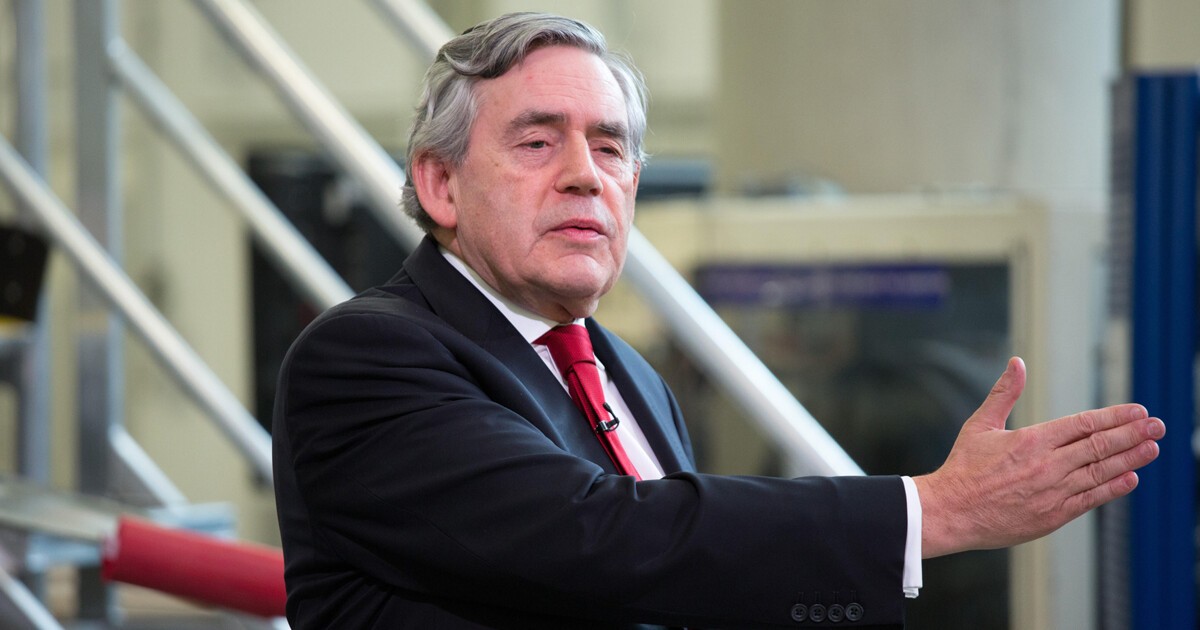
In August 2007, two months into Gordon Brown’s premiership, two-thirds of voters approved of his performance: one of the highest rates of satisfaction for any prime minister over the last twenty years. Labour was well ahead of the Conservatives in the polls. The Tory leader, David Cameron, was in a difficult phase, no longer a fresh figure after a year and a half in charge, and facing growing internal opposition to his liberalisation strategy. Brown, long regarded at Westminster and by the media as a ruthless operator, was widely expected to call a general election to take advantage.
The following month, with that expectation even stronger, I ran into a pro-Labour political journalist at a London bus stop. He had just come back from the party’s annual conference, and his usual low-key manner was replaced by something approaching excitement. Labour people at conference had insisted an election was coming, he said, and they expected to win. They also expected this result to prompt a Tory split – liberal Cameroons on one side, reactionary Conservatives on the other – which would extend Labour’s time in office even further. The party had already been in power for a decade, thanks in large part to Brown’s extended, generally acclaimed tenure as chancellor, and it seemed perfectly possible that this dominance would continue. As had been the case during stretches of the 1940s, 1960s and 1970s, centre-left government seemed to be becoming Britain’s natural state.
Things didn’t work out like that. Brown decided not to call an election and only a few weeks later his approval ratings collapsed and never fully recovered. His premiership lasted less than three years. Rather than a continuation of Britain’s run of relatively long and stable governments since the 1980s, Brown’s administration was the start of something else: a period when prime ministers quickly and consistently went from being seen as national saviours to being hated. It’s a period we are still in.
At the 2010 election, Labour received one of its worst vote shares since the Second World War. For four years after this humiliating defeat, Brown largely retreated from public life, ‘very down and down on himself’, according to an old friend quoted by James Macintyre in this well-sourced biography. He spent most of this period at home, a detached Victorian house in North Queensferry, a village looking across the dark waters of the Firth of Forth towards Edinburgh, where his political career had begun. He said and wrote little for public consumption about the reasons his administration had failed, after seeming to start so well. Journalists and voters turned their attention to the Tory-Liberal Democrat coalition, while his own party moved away from Brownite politics, under a new, much younger and less brooding leader, Ed Miliband. Brown’s premiership was left as a bit of a mystery: an example of formidable talent, experience and hard work somehow not being enough; and of a politician highly successful at reducing poverty nevertheless failing to connect with many of the beneficiaries of his policies. Like Barack Obama, another centre-left leader with a seductively rich voice and extensive powers of oratory, in office Brown was a disappointment to many of his admirers. In 2015 he retired from Parliament.
Since then, despite his government’s grey, opaque quality, his reputation has gradually but substantially recovered. By 2024, Macintyre writes, ‘the polling company YouGov reported … that Brown was the most popular of all [living] Labour politicians … above, for example, Andy Burnham … Ed Miliband, Tony Blair and Keir Starmer.’ According to Macintyre, a political journalist of long experience, he is ‘also probably the most respected of the eight currently living former prime ministers’. It’s not all that difficult to come top in a popularity league table that includes Liz Truss, Boris Johnson, the only slightly less discredited Cameron and the still intensely divisive Blair, Brown’s former close comrade and then bitter rival. Yet, at the age of 75, Brown has regained much of the credibility and moral authority, even mystique, he built up during his relentless rise through Labour politics from the early 1970s. Some of this recovery is a matter of personal integrity. While many Westminster politicians find irresistible the opportunities offered to them by calculating rich people, an unnamed Labour MP tells the author that ‘I have never met anyone less interested in money than Gordon Brown.’ Macintyre says that he ‘accepted no gifts while in office, declined his prime ministerial pension, paid his own way with suits, spectacles and decorating through his time in Downing Street and left office in considerable debt as a result’. It’s not the only time in the book that Starmer’s premiership, which began with many people hoping he would be a figure of Brown-like probity, suffers by comparison.
Since the mid-2010s, Brown has also become a prominent campaigner: against Scottish independence, the two-child benefit cap and the continuing official silence around much of the Jeffrey Epstein scandal; for the restoration of pensioners’ winter fuel allowance, global improvements in health and education, and closer co-operation between governments to deal with international crises. You don’t have to agree with all of his causes, or believe they are practical, to accept that he has become a significant public figure again, making widely reported speeches, writing energetically researched and argued reports and articles, and arm-twisting Starmer’s ministers. Unlike many veterans of New Labour, one of the most unrepentant cohorts in British politics, he seems to have become more open-minded. Once one of Westminster’s most renowned bearers of grudges, he now sometimes takes part in respectful online discussions with former enemies such as John McDonnell, who stood against him for the Labour leadership in 2007.
This relatively short biography devotes four chapters to Brown’s life after Downing Street. Here, as throughout the book, the tone is occasionally critical but essentially admiring. ‘During his ten years as chancellor and his three as prime minister,’ Macintyre writes, ‘he could be difficult, obstructive and needlessly suspicious … But Brown … pursued power for a purpose’ and is ‘more than due a reappraisal … Talking to people away from Westminster, there appears to be a thirst for the kind of substance that Brown represents.’ New Labour sources dominate the text, and are frequently quoted at length, while those who have perceptively criticised Brown from the Labour left, such as McDonnell, barely feature. Brown’s former adviser, minister and key ally Ed Balls appears constantly, either giving detailed, sometimes fascinating but largely unchallenged accounts of his old boss’s policy decisions, battles with Blair and more ambiguous Westminster manoeuvres, or providing summaries of Brown’s unique qualities that could come from a party political broadcast:
The thing which is distinctive about Gordon was that he didn’t see being a politician … as an end in itself, [but] as an opportunity to do things in government at the highest level, things which had been his purpose for all his life … [such as] tackling poverty, or investing in the NHS or being tough with the public finances …
Even Blair, who, as well as falling out with Brown in government, has moved a long way to his right since then, contributes a half-page paean to Brown’s ‘extraordinary intellect’ and knowledge of Labour and Westminster politics. ‘I learned an enormous amount from him,’ Blair says, including ‘how to make a [party] conference speech’. Later in the book, he adds: ‘We used to have fun together. I mean, Gordon, he has got his very serious side, but he can be immensely entertaining company.’
Brown is also quoted several times, but fortunately his statements are less upbeat and more revealing than those of his former comrades. About his brief competition with Blair for the Labour leadership after John Smith died suddenly in 1994, Brown says with raw terseness: ‘Well, [Blair] was entitled to run of course if he wanted to, but … he essentially tried to gazump me.’ The story of how Blair came to replace Brown as Smith’s successor, and then made Brown wait much longer than he wanted or expected to become prime minister, has been told many times, and Macintyre’s version, while clear and balanced, adds little. It also misses a chance to reflect on how much British politics has changed since one Labour prodigy could promise another that, in Brown’s words, he ‘would give me control of economic and social policy and would stand down during a second term’. In today’s more economically troubled and volatile country, the ambitions of chancellors are more modest, and the lifespans of governments and prime ministers a lot shorter.
In some ways Brown used the slower, more predictable pace of politics during the 1990s and 2000s well. More of a planner and an implementer than an improviser, he oversaw economic growth per capita between 1997 and 2010 which exceeded that of France, Germany and the United States – and far exceeds Britain’s feeble growth rate since then. He almost halved the number of children living in poverty, and after his administration the elderly were no longer poorer on average than other Britons. He pushed through his own preferred anti-poverty measures, such as tax credits for the low-paid, and encouraged civil servants to come up with their own. There is a great quote here from an official in the Department for Work and Pensions: ‘If you want to get Gordon to sign off on something it’s a good idea to stick a chart on the front showing the big gain going to the poorest 10 per cent.’
Brown wasn’t always keen for the egalitarian consequences of his policies to be advertised. Like Blair and New Labour generally, he feared both the right-wing press and the harsh assumptions of many voters that these papers helped form and sustain. While Macintyre says that Brown is an ‘admirer’ of the Marxist theorist Antonio Gramsci, he did not seem to believe, even when he was arguably the most powerful person in Britain in the late 1990s and early 2000s, steering Labour’s domestic policy, that the ‘common sense’ which underlay public opinion and political discourse could be challenged and altered. In 1999 Brown was furious with the journalist Robert Peston for describing that year’s Budget as ‘seriously redistributive’ in the Financial Times. ‘Why did you write that?’ he asked Peston. ‘It was profoundly unhelpful.’ This anxious refusal to make the case for a more equal country meant that when Labour lost power, many of its most progressive reforms could be reversed relatively easily, because not enough voters understood or supported their rationale. Earlier Labour governments, such as Clement Attlee’s in the late 1940s, had not made that mistake, promoting projects such as large-scale council house building and the new NHS so effectively that their Conservative successors were forced to continue with them. According to Macintyre and many of his sources, Brown has an encyclopedic knowledge of Labour history. But in government some of its most important lessons appeared to elude him.
As chancellor, a fatal conservatism also shaped his approach to Britain’s oversized and destabilising financial services industry. In opposition, he had spent years wooing the City of London in what journalists called the ‘prawn cocktail offensive’, which Macintyre doesn’t mention. One motivation was to persuade bankers that a Labour government would be sensible, in the City’s self-interested terms, which essentially meant it wouldn’t impose new regulations on the banks’ ever riskier activities. Brown thought the financial sector was crucial to economic growth, and to the extra tax revenue New Labour would need to reduce poverty and repair public services, run down by almost two decades of Tory rule. Yet mixed in with this pragmatic appeasement of the City was an admiration, which only grew once Brown was in government. In a typical speech to a City audience in June 2002, he thanked his audience for allowing London to maintain
its position among the world’s top financial centres … The importance that the City attaches to integrity and the highest standards in the provision of financial services is [one of] the enduring means [of achieving this position] … As the world economy has opened up, you have succeeded not by sheltering your share of a small protected national market but by striving for a greater and greater share of the growing global market … You have embraced technological innovation … transformed the skills of your workforces … What you, as the City of London, have achieved for financial services we, as a government, now aspire to achieve for the whole economy.
Five years later, the financial crisis began. Rather than being a model for the rest of the economy, the City’s practices had plunged it into recession, and ruined the government’s finances and New Labour’s reputation for successful economic management. Luck is important in politics, and Brown, who had recently, finally, become prime minister, took the blame rather than Blair, who was even more of an enthusiast for lightly regulated capitalism but had conveniently left the Commons by the time the crisis started. Brown then played a central role in the international effort that prevented the crisis becoming a global meltdown. Macintyre makes much of this demonstration of Brown’s brainpower and summitry skills – it also provided a rare instance of effective political improvisation on his part. Less astutely, Brown brought Peter Mandelson back into the cabinet, despite their volatile relationship and Mandelon’s history of personal scandals. As political correspondent for the New Statesman, Macintyre was one of the facilitators of this ‘imaginative move’, he tells us, a role that looks less impressive now, with the allegations that Mandelson leaked important Brown government material to Epstein, than it perhaps did when this book went to press.
Macintyre does not consider whether the financial crisis was also a domestic political opportunity which Brown failed to grasp. Had he punished, or just loudly criticised, some of the guilty bankers – however cynically, given his previous enthusiasm – he might have saved his premiership. Instead, in April 2009, he made a single, coded reference in a speech to the way the crisis had discredited free-market capitalism – ‘the Washington consensus is over’ – which only those fluent in the jargon of globalisation could understand. The public anger about greed in the City and other institutions that had been profiteering recklessly and at huge social cost for a quarter of a century, since the free-market reforms of Margaret Thatcher, remained unaddressed, as it still is – with the fleeting exceptions of brief forays during the Labour leaderships of Miliband and Jeremy Corbyn. As the recently elected Green MP for Gorton and Denton, Hannah Spencer, put it in her victory speech, ‘Instead of working for a nice life, we’re working to line the pockets of billionaires.’ Labour lost this safe seat, as it lost many under Brown, partly because, unlike the Greens now, it would not or could not make a left-wing populist case for an economic reset.
Why could someone as clever, intellectually curious and socially conscious as Brown not see that British capitalism needed reform? Again, the book avoids the issue. But perhaps one part of the answer is that there’s no evidence here of Brown engaging with left-wing thinkers, Gramsci aside. As is usual in studies of Brown, the book mentions that in 1975, as a 24-year-old, he edited a collection of socialist essays called The Red Paper on Scotland. There, he wrote that it had become ‘increasingly impossible to manage the economy both for private profit and the needs of society as a whole’ and that the only way out of this dilemma was ‘a massive and irreversible shift of power to working people’ and ‘free universal welfare services controlled by the people who use them’. The first solution was also proposed by Tony Benn during the 1970s and 1980s, and the second by Corbyn and McDonnell during their brief ascendancy in the 2010s.
However, Macintyre shows that Brown’s radical phase didn’t last long. By the late 1970s, he had become a defender of the relatively right-wing Labour chancellor Denis Healey – a steamroller of an orator and a fast learner in a crisis, who could be seen as a Brown role model. As a precocious new MP during the 1984-85 miners’ strike, Brown was unimpressed by the leadership of the left-wing veteran Arthur Scargill – because Scargill ‘turned the dispute into a political strike personalised around himself’ – yet typically also gave the strikers practical help. His constituency, Dunfermline East, was in an old mining area, and workers from striking pits elsewhere in Fife still lived there. ‘There were ten strike centres locally,’ Brown told Macintyre, ‘and most Fridays I visited them to give whatever financial help I could. There was grinding hardship such that I had never seen before.’
This is an interesting admission, given that Brown had grown up in Fife surrounded by industrial decline and unemployment, as the local mines and linoleum factories closed during the 1960s. Friends he made at school had to move to England so their fathers could look for new jobs. Brown’s own father, a Church of Scotland minister and a huge influence on him, had also worked with poor families in Glasgow. The impression this biography gives of Brown’s lifelong preoccupation with poverty is that it has always been more moral than political. His father, despite his strong social conscience, was private about his own politics. This unideological upbringing perhaps begins to explain why Brown has achieved so much as a legislator and campaigner against deprivation, and yet has done relatively little to alter the economic structures and forces that produce poverty in the first place. In Britain as in other starkly unequal countries, standing up for the economy’s losers with eloquence and purpose can make you a revered figure. The less popular political task is taking on the winners.