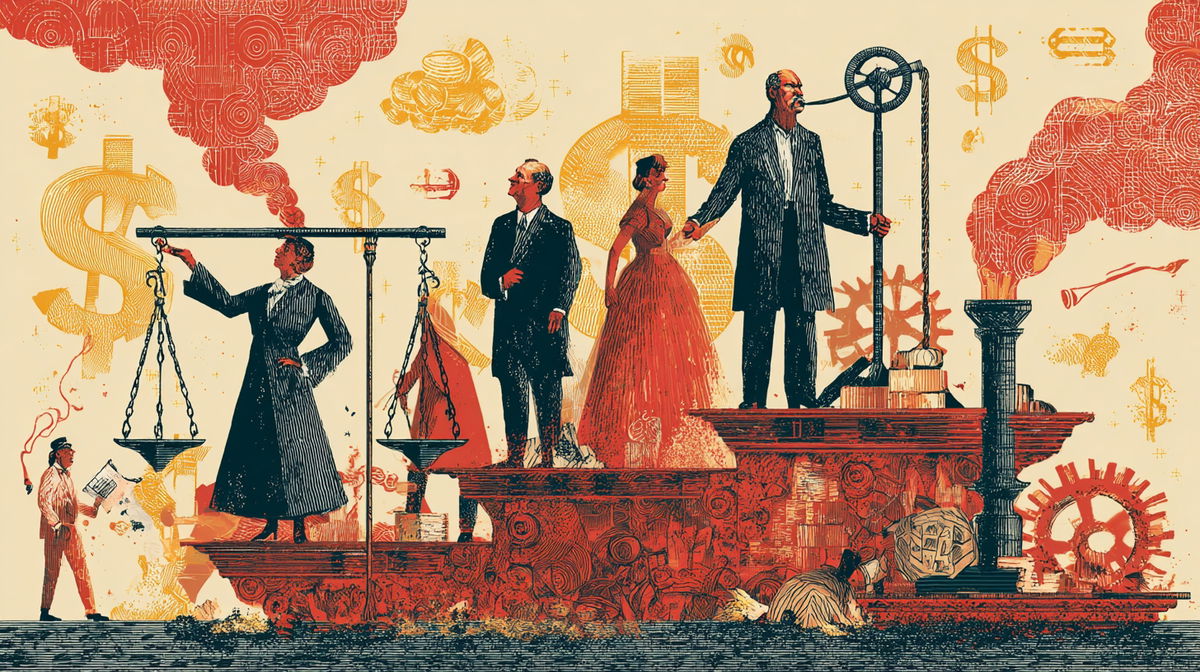
- Epstein as symptom, not cause: The scandal reflects a political economy where extreme inequality enables elites to operate above accountability — Epstein’s world of private islands and lavish parties was the ultimate expression of status consumption in an unequal society.
- Rentier capitalism at the root: The shift from wealth creation to wealth extraction — through accounting tricks, tax havens, and political lobbying — creates and maintains the inequality that allowed figures like Epstein to thrive.
- Systemic failure to hold elites accountable: From the MP expenses scandal to Mandelson’s repeated returns to power despite serial misconduct, the pattern reveals structural inability to manage elite corruption — not just individual bad apples.
- Crises haven’t delivered reform: Neither the 2008 financial crisis, Covid-19, nor the environmental emergency has triggered systemic change, raising doubts about whether the Epstein revelations will prove any different.
- Deliberative democracy as the way forward: Citizens’ assemblies and participatory budgeting can redistribute political power, with Ireland’s referendums on abortion and same-sex marriage demonstrating that informed publics are more progressive than existing political structures allow.
As we watch the wave of revelations from the Epstein files engulf our politics and the powerful, toppling royalty and other elites from their exalted positions, one question keeps surfacing — why did so many of the rich and powerful get entangled with Epstein, even after he had been convicted of soliciting prostitution from a minor and was awaiting trial for sex trafficking? It calls to mind the comic persona Mrs Merton’s iconic question to the performer Debbie McGee: “What first attracted you to the millionaire Paul Daniels?”
Epstein clearly wanted proximity to status and power and was willing to pay for that access. Those in power clearly wanted even more money than they already had and to be part of Epstein’s glamorous world of private islands, luxury town houses, private jets, and lavish parties. “I’m really fantasizing about the Caribbean island,” wrote the renowned academic and linguist Noam Chomsky in an email to Epstein. Perhaps we shouldn’t be surprised. After all, we have become accustomed to politicians vulgarly misusing their office to grab as much as they can get their hands on — witness the former UK prime minister Boris Johnson getting an extravagant refurbishment of his Downing Street flat paid for by a wealthy donor, and the MP expenses scandal of 2009, after which 392 UK politicians were ordered to repay £1.3 million of misclaimed expenses, including upkeep for country estates, phantom mortgages, and luxury hotel stays.
These scandals are not merely unfortunate lapses in judgement by a few “bad apples.” They are the predictable symptoms of a society where extreme inequality has reached a breaking point. When wealth and power are concentrated in so few hands, the social and psychological distances between the elites and the rest of us become vast. In this rarefied air, the “social evaluative threat” — that constant anxiety about status which plagues more unequal societies — drives even the fabulously wealthy to “self-enhance,” flaunting their supposed worth through conspicuous consumption and proximity to power.
Epstein’s world was the ultimate manifestation of this status consumption. For the elites who orbited him, private jets and Caribbean islands were more than luxuries; they were markers of a first-class identity that supposedly insulated them from the second-class reality endured by the rest of us.
Smart, Progressive Thinking on the Big Issues of Our Time
Join 20,000+ informed readers worldwide who trust Social Europe for smart, progressive analysis of politics, economy, and society — free.
The architecture of extraction
This entanglement of political and financial elites points to a deeper malaise: the shift from wealth creation to what economists call wealth extraction, or rentier capitalism. Instead of building businesses that serve the common good, too many at the top have become experts at manipulating the social or political environment to grow their own assets without creating any new value for society.
This is the web that creates and maintains the inequality underpinning our social dysfunction. In my new book, The Good Society: And How We Make It, I describe in detail how inequality acts as a major roadblock to wellbeing and sustainable prosperity. It fosters an environment where those who command legitimate entities use them as weapons to defraud the public, whether through accounting tricks, tax havens, or political lobbying. To fix this, we need more than better oversight; we need a radical shift in our political economy — the way our laws and institutions govern the economy — and we can only get there if we have a positive vision of where we want to be and a roadmap of how to arrive.
Many of us thought we would see transformational change after the global financial crisis, but we didn’t. The global Covid-19 pandemic felt like another moment that might lead to a reset of our societal ambitions and structures, but it didn’t. We face an existential environmental crisis, yet we are not doing anything like what we need to do to survive. With this track record, it is hard to imagine that the Epstein scandal will provoke the sort of shift we need to make. If we cannot even manage problematic individuals, what hope is there?
The disgraced politician Peter Mandelson’s own words should have served as a warning when, in the early years of the New Labour government, he said: “We are intensely relaxed about people getting filthy rich as long as they pay their taxes.” He was clearly hell-bent on getting filthy rich himself, hence his scandalous track record of undisclosed loans, request for a pay-off of £547,000 (which would have been the remainder of his four-year salary) when he was sacked as US Ambassador, undue pressure on government officials, conflicts of interest, and lobbying — quite apart from his unsavoury support for Epstein. On 23 February, Mandelson was arrested over claims he committed misconduct in public office during this friendship. Yet, he was repeatedly brought back into the heart of government and politics, free to continue feathering his own nest with impunity. If our political system cannot handle the manipulation and corruption of the elite, what is the answer?
Citizens, assemble
We need to redistribute power as much as we need to redistribute wealth and income. All forms of deliberative democracy can help us to revitalise our civic society and relocate agency and policy direction away from vested interests and privilege. Citizens’ assemblies — composed of people selected at random to learn from experts, consider evidence, and debate thorny issues — offer a quiet revolution that can dissipate our democratic malaise and lead to profound change. These assemblies, and other forms of deliberative democracy such as participatory budgeting, can empower ordinary citizens to find practical, non-ideological solutions for a good society that works for all of us. Just two examples of successes in Ireland, on abortion reform and same-sex marriage, demonstrate that when we trust the public with quality information and time for dialogue, they prove far more progressive and ambitious for change than our current political structures allow.
As Marcel Proust once said, we are “too ready to believe that the present is the only possible state of things.” The Epstein files and the Mandelson scandal are reminders that the present state of things is simply unacceptable. A good — and much better — society is possible, but only if we are brave enough to tackle the inequality that currently tethers our politics, our economy, and our culture to the interests of the very few.
Help Keep Social Europe Free for Everyone
We believe quality ideas should be accessible to all — no paywalls, no barriers. Your support keeps Social Europe free and independent, funding the thought leadership, opinion, and analysis that sparks real change.
Social Europe Supporter
— €4.75/month
Help sustain free, independent publishing for our global community.
Social Europe Advocate
— €9.50/month
Go further: fuel more ideas and more reach.
Social Europe Champion
— €19/month
Make the biggest impact — help us grow, innovate, and amplify change.