AI-generated deepfakes, algorithm amplified propaganda on social media platforms in the legacy press are flooding public discourse with a runaway surge of disinformation.
Democracies are being outpaced by a rapidly evolving information crisis. This is heralding a collapse of our democratic capacity to verify what’s real, deliberate together, and hold power to account.
Carl Bernstein, formerly of the Washington Post and of Watergate fame, wrote of the crossroads facing the press back in 2019.
Trust
“One of the notions is that the press exists for the public good, not just to make money for owners or stockholders or media organisations, not just to their ideological or partisan interests.
"Another notion is what we do as real journalists is to give our readers the best obtainable version of the truth. It’s a simple concept, but it’s very difficult to achieve.”
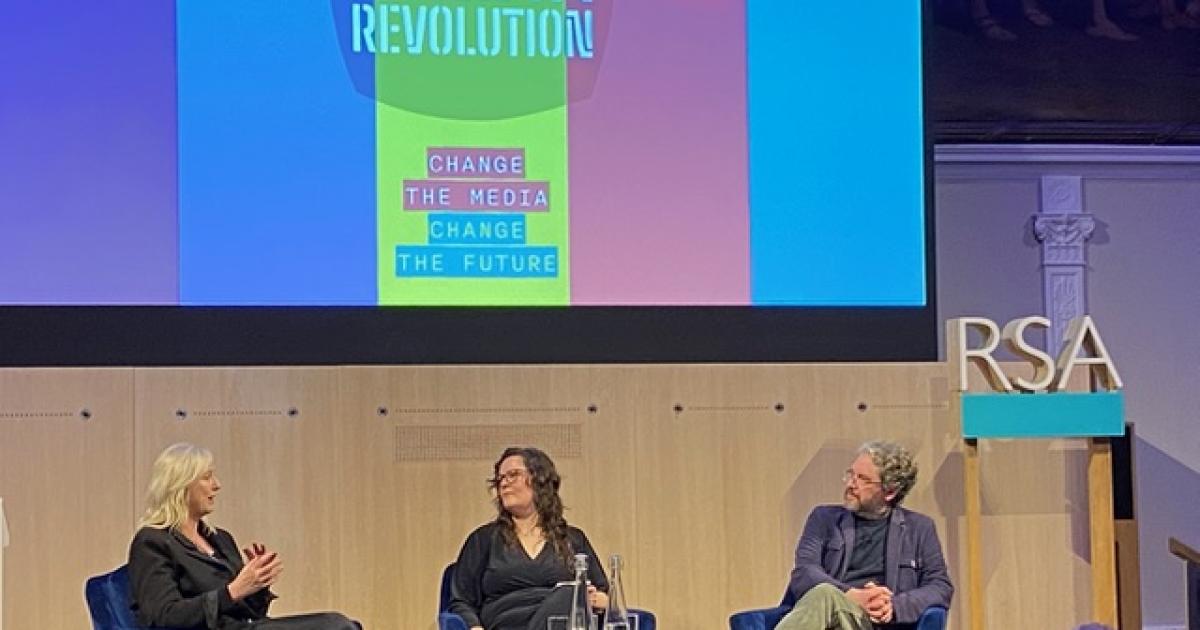
Media Revolution and the Royal Society of Arts jointly hosted an event centred around a new framework for democratic renewal developed in February.
Eliot Higgins, founder of Bellingcat, the investigative organisation that confronts the failure of the media landscape to hold true to that “simple concept” lead the event.
The central question: “Can democracies still function when truth itself is up for debate - and what will it take to restore public trust?”
Scrutiny
To address this question, Higgins introduced what he calls the arc – a framework for democratic checks and balances built on three interdependent pillars: verification, deliberation and accountability (VDA).
Verification is a shared commitment to evidence and truth, essentially employing the scientific method; deliberation is the capacity to reason together in good faith; accountability is the ability to hold power to agreed standards. When these pillars weaken, democracy falters; when strengthened, it thrives.
The arc framework proposes eight tracks of action that move beyond technocratic quick fixes.
It calls for cultivating critical thinking and constructive discourse across society; rebuilding civic trust and shared values in a fractured epistemic landscape; embedding democratic principles in governance; and, crucially, protecting evidence-based journalism so that truth and accountability shape public conversation.
Indeed, the rebuttal of disinformation in a media landscape increasingly resistant to scrutiny and, at times, openly hostile to democratic institutions is the frontline of the battle for our commonwealth.
Performative
Higgins and Liz Pendleton, a co-founder of Media Revolution, were joined by Carole Cadwalladr, the investigative journalist who exposed the Facebook-Cambridge Analytica data scandal.
What we do as real journalists is to give our readers the best obtainable version of the truth.
They discussed how to combat established disinformation networks and what new civic, investigative, and institutional infrastructures are needed to rebuild shared reality.
The arc framework itself is expansive in its Socratic questioning and deliberated responses, but discussion from the stage centred around what the arc identifies as three distinct states of civic health.
"Functional systems exhibit strong verification, deliberation and accountability: they are transparent, trusted and responsive.”
Hollow systems, however, are merely performative. They retain the outward forms of democracy but little of its substance. Public inquiries generate reports but few consequences. Regulators appear active but have been emasculated or captured.
Higgins pointed to Britain’s own recent history: “My general feeling is we're definitely in the performative mode and that's something that's been going on for decades.
Weaponised
"When we have public inquiries like the Leveson inquiry for example, [it] may seem to have the function and the form, but when it actually comes to outcomes, the accountability – what does that look like? It looks like a couple of people writing a report and not much happening.”
He added: “It's about giving the impression that you're doing this stuff but in reality you're just as an institution holding on to the power that you have.”
The arc describes “disordered” systems, where verification is supplanted by propaganda, deliberation by polarisation and manufactured outrage, and accountability by scapegoating.
In such environments, democratic rituals are not abolished but repurposed and weaponised – deployed to reinforce the power of an in-group and punish an out-group.
Higgins said: “If you want to see an example of that happening today, look over to the US where you see that simulation happening all the time.
Collapse
"We did work on the Alex Pretti shooting where you saw in real time the kind of video footage being published. You could see the gun being removed, him being shot afterwards, and then within hours you had a completely different version of reality being proposed by the Department of Home Security saying that he was waving a gun threateningly.”
We see the seeds of this trend germinating in our media where legacy outlets rarely investigate, deferring instead to opinion columns that propagate division and antiscience, untroubled by a captured regulator. Even the BBC has its agenda set by the tabloids and their billionaire owners.
Cadwalladr described a multi-layered crisis. She recalled the moment of Donald Trump’s ascent and what she saw as a profound realignment in which the purveyors of information are now totally aligned with the autocrat who's running this world's superpower.
When the primary distributors of information align with political authority, she warned, the terrain shifts entirely. “Where we are,” she said, “is in a moment of total information collapse.”
If we don’t change course the health of our democracy is severely threatened. However, the panel’s concluding discussion elicited practical responses.
Fund
“If our democratic information system is indeed faltering, what meaningful actions can citizens take in the next year to strengthen verification, deliberation or accountability?"
Higgins spoke of “recognition events” – tipping points at which large sections of the public realise that what they inhabit is not a functioning democracy but a simulation of one.
Such moments, he said, must be accompanied by a realisation of responsibility: that we are not merely passive recipients of information but active distributors of it. In a functional democracy, we owe one another a duty of care over what we share. Verification begins at home.
Education, too, he emphasised, is central. Critical thinking and media literacy cannot be an optional extra but must be embedded from school through to university, and he is in conversation with curriculum planners to this end.
Cadwalladr’s plea was blunt: pay for your news. A functioning democracy requires journalists willing and able to hold power to account. Independent reporting cannot survive on applause alone. If readers want accountability, they must help fund it.
Responsive
An audience member disputed that activists could claim to be objective journalists. She replied that reporting can only be trusted when journalists declare their interests. It is when they work as propagandists for power that they lose their claim to be truth tellers.
Good work is already being done to restore trust across many sectors. However, this work is often in silos.
Higgins points out, in his mission statement, that his arc needs to be built “on the understanding that no single intervention can restore democratic health. Instead it requires a coordinated system of action.”
It is therefore fitting that one of Media Revolution’s core aims is to foster collaboration across diverse demographic groups, building an ecosystem that becomes greater than the sum of its parts.
We are proud to be an early adopter of the arc framework. Its emphasis on verification, meaningful deliberation, and genuine accountability offers a vital pathway back towards cultural cohesion and a functional system that is transparent, trusted and responsive.
This Author
Tom Hardy has over 40 years’ experience in education as an editor, writer, and consultant. He has written for the Times Educational Supplement and the International Journal of Art and Design Education and advised the Department for Education. He now works with Media Revolution.