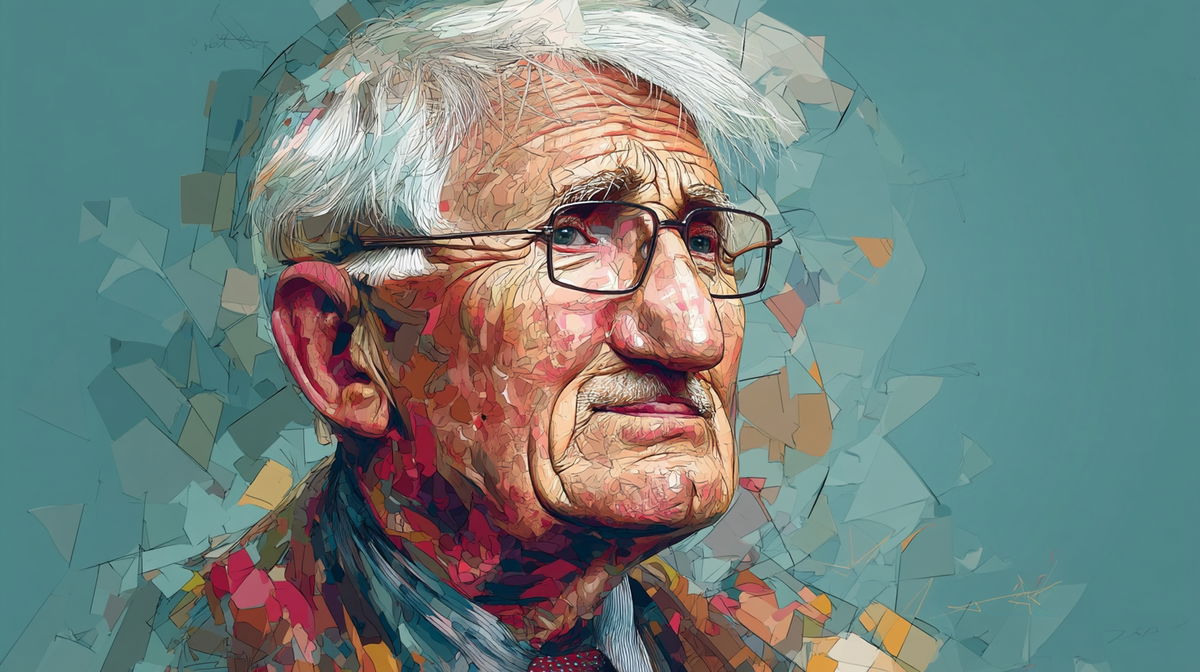
- A life forged by catastrophe: Habermas’s discovery at sixteen that he had grown up in a criminal regime drove six decades of philosophical and political engagement.
- Democracy as discourse: His theory of the public sphere — grounding legitimacy in reasoned debate rather than elections alone — became one of the most influential ideas in modern democratic thought.
- Europe as an unfinished project: Habermas championed a democratically empowered EU as the only vehicle capable of subordinating globalised markets to democratic self-determination.
- A combative, not quietist, thinker: Far from the ivory-tower rationalist his critics described, Habermas was a relentless provocateur who shaped nearly every major debate in postwar German public life.
- The world we live in: In his final years, Habermas himself despaired that “everything that had made up his life was currently being lost ‘step by step.’”
We are living through a period defined by what the late German philosopher, sociologist, public intellectual and engaged critical theorist Jürgen Habermas described as “the uncanniness of the times.” Whether it is expressed as the retreat of international law, the death of the rules-based international order, the end of liberal democracy or the loss of Holocaust memory as the negative touchstone for politics — to name but a few of the symptoms — commentators across the political spectrum agree that global politics is in a state of flux, an interregnum in which the old world has died but the new has not yet been born. Given that Habermas’s life and work both reflected and indelibly shaped the postwar era, it is not unreasonable to think that the intellectual historians of the future will date the end of the post-1945 world order to his death on 14 March 2026.
From his birth in 1929, a period defined by the aftermath of the Great Depression and just a few years before Hitler came to power in his native Germany, to his death shortly before his 97th birthday, Habermas’s life and work were shaped by the key events of his time. Most notably, in 1945 — as a sixteen-year-old who had barely managed to avoid being drafted into the war effort in the final days of the Third Reich — Habermas suddenly had to confront the fact that he had grown up in a criminal regime. This realisation, and his attempt to come to terms with it, would shape the rest of his life. In one of his rare personal reflections, he openly admitted that his perpetual “fear of a political relapse” shaped both his politics and “continued to spur my scholarly work” — from his 1962 Structural Transformation of the Public Sphere through to his final three-volume opus, released in 2019 and recently published in English under the title Also a History of Philosophy.
For much of his life, Habermas’s attempt to come to terms with the past was rooted parochially in his commitment to the democratisation of the West German Federal Republic. However, given the key role that the victory over fascism played in shaping the postwar world — and the way the lessons of the Holocaust came to be incorporated into a global, cosmopolitan memory — his specifically German experience is an example in miniature of virtually all the crisis tendencies of the postwar order. In attempting to build on the ideals of the Enlightenment by fulfilling the promises of the “unfinished project of modernity” while also recognising the role that these same ideas had played in “steer[ing] society towards barbarism” in the Holocaust, Habermas’s project reflects the West‘s broader attempt to reckon with its the darker aspects of its legacy — not only the horrors of the Holocaust in Germany but also the gulag in the Soviet Union, slavery and the internment of Japanese Americans in the United States, to name but a few examples.
Philosophically, Habermas is usually associated with the critical theory developed at the Institute for Social Research at the Goethe University in Frankfurt, where he worked for the majority of his career, albeit in three separate stints. His commitment to “learning from disaster” is visible from the start. In Structural Transformation of the Public Sphere, his first, most influential, and most widely cited work, Habermas developed the concept of the public sphere as a normative ideal that grounds democracy within a wider concept of humanity based not on status, ethnicity, race, or confession but instead on mutual respect and understanding — one that allows “the authority of the better argument [to] assert itself against that of social hierarchy.” His argument has a historical dimension as well. In Habermas’s telling, the rise of the salons and coffeehouses of seventeenth-century Europe, in which individuals in the early phases of capitalism increasingly encountered each other as equals who shared an interest in public affairs, gradually produced a public that monitors and criticises the state through informed and rational discourse.
Smart, Progressive Thinking on the Big Issues of Our Time
Join 20,000+ informed readers worldwide who trust Social Europe for smart, progressive analysis of politics, economy, and society — free.
While Habermas’s philosophical work ranges widely — addressing epistemology, the philosophy of social science, ethics, and morality — it is bound together by his fundamental conviction that, since it is mediated by language, human interaction inevitably implies mutual recognition and equality. Linguistic communication forces us recognize the other as someone who can not only understand what we are saying, but also has the capacity and freedom to respond to it. This insight is summed up in Habermas’s claim that “As soon as we start communicating, we implicitly declare our desire to reach an understanding with one another about something.”
Given his fundamental desire to ensure that the crimes of the Holocaust could “never again” be repeated, Habermas invariably applied his philosophical and sociological insights to political theory. In the Theory of Communicative Action (1981) he argues that the expansion of markets and bureaucratic administration, which have increasingly come to dominate all areas of modern life, have progressively “colonised” the everyday “lifeworlds” of individuals by encroaching on the family, religion, politics, and other domains of the communal reproduction of everyday life that had previously been protected from the expansionist, instrumental logics of money and power. Building on his linguistic philosophy, Habermas contends that the relentless attacks of these “systemic forces” upon the “communicative infrastructures” of society can be contained only by a countervailing expansion of the power of public communication — by subordinating the operations of the economy and the government to informed, critical, public discourse. It is this basic insight that also grounds his main statement of political philosophy in Between Facts and Norms (1992).
Habermas’s influence as a philosopher is incalculable. Even those who disagreed with were forced to admit that he was a titan of twentieth-century thought. Within political theory he is recognised above all as one of the founders of deliberative democracy, which locates democratic legitimacy in public debate rather than in the outcomes of elections. His towering status within democratic theory is visible in the fact that John Rawls, whose 1971 Theory of Justice is often credited with reviving the previously moribund field of political philosophy, once described Habermas as “the greatest thinker about democracy.”
The public intellectual
Alongside his academic work theorising communication and the democratic public sphere, throughout his long and illustrious career Habermas also actively participated in public debate. In line with his commitment to working through the Nazi past, as a student Habermas burst into the West German public sphere in 1953 with a denunciation of Martin Heidegger, Germany’s most famous and influential living philosopher, for reprinting a lecture series on metaphysics originally delivered in 1935 without removing a favourable reference to the “inner truth and greatness” of the National Socialist movement. Even at this early stage, Habermas already exhibited a keen awareness that philosophers like Heidegger (and later himself) were not just scholars but also “political personalities” and “participating citizens,” who bear a responsibility to “the development of excitable and easily enthused students” as well as to the public at large.
As Habermas’s editor at the Frankfurter Allgemeine Zeitung, Karl Korn, had predicted, this intervention indeed provoked a “violent brouhaha.” As a public intellectual, Habermas never shied away from controversy. This is visible in his condemnation of certain leaders of the student movement of 1968, which he otherwise supported, for their alleged “left fascism,” as well as in a number of subsequent controversies. Thus, while Habermas’s critics have often accused him of developing an overly rational concept of the public sphere modelled on a university seminar, Habermas’s own combative participation in the “acid bath of relentless public discourse” shows that he believed that only a wild, anarchic, and conflictual public sphere can truly force formal political and economic institutions to take the views of the broader public seriously.
From its foundation in 1949 until German unification in 1990, Habermas participated in and shaped almost all of the major debates in the so-called Bonn Republic. Perhaps most famously, in the Historians’ Debate of the mid-1980s he called out the government of Chancellor Helmut Kohl and a group of conservative historians aligned with it for seeking to relativise the Nazizeit so that Germany could once again have a “normal” foreign policy no longer burdened by the moral legacy of the Holocaust. Speaking as “a patient who undergoes a revisionist operation on his historical consciousness,” Habermas pushed back hard against this attempt to dislodge Auschwitz from the centre of German politics, fearing that it would undermine the moral foundations of what he still saw as the fragile achievements of German democracy.
Upon Habermas’s death, the President of the German Federal Republic, Frank-Walter Steinmeier, noted, “We will miss his voice. Our country owes him an incalculable debt.” This tribute and the many others he received may make it seem that postwar Germany was a rationalistic, Habermasian republic. However, the history of his public engagements demonstrates that those who claim he exercised “dictatorship” or “cultural hegemony” over the German public sphere are mistaken. While it is certainly true that Habermas was accorded a certain respect as the éminence grise of the German public sphere, this recognition is more visible in the vehemence with which he was attacked than in the agreement his interventions found. Whether it was his opposition to German rearmament or his belief that German unification should only have occurred after a constitutional convention and plebiscite of the populations of both the former East and West, Habermas was rarely on the winning side of the argument. However, this was never the point. On his understanding of the public intellectual as a guardian of public debate, his goal was not to convince but to force his opponents to listen to and debate his views in full view of the broader reading public.
Habermas’s capacity to provoke outrage did not diminish in his old age. On the contrary, as a child of American postwar re-education, in recent years his views increasingly seemed out of step with the times. While he recognised that the full-scale invasion of Ukraine was “unleashed arbitrarily by Russia,” in 2022 Habermas drew the ire of many on both the left and the right for arguing that the Federal Republic should not abandon its “hard-won” commitment to the “pro-dialogue, peace-keeping focus of German policy” that had emerged after 1945. Reflecting his worry that “the armament process seems to be acquiring a momentum of its own,” Habermas noted that what “really irked me” were the “bellicose reflexes” and “highly emotionalized war mentality” in a country that had worked so hard “to achieve the necessary critical distance from our own nationalistic past.”
While his reflections on Ukraine were controversial, this paled in comparison to the reaction to Habermas’s decision to co-sign a statement addressing the “rightly understood solidarity with Israel and Jews in Germany” following the unprecedented attack on Israel by Hamas on 7 October 2023. Few would likely have disagreed with the claim that “Israel’s actions in no way justify anti-Semitic reactions, especially not in Germany,” or that “Jewish life and Israel’s right to exist are central elements worthy of special protection in light of the mass crimes of the Nazi era.” But the fact that the statement went on to claim that Israel’s military retaliation against Hamas was “justified” and that “the standards of judgment slip completely when genocidal intentions are attributed to Israel’s actions” provoked outrage even among Habermas’s closest colleagues and friends.
I share the disappointment with this statement voiced by many others. However, it is important to keep in mind that it was published on 13 November 2023, a mere five weeks after the start of Israel’s war in Gaza. In the wake of the October 7th attacks, Germany — like much of the rest of the world — experienced a period of rising anti-Semitic violence, with physical attacks on Jews as well as symbolic acts, including the drawing of swastikas and stars of David on Jewish businesses and homes, reminiscent of the treatment of Jews during the early stages of the Third Reich. While this perspective does not absolve Habermas or his co-signatories for not addressing this issue after further developments made clear how disproportionate Israel’s response in Gaza had become, the rising spectre of anti-Semitism was shocking — particularly to someone like Habermas, given his commitment to keeping the Holocaust at the centre of German historical consciousness and national identity.
The European and the legacy
While Habermas’s public commentaries in the first four decades of his career focused primarily on developments in his native Federal Republic, following the revolutions of 1989 and the unification of Germany he increasingly turned his attention to the project of European integration. Readers of Social Europe probably know him best for his heartfelt commitment to the European Union. While Habermas was a strident critic of the EU in its current form — in line with his theoretical commitments, his opposition focused in particular on its executive federalism and its use of emergency politics to bypass public debate — he tirelessly pleaded for it to develop into a postnational democracy. Habermas himself sought to bring the new transnational European public sphere he thought necessary to legitimise a democratically empowered EU into being through his public interventions, most notably in a text co-signed by his erstwhile sparring partner and later friend Jacques Derrida opposing the US invasion of Iraq in 2003.
Habermas initially developed his support for the EU as part of his writings on the postnational constellation in the 1990s, in which he foresaw many of the problems that would later be associated with globalisation — most notably the loss of political control over economic forces. While Habermas is often seen as a progressive neoliberal complicit with many of liberalism’s problems at the start of the twenty-first century, over the course of the Great Recession and the crisis of the eurozone that followed in its wake, he consistently pleaded for the EU to expand its powers and develop into a solidaristic democratic federation that would allow politics not only to “catch up with globalized markets” but to do so in “institutional forms that do not regress below the legitimacy conditions for democratic self-determination.” His interventions were guided by his “hope that the neoliberal agenda will no longer be accepted at face value.” Unfortunately, here as in many other cases, Habermas’s ideas were ignored and his hopes disappointed.
Regardless of what we might think of Habermas’s substantive positions, one thing is clear: he was not the quietist, non-political thinker many of his critics make him out to be. Habermas never needed to be placed into contact with the “’real’ world from which it otherwise remains largely isolated”; on the contrary, these reflections show that Habermas’s work has been politically engaged from the start. Indeed, far from betraying his teachers in the Frankfurt School and developing a “form of critical theory [that] apparently abandons the aim of fundamental social change,” Habermas’s work as a public intellectual — as well as the fact that his activities as an engaged critical theorist sought to put his philosophical ideas into practice — instead shows that he was a rightful heir to the first generation of critical theory, particularly to the work of his mentor, Theodor Adorno, who was one of the early Federal Republic’s most important public voices.
Additionally, while some see him as a mainstream liberal whose philosophy was a form of “applied ethics,” Habermas’s interventions in the public sphere actually embodied the Marxist call for philosophy not only to interpret the world but also to change it. From this perspective, it seems only fitting that Habermas passed away in the morning of 14 March — the 143rd anniversary of Karl Marx’s death — a thinker with whom his work and his legacy are so closely connected. While Habermas disappointed many on the left with his opposition to revolutionary politics, his commitment to a Kantian “radical reformism” still sought to realise many of the left’s goals by empowering politics vis-à-vis economic forces.
Most importantly, throughout his writings as a public intellectual, Habermas never lost his commitment to democracy — to the idea that he could only present arguments, leaving his fellow citizens the communicative agency to decide what they thought and what they wanted to do, even if their decisions would often go against him. In this sense, his public-facing work served as an expression of his conviction that “Democracy depends on the belief of the people that there is some scope left for collectively shaping a challenging future.”
In his final years, Habermas increasingly despaired of the state of the world in this new time of transitions. Speaking in 2023, Habermas noted his growing feeling that “everything that had made up his life was currently being lost ‘step by step.’” In one of his final public interventions, Habermas repeated his call for Europe to become “a Union capable of independent political action” so that “European countries [can] effectively bring their common global economic weight to bear in support of their normative convictions and interests.” However, when I asked him about his conviction that the EU could anchor a more democratic global order during my visit to discuss my biography of him as a public intellectual, he replied: “That is all over. I no longer believe in that.”
Given contemporary developments and the death of his wife, Ute Habermas-Wesselhoeft, last year, it is perhaps not surprising that Habermas no longer felt at home in a world that is increasingly unhomely — the literal translation of the German word Unheimlichkeit which features in the description of the times with which I opened this essay. Some may be tempted to see Habermas’s death as the final nail in the coffin of the more reasonable, democratic, communicatively governed world he presented in his theoretical work and for which he fought in his public interventions. However, such fatalism can quickly become a self-fulfilling prophecy. Rather than accepting the return of fascism and democratic decline, it seems to me that today’s geopolitically turbulent and disintegrating world needs Habermas now more than ever. Rest in peace.