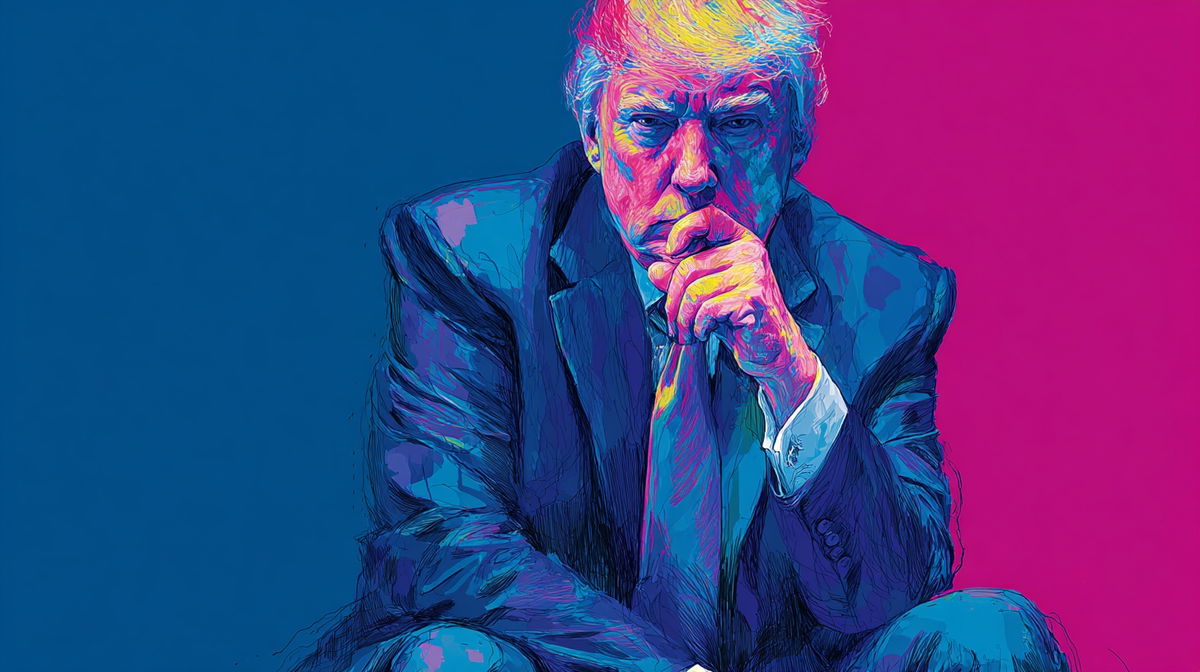
- Historical precedent, broken: Trump’s behaviour — self-portraits in federal buildings, name-branding the semiquincentennial — has no equivalent in American presidential history, yet his party has embraced rather than challenged it.
- The cult’s internal logic: Personality cults serve a political function — binding fractious coalitions and shielding leaders from accountability — but their effectiveness depends entirely on the political and cultural context in which they operate.
- Narcissism as a liability: Unlike shrewder cult leaders who deflect blame onto subordinates, Trump’s compulsion to dominate every narrative ensures that all failures ultimately attach to him personally.
- The DARVO trap: Trump’s default governing mode — deny, attack, reverse victim and offender — works against cowed elites but is ill-suited to managing a complex administration or sustaining long-term public support.
- Structural self-entrapment: By making the Republican Party wholly dependent on his persona rather than a programme, Trump has left it with no exit strategy when the cult’s appeal inevitably fades.
There is no precedent in American history for a president who papers his image across government department buildings; adorns the walls of the White House with tacky portraits of himself; wants his face on a coin; names edifices after himself (including some already named after previous presidents); and trademarks his name in conjunction with the number “250” in advance of the country’s semiquincentennial. Yet Donald Trump has done all these things, and despite his party’s long-standing objection to “government overreach,” the Republicans have responded by solidifying his personality cult.
Recall Trump’s State of the Union address last month. One Republican congressman begged the president to initial his tie (which bore an image of Trump’s face), and another – already well-known for wearing a hat emblazoned with “Trump was right about everything” – declared himself “starstruck.” Far from exceptional cases, these embarrassing spectacles capture what the party has become.
Personality cults always draw on the leader’s narcissism and followers’ desire for order or a strong authority figure. But whether leaders can effectively use the cult of personality to entrench their power depends on the political context in which the cult is embedded. In Trump’s case, his conduct not only flies in the face of the egalitarian political culture that self-effacing leaders like George Washington tried to foster; it is also likely to weaken his position over the long run.
Personality cults feature in many different forms of modern politics, even if the underlying ideologies differ radically. Mussolini, Hitler, Stalin, Mao, and North Korea’s Kims are obvious examples; the French president-turned-emperor Napoleon III was a pioneer of the tactic. Already in the mid-19th century, he understood that modern mass politics and mass media could be used to generate legitimacy, even using paid cheerers to create the impression that the people loved him.
Smart, Progressive Thinking on the Big Issues of Our Time
Join 20,000+ informed readers worldwide who trust Social Europe for smart, progressive analysis of politics, economy, and society — free.
In some cases, personality cults have helped keep heterogeneous coalitions together. Different factions of a party or movement might not agree on a political program, but that is of secondary importance if they venerate the same leader. At the same time, personality cults often elevate the leader above his party or government, which allows for policy mistakes or corruption to be attributed to wayward underlings. Se lo sapesse il Duce (“If the Duce only knew”) was a common refrain in Fascist Italy. Similar sayings were common in Germany under Hitler and in Russia under the czars.
Personality cults can be effective at conveying strong symbolic messages without the need for complicated ideological explanations. Thus, Stalin managed to present himself both as a hard-working bureaucrat (always keeping his office light on late into the night) and as the only one who knew how to reach the promised land of Communism. That is why so many paintings show him gazing purposefully into the distance, at some yet-to-be-revealed destination outside the frame.
Similarly, Mussolini, originally a journalist with intellectual pretensions, modeled a Fascist ideal of masculinity by posing as a bare-chested man of the people who would help with the harvest. And Hitler’s quasi-religious speeches reinforced the sense that he had been ordained by Providence (a favorite Nazi concept) to build a Thousand-Year Reich.
For his part, Trump certainly has a knack for staging performances, using props, and putting others in their place. He has turned the Oval Office into a royal court where sycophants jockey for his attention, and his sloganeering (“build that wall”) has been undeniably effective with his base. Whether Trump’s wall along the 2,000-mile border with Mexico is ever built is beside the point; at least his followers feel sure about what exactly he stands for.
And yet both the content of Trump’s program and the images he creates have lately become deeply unpopular. Even those clamoring for mass deportations are not automatically willing to accept the killing of US citizens in the streets. Likewise, those who welcome the Republican Party’s Islamophobia (according to one congressman, “Muslims don’t belong in American society”) will not automatically support an illegal war on the Islamic Republic of Iran. And no one is too pleased to see their leader dishonor fallen American soldiers by showing up to their repatriations wearing his own merchandise.
Moreover, Trump’s all-consuming narcissism does not allow him to achieve the elevated status that enables cult leaders to avoid accountability for their subordinates’ mistakes. While occasionally professing ignorance about what his own appointees are doing, he is ultimately incapable of distancing himself from any aspect of his administration. Everything must be about him (and, of course, everything must always be going great).
For example, although Trump was reportedly furious with Kristi Noem for claiming that he had approved her self-promotional ad campaign (which cost the equivalent of a major Hollywood production), he could not bring himself to disavow the disgraced Homeland Security secretary openly. And though Trump did eventually remove her, Noem still will hold a position in the administration.
Trump’s own approach to governing (and business) has long followed the pattern of what psychologists call “DARVO”: Deny, attack, and reverse victim and offender. Sometimes, this strategy can be effective, especially in the face of already cowed elites. But smarter autocrats know that the occasional scapegoating of an underling, or even an apology once in a while, can be better for their long-term interests.
While it has always been a mistake to underestimate America’s reality-TV-star president, one can safely conclude that he is incapable of learning. By always focusing attention on himself, he has ensured that all future disappointments and complaints will eventually be directed at him. That means his party will have few means of distancing itself from him. The only hope for Republicans, it appears, is to fiddle with elections or persuade enough voters to stop believing their own eyes.
Help Keep Social Europe Free for Everyone
We believe quality ideas should be accessible to all — no paywalls, no barriers. Your support keeps Social Europe free and independent, funding the thought leadership, opinion, and analysis that sparks real change.
Social Europe Supporter
— €4.75/month
Help sustain free, independent publishing for our global community.
Social Europe Advocate
— €9.50/month
Go further: fuel more ideas and more reach.
Social Europe Champion
— €19/month
Make the biggest impact — help us grow, innovate, and amplify change.