On 3 November 1876, two days after the unexpected death of his younger brother René, Gustave Caillebotte made his will. He was 28.
It is my wish that sufficient funds be allocated from my estate to finance in 1878, under the best possible conditions, the exhibition of the painters known as Intransigents or Impressionists. It is rather difficult for me to estimate today what the necessary sum might be; it could go up to thirty, forty thousand francs or even more. The painters to figure in this exhibition are Degas, Monet, Pissarro, Renoir, Cézanne, Sisley, Mlle Morisot. I name these without excluding others.
I leave to the state the paintings in my possession; however, as I want this gift to be accepted, and in such guise that these paintings not end up in an attic or a provincial museum but rather in the Luxembourg and later in the Louvre, a certain lapse of time will be necessary before the execution of this clause, until the public may, I do not say understand, but admit this painting. Twenty years or so might be required; in the meantime, my brother Martial, or failing him another of my heirs, will keep them.
Caillebotte’s provision for an exhibition of his fellow Impressionists was extraordinarily generous – thirty or forty thousand francs was roughly equivalent to his splendid annual income (he came from a wealthy family and received his money largely in rents). But his decision to bequeath to the nation his collection of Impressionist works – and his far-sighted insistence that they be given real prominence, founded on a bullish belief in their intrinsic value – was magnificent. When he died in early 1894, aged only 45, the will came into effect. After some bureaucratic wrangling, and an outcry from the forces of conservatism (including a letter from the Académie des Beaux-Arts), 38 paintings from a possible 67 were accepted by the state, including Manet’s Le Balcon, Monet’s La Gare Saint-Lazare, Cézanne’s Le Golfe de Marseille and Renoir’s Bal du moulin de la Galette. A new space was created in the Musée du Luxembourg to accommodate them and the collection went on display in 1897, fulfilling Caillebotte’s prediction that it would take ‘twenty years or so’ for the public to ‘admit’ if not ‘understand’ the contents of his bequest. (The rest of the collection remained with Caillebotte’s brother Martial and was periodically offered to and refused by the government, until the offer was finally rescinded.)
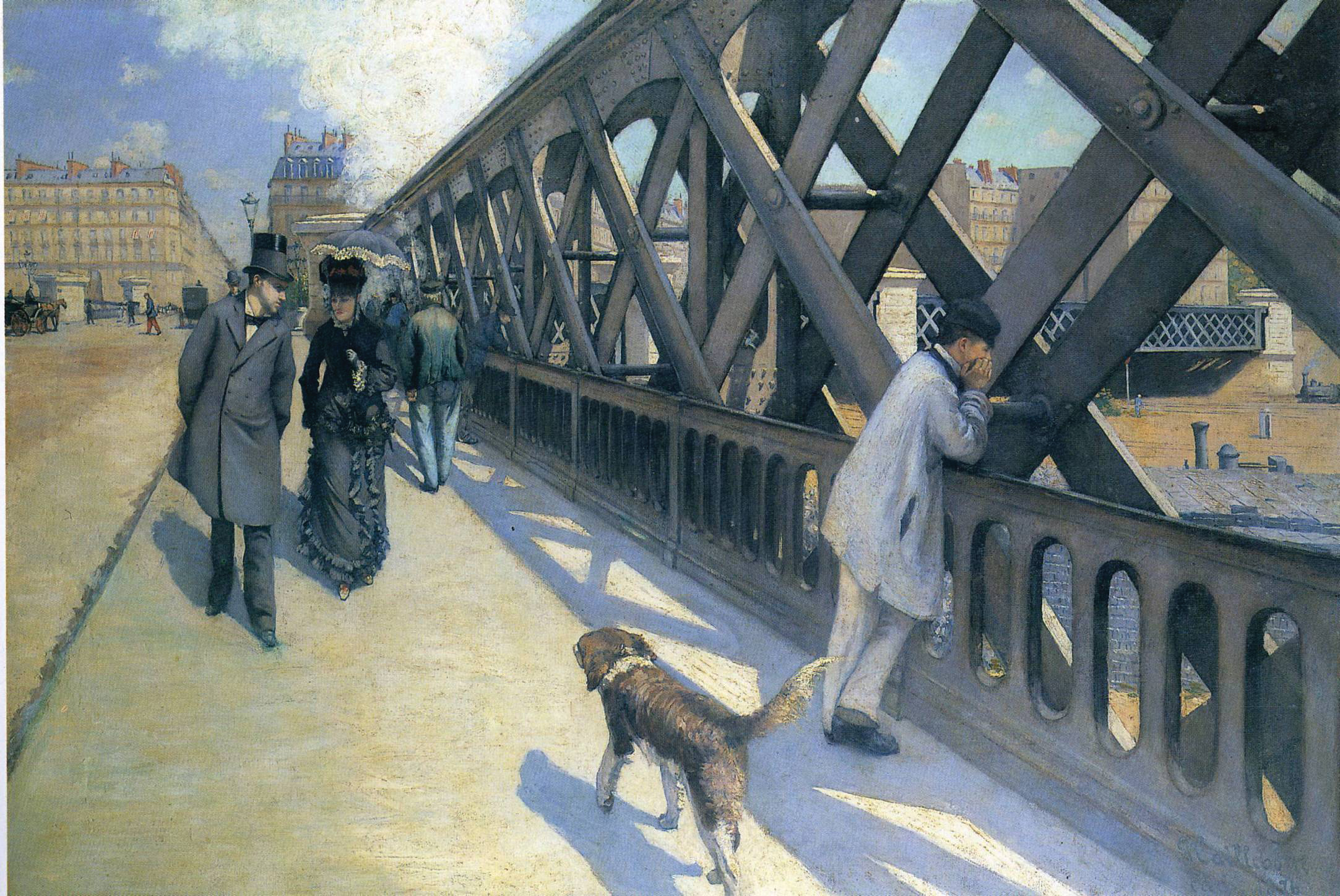
‘The Pont de l’Europe’ (1876)
Caillebotte’s personal modesty also had a legacy. He did not suggest that any of his own paintings were included in the bequest – Jean Renoir remembered him saying that his only wish for himself was that one day he might be ‘displayed in the antechamber of the room where the Renoirs and Cézannes are hung’ – and only two of his works, The Floor Scrapers and the innocuous View of Roofs (Snow Effect), accompanied his collection into the Luxembourg. As his descendant and biographer Amaury Chardeau points out, ‘with the exception of the portrait of a relative which entered the Louvre’s collections in 1926 as part of a donation, for five decades these were the only paintings of his visible to the French public.’
Caillebotte’s low profile would have surprised many of those who were paying attention to new painting at the time he made his will. The critics had singled him out in their reviews of the second Impressionist exhibition in 1876, where he exhibited The Floor Scrapers. The next year, he sh0wed several other major paintings, including those usually seen as his masterpieces, The Pont de l’Europe and Paris Street; Rainy Day. He contributed to the subsequent Impressionist exhibitions of 1879, 1880 and 1882. And he was not significant only for his work – or for his inspired collecting of his friends’ pictures. He was also the dominant figure in putting on most of the exhibitions in which he took part after 1876: finding and renting the venues, rallying and organising the painters (no easy task), paying for the publicity, sending out the invitations, loaning pictures, doing the hanging and making purchases when, as usual, the public did not oblige. He even fell out with Degas over the design of an exhibition poster. In 1882, the critic Gaston Vassy visited the exhibition space and found him ‘working like a porter, exactly as if he didn’t have an income of a hundred and fifty thousand francs’. Over the years, Caillebotte was especially kind to Monet, helping him out of financial trouble and renting him a studio near the Gare Saint-Lazare, which enabled him to make his studies of the area.
Yet after 1882, Caillebotte’s enormous energy, and his ambition, seemed to fizzle. With some exceptions, his work declined. He spent most of his time at his estate in Petit-Gennevilliers, just outside Paris, where he became involved in competitive sailing, not only as a racer, but as the designer of more than twenty boats, for himself and others. He also found time to be elected as a municipal councillor, speeding up the transactions of local government by paying for things himself. And he was very involved in his garden, swapping cuttings and horticultural chit-chat with Monet. He was at work in his garden when he was taken ill in February 1894, dying soon after. A posthumous retrospective was held at the Durand-Ruel gallery, but hardly anything sold. Gradually Caillebotte became important not as a painter, but as the man whose death enabled the Caillebotte bequest. Most of his own works remained in the family until the 1950s, and it was only when they were offered to a market on the lookout for affordable Impressionism that his critical fortunes began to turn. Progress has been slow. In the edition I have of Nineteenth-Century Art: A Critical History (2011), he merits a single mention, which, judging by the index, puts him on the same level of artistic significance as Robert E. Lee.
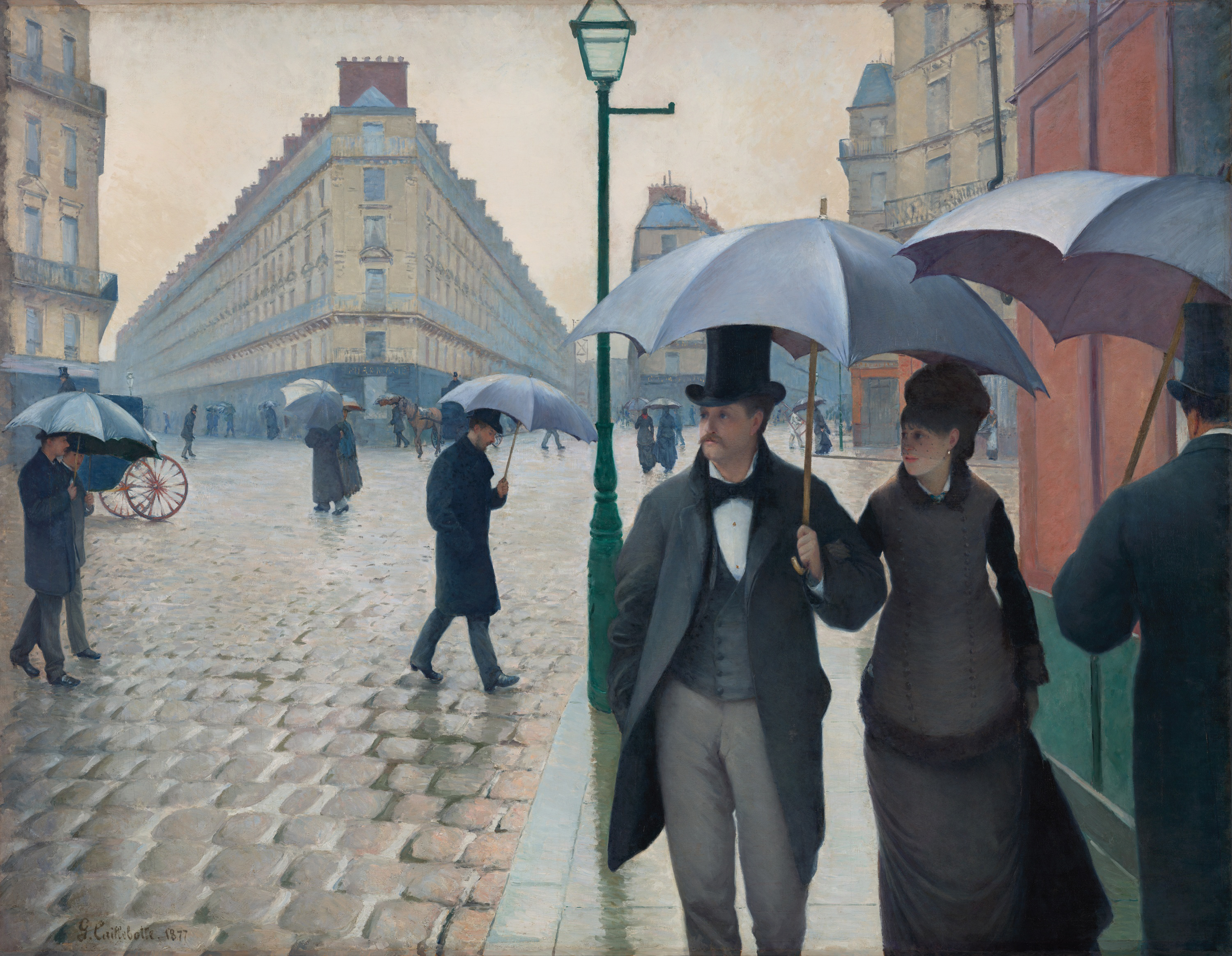
‘Paris Street; Rainy Day’ (1877)
In 1996, introducing an exhibition at the Royal Academy called Gustave Caillebotte: The Unknown Impressionist, the MoMA curator Kirk Varnedoe, along with Marie Berhaut a pioneer of Caillebotte studies in the 1970s (and still his most eloquent interpreter), reckoned that it was ‘inevitable, even if awkward and ultimately less than informative, to broach the general question whether Caillebotte was “as good as” the other Impressionist painters’:
A simplified answer would have to be no. He had neither Degas’s skills as a draughtsman nor Monet’s as a colourist, and his development was not as extensive as those of his fellows. Yet comparing picture for picture … I would value any one of Caillebotte’s best works … as a more important, original and rewarding painting than any Pissarro, all but a handful of Renoirs, and a fair number of Monets from the same period.
It is one of the paradoxes of Caillebotte’s reputation that he is at his best when he is least obviously an Impressionist, and at his worst when he attempts to play on the same pitch as Monet and Pissarro, as in the landscapes and flower and garden studies of his later period. Indeed, many of the critics at the early Impressionist exhibitions were attracted by Caillebotte’s smooth, controlled brushwork, his level colouring and high finish: nothing of the inspired sketch here. Hence Zola’s disapproval of his work as ‘anti-artistic painting, tidy painting, a mirror, bourgeois in its precision’, with nothing of ‘the painter’s original expression’. Caillebotte’s originality, and his provocations, came in other forms.
Take The Floor Scrapers (1875), with its three shirtless men, raboteurs who were preparing the floorboards for Caillebotte’s new studio in the family’s Paris home on rue de Miromesnil. The floor tilts dramatically upwards to the top of the picture frame; the skirting-board draws its line along the furthest labourer’s back. Like many of Caillebotte’s most interesting works, The Floor Scrapers pulls and pushes and drags the eye: back to the balcony window, and to the squeezed top-left corner; forward, with the flood of light and the outstretched arms of the men, and the tool in the foreground; across the three men in their unobtrusive pattern, backlit and so similar-looking that, as has been said, they might be the same man seen at different moments – crawling recorded by Muybridge. We know that these effects were achieved, despite the realism of subject and style, by careful manipulation: the angle of the fireplace nudged into line with the corner of the room; the dome of Saint-Augustin, in fact not visible from this angle, magnified and brought forward, contoured with implausible exactness by the filigree of the balcony; the large scraped section of floor perfectly positioned to trap the light; the gilt mouldings on the wall added to help manage the viewer’s sense of scale.
Caillebotte achieved similarly disconcerting effects in Luncheon (1876), a depiction of a family mealtime that positions the viewer at one end of an achingly polished dining table, which spreads like a great pool to take up almost half of the picture, covered by a ripple effect of crystalware, with each glass, bottle and decanter standing in its own reflection, and each piece in visual contact with another, rims overlapping or mirroring, edges and lengths lining up. Nothing fails to fit. And there is that extra element of the uncanny: the pictorial space too large-seeming at the right, and Caillebotte’s brother René positively hulking when compared with their mother and the butler at the other end of the table, which, one critic carped, must be forty feet long. Then there is The House Painters, done the following year, which again seeks to perplex the eye: on the expanded right-hand side, in the foreground, are the four white-coated painters, poised outside the shopfront of a wine merchant, their two ladders forming an interlocking pattern that climbs nearly to the top of the picture; and then at the squeezed left, the severe vertical of the kerb, shearing away to make a vanishing point in the far distance, the people and vehicles abruptly becoming miniature. The picture is barging at us, and fleeing at the same time; it is both particular and abstract. And yet again we are struck, once we have fought to bring its elements into relation, by the unlikely precision of its pattern, its overdetermined unity. We notice that the painting is cut into sharp triangles, and that the buildings and the road, the pavement and the sky, are hinged just like the painters’ ladders, as though these too might be folded up, and the whole scene carried away overarm.
Varnedoe argued that this netting of discordant elements – near and far, particularity and pattern – is what constitutes Caillebotte’s brilliance and gives many of his best paintings their ‘family resemblance’. How was it done? By trampling on the accepted rules of perspective, for one. In an essay written with Peter Galassi, Varnedoe showed that Caillebotte brought the viewpoint of his paintings – the eye’s distance from the imagined ‘window’ framing the depicted scene – as much as five times closer than was recommended by painting manuals, with exactly the consequences students were taught to avoid: ‘the foregrounds … splayed and enlarged, the backgrounds diminished, the convergences made to seem more acute, and the overall sense of space profoundly altered’. The basic effect is easy to recreate with a phone camera: try framing an image, and without losing it, steadily move the camera closer; watch the scene expand sideways, and the distances accentuate. Indeed, it seems likely that Caillebotte was relying on a camera: his preparatory drawings are often very small and exact, made on tracing paper and approximately the size of photographs. But this wasn’t all. As Varnedoe pointed out, Caillebotte chose to make his images more emphatically unusual ‘by positioning figures or objects close in the foreground, by consistently setting the vanishing point far to one side, and by using prominent empty spaces to emphasise the breadth of the foreground and the swiftness of movement into the background’.
This helps account for some of the distinctiveness of The Floor Scrapers, Luncheon and The House Painters, and of Young Man at His Window (1876), with its large and inauspicious foreground of carpet, chair, glass door and chunky balustrade, which ultimately serves to emphasise the relationship between the figure of René Caillebotte – off-centre, seen from behind, his solidity reinforced by collected shadow – and the sudden leap the picture takes over his left shoulder into the distance, to the sunlit buildings two streets across, which has the effect, enhanced rather than cancelled by the suggestion that René might be watching the small figure of a woman crossing the road, of presenting us with two distinct scenes, in what Varnedoe calls ‘a charged relationship, competitive or covalent’.
In the same year, Caillebotte achieved something similar, if more memorable, in The Pont de l’Europe, which is so visually complex it baffles easy description. On the right is the exaggerated foreground, with the spread of pavement and huge latticed trusses; on the skewed left, the perspective rushes away to the vanishing point, following the line of the kerb as in The House Painters. It is one of Caillebotte’s unexpected framings, his wayward snapshots of an everyday scene, though in his usual way he also made tactical modifications, tidying the rooflines, widening the pavement and enlarging, relative to the rest, the diamond shape made by the trusses nearest to the viewer. But all of this is complicated further by the fact that, as Galassi discovered, Caillebotte carefully planned for there to be two planes of projection, one of which, focused on the perspective back to the other end of the bridge, has as its centre of vision the top-hatted head of the man strolling towards the viewer (believed to be a self-portrait), while the other, focused on that deliberately enlarged diamond shape, has as its centre of vision the head of the blue-smocked worker leaning on the parapet of the bridge. Caillebotte’s other lopsided pictures were called ‘half-pictures’, but this is more like two in one. And yet the two planes are linked, and the viewer’s divided eye united, by the look the Caillebotte figure directs at the worker. This look is fundamental to the picture’s design, and yet it was missed by many contemporary critics, and by several 20th-century ones, all of whom were determined to see a relationship between the Caillebotte figure and the woman walking close by him, although she is a step or two behind and looking in the opposite direction.
In Paris Street; Rainy Day, another great painting, completed a year later, in 1877 – and it is literally great, at seven feet by nine feet (The Pont de l’Europe measures four feet by six) – the same perspectival trickeries are employed: enlarged figures in the right-hand foreground, including one who is practically all elbow, plus a little bit of umbrella; a rapid backwards plunge at the middle and far left, following the exaggeratedly sheer lines of Haussmannian architecture. The colouring is more striking, however, in its pale greys and blues, and with the shiny-wet cobbles, catching the light, used to accelerate the plunge. There is also, at first glance, an enhanced sense of movement, of urban bustle, in the number of figures moving about, at different scales, in every part of the canvas, most of them under umbrellas. Yet the more you look at it, the more the picture seems to slow down, until it takes on the frozen quality of a photograph or a film still (as opposed to the permanently dancing quality of a Monet or Pissarro streetscape). You notice that, as in Luncheon, the parts of the picture are in slightly too perfect relation: the two men on the far left appear to be walking under the same umbrella, but are actually under separate ones, overlapping so as to have become indistinguishable, and both umbrellas follow the curve of the wheel of the carriage behind them; a man’s legs seem to dangle from the umbrella held by the man passing behind the lamp-post; and the umbrella held by the man approaching us on the right cuts between two distant figures – one of Caillebotte’s white-coated painters, carrying his ladder, and a woman about to cross the place du Dublin, both of whom have had their faces obliterated.
These figures all look like what they are – individual studies, pre-prepared, and then, so to speak, copied and pasted into interesting positions. Their distinctness, not just from one another but also from the scene itself, is an effect, as Galassi observed, of being drawn from ‘a separate, face-on viewpoint, rather than being distorted to conform to the central spatial system’, so that they lie flat on the surface, as do the cobbles in the foreground: the effect may have been borrowed from Piero della Francesca, and was adopted by Seurat for the layering effect of A Sunday on La Grande Jatte and Bathers at Asnières. If this wasn’t enough conscious artificiality – we might recall how The House Painters seems to ask to be folded away – the figures in Paris Street; Rainy Day are also subordinate to a ‘mathematically proportioned surface order’, the exact details of which, though patiently laid out by Galassi, continue to elude me (having limped through GCSE maths on the third attempt). It involves, however, an organising horizon line, which runs along the middle of the picture and passes through the heads of almost all the figures, whatever their distance (try running a finger directly across from under the hat brim of the man on the far right). Stepping back, then, we have a strong sense of Caillebotte’s cool, mastering intelligence, as all-encompassing as that rainy-day light. This doesn’t detract from the picture’s impact: rather it explains it. Here, the ‘charged relationship, competitive or covalent’, is the one between Caillebotte and the teeming visual energy of Paris itself.
What kind of painter are we dealing with? If we must continue to think of Caillebotte as an Impressionist – partly on the grounds of his prominence in their exhibitions and his crucial organisational role, partly because at times in his career he was happy to go out into a field, loosen his brushwork and turn up his colour, and partly because of his preoccupation with capturing light and the urban landscape – it still makes sense to place him with those figures on the edges of the movement: Manet, Degas and Sickert (who, though twelve years younger than Caillebotte, was already chummy with Degas as a very young man in the early 1880s). All of these painters privileged line over colour; prioritised the human figure and to some extent the interior in their scenes of modern life; experimented with cropping, reflections and tilting, tipping perspectives. Caillebotte’s portraits, many good but none great, show Manet’s influence, but there are more interesting connections. The size of Caillebotte’s foregrounded figures, their way of pushing at the picture frame, has something in common with what Michael Fried called Manet’s ‘facingness’, except, as Fried and others have noted, Caillebotte’s figures are more often, and to an unusual extent, seen from the rear (so perhaps we should talk of Caillebotte’s ‘facelessness’). When they address the same subject – boaters on the Seine outside Paris – Caillebotte’s rowers, unlike Manet’s, have their heads turned away, even when, as in Boaters (1877) or Boating Party (1877-78), they are seen close up, thrusting towards us. The man standing in front of a mirror in In a Café (1880) – which preceded by two years Manet’s Bar at the Folies-Bergère – does not gaze out towards us, like Manet’s barmaid, but past us, towards two men, who are themselves sitting in front of another mirror, which masquerades as a window because it is reflecting the outdoors.
Caillebotte shares with Degas a habit of careful planning, a liking for smooth surfaces and abrupt cropping (we might compare Paris Street; Rainy Day with Degas’s Place de la Concorde of two years earlier or At the Bourse of two years later), and an interest in conjunctions of near and far (in Degas’s theatre and concert scenes, for example, which foreground musicians and audiences against the pull of the stage), but also in depicting work and, in the later examples of Man at His Bath and Man Drying His Leg, the intimacies of washing and drying oneself. With Sickert he shares, perhaps simply because he initiated it, the motif of men looking from a balcony, which starts with the picture of René and proceeds through several iterations, including Man on a Balcony and A Balcony, both of 1880; though in Sickert’s music hall scenes the viewpoint is usually reversed and the gazing men are seen from across or below.
Caillebotte and Sickert are also linked by their play with mirrors (Sickert, in Gallery of the Old Bedford, has two mirrors that pose as windows) and a love of line-pattern, shown for instance in Caillebotte’s attentive following of elaborate ironwork (which, magnified, becomes the subject of a whole painting in View Seen through a Balcony) and Sickert’s of the gilt curlicues that decorated music halls. Both painters are interested in a certain kind of psychological scene, often characterised by a seedy boredom, a waiting for something to happen, and a feeling of contained tension between a man and a woman. There seems a clear link, to choose just one example, between Caillebotte’s Interior, Woman at the Window (1880) and Sickert’s Ennui (1914). Caillebotte’s only major female nude (c.1880) is quite close to one of Sickert’s reclining women, and has some of the same careless, self-absorbed quality. One might also think of them as stationary, indoor painters, whose triumph is to charge a single space with many different kinds of feeling: the majority of Caillebotte’s portraits, interior and balcony scenes were located in the apartment he shared with his brother on the boulevard Haussmann, just as most of Sickert’s nudes and scenes were posed in his various shabby studios.
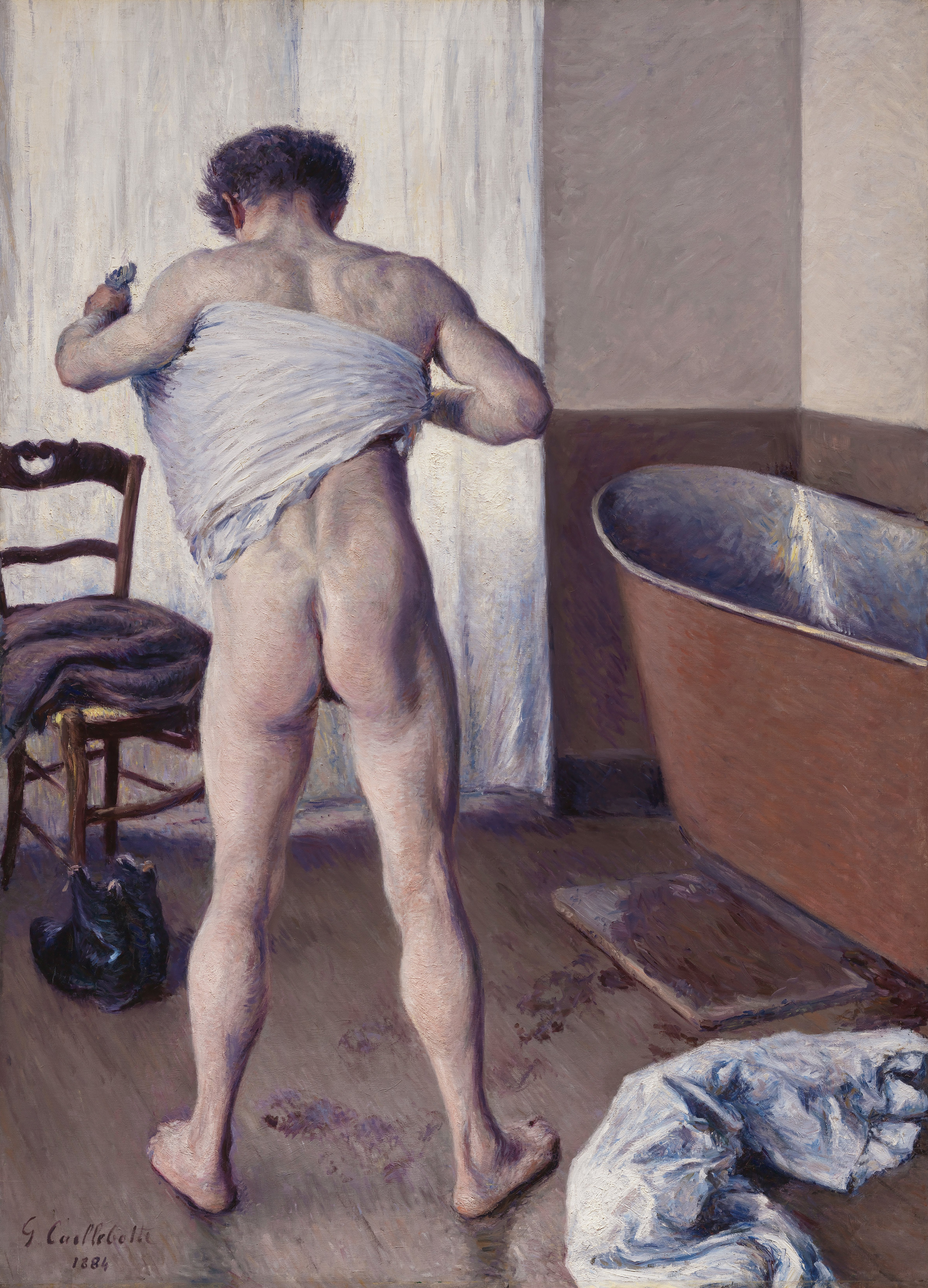
‘Man at His Bath’ (1884)
Still, for all these commonalities, it is not only the case that a great Caillebotte could not be by anybody else (which might be said of all great paintings), but that, in some deeper sense, it does not even seem to be like a painting by anybody else – his works ‘aggressively “don’t fit” into the traditional ways of understanding the period’, according to Varnedoe, who remembered that at the time of his rediscovery in the 1970s, Caillebotte seemed ‘a cultural coelacanth, an evolutionary misfit’ with ‘unfamiliar hybrid features’. It is surely the originality of his conceptions which means that even if people don’t immediately recognise Caillebotte’s name, they will usually recognise his major pictures, even from a short description. It is not just his peculiar way of perceiving and framing the world – what Varnedoe called his ‘subversion of normal spatial experience’ – but the atmosphere thus created, which seems almost always to be one of separateness, pensiveness, even absentness. I’m not sure anybody smiles, or comes close to smiling, in Caillebotte. Nobody communicates, except by means of the visual accidents that connect them but of which they are unaware. These are receding paintings: literally and figuratively, they pull away from us. But they also tease us with those fixed presences in the foreground. In their secretiveness – in refusing to disclose the faces of their subjects, or what their subjects are looking at – they create in us a feeling of longing that ends by suffusing the image itself. They usually show two things, two worlds at once: a front view and a back view, or rather a back view and a front view, which might be taken to represent the seen and not seen, the known and not known quality of urban life.
Or perhaps it is representative of something else. Here is Varnedoe again:
The dichotomy between near and far is not simply a set of aesthetic alternatives for him, but a division strongly felt in terms of human experience. It pervades not just the compositions but also the themes of his paintings, determining the very types of consciousness he depicts … [The dichotomy] seems to be one that has its roots in a dilemma between private insularity and public society, between home and city, and Caillebotte’s recurrent figure of the spectator, poised on the threshold between private and public worlds, thus seems a central emblem in his art, even a symbolic self-portrait.
Could this spectator figure be a symbolic self-portrait of the artist as a gay man, living two lives, divided from himself and his society? The question of Caillebotte’s sexuality has been bubbling away since the late 1990s, when the art historian Norma Broude advanced readings that aimed to ‘decloset and decode’ a number of his major works, outlining her view of his ‘clandestine but nonetheless courageous project’ in an essay titled ‘Outing Impressionism’. With Painting Men, an exhibition that began at the Musée d’Orsay in late 2024 and visited the Getty in Los Angeles before ending at the Art Institute of Chicago last autumn, it at last threatened to boil over. The Parisian art-critical establishment wasn’t happy about the implied approach, interpreting it as a form of American woke madness, even though the exhibition (which I saw at the d’Orsay) and the catalogue refrain from making any bold or wide-ranging arguments about sexuality; still, by the time the exhibition reached Chicago, its name had been changed to Painting His World – which somehow manages to sound gayer than the original.
All that the curators of Painting Men wanted to point out, really, was that Caillebotte’s art is unusual in yet another way: for its preponderance of male figures. Of his five hundred paintings, a hundred represent men exclusively; seventeen include both sexes; and 32 represent women only. I’m not convinced the curators believe what they’re saying, however, when they propose that Caillebotte positions ‘the issue of male identity as central to the project of modern art’, or when they argue that ‘more than any other painter of his generation … Caillebotte seems to have been preoccupied with notions of masculinity and virility’ (an oddly shy use of ‘seems’) and claim that his ‘artistic vision was inextricably bound up with a questioning of masculine identity’.
Not convinced: because the catalogue essays do little to back up these big claims, however informatively they discuss Caillebotte’s relations with his father and brothers, his army service, his status as an ‘amateur’ painter, his interest in sport and so on. Where they are more specific about masculinity in relation to the art itself, they tend to be on familiar ground: considering whether, in painting raboteurs and house painters, or in making a connection between a figure representing himself and a smocked worker on the Pont de l’Europe, Caillebotte was finding modes of solidarity with other men who worked with their hands; giving expression to his republican, democratic, bohemian ideals; responding to the literary vogue for naturalism; or representing a political culture energised by ideas of male strength and healthful activity, after the humiliations of the Franco-Prussian War and the slaughters of the Paris Commune.
But Caillebotte did not only paint workers: he painted bourgeois men in plenty, too, and a naked man after his bath. There is something dubious about the idea that, because Caillebotte painted men, he must have been questioning male identity – especially since nobody seems to know what this questioning involved. A much simpler question, one that we can at least guess at the answer to, is: why did Caillebotte paint so many men? Why did he repeatedly paint the bodies and faces of men, in a variety of settings and with a variety of purposes that cannot add up to a statement or query about male identity (because why would they), but surely tell us something about the identity of Gustave Caillebotte, male painter?
An obvious answer – the obvious one – is that Caillebotte was a bachelor, with a long-term mistress called Charlotte Berthier who was not acceptable to his family on class grounds and whom he apparently had no wish to marry, and that his world was strongly homosocial. Other answers fall in behind this one. His studio was in his home and he painted the friends who came to call, in poses and against backdrops that interested and challenged him. He had no sisters. He had no children. He was rich and did not need to paint other men’s wives for money. He was interested in painting Paris, its busy streets and its architecture, and not the countrified, riverside, holiday occasions that attracted both sexes. His interest in rowing and sailing was of a serious, competitive kind that precluded the presence of the women who feature in Manet and Monet’s pictures of the same subjects. He was simply a ‘man among men’, as Chardeau puts it, and ‘no archive seriously supports the theory of either an open or a closeted homosexuality.’
Alas, ‘he was a bachelor’ has rarely satisfied anyone. And, to me, there is something strangely hollow in this list of statements posturing as answers. The pictures themselves, in their massed maleness, seem to push back, too solid and potent a fact to be explained away by the scant and frail details of the life (almost all of Caillebotte’s correspondence was destroyed by his sister-in-law). It is not that any of the works – even the most obvious candidates – have the warm, lingering sensuality of Sargent’s depictions of men, or of Bazille’s (his portrait of Renoir, hugging his pulled-up knees in a chair, was enough to raise a pink flag for me, and that was before I discovered the naked peachy fishermen and the lounging swimmers). It is something else, harder to distinguish and articulate. It has to do with looking – not just what is looked at, but how; and what the act of looking is made to express. It takes us back to Varnedoe’s general remarks, which I suggested might be read in a way not intended by him: that in Caillebotte’s art the ‘dichotomy between near and far is not simply a set of aesthetic alternatives’ but ‘a division strongly felt in terms of human experience’, with ‘its roots in a dilemma between private insularity and public society’, so that ‘Caillebotte’s recurrent figure of the spectator’ appears as a ‘central emblem in his art, even a symbolic self-portrait’. We might try to see if these remarks can be applied in this other sense, as relating to homosexuality.
The star witness, waiting in the wings all this time, is Man at His Bath (1884): Caillebotte’s large picture of a naked man seen from behind, just out of his soak, caught in the act of vigorously towelling his back, conveyed with a whipping of white paint. He stands out against the paler white of a curtain: his legs are planted apart, his feet turned out, his head bowed so that we see only his neck, ears and tousled hair. Excepting his neck, his skin is much pinker on his lower half, the paint more thickly worked – especially on his buttocks, positioned at the centre of the picture, rosier than any other part of his body, divided and sculpted by a darkness that descends to become the shadowed outline of his balls.
It is a ‘near’ picture, private, screened and contained by the curtain, and yet behind the man stands the figure of the painter, and it is his nearness that is so intriguing: the naked man has ‘taken a bath that Caillebotte has witnessed’, Gloria Groom wrote in the catalogue for the Royal Academy exhibition, ‘or staged to look as if he had done so’, and is now being closely observed. Caillebotte draws our attention to this mysterious before – it is one of those longings he implants in the viewer – by painting in a lovely purple the water that has slopped over the side of the bath, soaked the wooden bath mat and marked the man’s footsteps over to where he is drying himself: his shirt sprawls on the floor; on a chair lies his jacket, and below, his boots. Thus the picture also contains, and evokes, the process of his undressing, as well as the nakedness that preceded and followed his bath. It is an image almost without precedent – departing from the tradition of the heroic male nude that had itself become almost extinct in the 19th century and substituting for it an extraordinary new intensity of physical/visual intimacy. (In a much smaller companion sketch, we see the same man seated on the chair, naked and towelling one outstretched leg, after the fashion of Degas’s women.) It was an intimacy too far – or too near. In 1888, four years after he had painted it, Caillebotte decided to send Man at His Bath to the avant-garde Les XX group exhibition in Brussels: it was rejected, and displayed separately, in an out-of-the-way room. He never exhibited again.
Wonderfully to the point as it is, Man at His Bath must not be seen in isolation – as it is in André Dombrowski and Jonathan D. Katz’s essay in the Painting Men catalogue – but connected with his other works. If Caillebotte’s erotic gaze is in a significant sense the subject of this later painting, then it can also be seen (as it was first seen by Broude) as the subject of an earlier one, The Pont de l’Europe, where the Caillebotte figure looks across at the worker. When contemporaries and later critics saw a relationship between the Caillebotte figure and the woman walking behind him, were they unconsciously recognising the force of this linking look – the thing they could not, would not see? And did Caillebotte rely on this? Even as he added the dog that walks in the space between the two men, and whose lifted, phallic tail connects it to the worker?
That Caillebotte looked absorbedly at workers in other paintings, too – the shirtless raboteurs, the handsome young house painters – might well mean that he was a man of democratic, republican beliefs, interested in forging imaginative connections, bonds of sympathy, with labouring men. It might even mean that he was interested in making ‘male identity central to the project of modern art’. But such fantasies of cross-class connection, although ideologically genuine, were very often held by gay men in this period, and were central to their ideas of modern art. They were meat and drink to Whitman, Edward Carpenter and John Addington Symonds, who wrote of a world delivered from ‘traditions regarding style and the right subjects to be handled’, and of an ‘emancipation of the intellect by modern science and the enfranchisement of the individual by new political conceptions’, with the result that
the poet or the artist is brought immediately face to face with the wonderful fresh world of men and things he has to interpret and to recreate. The whole of nature, seen for the first time with sane eyes, the whole of humanity, liberated for the first time from caste and class distinctions, invite his sympathy. Now dawns upon his mind the beauty, the divinity, which lies enfolded in the simplest folk, the commonest objects presented to his senses. He perceives the dignity of human occupations, the grace inherent in each kind of labour well performed.
We should link Caillebotte’s images of labour to Boaters and Boating Party, those close-up views of rowing men, sleeveless or coatless: especially the man in the latter painting (which Broude made central to her argument), with his spread legs and slightly bulging crotch, accentuated by the gathering of his trousers. In his catalogue essay, Paul Perrin notes that boating was ‘recognised at the time as particularly egalitarian, because it involved men from different social backgrounds and placed them on the same footing, and fraternal, since it promoted the spirit of clubs and collective effort’. It is relevant that Caillebotte’s exclusively male boating pictures call to mind those of Thomas Eakins, a French-trained gay painter whose style elsewhere is reminiscent of Caillebotte’s (compare the rangy physique of his boxer in Salutat with one of the raboteurs).
What if we go a little further, then, and conceive of Caillebotte as having a gay or queer male gaze, which structured or directed much of his work? We look over the paintings, and remember the images of men watching men: In a Café, with the main figure looking past the viewer at the two men we see in the mirror; the swimmer, climbing out onto the bank, who looks across at the arched body of a diver; Caillebotte’s self-portrait of 1879, where his gaze in the mirror also takes in his friend Richard Gallo, who sits behind him on a sofa, in a pose the curators of Painting Men call ‘not trivial, evoking as it does images of couples in which one of the partners discreetly hangs back’; the strange late picture of Caillebotte and his friend Émile Lamy, standing only a little apart, divided (from the perspective of the viewer) by a tree, and staring directly at each other. We see those images of men watching, alone or in pairs, standing at or leaning over balconies – which are also images of Caillebotte’s watching. All those rear views, trousered behinds, with Man at His Bath beneath them.
If we imagine Caillebotte’s paintings as depending on what we might call a ‘cruising eye’ – one that focuses on instances of men watching men, and also instantiates the act of watching men – then we can see his pictures of the city differently. Paris Street; Rainy Day – with what Varnedoe called its ‘over-wide isolation between figures’, the majority of them male, and its ‘anxious over-openness’ – becomes a survey of possibilities, of the secret existences and experiences concealed and suggested and enabled by all this busyness and anonymity. A secret life that is both tantalisingly near and troublingly distant, that is difficult to communicate.
But this cruising eye is also central to two of Caillebotte’s strangest and most original images, and to his extremely particular vision of the urban experience – and so to his project of modern art. In A Traffic Island, Boulevard Haussmann (1880) – ‘Caillebotte is doing traffic islands on the boulevard Haussmann from his windows, or so I’m told,’ a bemused Degas wrote to Pissarro – Caillebotte gives us an elevated view, without any visible trappings of a window: we simply look out on a traffic island, surrounded by a moat of road. Everything is very pale, in dusty shades of white and pink, seemingly under blinding, baking sunlight. There are people, probably women, crossing the road, and two carriages, and there are lamp-posts round the island, but these are all sketchy, hardly more than gestures. And yet the image, otherwise so oddly blank, is made stark and vital and mysterious by three men, firmly painted in heavy black coats and hats, with featureless pink faces, casting distinct shadows, who stand at equal distance from one another. One man faces away, at the far side of the island, and the other two face the viewer, one at the near side of the island and the other only visible from the sternum up, cut off at the very bottom of the picture frame.
In the other image, made in the same year, Boulevard Seen from Above, Caillebotte gives us an even more radical view, looking directly down on the pavement from a high window. Seen from this unexpected angle, the road makes a diagonal across the top of the picture, and the branches of a tree stretch to cover almost all the pictorial space. Varnedoe called it one of ‘the most astonishingly modern paintings in Caillebotte’s oeuvre. Its origins, and its uniqueness in its time, defy simple explanation.’ But again, fitting between the branches that spread above them, are four men, black-coated and featureless, two standing near each other, and one walking with his head turned in the direction of another, who lounges cross-legged on a bench.
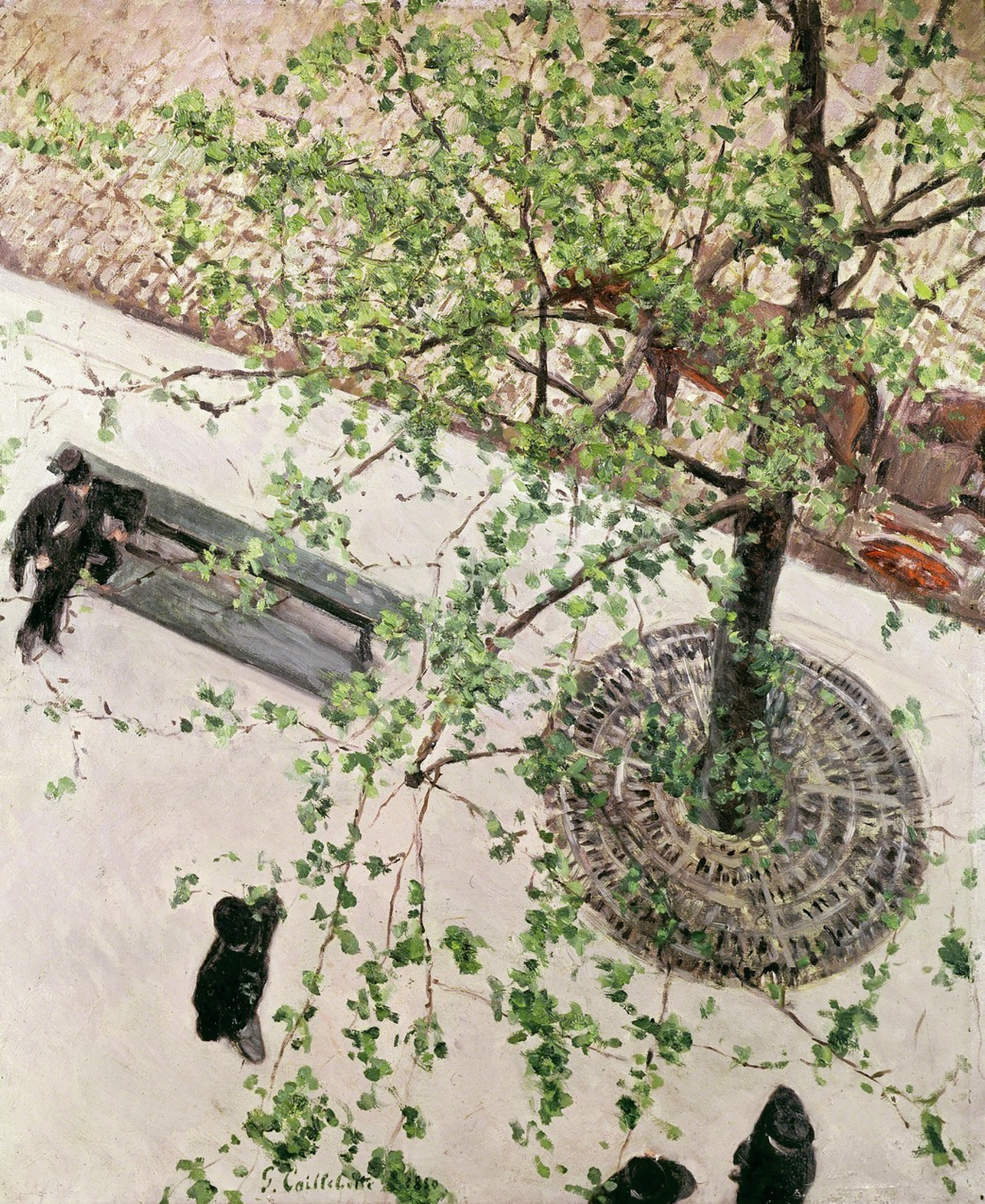
‘Boulevard Seen from Above’ (1880)
What two images better capture the modern city as a place of anonymous, anonymised watching – putting men on display, running them up against one another, making them subject, whether they are conscious of it or not, to the cruising male eye? The pictures’ experimental perspectives combine near and far in one flat, enclosed plane: collapsing our view into that of the watcher, and yet keeping the visible figures abstract, unknowable and, as yet, unreachable. Near and far, private and public, known and not known: these push-and-pulls of homosexual existence are dramatised and the figure of the spectator, Caillebotte’s symbolic self-portrait, made central to this sexualised version of the urban experience, and of late 19th-century modernity.
To all of this, convincing as it seems to me, the sceptic might simply state again, with Chardeau, that no archive supports ‘either an open or a closeted homosexuality’ (though when it comes to Caillebotte there is no real archive to speak of). They might point to Caillebotte’s apparently much loved partner, Charlotte, who was generously provided for in his will – though their relationship does not preclude a parallel or contiguous desire for men that may have been unarticulated and perhaps never acted on (and Caillebotte did have an unusual number of bachelor friends). Or scepticism may take another, more peculiarly 21st-century form. In their essay Dombrowski and Katz, though alert to the homoerotic qualities of Man at His Bath, argue that
in the absence of anything definitive regarding Caillebotte’s sexuality, we should not take his heterosexuality as a given either but understand the framing of the query concerning his sexuality as itself so contaminated by present-day assumptions and ideologies as to be essentially meaningless. It is his paintings’ sexuality – and especially their rather explicit and pronounced homoerotic scenarios – that concerns us instead.
They conclude by saying that his work is a
challenge to the notion that homosexuality is the other side of heterosexuality, or that homosexuality belongs only to the homosexual. His paintings, after all, belong to a moment before the very idea of homosexuality would carry the day. Instead, they turn on the notion that there are no absolutes in desire, that sameness and difference animate all forms of sexuality, homo- and hetero- alike. [His male nudes] functioned then, as they do now, as evidence that … oppositions are engineered and thus not nature but mere culture, that identity is a fragile and fugitive thing, easily undone. Born of a period before our categorisations, his paintings of naked men seem to have already known what we only lately have discovered.
In its generalities, in its abandonment of historical perspective and comparative analysis, in its removal of sexuality from humans and attribution of it in the most shapeless possible form to paintings, in its reheated Foucauldian conceptions (the strangely misguided and obtuse belief that late 19th-century categories of sexuality were new ideas and impositions, rather than just the latest and often the first progressive attempts to describe groups and types of people that had always been present and visible in human society) and, best of all, in its touching belief that it is not ‘contaminated by present-day assumptions and ideologies’, this argument takes us nowhere. Compare it with Broude’s assertion, more than twenty years ago, that to discuss images ‘solely as cultural artefacts that can be divorced from the sexuality of their makers would be to collude in the effacement of gay history and identity’. The belief that all the answers are on the surface is inimical to the spirit of Caillebotte’s work. If Caillebotte’s paintings teach us anything, it is that looking is its own pleasure.