The Cuban artist Wifredo Lam’s best-known work, La jungla (1942-43), is a riotous and unsettling painting. Measuring nearly eight feet by seven-and-a-half, it features a series of anthropomorphic figures standing amid dense green vegetation. They are long-limbed, with outsize feet and curving buttocks; parts of faces, somewhere between stylised human and totemic animal, float above their torsos; three of the figures have plump fruity breasts attached to their bodies, while two have scrotum-like appendages on their chins. In the upper right of the painting, a hand holds up a pair of shears; at the lower left, a face is attached to one of the figure’s shins, perhaps a parasite or just another piece of its fantastical anatomy.
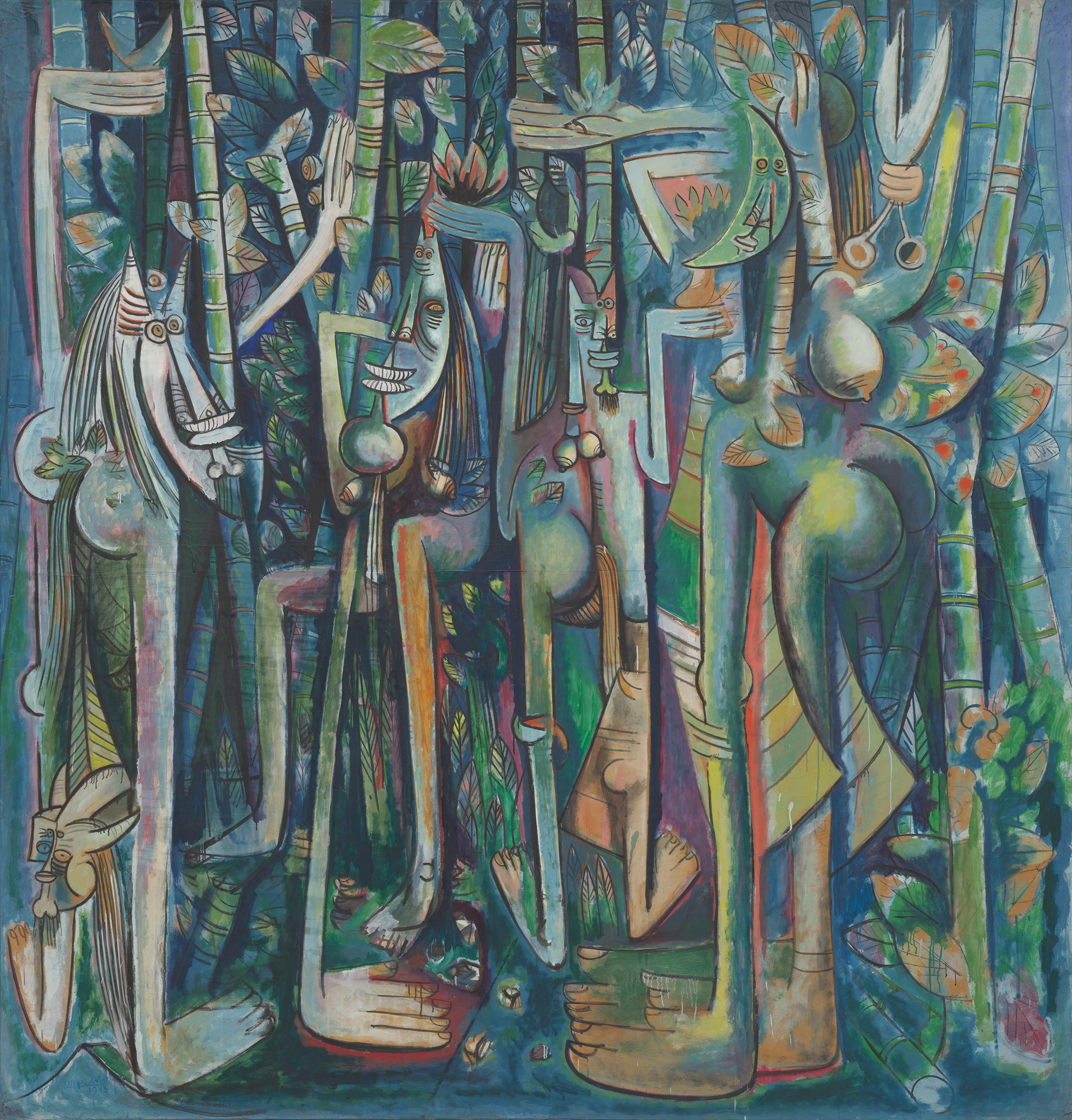
‘La jungla’ (1942-43)
Many have interpreted the figures in La jungla as representing the orishas, the guardian spirits of Afro-Cuban spirituality, and the painting itself as a celebration of the African component of Lam’s heritage: his mother was of Spanish and African descent, his father Chinese. Yet unlike many of Lam’s other works, La jungla doesn’t make direct references to African traditions, and its deliberate ambiguity of tone – at once spectral and fleshy, sensual and comic – resists any straightforward reading. Lam himself was coy about its meaning. Towards the end of his life, in 1981, he referred to it as a ‘self-portrait’. ‘You only have to look at it, it’s me,’ he said. But the painting also seems intended to parody the Western fetishisation of colonised people’s bodies and cultures. In 1950, the Cuban anthropologist Fernando Ortiz described the buttocks of the figures in La jungla as embodying ‘Cuba’s sensual mulatto nature’, yet they seem (at least to me) to send up that stereotype. When asked about them decades later, Lam deadpanned: ‘I put the large buttocks there as a volume corresponding to the diagonal on which the weight of the composition rests.’
MoMA acquired La jungla in 1945, and between 1946 and 1988 it hung in the museum’s lobby – a prominent location but also a liminal one that perhaps implied some unease over what exactly the painting was doing. For the poet and critic John Yau, the painting’s placement signalled its exclusion from the canon and by the same token Lam’s secondary status as a mere follower of Picasso or an imitator of Surrealism. MoMA’s current retrospective, When I Don’t Sleep, I Dream (until 12 April), is the largest yet devoted to Lam, and is clearly designed to rectify this marginalisation. The new English translation of Jacques Leenhardt’s 2009 monograph on Lam adds further impetus to that effort (Thames and Hudson, £55).
Born in the sugar-producing town of Sagua la Grande in 1902, the year Cuba finally attained full independence, Lam moved to Havana in his late teens and began making art. In 1923, he received a scholarship to study in Madrid and spent the next fifteen years there, working at first on painstakingly dense pencil portraits – Dürer was an early influence – as well as landscapes and self-portraits in oil. The wry deployment of ethnic stereotypes is evident from early on: Sol (1925) shows a languid, semi-reclining Lam dressed in a Chinese silk gown and holding a fan. While in Spain he also absorbed Cubism, though his palette was often brighter: an untitled work from 1937 shows two seated female figures, faces and bodies deconstructed into an assemblage of planes and curves in yellow, green, purple and a rich chalky blue.
In 1931, Lam lost both his wife and one-year-old son to tuberculosis, a tragedy that shadows later works such as the faceless Mother and Child (1939). He began to frequent leftist circles, meeting Federico García Lorca and other socialist intellectuals. When the Civil War began, he enlisted in the Republican army and fought in the defence of Madrid. While convalescing from an illness contracted in a Republican munitions plant, Lam painted La guerra civil (‘The Civil War’), in which a morass of figures and body parts tangle, and rifle stocks point at various angles towards the centre of the painting. In the lower section, three female figures emerge more clearly, hunched in grief over a prone body; behind them, a woman carrying a child confronts an impassive soldier. The palette here is more subdued, the background a faded beige: La guerra civil was painted on sheets of kraft paper glued together, and Lam left much of the surface untreated.
In the late 1930s and early 1940s, Lam used kraft paper out of necessity, but later he frequently returned to it out of choice, and would often use commercial paint thinned with turpentine rather than oils. The untreated surface contributed to another shift in his method: a blurring of the relation between figure and ground, which creates a sense of spatial unmooring. In La guerra civil, the ground on which the conflict is unfolding – physical and political – is solid enough, but his later work often seems to suspend the laws of gravity, the feet and arms of his spectral figures floating towards the edges of the frame.
In 1938, Lam moved to Paris, where he befriended Picasso. The latter’s influence is clear in such works as Tête (1940), where the large oval of a face is segmented by a long wedge of a nose, the mouth and one eye simplified into horizontal lines. The fall of Paris in June 1940 forced Lam to join the exodus to Marseille and he became close with the Surrealists: André Breton, Max Ernst and Benjamin Péret were among those also waiting for an exit visa. At first through the collective drawing game of ‘exquisite corpse’ and then in a stream of ink drawings, Lam unleashed a burst of fantastical forms: combinations of human and animal anatomy flow into plants and chairs, nipples and nodules protrude from bodies, teeth and eyes appear in unexpected places. While Surrealism clearly played a role in unlocking these forms, he also seems to be playing a characteristic double game, edging back and forth between something that looks like a symbolic language and the gleeful play of autonomous forms.
In March 1941, Lam was able to leave Marseille, making his way to the Caribbean on board the Capitaine Paul-Lemerle. Quarantined in Vichy-controlled Martinique for a month, Lam met Aimé Césaire, forging what would become a lifelong friendship; two years later, Lam illustrated the Spanish translation of Césaire’s Cahier d’un retour au pays natal, the first of many collaborations. Césaire, for his part, wrote some of the earliest critical assessments of Lam’s work, finding in it a visual counterpart for his own condemnations of colonialism and re-engagement with African cultures. Lam often asked his friends to give titles to his paintings, and it was Césaire who put a new name to a gouache from 1938 of a weeping, dark-skinned woman, her face broken into geometric blocks of colour. In 1961, he titled it Madame Lumumba, after the wife of the Congolese leader assassinated earlier that year.
In August 1941, Lam returned to Cuba – a difficult homecoming. ‘What I saw on my return was like some sort of hell,’ he said, referring to the country’s semi-colonised status and pervasive corruption, which for Lam extended to the commodification of Afro-Cuban music and dance. ‘I refused to paint cha-cha-cha,’ he told Max-Pol Fouchet in 1976. Yet he found a way out of this apparent impasse: between 1942 and 1949 he produced some four hundred paintings. The breakthrough of La jungla comes after a series of works in which Lam was developing a new idiom; all feature anthropomorphic figures which loom out of tropical vegetation. The speed with which he was working is fully apparent: in parts of La jungla the thinned-down paint has run a few inches, giving the painting an air of hastiness that is at odds with the density of its composition and its monumental scale.
These formal developments seemed to reflect a shift in purpose that perhaps explains La jungla’s ambiguous power. In his interview with Fouchet, Lam noted that on his return to Cuba, he wanted ‘to paint the drama of my country, but by thoroughly expressing the negro spirit, the beauty of the plastic art of the blacks’. In this way, he added, ‘I could act as a Trojan horse that would spew forth hallucinating figures with the power to surprise, to disturb the dreams of the exploiters.’
According to Césaire, what Lam’s paintings carried was a ‘cargo of revolt’: ‘men full of leaves, of sprouting sexual organs, growing topsy-turvy, hieratical and tropical: gods’. Many of his works from this period incorporate elements from African and Afro-Caribbean religions: Le Sombre Malembo, Dieu du carrefour (1943) includes a horned face that seems intended to represent the Yoruba deity Elegguá, god of the crossroads. Mofumbe and Omi Obini (both 1943) are like Cubist portraits of orishas, the former against a backdrop of dazzling spatters of colour, the latter standing in front of a wall of multicoloured vegetation. These spiritual motifs were familiar to Lam: his godmother, Ma’ Antoñica Wilson, had been a priestess of the Lucumí religion. His return to Cuba coincided with a growing interest in Afro-Cuban traditions, and Lam became close to some of its leading proponents, including the anthropologists Fernando Ortiz and Lydia Cabrera. In 1946 he travelled to Haiti to exhibit some recent paintings and while there attended Vodou ceremonies, which by all accounts exerted a powerful influence on him. (And on others: Breton apparently felt sick afterwards, leading Lam to make fun of his earlier enthusiasm for ‘convulsive beauty’.)
Even as he deploys African and Afro-Caribbean spiritual motifs, however, Lam transforms and adapts them. There are drawings that echo the formal language of vèvès, the ritual tracery of Vodou, and then there is the enigmatic figure of the femme-cheval, the horse-headed woman, which first appears in a painting of the same name in 1948. In Vodou ceremonies, the person being possessed by a given deity is referred to as a ‘horse’ who is ‘mounted’, making the femme-cheval a kind of freeze-frame of this transitory fusion of the human and the divine. It also speaks to Lam’s own experience of in-betweenness. While in Haiti, he met the artist Hector Hyppolite, who rejected the idea of a direct African influence on Lam’s work by assigning it to another part of his heritage: Lam did not paint ‘African symbols, he paints Chinese ones’. Later in 1946, Lam returned to Europe and expressed another sense of dislocation: he wrote to his second wife, Helena Holzer, that ‘here I feel that I am a sham, like some exotic being (branded, as it were), like a Negro or Oceanic statue from the Pacific, it doesn’t matter where from, but whose transplanted being becomes here a sterile product, a weird museum object.’
Yet what felt inauthentic in Europe was central to Lam’s understanding of his own work in Cuba. He referred to a ‘desire to include in my painting all the transculturation that had occurred in Cuba’ – using a term coined by Ortiz to describe the island’s fusion of cultures. The ingredients Lam identified included ‘the native population, the Spanish, the Africans, the Chinese, French immigrants, pirates’, adding: ‘I claim all this past for myself.’ Where others might seek to meld these components into a harmonious synthesis – Ortiz used the metaphor of an ajiaco, a stew – Lam kept them in tension, leaving their incongruities unresolved.
After Fulgencio Batista seized power in 1952, Lam settled in Paris and would spend most of the rest of his life in France and Italy. Many of his works from the late 1940s and early 1950s retain the anthropomorphic figures of previous years but with a much more sombre palette: La Rumeur de la terre (1950) features white and grey wing-like entities floating amid huge black angular forms, all against a dark brown backdrop. Lam’s largest work on paper also dates from this time: Grande Composition (1949), some ten feet by fourteen, is populated by the familiar long-limbed, human-animal hybrids – bodies sprouting horse tails, hooves, breasts and horns. He leaves the kraft paper bare, filling in the background with charcoal; pencil lines are visible across much of the surface, as if the work were still in progress or the thought behind it incomplete. In overall effect, Grande Composition is reminiscent of Picasso’s Guernica. But what crime is being committed here, what battle being fought out? A more ambiguous drama is unfolding, and Lam’s deployment of elements from multiple traditions – the mask-like faces seem to draw equally on African and Oceanic art – points again to the slow process of ‘transculturation’, with its combination of conflict and absorption.
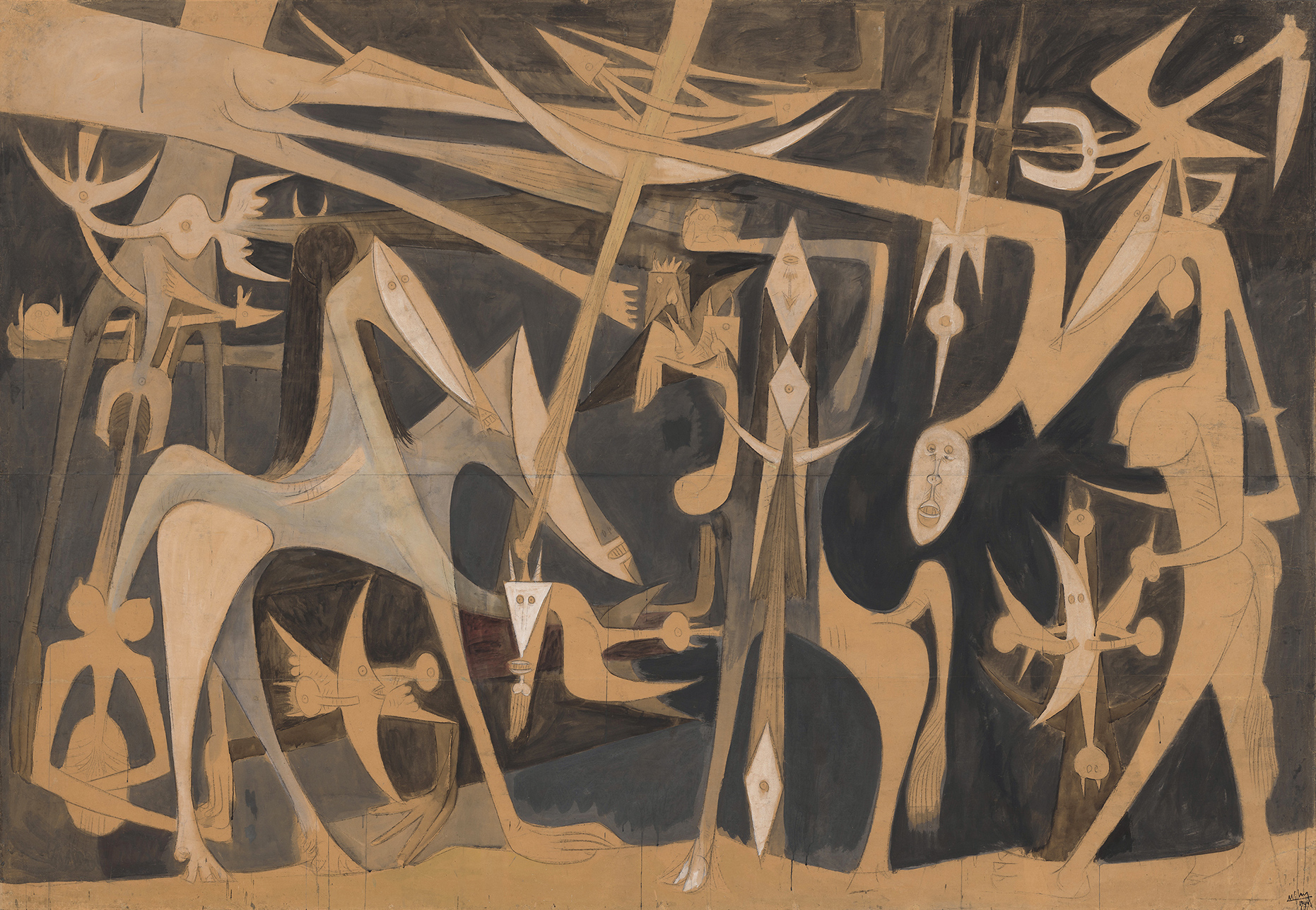
‘Grande Composition’ (1949)
In the late 1950s, Lam developed a new formal vocabulary in a series of large abstract works known as the ‘Brousse paintings’. These lack any figurative element: instead we see dense thickets of angular forms, occasionally flecked with white or dashed through with other colours. The ‘bush’ of the title refers to the vegetation characteristic of much of rural Cuba, a tangled, swampy undergrowth called manigua. Celebrated in national mythology as the terrain of Cuba’s independence struggles, at the time it would also have evoked Fidel Castro’s guerrilla struggle against Batista.
The Brousse paintings are the only occasion where the MoMA exhibition refers, even obliquely, to the Cuban Revolution. Given the ongoing US blockade of Cuba, this is perhaps not surprising; notably, the exhibition features no works loaned from Cuba, which would almost certainly have been confiscated by US authorities. Still, the silence is puzzling given Lam’s strong public support for the revolution. He called a 1958 painting Sierra Maestra in homage to the mountains where Castro’s rebellion began, and visited Havana regularly from the early 1960s onwards, giving interviews to outlets such as Bohemia. El tercer mundo (1965-66) was painted on site for the Museo Nacional de Bellas Artes and Lam contributed to a huge mural titled Cuba colectiva. When his health began to fail in 1980, he returned to Cuba for treatment, and after his death in Paris in 1982 his ashes were interred in Havana’s Colón Cemetery, after a state funeral presided over by Castro.
The elision of the Cuban Revolution becomes especially glaring given the prominence the exhibition gives to the theme of decolonisation. Lam’s connection with Césaire is rightly emphasised. But the political upshot of their shared anti-colonialism appears reduced here to a generalised anti-racism and, as the curators of the exhibition put it, a commitment to ‘making space for diasporic culture’. The idea that decolonisation might amount to something more concrete and radical than this, and that the Cuban Revolution might have been an example of it, doesn’t seem to enter the frame. But it’s clear that Lam saw it in these terms: he painted El tercer mundo while the Tricontinental Conference – including delegates from Africa, Asia and the Americas – was taking place in Havana, connecting Cuba’s struggle against US imperialism to those of recently independent states against their former colonisers. The painting’s vertiginous dissolution of perspective – gravity is again suspended, allowing a jumble of spectral figures to drift up and down and across the frame – might well depict a world finally unloosed from its imperial moorings.
Lam described his work as ‘an act of decolonisation, not physical but mental’. The phrase is frequently quoted by critics and is cited in the exhibition to support its claim for Lam’s contemporaneity. Less often mentioned is the fact that those words are taken from an interview published in Bohemia in 1980, in which he also insisted that ‘I would like people everywhere to be well aware of my solidarity with and confidence in the Cuban Revolution.’ For Lam, mental decolonisation wasn’t disconnected from the political kind; the two unfolded in tandem, and Cuba was carrying it out in the political sphere just as he was in the artistic one.