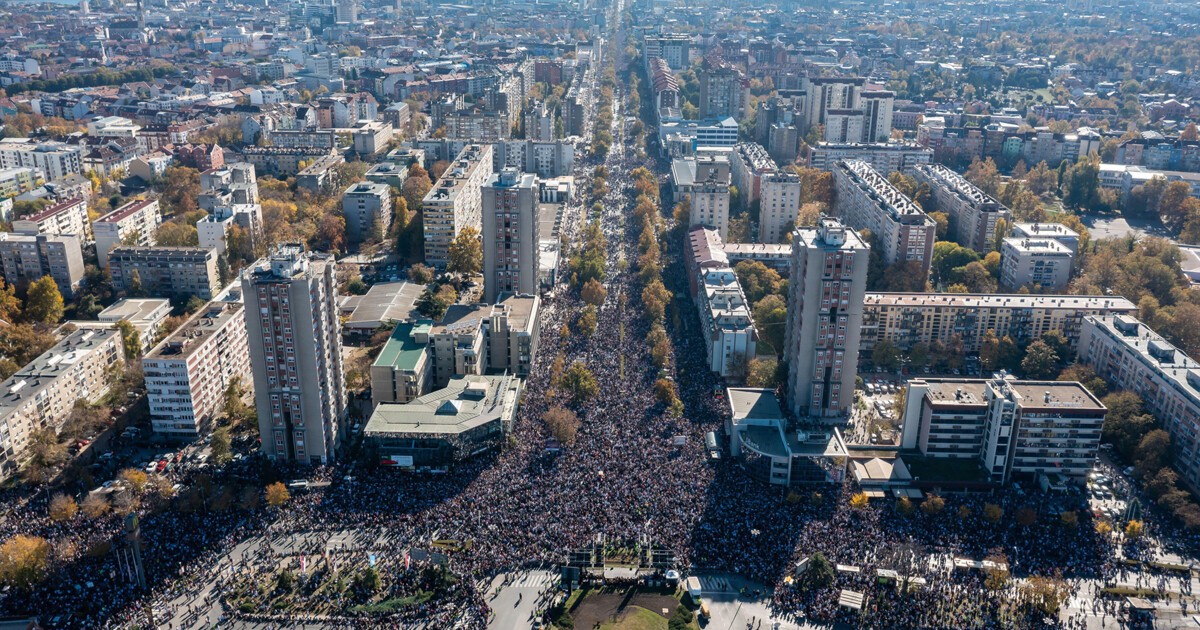
On 1 November 2024, the canopy of a recently renovated train station in Novi Sad collapsed, killing sixteen people. In the weeks that followed, a new protest movement coalesced; it continues to demonstrate sixteen months later. For its leaders, the collapse is symptomatic of the corruption at the heart of Aleksandar Vučić’s increasingly authoritarian government. Questions around corruption and democracy don’t only concern young people, but it was students who led the way, and in Serbia, ‘the students’ and ‘the protesters’ are now treated as more or less interchangeable.
It didn’t start out that way. The collapse of the train station drew people of every age and background onto the streets. But opposition parties failed to use the opportunity to present a wider set of complaints about Vučić, a decision many members now regret. Three weeks after the collapse, students from the Faculty of Dramatic Arts in Belgrade organised a protest. Following a crackdown in which students and academics were attacked by supporters of the government, the drama students decided to carry out a ‘blockade’ of the faculty, bringing classes to a halt. University departments around the country followed suit. A loose confederation soon formed, making decisions by majority vote at assemblies. This structure has held for more than a year. All students are invited to come to the meetings and vote; no one else can attend, though academics have generally supported the students, and sometimes collaborate with them outside the meetings.
At first, the student movement distanced itself from electoral politics. It demanded accountability through blockades and street mobilisations, often at the time – 11.52 a.m. – of the station’s collapse. Since last spring, however, it has called for elections; it now has a list of candidates, which hasn’t yet been made public. To find out what will come next, you have to pick up gossip from a twenty-year-old. Or you can do what the rest of the country does: wait for the web of secret councils to make a decision and publish it on social media, where unnamed representatives post as ‘Studenti u blokadi’. Two polls last year indicated that more than half the population would vote for the student list in an election and that more people trust the students than trust Vučić.
Along with secrecy and a lack of hierarchies, another feature of the movement has been the formation of neighbourhood assemblies called zborovi, following an appeal last Marchfrom the students to spread direct democracy outside the university. More than a hundred zborovi were set up around the country, according to the student movement. But when the assemblies made demands to local politicians and officials – to improve school facilities, say, or to repair potholes – they were ignored. ‘The zborovi were supposed to take some pressure off of the students, who are tired, and bearing so much responsibility,’ Nina, a mathematics student, told me when I visited Belgrade last November. ‘But the population did not place the same trust in them that they have put in the student movement.’ I arrived a year after the train station collapse: the students had organised a huge rally in Novi Sad to mark the anniversary, and tens of thousands of people turned up, making clear that the movement was still very much alive. On 2 November, Vučić said he would call parliamentary elections before the current term ends in December 2027 (a new date has yet to be announced). The same day, Dijana Hrka, the mother of one of the victims, began a hunger strike outside parliament. ‘The students have united Serbia and are fighting for justice for all of us,’ she told local media. ‘They are all my children.’
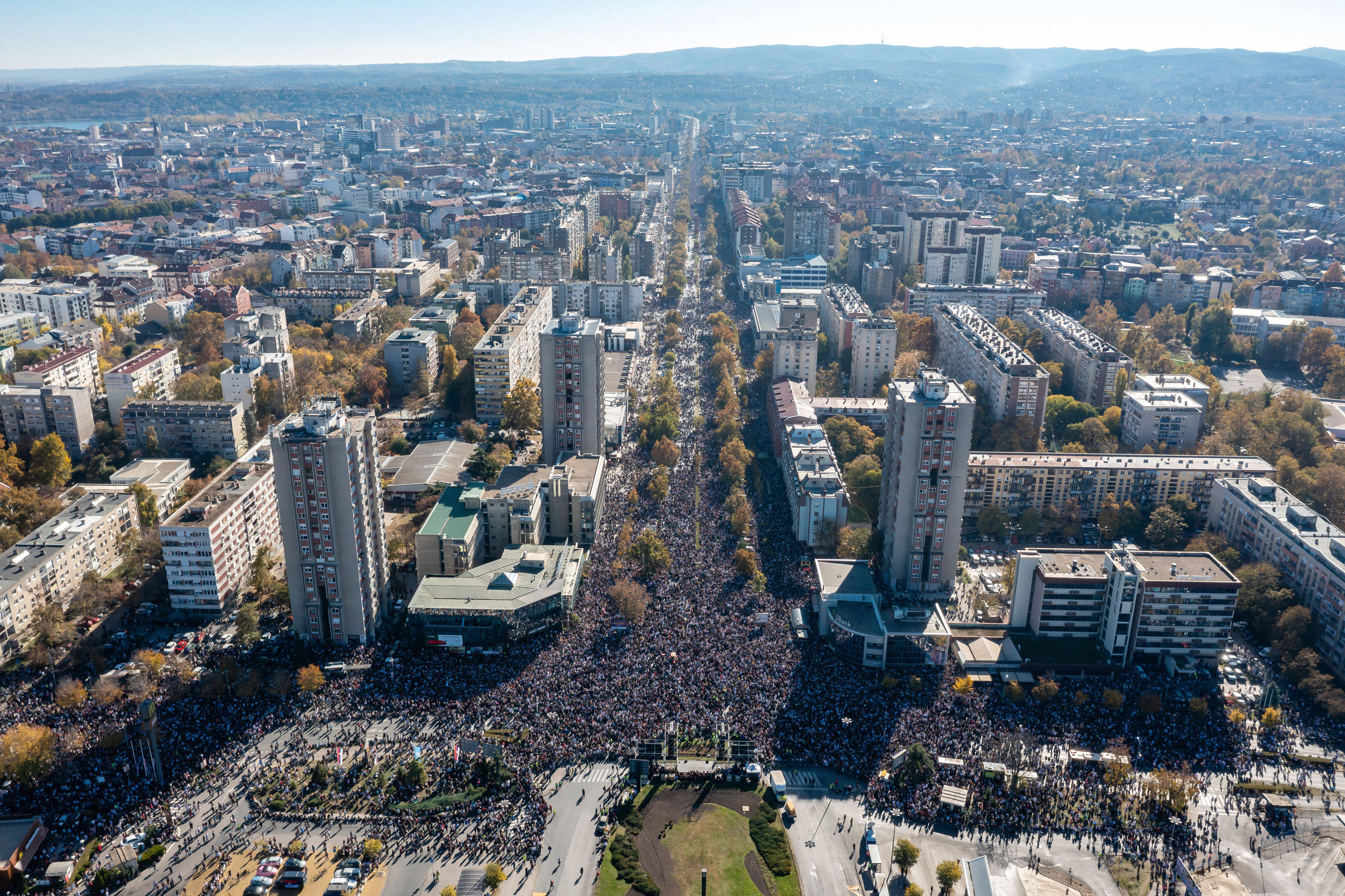
Rally to mark the first anniversary of the train station collapse, Novi Sad, 1 November 2025.
A few days into her hunger strike, I joined Hrka and her supporters outside the National Assembly. They traded insults with pro-Vučić activists, who have their own encampment – known to the protest movement as ćaciland – in Pionirski Park, opposite parliament. (The name comes from an incident in January 2025, when someone in Novi Sad tried to graffiti ‘students, go to school,’ but misspelled the word đaci, or ‘students’. The protesters have adopted ćaci as shorthand for supporters of the government, especially those who man the pro-government barricades.) The student protesters chanted at the ćaci, alternating between ‘Vučiću, lopove!’ (‘Vučić, thief’), ‘Aco, pederu!’ (‘Alex, faggot’) and ‘Aco, šiptare!’ (literally ‘Alex is an Albanian,’ though šiptar is usually used as a slur). Some protesters think the last of these is true: there’s a conspiracy theory that Vučić’s mother had an Albanian lover. Others argue that Vučić has betrayed the Serbs in Kosovo and capitulated to its Albanian masters.
The next day, I took a bus to Kosovo. It’s a slow journey, through parts of Serbia that are markedly less developed than Belgrade or Novi Sad, and more likely to back the government: most of Vučić’s supporters are older Serbians living outside the major cities. Eventually the bus stopped at a border recognised by half the world. Since the 2008 declaration of independence, 110 out of 183 UN members have recognised Kosovo as a sovereign state (most recently the new Syrian government, which formally recognised Kosovo last October, and the Bahamas). There’s a statue of Bill Clinton in Pristina and many Kosovar Albanians feel positively about the Nato intervention in 1999, yet Kosovo doesn’t have full autonomy and remains highly dependent on Washington. The left-leaning Self-Determination Movement, which has governed Kosovo since 2021 after emerging from its own protest movement, deleted pro-Palestine Facebook posts and articles on its website after taking power, presumably to avoid offending Washington.
Kosovars have been paying attention to the protests in Serbia. ‘It is impossible not to notice quite a few things that cross the line,’ Rozafa Maliqi, a community organiser, told me. She was referring to anti-Albanian chants, as well as the nationalistic character of some of the movement’s public statements. ‘It is obvious that nationalism is present in the demonstrations. What is not obvious is what will happen if the students “win”,’ Auran Doli, a recent graduate from the University of Pristina, said. ‘On the one hand, it’s positive that there is a movement to oppose Vučić in Belgrade. On the other hand, I don’t think they have the organisational structures or the coherent political project needed to transform that opposition into real change.’
A similar critique has been made by the economist Branko Milanović, Serbia’s most famous public intellectual. Last March, he wrote a post on Substack arguing that, for all the students’ bravery, the protests would accomplish the opposite of what they wanted. ‘The movement realised early on that it could be successful only if it was entirely apolitical,’ he wrote. To transform itself from a protest movement into a political movement, it would need to establish ‘a hierarchical organisation with known leadership (no single leader has emerged in almost four months!), convert its current language into a political idiom, and expect, or hope, to politically represent large segments of the disaffected population’. But, Milanović warned, ‘once it does that, it descends to the level of political parties, which are widely distrusted.’ He was withering about the protest movement’s commitment to secrecy, writing that it resembled ‘more the Khmer Rouge than the Polish Solidarność’.
This intervention, by a professor comfortably employed in New York, angered the students, their supporters and sympathetic academics. But in the weeks that followed, the movement slowly and carefully changed its stance, calling for elections and starting to prepare its list. The selection process itself is secret, but it’s not hard to find out that candidates will include academics, civil society leaders and some athletes. I met people who had been asked to join but declined, out of a desire to escape the inevitable media onslaught.
Dobrica Veselinović, a deputy for the Green-Left Front in the National Assembly, told me he could understand why the students ‘decided to put up a wall’. He’d seen for himself the way activists can be targeted in the press and in the courts. His own party was formed in 2023, having emerged out of an earlier protest movement, Don’t Let Belgrade Drown, which had opposed a redevelopment project on the city’s waterfront. The activists eventually decided to enter party politics. The Green-Left Party now has ten seats in the National Assembly. They didn’t appreciate it when the student movement, especially in its early days, denounced the entire opposition.
On a previous visit last March, many students told me their movement was open to right-wing members. Some mentioned that they had told visiting journalists that the protesters included students with right-wing views, only for this to go unmentioned in the eventual articles. But in Serbia, it’s impossible to ignore those elements. Comments by speakers at an event on 28 June (commemorating the Battle of Kosovo), including claims that the protests were about ‘Serbian people outside Serbia’ and ‘the struggle for Serbian integralism’, made it clear that Serbian ethnonationalists are present in the movement. Supporters of the protests scrambled to offer explanations. Many students didn’t share the views of the speakers, they said, but if the movement sought to speak to and represent all Serbians, it couldn’t exclude those who are nationalist or right-wing. Once the students had helped bring about the end of the Vučić regime, discrete political groupings – right-wing, left-wing, centrist, internationalist, environmentalist – would form.
For now, it’s not difficult to find students who oppose Vučić from the right. I met Milos, a dedicated weightlifter, at an upscale restaurant in central Belgrade. He declined the starters I’d ordered, saying he’d recently cut out carbs. He told me he was in the movement for three reasons: he wants to put the Orthodox Church back at the centre of Serbian society; he opposes the LGBT agenda imposed by the West; and he thinks Serbia needs to do more to support the ethnic Serbs living in Kosovo.
In parts of Belgrade, daily life is still routinely brought to a halt by protests. There have been major protests since the start of the year: thousands marched in Novi Sad on 17 January, and there was a large rally outside the University of Belgrade ten days later in support of the academics and teachers who have lost their jobs because of them. Vladan Petrov, a professor of law at the university and a judge on Serbia’s constitutional court, told me he thought the disruption should end. The best thing, in his view, would be if the pro-government encampment were dissolved and the daily protests gave way to ‘the return of dialogue through our institutions’, ahead of the elections. Petrov has publicly supported Vučić. He is comfortable being seen as a defender of the current order, but understands that many people don’t trust the country’s institutions. The president, he says, ‘now has more power than is theoretically in line’ with the letter of the constitution. But he stressed that Vučić wouldn’t have been able to accumulate that power without winning three elections. Even in the poll most often cited by supporters of the student movement, 42 per cent of Serbians say they would vote for the ruling coalition.
The students I spoke to often invoked similar movements, such as the protests in Chile 2011, which led to the election of a former student leader, Gabriel Boric, as president. Vučić himself has compared the movement to the ‘colour’ revolutions in Eastern Europe in the 2000s, which were backed by Western powers. But despite having emerged from the nationalist movement led by Slobodan Milošević, during his thirteen years in power Vučić has been a mostly reliable interlocutor for Washington, Brussels, Moscow and Beijing alike. (He has been critical of the US attacks on Venezuela and Iran, though it’s not clear if the Trump regime has noticed.) ‘Vučić wants to treat this like it is Maidan, because he believes he knows how to fight Maidan, but this is not Maidan,’ Miloš Vukelić, who teaches international relations at the University of Belgrade, told me, referring to the uprising in Kyiv in 2013-14. The Ukrainian example allows Vučić to associate the protests with a movement that is unpopular in Serbia: a 2022 poll showed that a majority of Serbians blame Nato for the war in Ukraine and view Russia as a ‘true ally’. But among the protesters, one of the most common accusations levelled at Vučić is that he has been too accommodating of foreign powers, to his own benefit and to Serbia’s detriment. This critique sometimes takes a leftish form (foreign companies must respect the environment and workers’ rights) or it might be expressed in the language of Serbian nationalism (Vučić has abandoned Kosovo, the heart of Serbia).
When a student uprising unexpectedly toppled the government in Kathmandu last autumn, a meme circulated on social media urging Serbia to ‘do a Nepal.’ If there was a moment last spring when that might have been possible, it seems to have passed. Some of the students I interviewed knew that I’d written a book about mass protests which ended in disappointment. ‘If you are here, that is already a bad sign,’ one of them joked. But I wasn’t there because I thought they’d fail, and it’s not as though they’re confident they’re going to succeed. Some of the students asked whether I thought their movement could serve as a model for others. But it’s hard to think of other countries where ‘the students’ could stand in for the entire political opposition. In the US, university students are now seen as an elite class committed to a specific form of radical politics. If Serbia is an exception, it’s one explained in part by the history of Yugoslavia. The Socialist Federal Republic had its own student revolt in 1968, when protesters called on the government to tackle inequality and provide more jobs for graduates. Tito eventually said that ‘the students are right’ and gave in to some of their demands, promising a renewed commitment to socialist ‘self-management’ and improved living conditions for students, though in the end little changed. Most Serbian universities are public and almost half of students attend for free. Educational institutions are seen as belonging to the country as a whole, and many Serbians regard students as the children of the nation.
In the last few months, classes at university faculties have resumed. The assemblies continue to meet and make decisions, but face the familiar problems of horizontal structures and voluntary ‘direct democracy’. Only a small number of students still attend. At this point, then, those referred to as ‘the students’ are in fact a small, dedicated core of individuals – something like a vanguard – trusted, for now, to make serious decisions. But the Serbian students don’t want to be an ideological vanguard – they want to represent every current of thought in society. They’re still trying to avoid ‘politics’ and ideological divisions, even as their candidates are preparing to stand for election.
Before I left, I attended a zbor in Borča, sheltered under the canopy of an outdoor basketball court. ‘Since everyone in the neighbourhood is invited, it’s technically possible that just fifteen or twenty ćaci could show up and vote to dissolve this zbor,’ a woman called Sara told me. ‘But they have not thought of that.’ There were thirteen people present – not a bad turnout for a cold, rainy night. After an hour of discussion they voted, among other things, to oppose the sale of the former headquarters of the Yugoslav army in central Belgrade, which have stood ruined since the Nato bombing campaign in 1999, to Jared Kushner’s investment company, Affinity Partners (the firm pulled out of the deal a few weeks later). There was no deliberation over whether the zbor should back the next actions taken by the student councils. None was necessary – it had already been established by majority vote that, as a matter of course, the zbor supported the students.