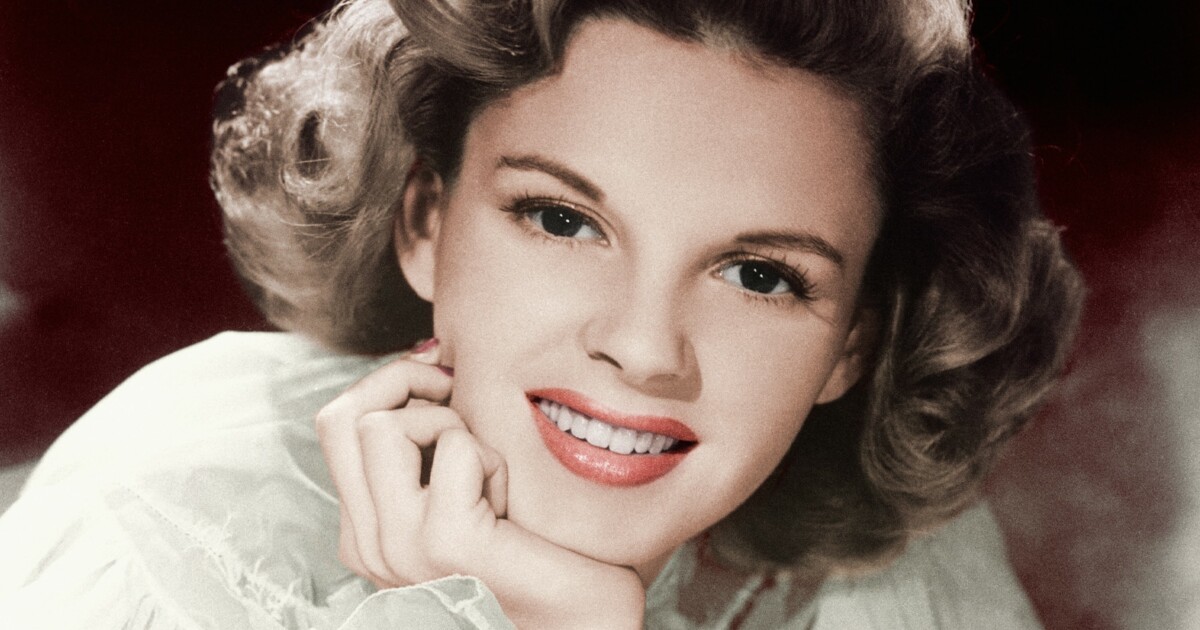
‘It’s hard to explain what it’s like to have a film corporation for a parent, but when my father died, Metro-Goldwyn-Mayer more or less adopted me,’ Judy Garland once said. To get a tiny idea of the strangeness of her position, watch the recording made in 1937 of the 14-year-old Garland with a sweet, rounded face and kiss curls singing ‘You Made Me Love You’ as a fan letter to Clark Gable, with a scrapbook of his pictures propped in front of her. The recording comes from a film called Broadway Melody of 1938 in which Garland stars with Robert Taylor and Eleanor Powell. It was her first feature-length film for MGM. She had performed the song earlier that year at Gable’s on-set birthday celebrations: he was the studio’s biggest star. Garland made a surprise appearance at the party, posing as a die-hard fan (in some versions of the story she leaped out of a giant birthday cake). Roger Edens, an MGM composer who was Garland’s music coach, and perhaps the most important artistic influence on her career, had written a new arrangement of the song (which was twenty years old). ‘Dear Mr Gable,’ Garland sings,
I am writing this to you
And I hope that you will read it so you know
My heart beats like a hammer
And I stutter and I stammer
Every time I see you at the picture show.
I guess I’m just another fan of yours
And I thought I’d write and tell you so.
She then starts to sing the familiar words:
You made me love you.
I didn’t want to do it, I didn’t want to do it.
You made me love you
And all the time you knew it, I guess you always knew it.
You made me happy, sometimes, you made me glad.
But there were times, sir, you made me feel so sad.
When you hear Garland singing these words in her low, liquid mezzo, a teenager’s banal crush on a famous film star becomes something deep and interesting and very, very poignant.
At the age of fourteen, Garland’s voice already had a raw pleading and a ravishing beauty of tone without ever seeming forced. On the phrase ‘You made me happy, sometimes,’ a tiny look of doubt flickers over her face and she pauses slightly before singing ‘sometimes’, telling us both that her fandom has made her suffer and that she loves Gable too much to tell him so directly. The delicate art of sparing other people’s feelings while revealing the cost to her is something Garland does better than any other singer; see also her meltingly sad rendition of ‘Have Yourself a Merry Little Christmas’ in Meet Me in St Louis, a song of consolation which leaves the consoler herself unconsoled. In ‘You Made Me Love You’, she sells the song with such an impression of sincerity and sweet touches of childish humour that you almost forget how creepy it is for a 14-year-old girl to be singing a love letter to a moustachioed man more than twice her age.
Apparently, Gable was so moved by her performance that he kissed her, at which Garland burst into tears (Mickey Rooney, her teenage co-star and classmate in the schoolroom on the MGM lot, joked that it was probably Gable’s bad breath that made her cry). Louis B. Mayer, the studio boss, held out his arms and Garland ran into them. Two years before The Wizard of Oz, this was already an artist in full mastery of her astonishing talent, yet MGM was using her as a party entertainer. Gable attended Garland’s official fifteenth birthday party on the set of Broadway Melody of 1938. He gave her a charm bracelet, which she kept for years. Her future third husband, the thuggish Sid Luft, was also at the party, with his then girlfriend, Eleanor Powell, Garland’s co-star. Luft recalled thinking that Garland was ‘full of beans, but she seemed a child’.
If you know anything about the life of Judy Garland, you know that she became a byword for the brutal and controlling ways of the ‘Hollywood factory’ and its tendency to swallow up child stars. You’ve probably heard that MGM encouraged Garland’s use of drugs – ‘pep pills’ to get her to work and suppress her appetite, downers to help her sleep – only to criticise her for being unreliable when she became an addict who sometimes couldn’t show up for work. Eventually, the studio dropped her. She wasn’t yet thirty. Even by the standards of MGM, Garland was overworked and undervalued. She starred opposite Mickey Rooney in a slew of teenage musicals for the studio and although the pair were equal in many ways – two multi-talented vaudevillian kids with sweet faces who had been singing and dancing on stage since they could talk and walk – Rooney, two years her senior, was paid up to three times as much per picture.
This difference in pay reflected the diminutive Rooney’s extraordinary – and to modern eyes, not entirely fathomable – box-office appeal. From 1939 to 1941, he was the top box-office draw in Hollywood and his Andy Hardy films (sixteen of them) together grossed almost $1.9 billion worldwide. The hokey plots of most of Rooney and Garland’s movies were constructed on the understanding that he was a bigger deal than she was. In the Andy Hardy series, Rooney was an Everyman teenager – girl crazy and car crazy – living in the fictional Midwestern town of Carvel. He had the cheeky personality that middle American audiences adored. In the ‘let’s put on a show’ musicals they did together, he is a theatrical genius. Garland is usually the girl next door, who is repeatedly rejected or ignored by Rooney in favour of more sultry beauties, even though she acts and sings those beauties off the screen, as she does Rooney himself. Garland and Rooney played out this dynamic in real life too, with Rooney – who let Garland know he wasn’t romantically interested in her – seducing a string of famous pin-ups including Lana Turner, Norma Shearer and Ava Gardner, who became his first wife. ‘Who wouldn’t want to go out with me?’ Rooney asked. ‘I had my own car, I had some nickels in my pocket and I was somebody.’
Being ‘somebody’ didn’t come with the same benefits for Garland as it did for Rooney. From the moment she arrived at the studio aged thirteen, MGM executives gave her the impression that there was a problem with the way she looked. Louis B. Mayer’s secretary, Ida Koverman, described her to an MGM representative as ‘really a marvellous child’ and a ‘little genius’, but the studio did little to nurture her self-esteem. They made her wear rubber discs to turn up the tip of her nose and removable tooth caps to fix her smile (these beauty rules were later referenced in A Star Is Born). They criticised her perfectly healthy teenage body until she starved herself enough to meet their standards. Her battles with MGM’s ‘doctors’ over her weight seem to have started soon after she signed her first contract in 1935. When the producers felt she had gained too much weight, the MGM cafeteria was told to serve her nothing but chicken broth, no matter what she ordered, ‘but not a noodle in it, because I had baby fat’. It was under the direction of Dorothy ‘Dottie’ Ponedel, the make-up artist on Meet Me in St Louis, that she finally dispensed with the tooth caps and nose inserts. ‘I don’t see anything wrong with your nose and your teeth look perfect to me,’ Ponedel said. ‘Let’s put these things in the drawer and forget about them.’
Garland, born Frances Ethel Gumm, the youngest of three musical sisters from Grand Rapids, Minnesota, seems to have fared worse than most of the stars at MGM. One reason was that the start of her career there coincided with the loss of her father, Frank Gumm, a small-town vaudevillian. Her first stage performance, at the age of two, was at the theatre he owned in Grand Rapids. She sang ‘Jingle Bells’ and loved it so much she wouldn’t stop, singing the song over and over again. Frank carried her off stage, laughing so hard he was crying. She often said that his sudden death from meningitis in 1935 was the most terrible thing that ever happened to her. In his lavish and loving new book about Garland’s MGM years, Scott Brogan (who runs several websites devoted to her life and career) wonders whether she might have had an easier time of things, at MGM and beyond, had Frank lived longer.
One of Frank Gumm’s singing partners said he had the most beautiful voice she had ever heard. A handsome and dapper man whose affairs with men put a strain on his marriage, he was the first gay man to love Garland and to be loved by her (two of her five husbands were gay or bisexual). He died less than a year after she changed her name from Frances Gumm to Judy Garland in preparation for stardom. Shortly before his death, he wrote to a friend that – after years of Garland’s mother, Ethel, trying to break the children into Hollywood – ‘Baby’ had finally got a seven-year contract with MGM at $150 a week: ‘a very attractive deal. Of course, it’s all on six months’ options and she has to make good or they have the privilege of letting her go.’ The studio prevented Garland from visiting Gumm in hospital the day before he died, insisting that she keep a singing engagement at the MGM Club. He had taken one of her blankets to hospital with him; after he died, Ethel threw it away. This was one of many things Garland couldn’t forgive her mother for, along with telling her that she had tried to abort her, remarrying on the anniversary of Frank’s death and colluding with MGM to keep her daughter on a diet and on performance-enhancing drugs (she had given all three girls drugs to keep them going during their stage performances long before Garland arrived in Hollywood).
MGM’s abusive treatment of its stars was supposedly justified by the dazzling films produced by the studio system. The company excelled at ambitious and glamorous musical numbers. These were produced by the so-called Freed Unit, led by Arthur Freed and staffed by brilliant choreographers, composers, dancers and musicians, many of them gay men (studio insiders referred to the unit as ‘Freed’s Fairies’). The most important person in the unit as far as Garland was concerned was Edens, who remained a friend and collaborator all her life. He gave her daily singing lessons from the time of her arrival at MGM and helped her learn to sell and shape a song. Listen to a 1935 recording of Garland singing ‘Broadway Rhythm’ and compare it with anything in The Wizard of Oz, which came out four years later, to get a sense of how much her phrasing and vocal control improved. She said that Edens – who first got involved with MGM as the accompanist to Ethel Merman, one of the great stage musical stars of the 1930s – taught her intonation and to ‘feel a song’. He was adept at choosing songs that would suit her voice and personality and at writing arrangements to maximise the impact of her delivery.
It was thanks to the Freed Unit that the adult Garland appeared in so many fabulous MGM set-pieces in which she emerges from a sea of besuited men or lipsticked chorus girls. My favourite, although it’s not in colour, is ‘Embraceable You’, from the lush Gershwin score for Girl Crazy (the last of her musicals with Rooney). ‘Embraceable You’ was choreographed by Charles Walters, a Broadway dancer and choreographer who would direct Easter Parade and Summer Stock. In the scene, Garland’s character has been given a white piano for her birthday: she sits on it and is wheeled round the room by a crowd of young men in dinner jackets who are supposedly students at an all-male college. Walters himself dances with Garland as she spins round the room with a Ginger Rogers-ish velocity and style. Her dress is floor-length and fitted down to the hips, with embroidery where it flares that makes it look as though she’s wearing a G-string. The whole sequence is joyously camp. The precision and lightness of the dance moves combined with the swoony romance of Garland’s voice and the humour of her singing a love song to a roomful of men adds up to the kind of sumptuous entertainment at which MGM in its heyday excelled.
Brogan writes that Garland was ‘the studio’s top leading lady’ in the age of the MGM musical. His hefty book – many years in the making – is a rich resource for anyone who wants to gaze on hitherto unpublished photographs of the wondrous one. Almost all of them are ‘from the author’s collection’, including such gems as a snapshot of Liza Minnelli posing with her mother in 1948 on the set of In the Good Old Summertime, wearing matching turn-of-the-century frocks and hats. Brogan’s favourite Garland song-and-dance scene is ‘Who?’ from the Technicolor film Till the Clouds Roll By, a bloated biopic of the songwriter Jerome Kern. The sequence was created by her second husband, Vincente Minnelli (Garland was pregnant with Liza at the time). It starts with a series of circus acts, including a trapeze artist and gold-painted elephants. It then segues to Garland, as Brogan writes, ‘floating down a flight of stairs surrounded by formally attired chorus men … She’s costumed in a beautiful yellow-gold gown with almost blonde auburn hair, which works perfectly against the backdrop of the male dancers all in black. Never was Garland more luminous.’
Brogan has studied Garland since he was a child in the 1960s, living with his military parents on a US base in Bahrain, where he spent his pocket money on vinyl recordings and any biographies of her he could find, waiting weeks for them to arrive. His decades of devotion allow him to clear up some myths, including a few of the tall tales told about The Wizard of Oz. None of the Munchkin actors hanged themselves on set, for example. It is also false that the studio wanted Shirley Temple to play Dorothy (the role and the songs were clearly written for Garland). It’s true, however, that the original Tin Man (Buddy Ebsen) had a bad reaction to the silver make-up and nearly died, and that the film was transformed by George Cukor, who came on set for a week after Richard Thorpe, the original director, was fired and before Victor Fleming took over. Cukor changed the bricks of the Yellow Brick Road from oval to rectangular and gave the Wicked Witch a bun to make her look scarier. He transformed Dorothy from blonde to brunette, toned down her make-up and advised Garland to act more naturally. She later said she learned more from Cukor in two days than she had ‘ever learned at any one time before’, because he knew how to talk to people her age. (He also directed her in A Star Is Born, arguably her greatest performance.) As Dorothy, she out-performed some of the most experienced vaudeville stars in Hollywood in the form of the Scarecrow (Ray Bolger), the Tin Man (Jack Haley) and the Cowardly Lion (Bert Lahr). The film lasts 101 minutes and Garland is on screen for all but five. If we had nothing to go on but The Wizard of Oz, it would be hard to disagree with Brogan’s thesis that ‘MGM was the best possible place for her talent to grow and thrive, and thrive she did.’
Was MGM really the best place for Garland to flourish? Brogan is right that she is now widely recognised as ‘the greatest female musical star in the history of film’ and that this reputation rests on her time at MGM, where she spent by far the largest portion of her film career. The more of her performances I watch, the more I think it’s pointless even to attempt to write about Garland’s art without superlatives. You don’t have to be a gay man to be a friend of Dorothy; you only have to have seen The Wizard of Oz as a child. I asked some professional musicians to explain what made her voice so great but even they were mostly reduced to mute gestures of love (though some disliked the exaggerated vibrato of her later years, when live shows had mostly taken the place of movies). Luft’s characteristically churlish explanation for his wife’s singing talent was that, despite her tiny frame (she was 4 feet 11 inches), she had an ‘enormous ribcage which gave her the advantage while performing – all the juice came from there.’ Yet this cannot explain the way that, as Susie Boyt has written, her singing makes ‘a direct assault on the heart’. Nor can it explain her humour, dancing and acting (‘Make like you’re singing it,’ Rooney told her when, as a teenage rookie, she was nervous about saying her lines). ‘That pathetic cry in her voice will do things to you,’ Merle Potter wrote in 1941, reviewing Ziegfeld Girl, a picture in which Garland played second fiddle to the more glamorous and grown-up Lana Turner and Hedy Lamarr, but outshone both of them the moment she opened her mouth.
No one at MGM could have taught her to sing the way she did. When the Gumm Sisters played San Francisco and Los Angeles in 1932 and 1933 – with Frank opening for them and Ethel on piano – all the reviews singled out the youngest sister for praise, although some argued she must be a very tiny woman because a child couldn’t sing with such power. The reviewer for the Los Angeles Record wrote that ten-year-old Frances was ‘astounding. Her singing all but knocks one for a loop, her dancing is snappy and clever.’ You just have to listen to a few tracks by Edens’s other protégée, Ethel Merman, whose voice, though full of character and oomph, was brassy and unsubtle, to see that there was only so much Edens or anyone could teach Garland about singing. Yip Harburg, who wrote the lyrics for The Wizard of Oz, said that she ‘sang not only to your ears but to your tear ducts’, comparing her to a Jewish cantor and adding that she had ‘one of the rare voices of that half-century’.
Cukor’s week of tactful and productive work with her on the set of The Wizard of Oz was an exception. More typical was her treatment on the set of Summer Stock. Garland missed days of filming due to illness. According to her fellow actor Eddie Bracken, the ‘upper echelon’ at MGM consisted of people ‘yelling at her, telling her to do this, telling her to do that, and she refused to do it. If someone had asked her nicely, it would have been done in one second.’ The film’s director, Charles Walters (the choreographer from Girl Crazy), wasn’t one of those who yelled at her; he was aware that ‘Judy needed more reassurance than anyone I’ve ever known.’ But the studio bosses, who now included Dore Schary as well as Mayer, hounded her about her weight. Garland had started the film drug-free and healthy but recalled that ‘they kept telling me the rushes looked awful’ and that she was ‘too fat’, so returned to a regime of ‘Benzedrine and no food’, which left her nervous and sleep-deprived. Her attendance on set dropped, making the bosses even angrier. ‘I was in the trap again.’
How many Judy Garland movies can you name? The Wizard of Oz, of course. And then what? Garland made 27 feature films for MGM over fifteen years. Of these, three were out-and-out masterpieces: The Wizard of Oz, Meet Me in St Louis and The Clock. Of these, only the first two are widely remembered. Her fourth masterpiece, A Star Is Born, was made by Warner Brothers in 1954. It’s striking that two of her three most acclaimed films for MGM were directed by Minnelli, who was one of the very few MGM directors to understand the greatness she was capable of and whose lens gazed at her with love (except in The Pirate, a deeply weird film in which he transferred his gaze from Garland’s face to Gene Kelly’s thighs, much to her distress).
The bosses didn’t just treat her badly but squandered her talent. The Freed Unit worked its magic on the song-and-dance numbers but the scripts and direction were often puerile. Take Girl Crazy. Despite the dreaminess of ‘Embraceable You’ and the other Gershwin numbers (Garland’s rendition of ‘But Not for Me’ has never been bettered and ‘I Got Rhythm’ with Tommy Dorsey and his orchestra is so much fun you would hardly know how much Busby Berkeley bullied her while directing it, except for the fact that she looks thin and manic in her cowgirl outfit), the non-musical narrative arc of the film fails to ignite. Girl Crazy is a rom-com that is neither funny nor romantic.
As Garland grew up, she was keen to move beyond the ‘kid sister’ persona MGM had created for her, but the studio was determined to keep her pigeonholed as a teenager, both in her films and her private life. At the same time, many MGM executives groped her or demanded sex. ‘Don’t think they didn’t all try,’ she once said. Mayer liked to touch her left breast while praising her for singing from the heart (he also joked that she looked like a little ‘hunchback’). In 1939, two months before The Wizard of Oz was released, she celebrated her ‘Sweet Sixteen’ (she was actually seventeen but the studio had rewritten her age) at Mayer’s beach house. MGM sent reports and photographs to all the fan magazines showing Mayer presiding over events like a proud parent. All ‘the gang’ were there to share the huge cake: Mickey Rooney, Jackie Cooper, Ann Rutherford and more. Cooper later said that the party guests had been told to follow a script. The studio’s habit of managing her friendships took a still more disturbing turn later that year, when they planted a studio spy, Betty Asher, to act as Garland’s publicity aide. Garland considered Asher a close friend for many years, not realising that Asher was pumping her for information about her life – sometimes getting her drunk first to loosen her tongue – and feeding it back to the studio bosses. When Garland became pregnant by her first husband, a musician called David Rose, the studio encouraged her to have an abortion: a baby would have ruined her image as a girlish ingénue.
Garland felt the oppression of being an eternal teenager so keenly that she didn’t immediately welcome Meet Me in St Louis when discussions about it first took place in 1942. Brogan reports that she thought ‘taking the role of a love-sick girl in high school in a seemingly bland story, adapted from a series of virtually plotless New Yorker short stories by Sally Benson about a family in 1903/1904 St Louis, Missouri, was a step backwards for her career.’ Her lover at the time, Joe Mankiewicz, agreed that Meet Me in St Louis was a poor fit. Mankiewicz – who also convinced her to go to therapy to talk about her father’s death and her mother’s cruelty – felt that the studio was putting Garland in shallow roles that left her gifts untapped. It was the right argument about the wrong film. In the end, it was the movie’s director, Minnelli, a former window-dresser from Chicago (a background that informed his remarkable sense of colour and style), who recognised what a showcase Meet Me in St Louis could be for Garland. When she tried to get out of it, telling Minnelli the script was ‘not very good’, he replied: ‘I see a lot of great things in it. In fact, it’s magical.’ As Brogan writes, ‘the more Garland saw herself … through Minnelli’s eyes, the more she saw how beautiful she looked, and the more she began to love him.’ In turn, he felt she was capable of ‘anything she wanted’ as a performer. His faith in her is apparent in everything, from the humour of her scenes with Margaret O’Brien as her younger sister, Tootie, to the trolley scene, which has a rare interiority for an MGM song-and-dance scene as well as the usual Technicolor surface charm. Through Minnelli’s direction, we seem to be both inside and outside Garland’s head as she scans the crowd for her boy. He once said that she was ‘as great as Duse, or Bernhardt, or Garbo’.
Many of those Garland worked with agreed that her talents outshone all those around her. Take Gene Kelly. Despite his reputation for being excessively critical and demanding of female co-stars, when it came to Garland, Kelly had only praise, marvelling at her ability to know a song after hearing it once and to ‘pick up a step instantly’. Fred Astaire, that other dancing perfectionist, said that she was ‘the greatest entertainer who ever lived – or probably will ever live’. Astaire was her co-star in Easter Parade, the highest grossing musical of 1948 and one of many extremely silly movies that she succeeded in turning into something sweet and profound, notably in the scene when she sits at the piano to sing ‘It Only Happens When I Dance with You’, a song of sincere love that almost makes you forget that Astaire is an odd-looking fifty to her radiant 26. ‘The rest of us will be forgotten,’ Frank Sinatra said. ‘Never Judy.’ To Lucille Ball, she was the most ‘naturally funny woman in Hollywood’, who made Ball look like ‘a mortician’ by comparison. Harold Arlen, who composed the music for ‘Over the Rainbow’, said that while the rest of the cast ‘come off excellently, she alone shines’. Because she elevated almost everything she was in, it can be hard to recognise how bad most of the films MGM put her in were.
After The Wizard of Oz, the studio plunged her back into a series of slight and absurd teenage musicals in which she is not even the main star. Babes in Arms was released in 1939, the same year as The Wizard of Oz. It was the first of her films to be directed by the tyrannical and alcoholic Berkeley, a director she loathed, but with whom the studio repeatedly paired her. Berkeley’s idea of direction was to shout at her: ‘Eyes! Eyes! I want to see your eyes!’ Garland and Rooney play the children of vaudevillians who decide to put on their own show with an orchestra of other children. The film’s high point is when Rooney and Garland sing ‘Good Morning’ with immense sunniness, a song that features more famously, though no more winningly, in Singin’ in the Rain. The low point is when the pair put on blackface for an extended minstrel show sequence. Garland was also required to put on blackface in Everybody Sing and Babes on Broadway and brownface in Ziegfeld Girl for a number called ‘Minnie from Trinidad’.
In Andy Hardy Meets Debutante, she finally got to kiss Rooney on screen, although once again, his romantic feelings for another woman form the main plot. Nothing else in the film comes close to Garland’s sublime performances of ‘All I Do Is Dream of You’ and ‘I’m Nobody’s Baby’. She delivers the latter with jaunty phrasing, perfect tone and the power of a singer twice her age as Rooney looks on, increasingly smitten. In 1940, she was at last given a leading role, appearing as both mother and daughter in Little Nellie Kelly, a musical about an Irish dynasty. The film is mainly remembered for ‘It’s a Great Day for the Irish’, which is still sung in St Patrick’s Day celebrations. In her death scene as the mother, her acting was so extraordinary, one of the other actors recalled, that ‘the grips, electricians, carpenters and all these so-called hard-bitten workers were so affected that they had to get off the set so that their sobs would not disturb or disrupt the soundtrack.’ But Little Nellie Kelly was hampered, as Brogan admits, by a ‘very thin story and cartoonish characterisation’.
In For Me and My Gal, released in 1942, Kelly’s character tries to persuade Garland’s character to join his vaudeville act: ‘You sing like a bird, dance like a deer … but that act you’re in, that’s two pins and a lollipop.’ He could have been talking about her relationship with MGM. All the same, For Me and My Gal, a black and white musical drama set during the First World War, was a huge step up from the Rooney musicals. It was the first feature film Kelly starred in, ten years before Singin’ in the Rain, and the first Garland musical since The Wizard of Oz in which the songs and the emotional storyline were integrated to some extent. It was directed by Berkeley, and Kelly remembered that Garland took him under her wing and fought his corner against Berkeley, even though he was a decade older than her.
Like many of Garland’s early films, For Me and My Gal is a love letter to vaudeville. Kelly is brilliantly cast as the arrogant but talented Harry Palmer, who tries to persuade Jo Hayden (Garland) to quit the act she is in and join him, in the hope of playing the Palace Theatre on Broadway. There are setbacks, including the disappointment of finding that the first ‘Palace’ they are booked into is in Newark not New York; then, more seriously, Jo’s younger brother is drafted. Garland performs her agony at her brother leaving for the front like something out of a Verdi opera; and her sense of betrayal when Harry injures his own hand to escape fighting is an acutely observed study of a woman waking up to the fact that her charismatic partner is a narcissist. The second part of the screenplay descends into conventional wartime propaganda, but no matter. For Me and My Gal was yet more proof that when Garland was given material that was even halfway good, she could turn it into something extraordinary.
To understand the greatness of Judy Garland as a screen performer, don’t start with The Wizard of Oz, where the effect of watching and hearing her sing ‘Over the Rainbow’ a mere five minutes in is so exquisitely intense that it’s hard to retain your critical faculties. Instead, watch two less heralded films from 1945 and 1946. The first shows that she could carry a drama even when she didn’t sing a note, the other that when cast in a spectacular MGM musical entertainment with the best dancers and singers Hollywood could buy, she was still in a different league from everyone else.
Start with The Clock, which Richard Brody described as having a greatness that extends in ‘many dimensions’: a war film about the home front, a portrait of a city and ‘one of the most rapturous, tender and indeed erotic romances released by a classic-era Hollywood studio’. It’s a romantic drama co-starring Robert Walker. If you only know Walker as Bruno, the creepy murderer in Hitchcock’s Strangers on a Train, it’s quite a shock to see how well he works here as a ‘green as grass’ boy from Indiana. Garland plays Alice Maybery, a wistful secretary who, after breaking the heel of her shoe on an escalator at exactly the right moment, meets Corporal Joe Allen (Walker). He has two days in New York before he is posted overseas and persuades Alice to show him the city. During a series of encounters with strangers at all hours of day and night, they fall in love, then have to face the bureaucratic and emotional trials of getting married in a hurry in wartime. The film is sensitively directed by Minnelli, who had just become Garland’s husband. During Meet Me in St Louis they had had a brief affair, despite the fact that Garland was still married to Rose and it was generally known on set that Minnelli was gay. But Garland admired his cultured sophistication and when shooting for The Clock finished, she sent him a desk clock as a gift with a note saying: ‘Only you could give me the confidence I so badly needed … my darling Vincente.’
Part of what makes the love story of The Clock so affecting is the sense Minnelli gives of Joe and Alice as just one young and fragile couple in an anonymous crowd of similar couples. At one point, they sit next to another couple wearing exactly the same outfits and you realise that Alice’s lace-trimmed dress is a cheap off-the-peg number – no less a uniform than Joe’s military dress. It is rare in a Hollywood film to have the uniqueness of the heroine’s dress undermined. Other than Minnelli’s direction – in which the skyscrapers of New York have never looked more exciting or terrifying – the film’s other great asset is Garland, who is vulnerable and funny and sincere. In The Clock, even without music, Garland gives us emotions we didn’t know we were allowed to feel. After she and Walker marry in a rushed ceremony, her response is not elation but a mix of terror, disappointment at the ugliness of the ceremony and humour at the sheer absurdity of the situation, most of this conveyed with a few subtle adjustments of her eyes. At one point, she thinks she has lost Joe for ever to the faceless mass of the city and her forlorn sadness is as raw and authentic as it was in The Wizard of Oz when Miss Almira Gulch takes Toto away. It is only when you get to the end of the film that you realise she hasn’t sung or danced at all.
Now – as if leaving the grey of Kansas – step into the Technicolor splendour of The Harvey Girls, which was MGM’s answer to the stage version of Oklahoma! As one of the reviewers at the time commented, The Harvey Girls is a ‘lot of malarkey’ about a group of waitresses who travel to a small frontier town to set up a wholesome restaurant where they face opposition from the local saloon-owner and the ‘dance-hall girls’ led by a scheming Angela Lansbury. It is as unserious and fun as The Clock is earnest. The musical is enjoyable if forgettable, but Garland’s performance is dazzling.
The movie’s most famous sequence – ‘On the Atchison, Topeka and the Santa Fe’ – is on YouTube. It’s an earworm of a song about the magic of train travel and won the Oscar for Harry Warren and Johnny Mercer. The sequence lasts eight minutes and 25 seconds. For the first five minutes, we are given the full MGM chorus plus various character actors celebrating the arrival of a steam train in a fictional frontier town called Sandrock, New Mexico. An ambitious overhead shot shows the arrival of the Harvey Girls as a sea of townspeople gather excitedly. All the glamour of MGM is on display. The women are in red lipstick and calico dresses. They introduce themselves with a series of sassy one-liners (‘We were schoolmarms from Grand Rapids, Mich. But reading, writing, ’rithmetic were not our dish’). The men are in colourful kerchiefs and cowboy hats. To top it all, we have Ray Bolger, the Scarecrow in The Wizard of Oz, singing ‘Give me a girl and a holster for my hip’ and leaping in the air in a checked suit. But the moment Judy appears, wearing a lavender grey dress, all this sumptuous entertainment seems mere scenery. The first words she sings are conventional, yet they feel human and uplifting: ‘What a lovely trip/I’m feeling so fresh and alive/and I’m so glad to arrive.’
Her attendance on set, as so often, had been erratic. She always found Technicolor films exhausting because the make-up took so long: she had to arrive two hours before filming started. The day that ‘On the Atchison, Topeka and the Santa Fe’ was filmed, Garland turned up at 1 p.m. The rest of the cast and crew had been rehearsing the number for days. After a quick run-through, Garland did the whole thing – a series of intricate dances with different sections of the chorus segueing into a dance with Bolger in which they both mime being a steam train – in a single perfect take. The director, George Sidney, said she ‘did it like she had been rehearsing it for six months’, which made up a tiny bit for the rest of her behaviour, which included phoning the assistant director at 3 a.m. to say how tired she was.
Some MGM studio executives, including Dore Schary, saw Garland’s behaviour on set as ‘obstinate’ and self-indulgent. He was one of the key figures in her eventual dismissal in 1950 from Royal Wedding (another film opposite Astaire) and then from the studio itself. But the drug-taking that led to her unreliability while at MGM was clearly a response to overwork and the perceived need to diet. After her death aged 47 from an accidental overdose, the head of the US Bureau of Narcotics, Harry Anslinger, said that he had met with her in 1949, and thought her ‘a fine woman caught in a situation that could only destroy her’. She told him she was exhausted from a work schedule that involved ‘taking amphetamines when she got out of bed in the morning, minor stimulants during the day, a shot of morphine before fulfilling night-time engagements and finally, a sleeping pill’. No wonder she was on edge. After she got the news about her dismissal from Royal Wedding, she ran to the bathroom and scratched her throat with a broken drinking glass. Minnelli broke down the door and became hysterical when he saw all the blood.
Any honest account of Garland as a performer has to acknowledge that part of the reason her singing speaks to us so deeply is the pain in her voice. After her death, James Mason, her co-star in A Star Is Born, said that she gave so much of herself on stage and screen there was ‘no currency in which to repay her’. One of her favourite currencies seems to have been applause, and after MGM dropped her, singing on stage became her most important work. On 23 April 1961 she sang at Carnegie Hall, where the adoring audience included Marilyn Monroe, Richard Burton, Bette Davis, Julie Andrews, Debbie Reynolds and Mickey Rooney. The recording of that concert spent thirteen weeks at number one on the Billboard album charts. Like ‘taking nineteen hundred wake-up pills’ was the way she once described the thrill of hearing an audience responding to her voice. On at least one occasion, in London in 1968, she produced a similar sense of emotional connection by asking the audience to sing ‘Over the Rainbow’ to her, when she lost her voice. In a series of rambling and emotional tape recordings she made between 1964 and 1967 – with a view to turning them into an autobiography – she complained that ‘sure, I’ve been loved by the public’ but she couldn’t ‘take the public home with me’. She wanted to set the record straight and give her side of the story. ‘For openers,’ she says, ‘I don’t know how to work this machine. I’m just astounded at this machine! This is the silliest way I’ve ever known of spending your nights alone. Talking to yourself into an obvious Nazi machine … But that’s the story of my life.’ She asks at one point whether Luft’s mother made the tape recorder.
It’s tempting to join Brogan in imagining an alternate reality in which, had her father stayed alive, Garland might have enjoyed all the perks and wonders of being an MGM musical star – being pushed around on a white piano by a sea of handsome men – with none of the exploitation, drugs and despair. To be a Garland fan is to have the illusion that you can save her from the wounds of the world, even as her voice and her eyes and her gloriously melodic laugh seem instead to be saving you. Many fans harbour fantasies of looking after her, as Susie Boyt explores in My Judy Garland Life (2008), by far the best Garland book I’ve read. Boyt surveyed a hundred Judy fans and found that most of them dreamed of caring for her, whether by brushing her hair, making her feel cherished in ways that MGM and most of her husbands failed to do, or keeping her away from pills.
Much as we may fantasise about comforting her, we will never know whether a happier Judy would have moved us as much. One of the great mysteries about Garland is the extent to which her vulnerability when performing was a calculated act. She seems to have had an excruciating need for validation as a performer: a neediness we can almost touch on screen. Yet she told Dirk Bogarde – her co-star in I Could Go on Singing, her final film – that she knew how to hurt audiences where they thought they wanted to be hurt. When trying to set the record straight about her life, she repeatedly rejected the idea that she was tragic or a victim, arguing that she should be seen as hard-working, happy and essentially comic. Certainly, as a performer, she had the most extraordinary ability to project a full-throated joy in her singing, even when life was not going well for her.
Consider Summer Stock, the final film she completed for MGM and the last one in which she teamed up with Kelly, although their chemistry is nothing like as vivid as it was in For Me and My Gal. The film is yet another ‘let’s put on a show’ movie in which Garland is a farmer who allows Kelly’s musical acting troupe to rehearse in her barn. If Summer Stock endures, it is primarily for a single song-and-dance sequence at the end which has little or nothing to do with the plot. Maybe it doesn’t matter that the rest of Summer Stock can’t measure up to the three shining minutes of Garland’s ‘Get Happy’ number. Maybe a better way to look at it is to say that these three minutes are so potent that they alone redeem the entire legacy of MGM musicals.
Garland had told Minnelli, to whom she was still married, that ‘if I can just get one great number across, I won’t mind the story too much.’ She had had the idea of adding the old Harold Arlen revivalist song ‘Get Happy’ as a coda to the film. During the filming, she was again often ill or absent, and in the eyes of the studio executives, she was overweight. Until she sings ‘Get Happy’, Garland is dressed as a matronly older sister in farm overalls, although she was only in her late twenties and looks perfectly lovely. After all the hounding about her weight, she took a break for a couple of weeks and lost twenty pounds – apparently the result of hypnosis – then came back and performed ‘Get Happy’ with an air of carefree lightness. As in ‘Embraceable You’, Walters provided the choreography. After the first take, she was angry and upset when he told her she was ‘too tentative’, but he went to her dressing room to calm her down and told her to ‘be Lena Horne’, which clearly worked.
She emerges from behind a sea of male tap-dancers wearing a tuxedo, tights and a Dietrich-esque fedora tilted over her eyes as the men in their pink shirts collapse around her. Some of her movements are so insouciant and subtle in their isolations that they are more like poses than dance steps; they clearly influenced the moves Bob Fosse gave Liza in Cabaret. Arlen described the song, with its references to ‘the judgment day’, as a ‘rhythm number with the feel of a spiritual’, but Garland’s performance turns these potentially heavy themes into a song of infectious sexiness, which seems to reach inside you and force you to feel better. The playwright Edward Albee recalled that when he saw Summer Stock at the Capitol Theatre in New York the audience burst into ‘sustained applause’ when Garland finished singing. ‘Nothing has instructed and gratified me more,’ he said, ‘than the time she convinced a bunch of afternoon movie-watchers that a strip of celluloid was the real thing’.