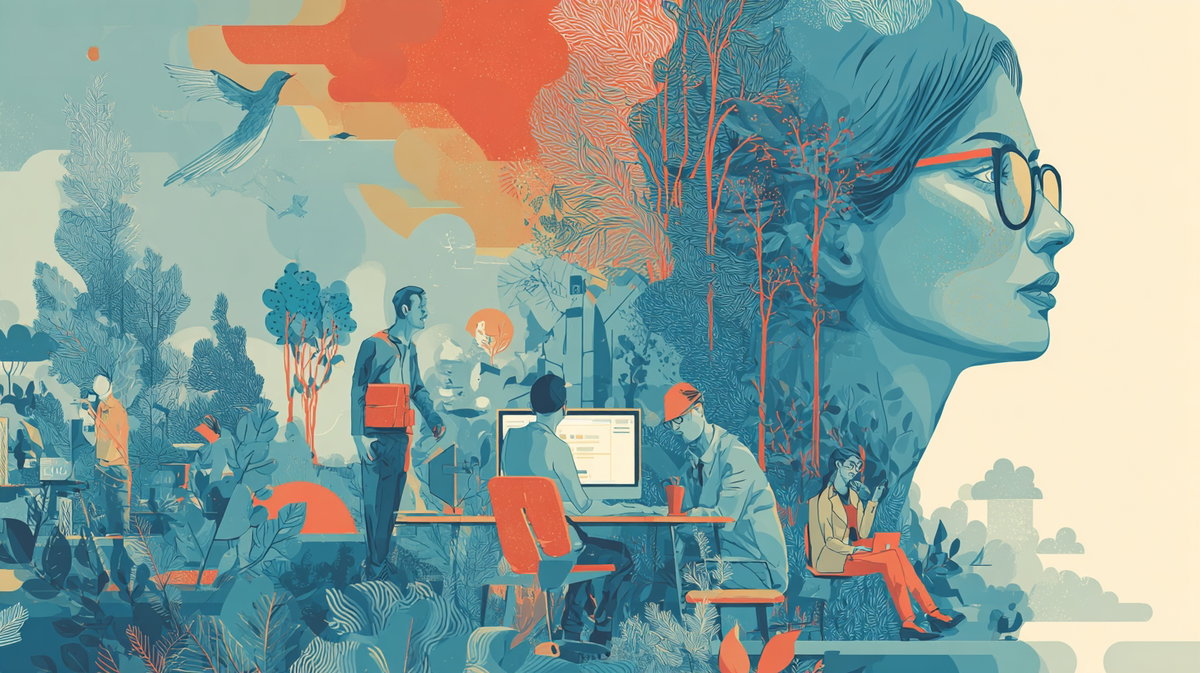
- Work intensified, not eliminated: Technology has added tasks for over 40 per cent of workers rather than replacing jobs, but a new gender gap in AI adoption risks leaving women behind.
- Flexibility masks new strain: While long working weeks have declined, remote work blurs boundaries between professional and personal life, fuelling mental health challenges that the nine-to-five era rarely produced.
- Climate change hits the shop floor: The share of workers exposed to dangerous heat has risen dramatically since 1990, with southern and eastern Europe bearing the sharpest impact.
- Frontline workers left behind: Those in non-teleworkable jobs endure the poorest conditions — high intensity, low autonomy, and inadequate recognition — driving acute labour shortages in essential sectors.
- Quality beyond pay: Eurofound data show that improving working time flexibility and worker autonomy can be transformative even where financial margins are tight.
In 1990, when Eurofound launched its first European Working Conditions Survey (EWCS), the European labour market was a comparatively uniform landscape. The typical worker was likely a young man in a western European factory, clocking in for a standard nine-to-five shift. Women’s labour-market participation stood at 55 per cent and, as late as 2005, 40 per cent of workers reported never using a computer at work. It was a world of standard employment, defined by open-ended contracts and a younger, growing workforce.
Eurofound publishes the new overview report of the 2024 survey in the context of a world of work stirred up by digitalisation, demographic shifts, and global shocks. Covering 35 countries — including the EU27, the Western Balkans, Norway, and Switzerland — the 2024 data reveal a workforce that is older, more female, and grappling with stressors unfamiliar to the previous generation. In 1990, fewer than 20 per cent of those aged 60–64 remained in employment; today, that figure is nearly 50 per cent, reflecting a society that is not only living longer but working longer.
The digital and physical transformation
Much has been made of the existential threat posed by artificial intelligence. However, Eurofound’s findings show a task-based evolution rather than wholesale human displacement. The data challenge a simplistic narrative of job replacement. While 30 per cent of workers report that technology has removed certain tasks, over 40 per cent state it has actually added tasks to their roles. We are not seeing the end of work but its intensification.
Furthermore, the survey reveals an emerging new gender gap in the workplace: women across all age groups are currently less likely to use AI tools than men. If Europe is to remain competitive, it must ensure technology is used in a way that augments work — increasing autonomy rather than diminishing worker discretion — and that the opportunities associated with technological progress benefit all.
Smart, Progressive Thinking on the Big Issues of Our Time
Join 20,000+ informed readers worldwide who trust Social Europe for smart, progressive analysis of politics, economy, and society — free.
Working-time quality is, overall, a good news story for Europe. Long working weeks are rarer, and flexibility is now a baseline expectation. The share of workers with no influence over the structure of their working time is happily decreasing. Yet a profound preference gap remains. Even among those working a standard 35- to 40-hour week, 30 per cent say they would prefer to reduce their hours if financial constraints were removed.
Tensions are also visible in the wake of the pandemic’s “big experiment” with telework. While remote and hybrid arrangements have levelled off at roughly 20 per cent of the workforce, the blurring of boundaries has birthed new risks. Increased work-life conflict is evident among remote workers who work during what should be free time. The difficulty of switching off and ceasing to worry about work is a mental health challenge that rarely existed in the era of the nine-to-five factory bell.
The physical risks of the 20th century — mining diseases such as silicosis and industrial noise — have largely receded. In their place, more insidious threats have emerged. Prolonged sitting is now a primary health concern, affecting over a third of the workforce and impacting long-term well-being. Repetitive hand and arm movements remain a stubborn issue, reported by 60 per cent of respondents in sectors ranging from manufacturing to care.
Alarming, too, is the emergence of climatic working conditions. Since 1990, the share of workers exposed to heat intense enough to cause sweating — even when stationary — has risen dramatically. This is increasingly the reality for construction, agricultural, and transport workers. The trend is most acute in southern and eastern Europe, providing empirical evidence of how climate change is physically reshaping the workplace. For workers picking fruit in a heatwave, the risks are as tangible as any industrial hazard of the past.
Convergence, division, and the road ahead
The expansion of the EU has been a story of upward convergence. When 10 member states joined in 2004, the disparity was vast, with longer hours (averaging 44 per week) and more hierarchical management. Today, these gaps have largely closed, not least thanks to the European legal framework on working time and health and safety. Many “newer” member states, such as the Baltic countries, lead the way towards a more gender-balanced workforce. This is also reflected in a higher share of female managers, with Estonia and Latvia the only EU countries achieving a 50/50 split.
Yet new divisions are appearing. The pandemic highlighted a sharp divide between teleworkable jobs and the two thirds of the workforce remaining on the frontline and the factory floor. Many of the frontline workers experience the poorest conditions: high intensity, low autonomy, and a lack of recognition. It is no surprise that these occupations and sectors often face acute labour shortages. If we want to attract workers back to healthcare or transport, the feeling of doing useful work is not enough; job quality, including pay, must match the social importance.
As the European Commission pursues the Quality Jobs Roadmap and prepares a Quality Jobs Act, the new overview report provides the necessary benchmark for upcoming policy discussions. Improving work is a complex, multidimensional task that encompasses more than just the vital issue of fair pay. While adequate wages are the bedrock of any quality job, Eurofound data show that workers also place immense value on other aspects of their employment. Improving these aspects does not necessarily have to be costly.
In sectors where financial margins are tight, increasing working-time flexibility — such as giving workers the power to adapt their start and end times, or some leeway to swap shifts — can be transformative. By increasing the share of workers who have some influence over their schedules, we can cushion the impact of challenging working conditions in other dimensions. By focusing on all seven dimensions of job quality, from the physical environment to autonomy, policymakers — including the social partners — can work together to make European labour not just more productive but more sustainable for the long term.
Improving working life remains a cornerstone of European progress. This data is an important tool for shaping a legislative and social framework that responds to the needs of a post-pandemic and digitally driven world. The challenge now is to translate these four decades of evidence into a future of work that is equitable, safe, and truly fit for purpose.
This post is sponsored by Eurofound
Help Keep Social Europe Free for Everyone
We believe quality ideas should be accessible to all — no paywalls, no barriers. Your support keeps Social Europe free and independent, funding the thought leadership, opinion, and analysis that sparks real change.
Social Europe Supporter
— €4.75/month
Help sustain free, independent publishing for our global community.
Social Europe Advocate
— €9.50/month
Go further: fuel more ideas and more reach.
Social Europe Champion
— €19/month
Make the biggest impact — help us grow, innovate, and amplify change.