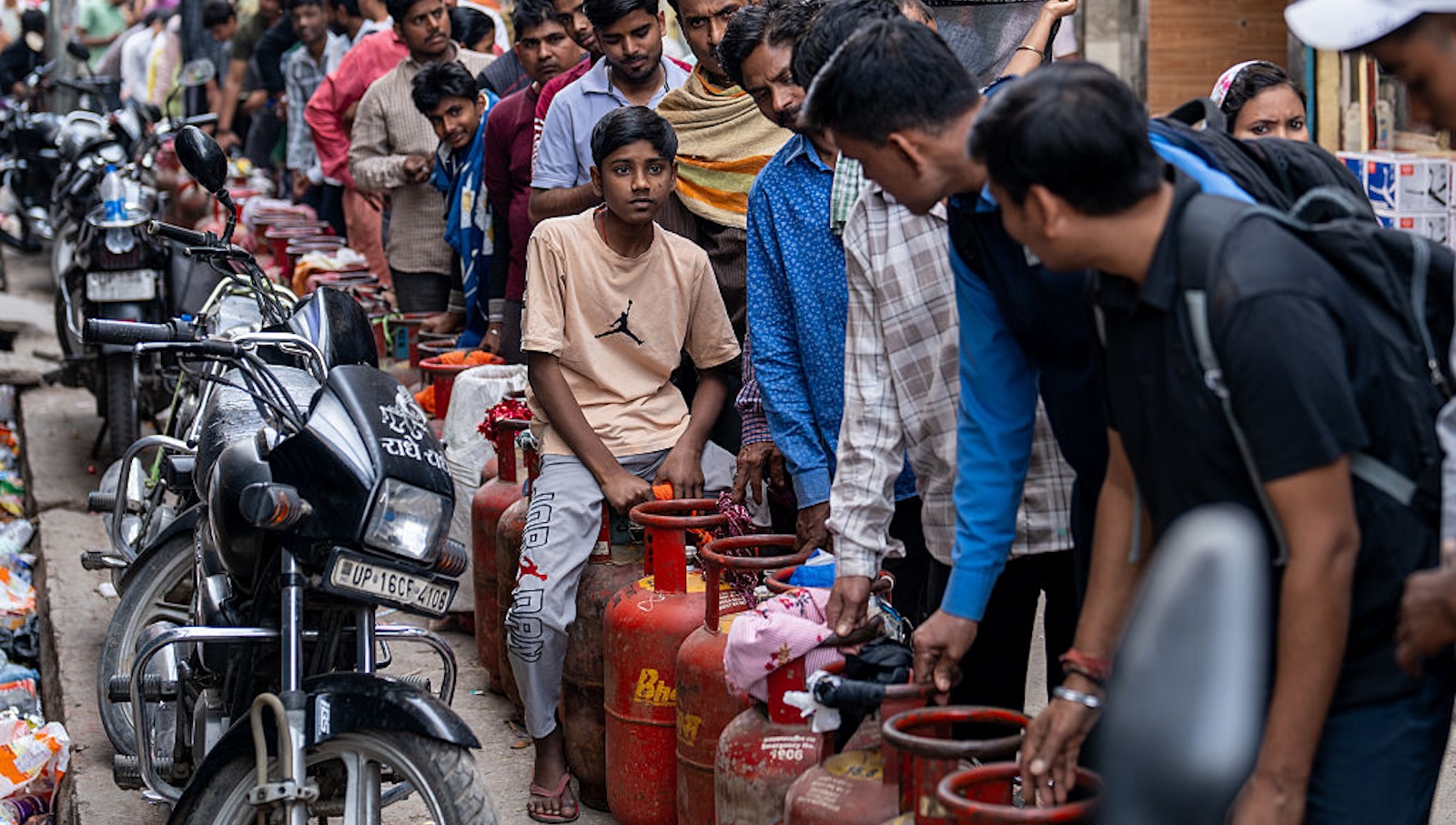
About a decade ago, India’s government began subsidizing the purchase of liquid petroleum gas, or LPG, to promote greater adoption among its lower-income citizens. Switching to the gas was considered a safer and more reliable alternative to burning wood and coal for cooking at home, which families in resource-strapped rural areas were still doing en masse. Ever since, the fuel has become ubiquitous. The bulk of Indian households prepare most of their food with it, and typically use a few cylinders of LPG every year, an amount that varies depending on whether they are in rural or urban communities.
In all that time, Subhash Kapoor hadn’t had much trouble securing cooking gas. Kapoor, who works as a driver in Noida, on the outskirts of New Delhi, lives with his wife and three children. A single gas cylinder would cost about Rs. 900 (about $10) and last about 40 days for the family. The process to secure one had become painless and routine: Every couple of months or so, he would place a call to a nearby gas agency, and the cylinders would be delivered to his home. In January, Kapoor did just that and received two cylinders, the maximum a household is allowed to keep at any given time.
“I had no issues getting a cylinder in January,” said Kapoor, speaking in Hindi. “I thought the cylinders were easily available. Whenever I called, they would send them home.”
That changed in early March. As the U.S.-Israel war with Iran took off, the Middle Eastern country shut down the Strait of Hormuz, a key channel for the flow of oil and, in particular, liquified petroleum gas, which more than 2 billion people across Asia and Africa rely on for cooking.
With the flow of trade through the Strait halted due to the conflict, a cooking gas shortage has swept across the country. India is particularly vulnerable because it is the world’s second largest importer of LPG. Last year, imports accounted for roughly 60 percent of India’s supply, 90 percent of which came from the Middle East.
Panic set in among those dependent on LPG for cooking. Out of the blue, Kapoor received a text message saying that he’d picked up his allotment of cylinders for March — even though he hadn’t. When he called the agency, he says he was told he wouldn’t be able to get another cylinder until the end of the month. Kapoor suspects that the agency sold his allotment off in the black market, where prices were surging.
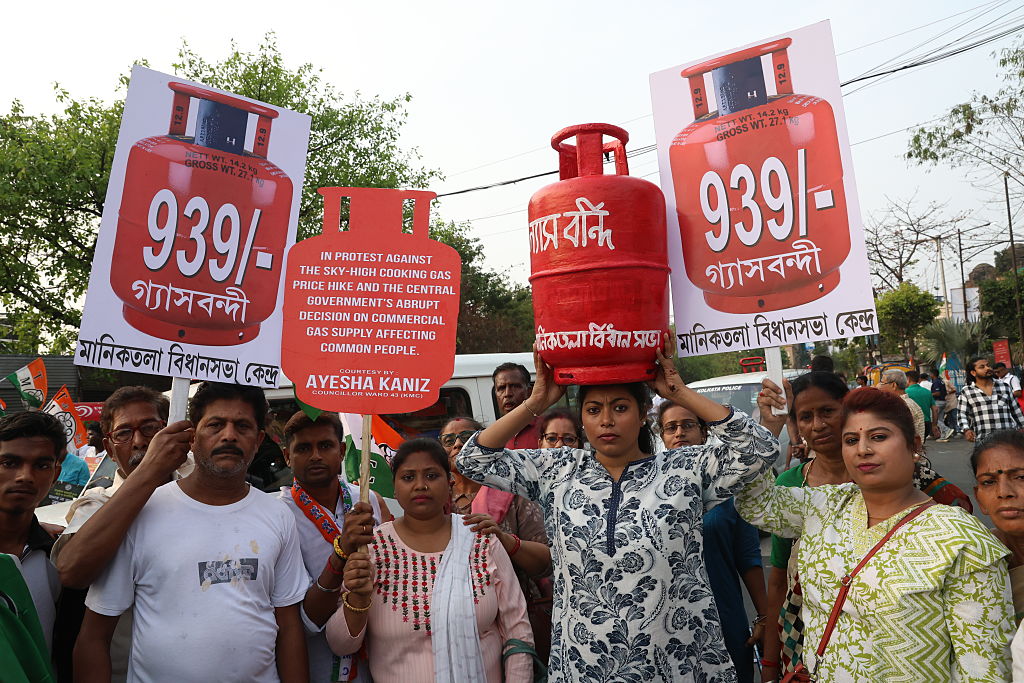
People began hoarding gas cylinders, and in the Delhi area, prices skyrocketed by 600 percent. Some people stood in line for three or four days to get LPG cylinders.
With his own supply running low, Kapoor had little choice but to turn to the black market. About three weeks ago, he purchased a cylinder for Rs. 3,600 (about $39), more than three times what he usually pays. Kapoor’s been able to schedule another delivery from the gas agency for April, and he’s hoping he won’t have to rely on the black market again.
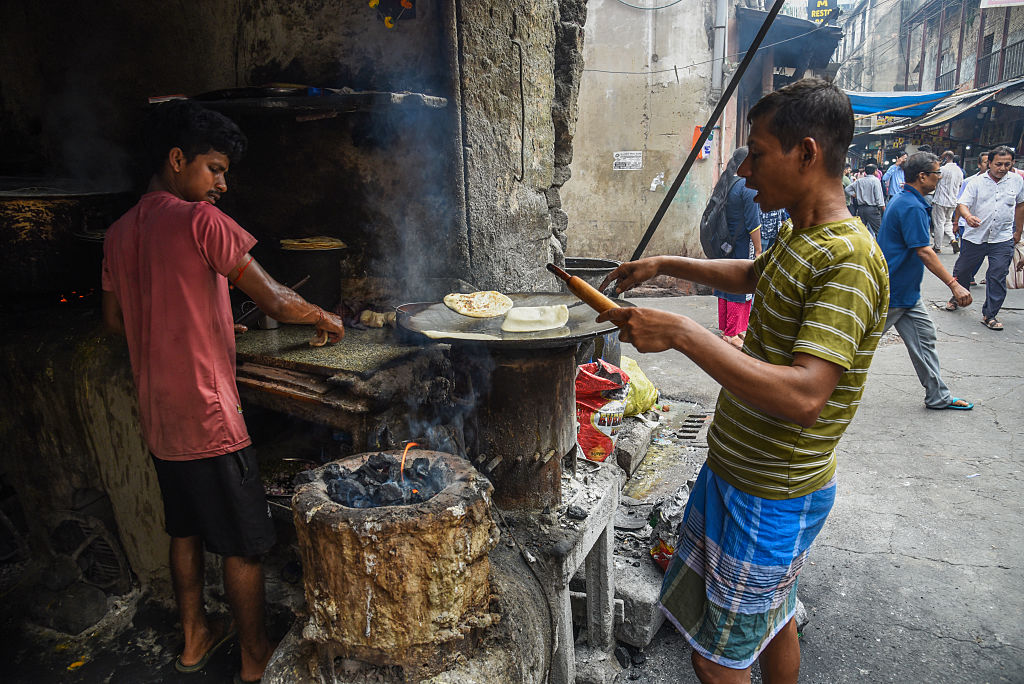
The shortage has forced restaurants across the country to close, while others have stripped staple meals like butter chicken and dosa that require more gas to prepare from menus. Everywhere from hospital kitchens to corporate businesses and school cafeterias have reported shortfalls. In Mumbai, street food vendors who serve chaat, vada pav, and other snacks that school children and day laborers rely on, are closing up shop, drastically altering their menus, or securing cylinders from the black market but hiding them in gunny sacks for fear of discovery. University students living on campus have also seen their dining options scaled back, with some colleges allowing students to cook in their dorm common areas.
For those who can afford it, induction stoves have become a popular option. The electric, plug-in stovetops sell for the equivalent of $20 to $30, and they’ve been flying off shelves. The demand for these stoves is so high that some manufacturers are running out of stock. But the stoves are only a possibility for those who can afford the upfront cost and live in homes with reliable electricity. Lower-income rural communities are much more likely to revert to burning wood and coal, said Dawit Guta, an economist at the University of Northern British Columbia who has studied the clean energy transition in India.
“Rural areas, they don’t have any other option,” he said. “This is the biggest challenge the sector is facing.”
When cooking gas becomes scarce or unaffordable, households begin making impossible choices, according to Chelsea Marcho, a senior director for research and policy at the Food Security Leadership Council and former USAID official under Biden. Many households throughout India are reverting to burning firewood, charcoal, even food scraps — a regression that carries its own serious health costs. The indoor air pollution generated by these practices puts families, particularly women and children who are most often home during food preparation, at heightened risk of heart disease, respiratory illness, and other harmful health conditions.
Some families may even skip meals, according to Marcho. And people’s diets are likely to shift away from nutritious staples that require longer cooking times toward faster-cooking foods or nonperishables that need no preparation at all. The tradeoffs, she said, are as much nutritional as they are economic.
The crisis has not yet tipped into a full-blown humanitarian emergency, but it is already disrupting everyday life and food access in tangible ways. Manufacturers that rely on LPG are also feeling the squeeze, meaning the damage extends well beyond restaurants and home kitchens. “We sometimes forget that food systems, and energy systems are deeply interconnected. So a disruption in one of these can quickly affect other parts of the system. We’re seeing this unfold in real-time right now,” said Marcho. “Cooking gas feels like a small piece of this puzzle,” she added, “but when you’re thinking about food systems broadly, and how everything’s connected, it can make a big impact on global food security.”
Meanwhile, the global food system is straining on all fronts. Fertilizer costs are spiking in tandem with fuel prices, making agricultural inputs more expensive. Packaging and shipping costs are rising, too. Every pressure point along the food supply chain, Marcho said, is getting more expensive — and all at once.
Economists predict that other nations with thinner margins that rely on LPG imports through the Persian Gulf could see similar cooking gas shortage patterns in the near future — among those in Asia are Thailand, Sri Lanka, Pakistan, the Philippines, and Indonesia. Countries with relatively strong economic growth and ongoing industrialization, such as Vietnam, Japan, South Korea, and Taiwan, are also likely to face significant access challenges. These countries don’t depend on the Middle East for fuel to prepare food, but they do depend on the region for a stable energy supply, which, when disrupted, can show up in escalating grocery costs.
But that’s just the near-term picture. If the Strait’s closure persists well into the rest of the year, Chris Barrett, an agricultural and development economist at Cornell, warns we could see it exacerbate the food accessibility crisis across multiple African nations, too. Those that are heavily reliant on LPG and food imports and already among the most food-insecure — such as Senegal, Zimbabwe, Malawi, Côte d’Ivoire, Zambia, and Mozambique — are highly vulnerable. Others, such as Nigeria, Ghana, and Tanzania, have been shifting to domestic production of LPG, which offers some buffer, but because of fertilizer shortfalls and rising food prices, no part of the continent is insulated. Global food commodity prices rose in March for the second month in a row, due largely to energy inflation from the U.S.-Israel war with Iran, according to the Food and Agriculture Organization of the United Nations, or FAO. If the conflict stretches beyond 40 days and high input costs persist, pronounced effects on global food supply and commodity costs are expected through the rest of the year and all of 2027.
Further down the line, Barrett argues that the war’s fallout could very well prop up the clean energy transition in some of the regions facing the more pronounced consequences. Some world leaders are already calling for a rapid transition amid skyrocketing oil prices as they enact emergency measures to protect supplies and slow inflation. South Korea’s president Lee Jae Myung even recently urged the country to rapidly shift to renewable energy while confessing the situation is “so severe even I can’t sleep at night.”
“I suspect that this is most likely to generate a bit of a slowdown in, for example, installation of new solar capacity across big parts of the low and middle income world,” said Barrett. “But once you get beyond the present pressing financial constraints, the incentives to move more rapidly to solar, in particular, or to a lesser degree, geothermal or wind, are massive. I mean, this is really illustrating the hazards of being dependent upon hydrocarbon shipped from halfway around the world, where the supply chain is very easily disrupted.”
Others, like Seungki Lee, an agricultural economist at Ohio State University, aren’t so sure. Because of the economic strain created by the conflict, nation-level progress toward the U.N.’s sustainable development targets, for example, are more likely to see at least a short-term regression on the aim to transition billions of households away from using coal, kerosene, or solid biomass as primary cooking fuels, according to Lee.
For now, Lee warns that if disruptions to the Persian Gulf’s flow of trade continue, no region will go unscathed.
In a televised address to the American people on Wednesday night, President Donald Trump stated that talks with Iran are ongoing, but did not clarify when he expects the war to end. “We are going to hit them extremely hard over the next two to three weeks,” said Trump. “We’re going to bring them back to the Stone Ages, where they belong.” Over the weekend, the president vowed to target Iran’s power plants and bridges, warning that the country would be “living in Hell” if the Strait isn’t reopened by Tuesday. Iran, for its part, has refuted the president’s claim of direct discussions.
Even nations in the Western Hemisphere, including the U.S., “are not immune” to the downstream effects on the global food system, Lee said. “Eventually, it’s a matter of time. Everybody will be directly, or indirectly, affected by this.”