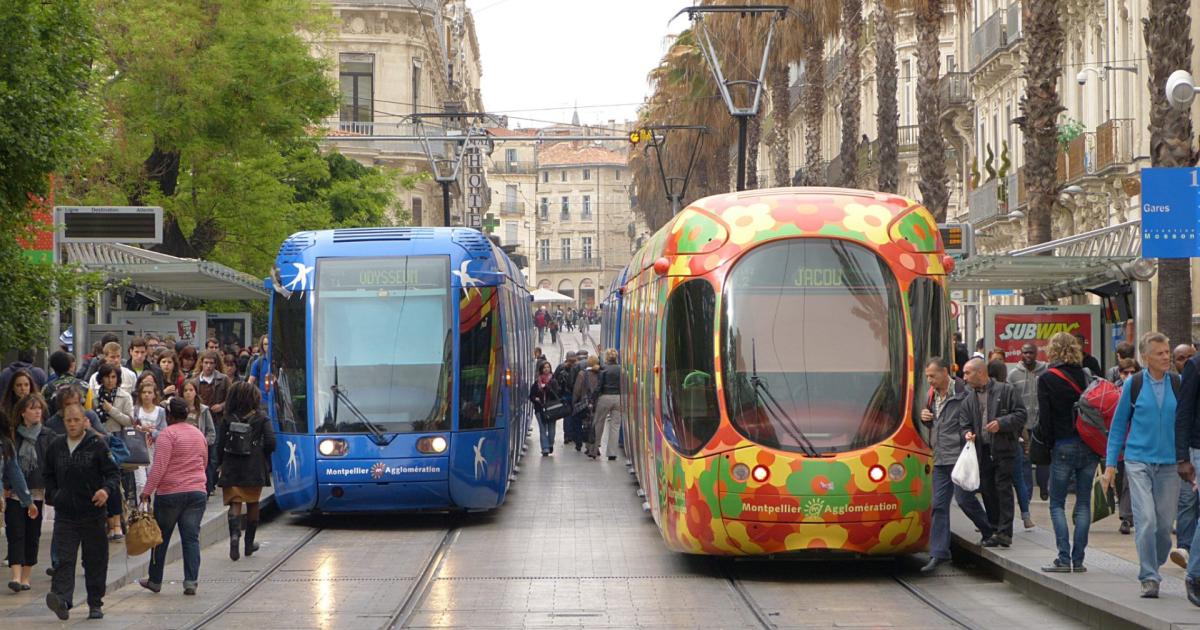
The results are in. Universal free public transport, introduced in Montpellier in southern France in December 2023, is proving to be a runaway success.
A Mobility Observatory set up by the local authority has published a report on the first two years of the scheme.
This article is part of our FREE PUBLIC TRANSPORT series in partnership with Fare Free London.
There is much still to be done – especially, investing in further improvements in the service, and tackling arguments about how it will all be paid for.
Proof
But the problems are easily outweighed by the achievements: car traffic is down, active travel is up, and low-income households are feeling the benefit.
More than half a million residents of the Montpellier metropolitan area are eligible for free transport passes, and 420,000 people (82 per cent) now have them. Public transport use is 39 per cent higher than it was in 2019 - just before the Covid-19 pandemic.
Free public transport was introduced in stages: on weekends in 2020, for under-18s and over-65s in 2021, for everybody in December 2023.
Anyone who lives in any of the 31 municipalities in the Montpellier metropolitan area, near France’s Mediterranean coast, travels without paying or swiping. They just need the pass, which acts as proof of residence.
Walking
On weekdays, the share of metropolitan residents driving a personal vehicle has dropped from 70 per cent in 2019 to 51 per cent in 2025. In the city proper, this share has fallen from 58 per cent to 45 per cent, according to the Mobility Observatory.
This fall has benefited walking - up from 17 per cent to 28 per cent across the metro area, and from 21 per cent to 29 per cent in the city - and also cycling -up from four per cent to six per cent metro-wide, and from five per cent to eight per cent in the city.
Public transport’s share of trips in the metro area rose from 10 per cent in 2019 to 15 per cent in 2025, and within the city from 17 per cent to 19 per cent.
Julie Frêche, metropolitan vice-president for transport and active mobility, said: “We’re not claiming it’s a miracle — but it’s a positive measure helping us accompany a change in habits. Especially since, at the national level, modal shares have remained flat.”
Frêche told activists in Grenoble that the introduction of free public transport is estimated to have increased the amount of walking by two-thirds, as people now walk daily from their homes to bus or tram stops.
Free
In Montpellier, an urban area without major industry, road transport accounts for the lion’s share of air pollution: 82 per cent of nitrogen oxides and 66 per cent of greenhouse gas emissions. These emissions are falling, and not only due to cleaner vehicles.
We’re not claiming it’s a miracle — but it’s a positive measure helping us accompany a change in habits.
“We’re seeing a drop in kilometres driven, despite a five per cent population increase since 2019”, Dominique Tilak, director general of Atmo Occitanie, the regional air quality agency, said.
Since 2020, she observes a shift linked to “a broader change in behaviour regarding car use, and public policies supporting that change”.
The French national government’s Audit Chamber issued a “mixed” assessment of Montpellier’s free transport scheme, coloured by neoliberal economic assumptions.
Worrying
Its conclusions, reported by Mediapart, focused on the new journeys made by tram or bus. Survey respondents said that, of these journeys, 33 per cent would previously have been made by car, 39 per cent would have been made by walking, cycling or scooter, and 28 per cent would not have been made at all.
The “initial assessment of the costs and benefits of these changes on health and the environment, conducted by the financial authorities, is negative”, the Audit Chamber concluded.
The Audit Chamber acknowledges that “the region’s economic dynamism has partially offset the loss of fare revenue”, but also points to an increase in public subsidies and a “renewed rise in the metropolitan area's transport debt”.
It further highlights “worrying financial prospects”, as “the work to extend the service” will require investment.
Budget
Philippe Descamps, the Le Monde Diplomatique reporter who travelled to Montpellier, saw it differently.
They reported: “'We’re not losing revenue — we have dynamic revenues', Renaud Calvat, mayor of Jacou and metropolitan vice-president for finance, replies [to the Audit Chamber’s assessment]. Chalk in hand before a blackboard, he walks through year-by-year figures showing how the mobility levy (versement mobilité, VM) has compensated for lost fare income, rising from €85 million in 2020 to nearly €125 million in 2025. 'The VM is a percentage of the payroll of companies with more than ten employees. That payroll has grown thanks to our attractiveness — new businesses setting up here, many small firms crossing the threshold.' Since the VM rate is unchanged, the financial burden on businesses has actually fallen: free transit exempts them from the share they previously had to contribute toward employees' transit passes.
Cécile Hautefeuille of Mediapart also reported the municipal authority’s robust response.
"In the Montpellier metropolitan area, revenue from ticket sales has fallen by 77 per cent compared to 2019, representing a loss of 30 million euros. 'We never said it was magically free!' Julie Frêche [metropolitan vice-president for transport] asserted. This 30 million euros 'represents 4.68% of the metropolitan area’s operating budget.' She stated that commercial revenue remains significant: 'Ticket sales to non-residents of the metropolitan area still bring in 9 million euros, because we have a very touristy region.'"
Crazy!
Most controversial of all, the Audit Chamber claimed: “In the coming years, the financing of public transport will depend increasingly heavily on public subsidies, funded by local taxpayers."
It added: "The annual amount of subsidies per capita allocated to transport is expected to rise from an average of €75 over the period 2015-2024 to €460 over the period 2025-2031.”
Julie Frêche denounced that as “biased”. She told Mediapart: “That’s a completely absurd figure! I don’t know where that amount comes from. There hasn’t been any tax increase, at least not in household taxes.”
An unnamed city official, quoted by Le Monde Diplomatique, hit the nail on the head: “At Bercy [the Ministry of Finance], free public transport is driving them crazy! It’s perceived as a loss of revenue for local authorities, but in fact, they are perfectly free to manage it as they see fit!”
High-quality
As soon as we can, we will look at all the information from the Mobility Observatory and the Audit Chamber – but it’s clear from the press reports that this is a political dispute.
The neoliberal assumption is that services have to be paid for at the point of use. Nigel Farage says that should apply not only to bus fares but to the NHS.
Water company bosses say that should apply to water, even when they don’t clean up the sewage. Montpellier shows us that a service paid for at the point of use in the past can be paid for by a small tax on businesses.
For universal free public transport to realise its full potential, investment in high-quality service will be essential – and Montpellier claims a degree of success here too.
Benefit
Over to Le Monde Diplomatique again:
"A consensus emerges from many studies on the subject: demand for public transit depends above all on service quality. 'The leveraging effect of free access is inseparable from an eight per cent expansion of service supply during our term', Julie Frêche insists. It is part of a 'systemic' transport policy. Her team has notably promoted carpooling, extended tram line 1 to the TGV [high speed rail] South France station, and inaugurated a fifth tram line, 16 kilometres long, at the end of December 2025. Of the five high-frequency bus corridors promised in 2020, only one has been delivered, Nathalie Oziol, municipal election candidate for La France Insoumise [France Unbowed], notes. Land acquisition problems delayed these projects, Frêche responds. While transit is “fully free” for metropolitan residents, it is not universal: visitors and residents of the wider urban area still pay. 'We’re not encouraging people from the periphery to use public transit at all — yet they account for most of today’s car traffic”, laments Green municipal election candidate Jean-Louis Roumégas, who would like to extend free access to all who work in the metropolitan area. The tram halts at Pérols, 3 kilometres from the nearest beach — a symbol of inter-municipal bickering stretching back to the reign of Georges Frêche (mayor 1977–2004). 'I converted TaM [Transports de l’agglomération de Montpellier or Montpellier metropolitan area transport] into a local public company to allow other municipalities or intercommunal groupings to join us', Mayor Michaël Delafosse (Socialist) says. 'That’s already the case for Montarnaud, whose residents now benefit from free transit.'"
Maintenance
Laurent Murcia, a union representative for Force Ouvrière (FO), the overwhelming majority union at TaM, also underlined the importance of investment, in an interview with Mediapart. “Free public transport is great”, he said, “but you have to provide the necessary resources!
“The increase in ridership has not been accompanied by an increase in the number of trams and buses. The trams are packed, the buses are packed. It takes longer, passengers are more irritated, and our breaks are shorter.”
Residents of Montpellier city had benefited from the zero-fares policy, but not those in surrounding areas.
Murcia, who is secretary of the Social and Economic Committee (CSE) and works as a bus and tram driver, said that his union advocates a “social fare” system.
“Infrastructure and its maintenance are expensive. We therefore believe it's better to charge those who can afford it in order to generate some revenue.”
Transfer
Murcia said that concerns about jobs being endangered had been allayed. “Initially, we were afraid that free public transport would lead to staff reductions, but the ticket inspectors were retained, and the ticket office staff were reassigned to other roles.”
Yannis Ruelle, spokesperson for the Montpellier Public Transport Users Collective, told Mediapart of a “feeling of abandonment” among residents living “at the end of the tram line” outside Montpellier.
“We receive testimonies from people forced to drive to the tram stop further away and wait half an hour instead of an hour”, he said.
Bus routes are also a big issue, Ruelle said. The introduction of line 5, which serves four municipalities in the metropolitan area (including Montpellier city centre), hasn’t helped matters.
“Buses that used to go directly to the city centre have been discontinued. Now, you have to transfer to the tram. That can really discourage people from using it.”
Passengers
The Montpellier metropolitan area defends itself from this criticism, arguing that the network is becoming increasingly comprehensive.
Frêche said: “Today, 82 per cent of the metropolitan area’s residents are served by the network, compared to 79 per cent previously. For the tram alone, 70 per cent are now served, compared to 57 per cent in the past.”
During campaigning for the municipal elections in March, the Mayor’s left-wing rivals also pointed up the transport system’s problems.
Roumégas, the Green candidate, said that zero-fares is “good for [households’] purchasing power. But tram lines have been so congested that passengers are sometimes left on the platform.”
Integrated
Oziol of La France Insoumise said there had been insufficient planning: “Without anticipating the rollout stages, free transit runs into two obstacles: reduced frequency and lower quality of service.”
Yet these left-wing candidates did not call for free transport, which they laud as a “social achievement”, to be reversed. Neither did others running for election: the billionaire Mohed Altrad wants to extend free provision to school canteens; former mayor Philippe Saurel talked about charging the “ultra-rich”.
Only the independent candidate Isabelle Perrein, backed by the right-wing parties MoDem and Union of Democrats and Independents, proposed to a partial return to paying fares.
Montpellier’s integrated transport policy targets further reductions in car travel and the expansion of car-pooling, public transport, walking and cycling.
Network
A strong grass-roots cycling campaign has helped, as reported by Le Monde Diplomatique:
"The catalyst for cycling policy came in autumn 2018. Then-mayor Philippe Saurel was dismissive of cyclists: 'You know, building infrastructure used by two people may not be ideal', he told a journalist. Within days, more than a thousand cyclists had gathered outside the town hall under the slogan: 'I am one of the two cyclists.' Nicolas Le Moigne, spokesperson for cycling association Vélocité, watched membership grow from around a hundred to over a thousand: 'This bottom-up civic mobilisation has shaped the public debate. Montpellier had no cycling culture; we convinced Saurel, then Delafosse, to work with Danish experts to help guide the project management.' The results are striking. Starting from almost nothing, the metropolitan area has avoided the big mistakes made by supposedly 'pioneer' cities such as Grenoble or Strasbourg. A coherent network has been built in under six years, with powerful symbols like the Comedy tunnel — once a road underpass, now reserved for bicycles. Problems remain: gaps in continuity at intersections, the inability to bring bikes aboard trams, and the absence of a long-term public bike rental service, while a very costly scheme incentivises the purchase of electric mopeds instead. In sum, free public transit has not penalised active travel modes."
Manoeuvre
Montpellier’s municipal councillors have responded forcefully to the criticisms of the zero-fares policy by the Audit Chamber.
Here is Le Monde Diplomatique again:
"In his written response to the Audit Chamber [report on Montpellier’s free transport scheme], Mayor Delafosse defends a 'political choice': 'Free transit makes public transport a common, universal, and equitable good. It corrects two major flaws of current systems: widespread non-take-up of social fare schemes, and the sense of injustice felt by the middle class, who are often excluded from such provisions.' But why not ask those who can afford it to contribute? 'This debate happened in 1885, over schools”, Renaud Calvat, metropolitan vice-president for finance, replies. “To create a genuine shift in mindset, you have to offer free access to everyone, because it benefits everyone.' […] To those who repeat that 'nothing is ever free', Delafosse retorts that roads cost the metropolitan authority €79 million per year: 'That's considerable, but no one ever questions those budgets.' To that figure should be added the externalities — the health, social, and environmental costs of the 'car system'. Montpellier’s early results, still to be confirmed, invite reflection on how to meet national greenhouse gas reduction and air quality targets. The mobility levy is, for me, one of the best funding instruments available, because it is directly earmarked for a specific expenditure', says Calvat. In Île-de-France, the levy has been raised to 3.2 per cent, accounting for three-quarters of all urban transit trips in France. Applying the same rate to the other twenty-one major metropolitan areas — currently capped at two per cent — would substantially expand their room for manoeuvre."
Collective
In his election manifesto, Delafosse made free public transport a “totem” – a commitment that appears on the ballot paper.
He regards it as a “structural” choice, linking “social justice, ecological transition, and territorial cohesion”, in a city with a poverty rate of 28 per cent, compared to 15.4 per cent across metropolitan France.
Delafosse cites Henri Lefebvre’s “right to the city” as the ultimate reason why free public transport matters.
Lefebvre, a mid-twentieth-century French philosopher, decried the way that urban spaces were being turned into commodities.
His idea was to “rescue citizens as the main elements and protagonists of the city that they themselves had built”, and to transform urban space into “a meeting point for building collective life”.
This Author
This summary of the outcomes has been compiled from press reports by Fare Free London, with the help of campaigners in France. The organisation brings together community groups, trade unions, environmentalists and others who see free public transport as central to a vision of the London in which everyone would want to live.