- A pedagogy of subordination: Workplaces are training people to accept unilateral authority, and those habits do not stay at the office.
- The hidden stake: The tech right’s break with liberal democracy is driven in part by demands that workers have voice inside their own firms.
- Law constitutes power: Employer authority is not a natural fact but a legal construct; labour law is where the rule of law enters the workplace.
- Algorithmic management: AI-driven systems are intensifying managerial command, making continuous surveillance and automated sanction routine.
- Beyond data protection: Europe needs stronger collective bargaining, codetermination and constitutional limits on workplace surveillance.
Peter Thiel’s recent private lecture series in Rome on the Antichrist should not be dismissed as another exercise in billionaire eccentricity. In unusually stark form, it condensed a worldview that is gaining influence across parts of Silicon Valley, the American right and sectors of the European far right as well. Thiel routinely invokes the spectre of a one-world government — one capable of regulating artificial intelligence or tackling climate change — as “the Antichrist”, a framing that casts democratic restraint and supranational authority as existential threats while elevating exceptional elites as the true bearers of freedom. The Rome lectures were revealing not as a cultural curiosity but as a symptom of a broader political convergence.
This became especially clear at the end of last year. Around the same time that Elon Musk escalated his attacks on the European Union after regulatory action against X, and even called for the Union’s abolition, the Trump administration’s National Security Strategy denounced the EU as anti-democratic and declared that the United States should help Europe “correct its current trajectory“. What is at stake here goes well beyond a disagreement over digital-market regulation or a diplomatic quarrel. It is a struggle over private power and, more specifically, over who gets to govern the deployment of technology in our societies.
As I argued in a recent keynote for FES – Future of Work, nowhere are the stakes of this confrontation between technology and democracy more visible than in the workplace: in the employment relationship, in managerial prerogative, and in the legal institutions that determine whether workers remain citizens at work or are reduced to subjects of command.
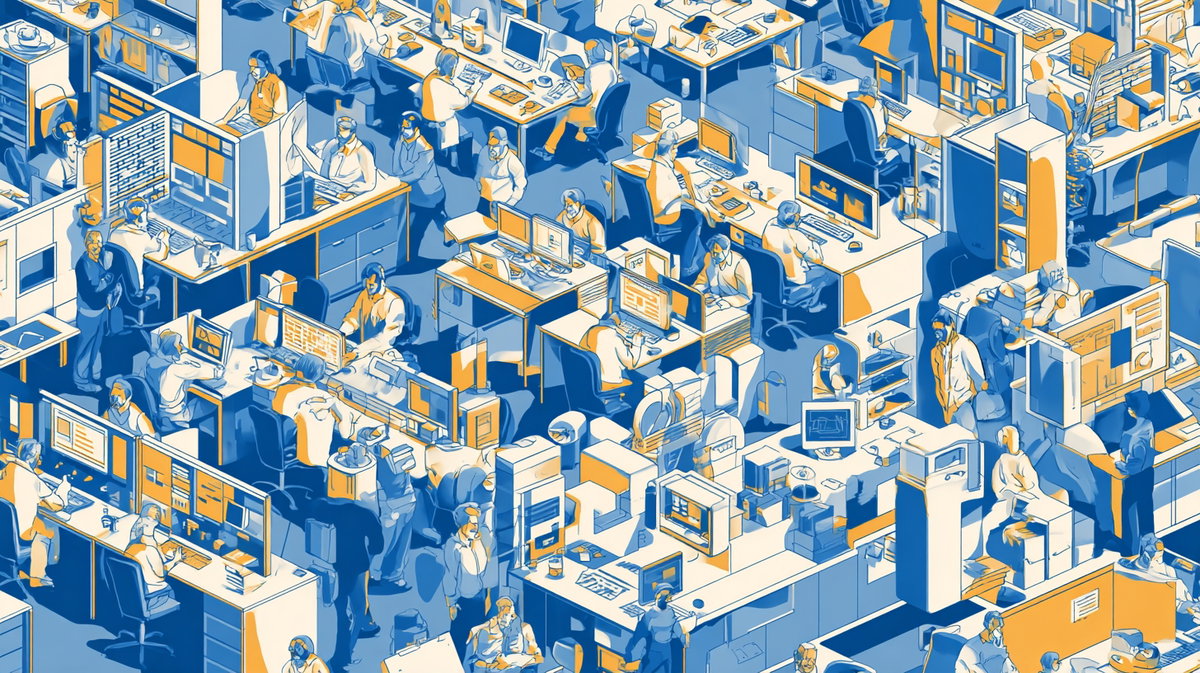
This is the dimension too often missing from commentary on the tech right. We hear a great deal about civilisation, sovereignty, Western decline and the culture war. We hear much less about the organisation of production. Yet if one wants to understand why so many tech elites are drawn to anti-democratic politics, one should look not only at what they say about the state but also at what they expect from the firm. One should look at the workplace, where hierarchy is normalised, obedience routinised, and surveillance increasingly built into the architecture of everyday life. That is where a pedagogy of subordination is learned in practice. And that pedagogy does not remain confined to work. It reverberates throughout democratic life.
Smart, Progressive Thinking on the Big Issues of Our Time
Join 20,000+ informed readers worldwide who trust Social Europe for smart, progressive analysis of politics, economy, and society — free.
Thiel is not simply a polemicist against liberal democracy in the abstract. He is part of a broader intellectual constellation that binds suspicion of democracy to admiration for concentrated authority. One of the key figures in that constellation, Curtis Yarvin, imagines political order in terms that reduce citizenship to exit without voice: if you dislike how you are governed, you may leave, but you do not meaningfully participate, contest or share in rule. That may sound like an exotic reactionary fantasy. In the workplace, its logic is entirely familiar. For decades, workers have been told that if they are unhappy they are free to go, but they are not entitled to challenge management, to negotiate the organisation of work on equal terms, or to contest the unilateral exercise of employer power. What appears radical in political theory often reproduces a much older grammar of managerial control.
From Silicon Valley to the Shop Floor
The connection is not speculative. Marc Andreessen recently complained that Silicon Valley’s break with the Democrats accelerated when employers could no longer fully control their own workforce, particularly after employees began demanding that companies take their own professed values seriously. In that account, the issue was not just taxation or antitrust. It was the workplace. More precisely, it was whether workers would have voice. The episode reveals something important about the political realignment of the tech right: one of its hidden stakes is who gets to control the workplace, and on what terms.
This is why labour law belongs at the centre of these debates. Labour law is not merely a technical field regulating wages, contracts and dismissal. It is one of the principal ways in which the rule of law enters the workplace. Employers are granted legal powers to direct, monitor and discipline workers. Those powers are not natural facts. They are constituted and structured by law. Labour law exists, in part, to ensure that these powers do not become arbitrary and all-encompassing, and that workers do not cease to be citizens the moment they enter the workplace. Workers’ rights, in that sense, are not just social entitlements. They are democratic safeguards.
The urgency of this becomes clearer still once we turn to artificial intelligence and algorithmic management at work. These technologies are usually discussed in the language of innovation, efficiency and competitiveness. But they also reorganise and reinforce authority. Employers increasingly use digital systems to hire, direct, evaluate and discipline workers, while collecting immense quantities of data about productivity, pace, location, communications and behaviour. The point is not simply that privacy is endangered, though it is. The point is that managerial command is being intensified through technology. These systems make it easier to monitor continuously, standardise evaluation, automate sanction, and weaken the spaces of discretion, judgment and collective resistance on which democratic work depends.
An Apprenticeship in Authoritarianism
In that respect, the workplace is becoming a privileged laboratory for a wider political culture. A world in which people are constantly tracked, assessed through opaque systems, ranked according to metrics they do not control, and denied meaningful participation in the rules governing them is not just a new model of work. It is an apprenticeship in authoritarianism. When people spend most of their waking lives in environments governed by unilateral authority and pervasive surveillance, it should not surprise us if democratic dispositions are weakened beyond the workplace as well. The habits cultivated at work shape the expectations people bring into politics.
That is why data protection, while essential, is not enough. What is needed is a stronger legal and collective response to digital technologies at work: more robust limits on surveillance, stronger collective bargaining and codetermination rights, and clearer recognition that workplace governance is a constitutional issue as much as an economic one. The question is not simply how to regulate innovation. It is who gets to rule, through what means, and whether those subject to power retain any meaningful voice.
Thiel’s Rome reflections on the Antichrist matter, then, not because they are bizarre but because they illuminate a broader tendency of our time: the fusion of technocracy, private command and distrust of democracy. A society in which millions of people spend their adult lives under rigid hierarchies, pervasive surveillance and weakened collective voice is also a society that trains them to accept power asymmetries as normal. People grow accustomed to the idea that those above decide and those below comply, and to thinking that freedom lies in adapting to rules made by others rather than in helping to shape them. That is why the erosion of democracy at work does not stay at work. It echoes into political democracy itself.
If Europe wants to defend democracy, it cannot do so only in parliaments, courts and foreign-policy communiqués. It must also defend the rule of law where millions of people encounter power every day: at work. That is where the contest over voice, subordination and citizenship is already being fought.
Help Keep Social Europe Free for Everyone
We believe quality ideas should be accessible to all — no paywalls, no barriers. Your support keeps Social Europe free and independent, funding the thought leadership, opinion, and analysis that sparks real change.
Social Europe Supporter
— €4.75/month
Help sustain free, independent publishing for our global community.
Social Europe Advocate
— €9.50/month
Go further: fuel more ideas and more reach.
Social Europe Champion
— €19/month
Make the biggest impact — help us grow, innovate, and amplify change.