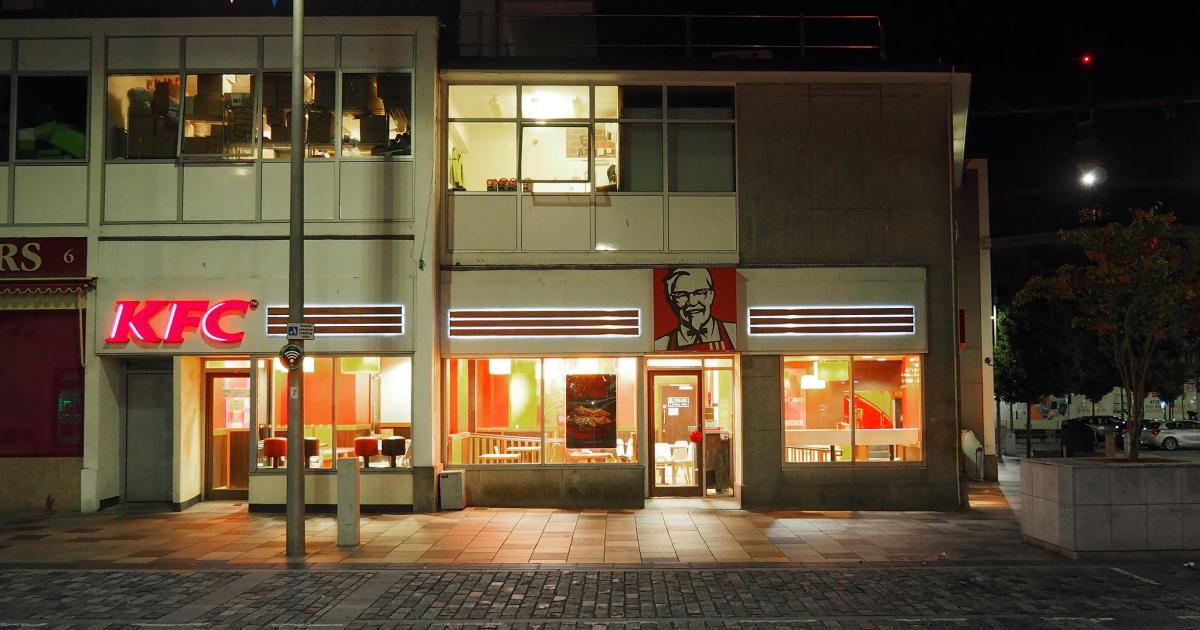
KFC proudly announced earlier this year that it will source 35 per cent of its chicken from British farmers by the end of 2026.
The timing is awkward. On Friday 20 February, KFC was among 18 major UK hospitality brands to withdraw from the Better Chicken Commitment (BCC), a voluntary pledge to raise welfare standards for over one billion broiler chickens served in British restaurants and sold by British retailers each year.
KFC’s commitment not only represents a low level of ambition for sourcing British chicken but is also accompanied by a retreat from higher animal welfare standards.
READ: FOOD BRANDS BREAK FRANKENCHICKENS PROMISE
Intensive
In 2019, KFC signed up to the Better Chicken Commitment, a six-point policy aimed at improving chicken welfare by addressing harmful practices such as breeding for excessively fast-growth and high yield, as well as issues related to housing, stocking density, and slaughter.
By pledging to source slower-growing birds produced to higher welfare standards, in line with public expectations, it positioned itself as a fast-food chain finally doing some good. Now KFC has walked away.
The day before 18 major hospitality brands withdrew from the BCC, the eight businesses that own them, including Yum! Brands, parent company of KFC, formed the Sustainable Chicken Forum, claiming to take a more "holistic view" of chicken production.
It’s hard to avoid the conclusion that KFC is hiding behind the forum to justify continuing to keep chickens growing as fast as possible in the most intensive systems, while claiming this is the ‘greener’ option.
Farm-assured
Supermarkets have also been reluctant to sign up to the BCC, citing increased costs.
Waitrose has fulfilled the Better Chicken Commitment in full, the only UK supermarket to have done so and M&S is on track to do so this year., The other retailers are lagging behind, and out of step with public opinion.
It's shameful that companies can boast about British sourcing while quietly dropping the animal welfare standards that would make that sourcing beneficial.
Polling has constantly shown that the public strongly cares about transparency and animal welfare standards - from protests against US chlorinated chicken entering our supermarkets, to research by DEFRA revealing that 85 per cent of UK adults agree we have a moral duty to safeguard animal welfare.
The Soil Association's Out to Lunch campaign included an independent assessment of children’s food and sourcing standards across major UK high street restaurant chains in 2024.
It found that just 11 of the 20 high street restaurant chains surveyed were sourcing 100 per cent farm-assured meat. Chicken came from as far afield as Thailand and Brazil, with significant gaps in traceability.
Shocked
Our biennial campaign – that sends an army of secret diner parents to assess the quality of kids' food at popular UK high street food chains – shows that many UK consumers have a strong preference for ensuring better traceability and supporting local and ethical producers.
The pig and chicken industry's resistance to method-of-production labelling means consumers will continue to be left in the dark.
In 2025, the National Farmers’ Union opposed the government’s proposal on introducing the labelling, their reason being that it might cause confusion and place extra strain on farms. Most UK-produced meat - over 90 per cent for chicken - is reared in intensive systems.
By now we already know there is a significant mismatch between consumer expectations and reality on both animal welfare and country of origin.
Compassion in World Farming’s Honest Labelling campaign shows that members of the public are genuinely shocked when they discover how animals are kept in what they imagined to be higher-welfare British farms.
Stocking
This highlights how current consumer information can be very misleading.
Method of production labelling could drive positive change. We have seen this with egg labelling, which drove a significant shift to approximately 80% cage-free UK egg production.
Unlike eggs, there is currently no legal requirement for meat and dairy products to display consistent method-of-production information, including in the out-of-home sector.
And when it is provided, it is often presented through a patchwork of voluntary labels and claims, which can be inconsistent and difficult for consumers to interpret. This represents a missed opportunity.
In its recent announcement, KFC stated that its British chicken is produced at a stocking density of 30kg per square metre, equivalent to roughly an A4 sheet of space per bird and described this as providing around 20 per cent more space than the industry average.
Reform
While presented as an improvement, stocking density alone is only one aspect of animal welfare.
The announcement gives limited information on other key factors such as breed, growth rate and environmental conditions, and applies only to part of its supply chain, with far less transparency around its imported chicken.
Without disclosure across the whole sector, it will continue to be difficult for people to make choices that align with their values.
The government must act. In December 2025, the government published its Animal Welfare Strategy for England, committing to a generational reform change in animal welfare and looking at how method-of-production labelling could drive real improvements in welfare outcomes.
That commitment must now be delivered on.
Labelling
Mandatory method-of-production and country-of-origin labelling – in which a business must label its meat, fish or seafood product with its country or place of origin, applied across retail and food service, including imports, would allow consumers to make genuinely informed choices, drive real improvements in animal welfare, and ensure that farmers investing in higher standards are not undercut by those who are not.
The health of people, the planet, and farmed animals must come before company profits.
Better labelling is long overdue and has overwhelming public support. In response to the 2024 government consultation on fairer labelling, over 99 per cent of individuals and 69 per cent of organisations backed mandatory method of production labelling. It’s time the government listened to their voices.
This Author
Rob Percival is the head of food policy at the Soil Association. He leads the Soil Association’s advocacy and campaigns for healthy and sustainable diets, with a focus on intensive poultry, issues associated with animal feed, and ultra-processed foods. He also works with the Food for Life programme, lobbying the British Government to improve the food served in schools, hospitals and public settings.