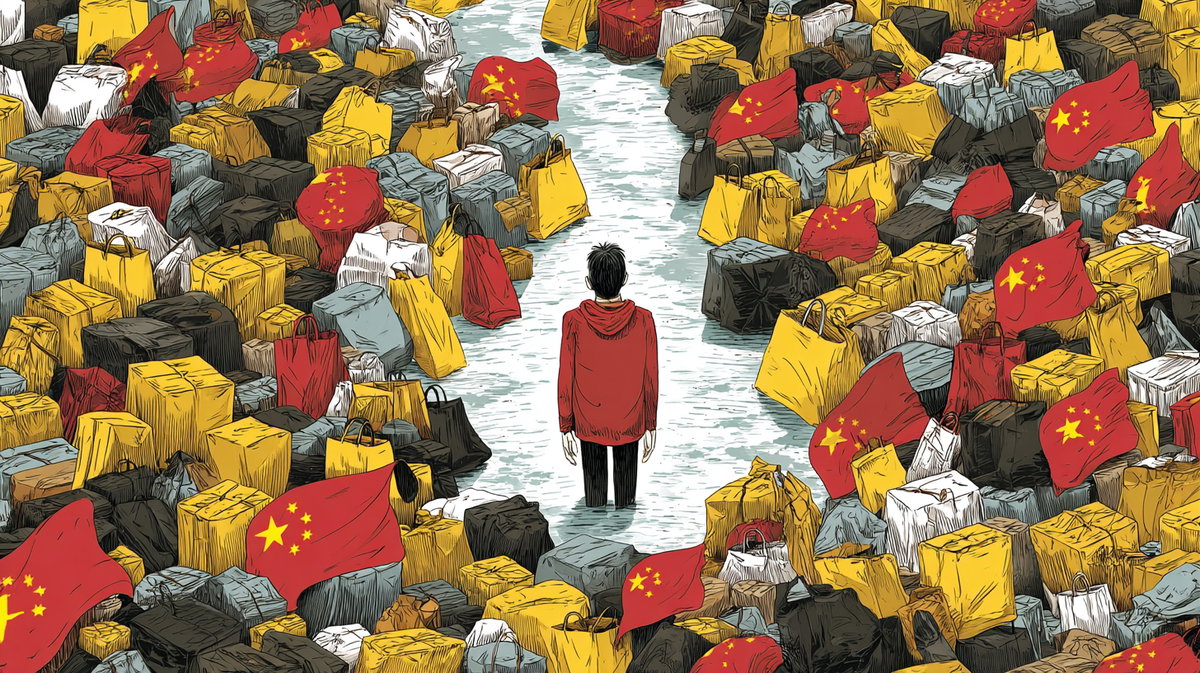
- A precise definition matters: Overcapacity is not the same as large-scale production — it refers to production capacity that persistently exceeds demand, leading firms to sustain high output that accumulates as inventory or is sold at below-cost prices, often sustained by state subsidies.
- Inventories, not exports, are the leading indicator: A substantial share of China’s excess output is being absorbed by swelling inventories rather than immediate export surges — a signal of pressure that will intensify when saturation is reached, not relief from it.
- Sector exposure is highly uneven: In semiconductors, hydrogen, and industrial robotics, China’s overcapacities are largely confined to lower-technology segments where Europe retains leadership. In electric vehicles and batteries, localisation trends protect European production.
- Trade defence has structural limits: Anti-dumping and countervailing measures are slow, reactive, and legally constrained; they cannot substitute for industrial policy. But they remain useful as a temporary shield against export surges and should be strengthened for that purpose.
- China’s reforms will not solve Europe’s problem: If Beijing’s anti-involution policies succeed, the result will be a more consolidated, more productive, and more innovative Chinese industry — a sharper competitive challenge for Europe, not a diminished one.
Something has shifted in the dialogue between Beijing and Brussels. After years in which Chinese officials dismissed European concerns about overcapacities outright, communication channels have slightly opened. This is welcome news — though the conversation that must now follow remains an uncomfortable one.
At the centre of European concerns sits the claim that Chinese industrial overcapacity leads to export surges at non-competitive prices — a threat to European manufacturing that has already triggered trade defence measures by the EU. For years, Chinese officials dismissed this outright, despite growing evidence, primarily from Chinese scholars. The political framing has now changed. Beijing has increasingly acknowledged a phenomenon it calls neijuan — involution: the pathological over-competition within China’s domestic market that builds excessive production capacity, hollows out profit margins, and destroys economic value.
This reframing matters. China is not conceding the label “overcapacity”; it is introducing policies to combat involution — and those policies should reduce excess capacity. The conversation is no longer entirely about whether the problem exists. It is increasingly about how to address it, and what the consequences of those policies will be.
Before assessing the risks for Europe, one needs to be precise about what overcapacity actually means. Overcapacity is not the same as large-scale production or large export shares. China is the world’s largest manufacturer, and scale alone is neither surprising nor problematic. According to our definition), overcapacity refers to a situation in which production capacity persistently and structurally exceeds demand over several years, leading companies to sustain high levels of production, with the resulting surplus either accumulating as inventory or being exported at prices that do not reflect full cost recovery.
Progressive Thinking on the Big Issues of Our Time
Read by policymakers, academics and journalists in 100+ countries.
Critically, this definition must account for the underlying causes. Overcapacity can build up in anticipation of high demand but should subside if demand does not materialise. It can, however, also be driven by subsidies, tax breaks, and cheap credit to secure employment at the behest of state officials whose advancement depends on hitting production and investment targets. This distinction matters enormously for understanding and countering overcapacity.
What the Data Show
Our analysis, prepared for the European Parliament’s Committee on International Trade (INTA), finds clear evidence of overcapacity, as defined above, across several Chinese industrial sectors. But how that overcapacity manifests is more nuanced than often assumed.
A substantial share of China’s excess output is, in fact, being absorbed in the form of swelling inventories rather than export surges. This is no relief for European industry; it signals instability and future pressure rather than current dislocation. When inventories reach saturation, the pressure to export intensifies markedly.
That said, the EU’s trade balance with China has deteriorated sharply. However, this is not solely the result of growing Chinese exports to the EU. Equally important, and frequently overlooked, is the collapse of EU exports to China. European goods are struggling to penetrate a market increasingly dominated by domestic producers, including those kept alive by state support. The bilateral imbalance is thus partly a demand problem in China and not merely a supply problem, further aggravated by the devaluation of the Chinese currency.
The frequently headlined risk that Chinese overcapacity is devastating European manufacturing is real, but it must be disaggregated before policy-specific responses can be designed. Our four sector case studies — on semiconductors, electric vehicles (EVs) and batteries, hydrogen, and robotics — reveal a picture that is highly uneven across industries.
In sectors where Europe retains technological leadership — semiconductors, hydrogen, and industrial robots — China’s overcapacities are concentrated mostly in low- and mid-tier segments or, in the case of electrolysers, in technology-ready segments, which limits direct impact on European firms. In the electric vehicles and batteries sector, ongoing restructuring and localisation of production networks in Europe reduce overcapacity risks for EV producers, but increase technological dependence on Chinese battery suppliers.
The EU increasingly uses trade defence instruments — anti-dumping duties, countervailing measures, and safeguards — to protect its industries against unfair competition. However, these instruments have limits and cannot substitute for enhanced domestic industrial and innovation policies. Actor-specific measures are inadequate to counter systematic Chinese industrial policy. Broad-based measures cannot be sustained over the long term or applied across multiple sectors without the risk of causing the familiar pathologies of protectionism — inefficiencies, higher domestic prices, and reduced competitive pressure.
Particularly problematic is the use of countervailing measures against foreign subsidies. By the time the evidentiary burden is met, the subsidies in question may already have contributed to scaling effects and technological progress that irreversibly reshape market structures.
Trade defence reform must include faster investigation procedures and improved cooperation with like-minded partners to avoid deflection through third markets — and, crucially, a clearer distinction between protecting strategic industries and merely sheltering incumbents from necessary competitive pressure. In short, Europe needs to update its trade defence architecture while recognising that trade defence is, at best, a temporary shield.
The Paradox in Beijing’s Calculations
Here is the paradox that European policymakers must sit with: China is itself increasingly motivated to reduce overcapacity — but not for the reasons European trade negotiators might hope.
Beijing’s concern is about the internal damage that involution is doing to Chinese companies themselves. Loss-making firms kept alive by government interventions depress margins, crowd out investment, and drag down the productivity of even China’s most competitive global champions. Firms that cannot generate sufficient cash flow are not investing in research and development. In a world where technological leadership is the ultimate competitive prize, involution is a strategic liability for China.
China’s new anti-involution policies — including more centralised investment planning and exit strategies for loss-making companies — are thus motivated by Beijing’s ambition to advance in the technological race, though their effectiveness remains to be seen.
The implication is sobering: even if Chinese overcapacity diminishes, the competitive challenge for European industry will not. A China that successfully consolidates around fewer, more productive, more innovative companies poses a sharper long-term challenge to European firms that still rely on their current technological capabilities.
The reopening of EU-China communication channels is an opportunity. Europe should engage Beijing on overcapacity, and the recent agreement on electric vehicles is an important signal in this regard.
But Europe’s primary task is to put its own house in order. That means modernising trade defence instruments to match the reality of state-driven industrial competition. The success of China’s policy shift is not guaranteed, and export markets remain a tempting release valve for excess capacity.
The real question for European policymakers is not whether China has too many factories. It is whether Europe is building the capabilities — in technology, talent, and investment — to compete with the Chinese companies that survive China’s own internal reckoning, for they may prove an even greater economic force in years to come.
This post is sponsored by ÖFSE