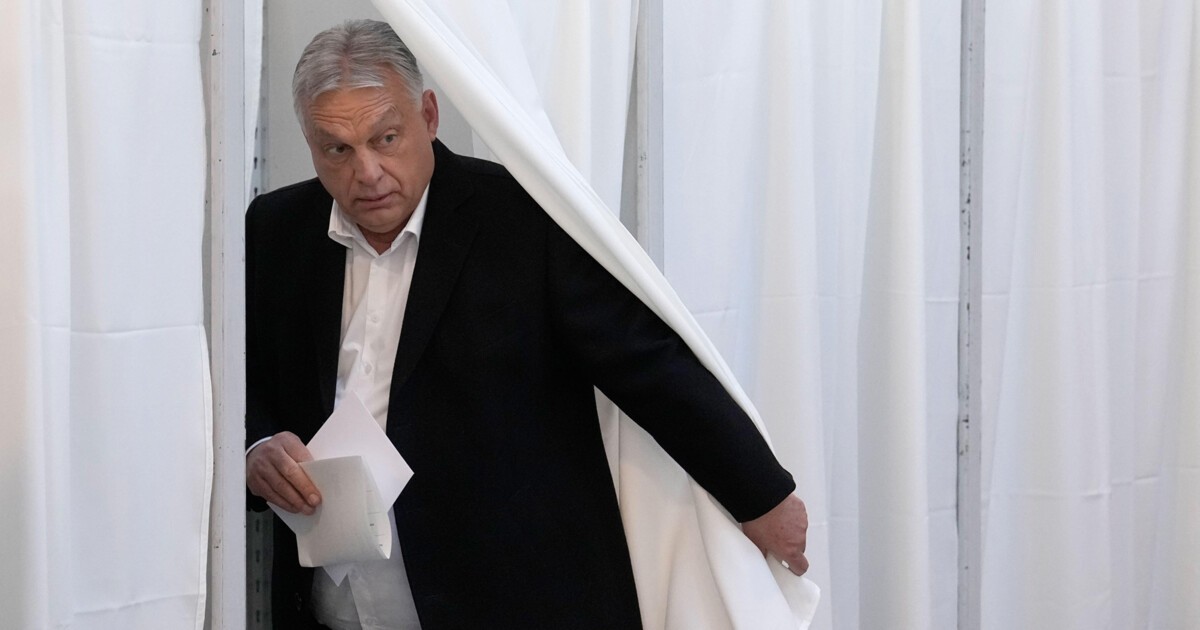
Can there be poetic justice in politics? Perhaps once in a lifetime. In 1989, a young Viktor Orbán bravely told the crowds in Budapest’s Heroes’ Square that it was time for the Russians to go home, just as protesters had demanded in 1956; almost four decades later, he was heckled on the campaign trail with the same words. There were more chants of ‘Ruszkik haza!’ during the celebrations on 12 April, after Orbán, Europe’s longest-serving head of government, was trounced. His party, Fidesz, ended up with less than 39 per cent of the vote, and just 52 of the 199 seats in the National Assembly.
Over the past sixteen years, Orbán’s self-declared ‘illiberal’ regime had pioneered methods for entrenching far-right populism in power. In 2010, Hungary’s electoral system had delivered Fidesz a two-thirds parliamentary majority, which he used to pass a new constitution, staff the state bureaucracy and courts with loyalists, help wealthy allies acquire media companies and subjugate schools and universities. With the electoral system tailored to his party’s advantage, 44 per cent of the vote was enough to deliver a two-thirds majority in parliament – which allowed the ruling party to change the constitution at will. Orbán employed what scholars call ‘autocratic legalism’: a form of government in which laws are passed according to proper procedures, but with the intention of strengthening the executive and enabling it eventually to act with impunity. Orbán advertised his country as a ‘laboratory’, and his efforts were copied elsewhere: the Polish far-right leader Jarosław Kaczyński promised ‘Budapest in Warsaw’; Trumpists learned how to exploit the US legal system, for instance by identifying obscure 18th-century laws that could be invoked to maximise presidential power.
Orbán created an intellectual and cultural infrastructure to spread an ideology, which he eventually dubbed ‘Christian Democracy’, centred on nationalism and natalism. Mothers were rewarded for having as many children as possible, with a system of grants, loans and tax breaks that amounted to 5 per cent of GDP. The Mathias Corvinus Collegium (MCC), a nominally private institution offering ‘supplementary education’ to students in order to create the next Fidesz elite, received more government funding than the rest of the higher education sector combined, thanks in part to its 10 per cent stake in the state-owned fossil fuel company. And so profits from cheap Russian gas – provided by Putin to shore up his major ally in the European Union – ended up financing fellowships for the academic turned Reform candidate Matthew Goodwin, speaking gigs for Niall Ferguson (who whined about ‘cancel culture’ in front of a prime minister who had just expelled the Soros-sponsored Central European University from his country) and lavish festivals where Peter Thiel and the former Austrian chancellor Sebastian Kurz flaunted their support for Orbán. Budapest became a pilgrimage site for MAGA-adjacent intellectuals eager to enjoy its food, ‘free speech’ and, as some gushed, a leader ready to discuss the finer points of political philosophy in English.
Some of the visitors seemed to be what used to be called ‘useful idiots’; they really couldn’t see the dark side. Others appeared to accept that corruption was just an unfortunate by-product of a strategy to create a national industry and local oligarchs, rather than being at the mercy of European corporations. Yet the line that Orbán was an anti-globalisation champion never quite worked. The country became so dependent on the German car industry that some called it an ‘Audicracy’ – a development welcomed by Angela Merkel, who for a decade turned a blind eye as Orbán became increasingly authoritarian and corrupt. More recently, Chinese and Korean companies were welcomed with open arms. A Samsung battery plant in Göd poisoned its own workers, who were exposed to carcinogenic chemicals at levels far above the legal limit; the populist enemies of globalisation covered up the scandal.
The sociologist Bálint Magyar characterised Orbán’s system as a mafia state. This wasn’t old-style corruption with envelopes changing hands under the table; rather, bids for lucrative state contracts were rigged to benefit the members of what Magyar called the prime minister’s extended ‘political family’. It included members of his actual family: his son-in-law built an enormous property empire; his father bought an estate that’s home to zebras and other exotic animals; his childhood friend Lőrinc Mészáros, a gas fitter, became the country’s richest man. The EU, noting the number of public contracts that only had a single bidder, came to realise that its infrastructure funds were being used by one of its self-proclaimed enemies to strengthen his own rule. European subsidies had become what oil used to be for certain Middle Eastern states: an effectively free resource to buy political support and pacify citizens. In 2022 Brussels finally suspended billions of euros of funding on account of ‘breaches of the principles of the rule of law’.
By that time, Hungary had the highest inflation rate in Europe, economic growth was flatlining, and the education and healthcare systems were visibly deteriorating (patients even had to bring their own toilet paper to hospital). The government was also failing by its own standards: the birth rate kept dropping. Yet Orbán’s opponents despaired that he had created a system that seemed invulnerable, even in the face of widespread discontent. Election rules kept being changed to favour Fidesz; opposition candidates were practically shut out of public media; everyone knew that careers could be ruined by criticising the regime. Nevertheless, the country didn’t feel like a dictatorship. European tourists flocked to Budapest, with its baths and fashionable ‘ruin bars’ in the old Jewish quarter.
The first real crack – it’s hard not to think of parallels with the Trump regime – had to do with paedophilia. Katalin Novák, the country’s first female president, who was often seen as a possible heir to Orbán, had pardoned the former deputy director of a children’s home who had been convicted of covering up abuse by his superior. Novák had apparently come under pressure from Zoltán Balog, a Protestant bishop and former minister of human resources, who is close to the Orbán family. News of the pardon broke in February 2024, leading to street protests; Novák eventually resigned; Judit Varga, another rising star, who had co-signed the pardon as justice minister and had been set to lead Fidesz in the 2024 European elections, also stepped down. The party’s image as protector of the traditional family was permanently damaged.
The affair had another unexpected consequence: Varga’s ex-husband, Péter Magyar (his last name means ‘Hungarian’), resigned from his positions in various state institutions and accused the government of ‘hiding behind women’s skirts’. Magyar had secretly recorded Varga describing the way government leaders made incriminating documents disappear (he claimed he had done this for their own protection); he also claimed that she had characterised the regime as a mafia. The day after his resignation, he gave an interview with the YouTube channel Partizán which was viewed 2.5 million times (in a country of 9.6 million people). Soon after, he mobilised tens of thousands of protesters outside parliament, where they shouted: ‘We are not scared!’
It was the beginning of a story no less remarkable than that of Orbán’s transformation from bearded student radical to elder statesman subservient to Putin. Magyar comes from a distinguished family of conservative lawyers: he is the great-nephew of Ferenc Mádl, an influential jurist and former president, and the grandson of Pál Erőss, a beloved figure who used to explain legal matters on Hungarian television. Magyar claims that there was a poster of the young Orbán on the wall of his childhood bedroom. He had a typical Fidesz career: a law degree at a conservative university followed by state service, first as a diplomat in Brussels, then as head of the legal department at a state-owned bank and CEO of the company that provides student loans.
A few weeks after Magyar’s resignation, Varga claimed in an interview that he had been abusive during their marriage; the accusations were eagerly picked up by Fidesz outlets, though no charges were ever brought. The war of the exes dominated the tabloids, and had the unintended consequence of making Magyar a public figure who, aside from starring in a marital drama, happened to be saying things about corruption that few expected to have confirmed by a Fidesz insider. As so often, elites are defeated not by their official opponents, but by defectors.
Magyar activated a dormant mini-party called Tisza (a combination of the words for ‘respect’ and ‘freedom’, but also one of Hungary’s main rivers). In the European elections in June 2024, Tisza received 30 per cent of the vote, coming an easy first among the opposition parties – a warning sign for Fidesz. The other anti-Orbán contenders now faced a dilemma: should they join the charismatic Magyar, who might have a chance of unseating the prime minister, or maintain a principled distance from a conservative whose views on the EU and the Ukraine war they found almost as distasteful as Orbán’s (he opposed fast-tracking EU membership for Kyiv). Liberal intellectuals distrusted him; many women were wary because of his ex-wife’s allegations and because, with his trademark sunglasses, he resembled an emissary from the manosphere. Meanwhile, Fidesz kept veering between attempting to ignore Magyar and throwing dirt at him, which probably only served to boost his profile.
Magyar understood that electoral districts had been gerrymandered in such a way that a divided opposition had no chance of gaining power; and as much as opposition parties might dominate in cities, gaining constituencies in the countryside was key to victory. Hence he did what previous opposition figures had never seriously attempted: over a two-year period, he visited hundreds of villages, sometimes holding up to six rallies a day. This was a way of getting round the problem that Fidesz cronies owned the local press. His rallies followed a formula: appearing with a Hungarian flag, he would give a speech quoting from folk epics and poetry (often recited together with his audience), and tell the crowd not to be afraid. Ordinary citizens put him up in their homes and drove him around in their cars. Young people in particular responded to Magyar’s message and his style. Teenagers compared him to Sándor Petőfi, the great national poet whose work inspired the 1848 Revolution. His famous line ‘now or never’ became a Tisza slogan; deploying the symbols of 1848 suggested that Orbán had created a feudal system which needed to be overthrown.
Magyar combined old-style retail politics with creative use of social media, the 19th century – a noble politician doing something for peasants and invoking great writers – with the 21st. Physical and online campaigns reinforced each other, not least because the Hungarian media landscape was changing. The Fidesz-controlled legacy media was terminally boring, but young journalists were launching new online ventures, often financed by donations; among these were Partizán and sites producing first-rate investigative work. Influencers supported Magyar and helped bring out crowds that were larger than those Orbán could mobilise (often, it seemed, only by offering some material reward).
Eventually, many of the opposition parties decided not to field candidates. And as the election approached, Fidesz appeared increasingly desperate. Orbán responded to Magyar’s combination of high and folk culture by appearing alongside rappers; he also instructed the party faithful to keep posting memes. Whistleblowers revealed dirty tricks that the government was planning. Fidesz appeared ready to release a sex tape of Magyar and an ex-girlfriend, but he got ahead of the story and accused the government of having set a honey trap. Apparently, Russian ‘political technologists’ were sent from Moscow to help Orbán; the supposed discovery of explosives close to the Balkan Stream gas pipeline in Serbia a week before the election, which allowed him to deploy soldiers in response, was hard to swallow. As the political scientist Gabriela Greilinger observed, Fidesz seemed to have forgotten how to campaign properly. Day by day, Orbán lost his aura of invincibility. What had still worked in 2022 – telling people that an opposition victory would lead to young Hungarian men being sent to die in Ukraine – now had hardly any effect. Meetings with Putin and a visit to Budapest by a characteristically hapless J.D. Vance probably backfired; several recordings were released of the foreign minister, Péter Szijjártó, receiving instructions from his Russian counterpart, Sergei Lavrov, talking like an obedient schoolboy and offering to send confidential EU documents to Moscow.
On election day, turnout was a record 78.9 per cent. Even small villages abandoned Fidesz, with Tisza winning 93 out of 106 possible constituency seats. Voters clearly had understood the message about unity; even the independent parliamentarian Ákos Hadházy, an anti-corruption hero who had led ‘safari tours’ to Orbán père’s estate, lost his seat to Tisza. More poetic justice: the system Fidesz had designed to favour the dominant party gave Tisza a two-thirds majority in the National Assembly. In his victory speech, Magyar promised, ‘Never again a country without consequences!’ (to which the crowd responded: ‘To prison!’). He wants to establish an office to recover stolen assets, and has asked Fidesz loyalists to resign, starting with the president, Tamás Sulyok (who has said he will think about it). No doubt these figures will soon complain that the rule of law is being violated in the name of restoring it – this, after all, is the playbook that Kaczyński’s Law and Justice party perfected after losing power in 2023. In particular, the president can veto legislation; he can only be removed if parliament and the constitutional court – which has of course been captured by Fidesz – agree.
Outside observers have rushed to draw lessons from Magyar’s victory. Centrists pushing liberal nationalism have pointed to Magyar’s tough stance on immigration (he has promised to maintain Hungary’s ‘very strict position’) and his decision to wrap himself in the flag – ignoring the fact that he didn’t campaign on border policies, and that he offered not just patriotic clichés, but a carefully crafted mythology about his connection to the country’s traditions. In the US, unsolicited advice to the Democrats has boiled down to running on an anti-corruption ticket. But if revealing conspicuous corruption were enough, Fidesz would have been defeated as long ago as 2018. Tisza’s presence in the countryside made the difference; it’s not a strategy that can be easily replicated in much larger countries.
Another lesson is even more challenging. As the political scientist Cas Mudde remarked, leftists and liberals had to hold their noses to support Magyar – but they did so, for the sake of restoring democracy. Elsewhere, the centre-right has rejected making similar sacrifices; instead, its leaders have been increasingly willing to ally with the far right. Many conservatives now claim that Orbán can’t have been an autocrat, because he lost an election and conceded. But in the kind of system created by Fidesz – what political scientists call ‘competitive authoritarianism’ – elections are largely free, even if they aren’t fair. Defeats for authoritarians can’t be ruled out.
Whether Hungarian liberals and leftists will rue their choice remains to be seen. The National Assembly doesn’t have a single MP from any of the left-leaning parties; then again, with Fidesz and the even further right Mi Hazánk as the only opposition, Magyar has no obvious reason to move rightwards. There’s also the question of how Tisza will develop: other charismatic leaders with new parties haven’t been very good at creating structures for genuine participation by members, let alone allowed rivals to rise (think of Macron or Farage).
The idea that Magyar’s win is a blow to the international far right is somewhat far-fetched. Few people care all that much about elections outside their own country; speculation about a supposed ‘populist wave’ advancing or receding is the poorest kind of analysis. But far-right intellectuals will no longer find Budapest quite so hospitable. Magyar has made it clear that taxpayer money can’t be misused for things like the MCC and, even more egregiously, the Hungarian offshoot of the American conservative festival CPAC. Some Trumpists will be bothered; Trump himself perhaps not so much. Unlike Putin, he never provided Orbán with real material support, and he has never pretended to be a loyal person. He might even prove receptive to a younger man in a slim suit: it worked for Zohran Mamdani.