Before he took to writing thrillers in the early 1960s, Len Deighton, who died in March at the age of 97, had worked as a railway clerk, a kitchen porter, a pastry chef, a flight attendant and a commercial artist. Having completed his national service in the RAF he used his demob grant to study at St Martin’s School of Art, going on to the Royal College of Art on a scholarship. After working in the kitchen at the newly opened Royal Festival Hall in 1951 – he’d begun by mopping floors but was soon roped into skinning a heap of sole – he came up with the idea of drawing recipes as cartoon strips. At first these were for personal use only – he didn’t want to spoil his ‘expensive cookbooks’, so ‘I wrote out the recipes on paper, and it was easier for me to draw three eggs than write “three eggs”’ – but then, thanks to the journalist Clive Irving, who enjoyed eating at his house, Deighton’s ‘cookstrips’ began to appear in the Daily Express in 1960 and soon moved to the Observer. They were collected in the mid-1960s as Len Deighton’s Action Cook Book and Où est le garlic? French Cooking in Fifty Lessons.
By that point Deighton was rich and famous, thanks to the runaway success of his early novels – The Ipcress File (1962), Horse under Water (1963), Funeral in Berlin (1964) and Billion-Dollar Brain (1966) – and the movie adaptations of them starring Michael Caine. In the opening scenes of The Ipcress File, as Caine’s character briefly dozes off while brewing his morning coffee, you can see a cookstrip pinned to the kitchen wall. The cookstrips are said to have enabled men – thanks both to the ease of following the instructions and the reassuring masculinity of their presentation – to boil, blanch, braise and baste with confidence, even tackling dishes as potentially daunting as boeuf bourguignon or osso buco (to be pronounced as Caine would say it). And the cookstrips’ virtues – clarity, immediacy, blunt humour, a no-nonsense air – are also evident in the best of Deighton’s novels. They share a few shortcomings, too, including a chauvinism that hasn’t aged well.
Caine’s character in the movies is called Harry Palmer, but the narrator of those early novels, sometimes known as the ‘Secret File’ books, remains anonymous. According to Caine’s memoir What’s It All About? the idea was to give the film character an ‘ordinary, boring name’. ‘What’s the dullest first name we can give him?’ the producer, Harry Saltzman, asked. ‘Harry is a pretty dull name,’ Caine suggested, and Saltzman doesn’t seem to have taken offence. As for a surname, ‘the dullest person I ever met,’ Saltzman said, ‘was called Palmer.’ There may be another reason that the name Harry popped into Caine’s head. He was, he says, halfway through reading The Ipcress File when Saltzman asked if he’d like to star in it. And quite near the beginning, the narrator is at Rome airport, ‘killing a minute with the paperbacks, when I heard a soft voice say: “Hello, Harry.” Now my name isn’t Harry, but in this business it’s hard to remember whether it ever had been.’
Recently discharged after three years in military intelligence, he’s in the early days of a new job at the WOOC(P), ‘one of the smallest and most important of the intelligence units’, run by a man called Dalby. The P stands for provisional but the rest of the acronym is mysterious. WO could perhaps be ‘War Office’ except the unit isn’t part of the army, reporting instead to the Cabinet Office. The element of trivial mystery, and the awkwardness of the extra O and the brackets, are rather the point, a satirical dig at the bureaucratic obscurantism that clouds the essential secrecy of spying. The narrator has been with the WOOC(P) for several weeks, and risked his life more than once, but still hasn’t received any pay.
The offices are on ‘one of those sleazy long streets in the district that would be Soho, if Soho had the strength to cross Oxford Street’. Though he had never been a spy, Deighton drew on his own experiences for The Ipcress File, which is part of what makes the world he describes so convincing (he saved his scuba-diving training in the RAF for Horse under Water). While studying at St Martin’s he had rented a ‘tiny grubby room’ in Soho and got to know the area well. Later, as the art director of an ‘ultra-smart’ advertising firm, he was ‘surrounded by highly educated, witty young men who had been at Eton together’ (they were also ‘kind’ and ‘generous’ and he enjoyed their company ‘immensely’, he later recalled; the narrators of his novels are more acerbic). He ‘took the social atmosphere of that sleek and shiny agency and inserted it into some ramshackle offices that I once rented in Charlotte Street’. There’s a young clown called Phillip Chillcott-Oakes, for instance, whose conversation seems to consist almost entirely of tracing social connections between people with ridiculous nicknames: ‘If you are in H.38 you must know “Rice-Mould” Billingsby.’
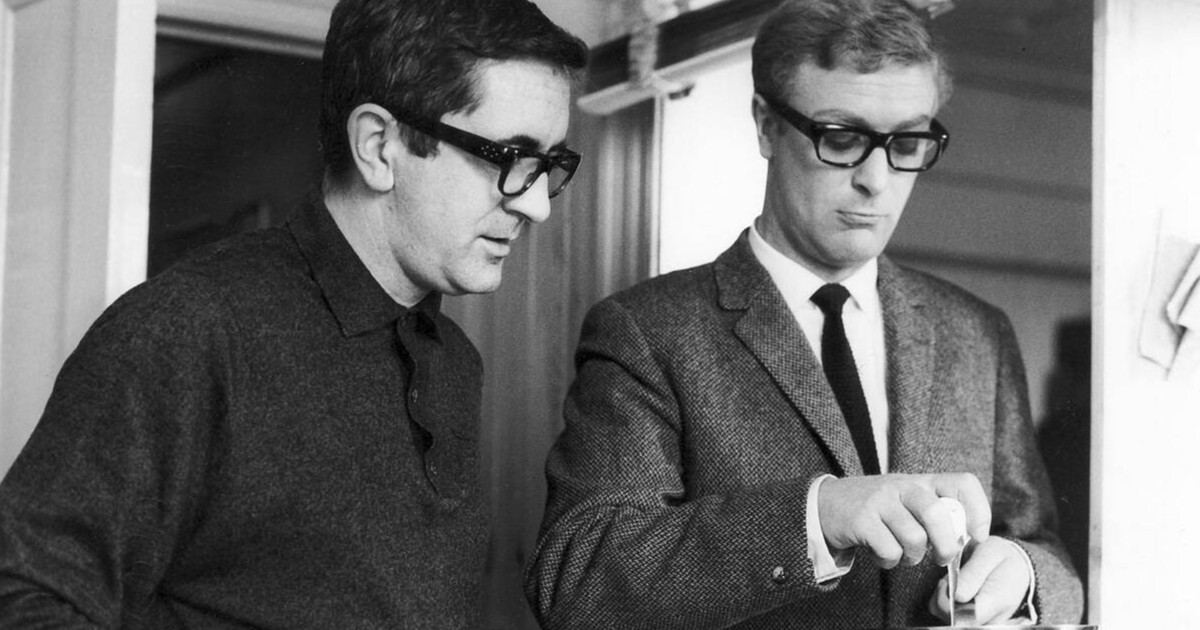
Working as a flight attendant for British Overseas Airways got Deighton ‘three or four days stopover at the end of each short leg’ and he ‘spent enough time in Hong Kong, Cairo, Nairobi, Beirut and Tokyo’ not only to make lasting friendships in those places but to write about them plausibly. Not so Burnley, the town where his narrator was born and grew up, and which Deighton knew only as the destination of parcels at the King’s Cross sorting office where he’d worked over one Christmas holiday. Giving the character Lancashire origins was an attempt to put some distance between author and narrator, a distance narrowed by the films. Harry Palmer is a Londoner. Deighton was born in Marylebone in 1929, Caine in Rotherhithe in 1933. Both their mothers worked as cooks, though in Caine’s case the skill doesn’t seem to have passed to the next generation. In the omelette-making scene in The Ipcress File, Palmer’s hands in the close-ups are not Caine’s but Deighton’s. There are on-set photographs of them standing next to each other at the stove, wearing identical black-framed spectacles. Deighton is looking on, wooden spoon in hand, as Caine fails to get the hang of cracking an egg one-handed.
The novel races from one side of the world to the other at bewildering speed, but pauses to linger over a decent meal:
The vichyssoise was rich with fresh cream, through which the fugitive flavour of leek came mellow and earthy; it was cold and not too thick. The steak was tender and sanguine, dark with the charred carbon of crusted juices, and served with asparagus tips and pommes allumettes. The coffee came along with strawberry shortcake. I ate it all, drank the weak coffee, then settled back with a Gauloise Blue. Poisoning seemed an unlikely method of dealing with my defection.
The influence of Raymond Chandler is clear from the rhythm of the sentences, the careful choice of adjectives – elsewhere, Deighton isn’t afraid of using a word like ‘horrisonous’ – and the deadpan sangfroid of the punchline. The narrator, eating in the officers’ mess on a Pacific atoll in the run-up to a nuclear test, has not in fact defected, though a friend in US intelligence has just told him he’s under suspicion. The reasons – for the suspected defection, the friend’s informing him and pretty much everything else – remain fairly muddy, as the plot is almost impossible to follow (it has something to do with disappearing scientists), but if that’s a defect it’s deliberate. Deighton wanted the book to be ‘ragged and untidy’, he said in 1966, and later suggested that ‘what happens in The Ipcress File (and in all my other first-person stories) is found somewhere in the uncertainty of contradiction.’
The almost dreamlike movement of the story is at times closer to Ishiguro or even Kafka than your standard spy thriller. The trick is to give up trying to make too much sense of what’s going on and enjoy the ride – the sentences, the wisecracks, the atmosphere. If you’re looking for the satisfactions of a tightly sprung plot, you should watch the movie of Funeral in Berlin rather than reading the book (I like both, but only the book has such pleasingly throwaway lines as ‘Samantha lived in the sort of road where driving schools teach people to turn round’). In a later novel, Berlin Game, Deighton’s narrator says that ‘it is in the nature of German syntax that you have to compose the sentence in your mind before you start to say it. You can’t start each sentence with a vague idea and change your mind halfway through, as people brought up to speak English do.’ I don’t know if this is true of speaking German but it’s certainly true of the way Deighton writes his sentences, if not all his books (I suspect he may have started some of them with a vague idea and then changed his mind halfway through).
The Ipcress File (the book) came out around the same time as Dr No (the movie). Reviews of the novel pointed out the contrast between the glamour of James Bond and the grime of Deighton’s spy world: there are no Aston Martins or high-rolling casinos in The Ipcress File, just ‘a little grey rusting Morris 1000’ and a grimy strip-joint on Wardour Street. The class difference between the protagonists is less apparent in the 1960s movies, though – Fleming’s hero is an Etonian but Sean Connery wasn’t – and I don’t see that James Bond is a less boring name than Harry Palmer. Both men are tough and sexy and quick-witted. Still, Deighton’s reputation was established as the creator of an anti-Bond, and it’s at least true that 007 wouldn’t be found messing around with eggs in the kitchen until Roger Moore whips a quiche out of the oven for Tanya Roberts in A View to a Kill in 1985.
By that point Deighton had created a new hero, Bernard Samson, who narrates eight novels published between 1983 and 1996, and has not only a name but a family life and a full backstory. He grew up in Berlin, where his father was an intelligence officer after the Second World War. Instead of being sent to boarding schools in England, Bernard was educated locally, so he knows his way around the city, speaks German like a native and has close, lifelong friendships with other Berliners, all of which comes in handy when he follows his father into the service. The novels are organised as three trilogies: Berlin Game (1983), Mexico Set (1984) and London Match (1985); Spy Hook (1988), Spy Line (1989) and Spy Sinker (1990), which is told in the third person and recapitulates the events of the previous five books from outside Samson’s point of view; and Faith (1994), Hope (1995) and Charity (1996). Deighton had planned a fourth set but abandoned the idea because ‘the fall of the Wall was such an earthquake that it would obliterate the long line and progress of the personal relationships.’ He lived another thirty years but wrote no more novels.
In an introduction, written in 2010, that appears in the Penguin Modern Classics edition of Berlin Game, Deighton says:
To give my characters a real, or at least a convincing, life demanded more space. Did giving them a domestic dimension mean pressing the pause button in order to relate the dull routines of mortgages, electric bills, children’s ailments and traffic jams? No, that is not the way to treat your readers unless you just don’t care about them; and in that case you should be writing literary novels.
The nine novels are in one sense the story of a complicated marriage as it moves through phases of companionship, suspicion, betrayal, separation and reconciliation. Fiona Samson (née Kimber-Hutchinson) also works for the service, so the couple’s professional and personal lives are inseparable. A hero who falls in love with another agent of doubtful affiliation had long been a staple of the genre, but for a pair of middle-aged spies to be married with children was more unusual (and taken up later by movie and TV franchises from Spy Kids to The Americans). ‘Treason and infidelity have too much in common,’ Samson observes at one point in London Match. This is certainly true from a narrative or dramatic perspective, and John le Carré also made use of the idea. But in le Carré, the mole will turn out to be the agent having an affair with the hero’s wife, while in Deighton, the hero’s wife will herself turn out to be the mole. This isn’t really a spoiler, or no more of a spoiler than you get if you take at face value the reassurance at the start of all the Bernard Samson novels – typical of Deighton’s professed consideration for his readers – that ‘the stories can be read in any order and each one is complete in itself.’*
Samson’s political or national loyalties are called into doubt at times by his colleagues and his superiors, but never by the reader, and he never questions them himself. He doesn’t seem all that interested in the reasons he does what he does, or whether or not the cause he’s fighting for is just. He takes all that for granted, which is one of the things that makes him good at his job: an introspective spy is inherently unreliable. He may make the occasional joke about the equivalences between the two sides in the Cold War – when a KGB interrogator in Berlin Game complains, or pretends to complain, that ‘deskbound Party bastards’ always get ‘the promotions and the big wages’, telling Samson he’s lucky ‘not having the Party system working against you all the time’, Samson replies that ‘we have got it … it’s called Eton and Oxbridge’ – and he may have little respect for some of the people he’s obliged to report to (‘“Let me tell you something, Bernard,” said Dicky, leaning well back in the soft leather seat and adopting the manner of an Oxford don explaining the law of gravity to a delivery boy … I wondered if there were a lot of people like Dicky in the army; it was a dreadful thought’), but there’s never any chance of his switching sides.
One of the longest and most coherent criticisms of capitalism in the novels comes in Mexico Set from Bernard’s oldest and closest friend, Werner Volkmann, a Jewish Berliner whose parents were killed by the Nazis:
‘Four out of ten Mexicans never drink milk, two out of ten never eat meat, eggs or bread. But the Mexican government subsidises CocaCola sales. The official explanation is that Coca-Cola is nutritious.’ Werner drank some of the disgusting coffee. ‘And, now that the IMF have forced Mexico to devalue the peso, big US companies – such as Xerox and Sheraton – can build factories and hotels here at rock-bottom prices, but sell to hard-currency customers. Inflation goes up. Unemployment figures go up. Taxes go up. Prices go up. But wages go down. How would you like it if you were Mexican?’
Samson’s response is simply to ask Werner if he’s quoting the KGB officer whom they’re in Mexico to encourage to defect. The closest Samson gets to reflecting on the inequities of capitalism is to look round a luxury yacht and ‘suppose it was everything a communist hated. Even a lapsed fascist like me found it a bit too rich.’
He’s joking, of course – he was never a fascist – though as jokes go it’s perhaps a little close to the bone. And, though unremittingly hostile to the Nazi leadership, Deighton and his narrators tend to withhold judgment when it comes to ordinary Germans who joined the party out of convenience or cowardice: which of them could say with confidence that they would have refused? It’s a thought experiment that Deighton plays out more fully in SS-GB (1978), set in a counterfactual universe where the Nazis won the Battle of Britain and the UK has been under German occupation since February 1941. Nine months later a dead body with two bullets in it is discovered at a flat in Shepherd Market, and Detective Superintendent Douglas Archer of Scotland Yard is called to investigate. ‘As long as the Germans let him get on with the job of catching murderers,’ Archer thinks, ‘he’d do his work as he’d always done it.’
It isn’t that simple, of course: in part because the murder turns out to be linked, through a convoluted set of relations, to the British resistance, US spy networks, the German atomic weapons research programme in Devon, a plot to free the king (who’s thought to be imprisoned in the Tower of London), and rivalry between the Abwehr, the Gestapo, the SS and the Wehrmacht; but also because it raises the question of what it means to enforce the law when you’re living under Nazi occupation. The least convincing element in SS-GB is probably that the Molotov-Ribbentrop Pact has held, as if Hitler would have been content to abandon the Drang nach Osten. Plausible or not, the Nazis have invited their Soviet allies to London for a ceremony to exhume Karl Marx’s body from Highgate Cemetery and transport his remains to Moscow. The occasion provides an opportunity not only for the resistance to strike a blow, but for Deighton to conflate Britain’s enemies of the 1940s and 1970s. His approach to individual characters is more nuanced, however: some of the Germans Archer has to deal with are more reasonable – or even decent – than others, and not everyone in the British resistance is exactly a hero.
The recognition that bad people can fight in a good cause and vice versa also informs Bomber (1970), another Second World War novel, though this time the war is progressing much as it did in reality. The book begins shortly before dawn on 31 June 1943 (a non-existent date, as Deighton is kind enough to observe in a preliminary note), as the crew of a Lancaster bomber are waking up after a party, and finishes 24 hours later. The narrative of the intervening day covers in engrossing detail the experiences not only of that flight crew but of other bomber crews, the ground crew at RAF Warley Fen, a fictional airbase in East Anglia, German radar operators on the Dutch coast, German fighter pilots and the civilian residents of Altgarten, a fictional German market town near the Dutch border that the British, aiming for Krefeld, bomb in error. Unlike the air raid it describes (and unlike some of Deighton’s earlier books), the novel is an astonishing feat of planning and organisation, successfully executed, in part thanks to the help of a friendly IBM engineer: Bomber was the first novel to be written with a word processor, or rather an MT72 electric typewriter, ‘the size and shape of a small upright piano’.
Deighton had always been interested in technology – the narrator of The Ipcress File has an IBM machine; the title of Billion-Dollar Brain refers to a supercomputer – and the capabilities and limits of technology are in part Bomber’s subject as well as playing a role in its creation. Deighton’s friend Julian Symons told him he ‘was the only person he knew who actually liked machines’ and suggested he write a book about them. ‘That was the start of Bomber … suppose I wrote a story in which the machines of one nation fought the machines of another’ without allowing ‘such a grim mechanical theme’ to ‘overshadow’ the ‘human element’. There are more than a hundred characters in the novel but among the most prominent are Flight Sergeant Sam Lambert, one of Deighton’s familiar working-class heroes; his wife, WAAF Corporal Ruth Lambert; a flight lieutenant educated at public school who would have been first in line to join the Nazi Party if he’d been born German; a German fighter pilot who has learned of some of the experiments being carried out at concentration camps and naively imagines that if only he can alert Göring to them, they will be stopped at once; a German radar operator at Noordwijk; and his young son, Hansl, who lives in Altgarten and is buried alive in the cellar where he seeks shelter from the British raid.
Bomber is in many ways Deighton’s least characteristic novel, though it’s also probably his best, and it’s hard to imagine anyone else writing anything quite like it. The book is a remarkable example of the way a narrative of great complexity can be constructed through the careful assembly of simple elements, and a timely reminder, nearly sixty years after it was written and more than eighty after it’s set, that bombing a hospital is an atrocity whoever does it, and for whatever reason, deliberate or not.