
Since 2018, when it bought the chemical manufacturer Monsanto, the German conglomerate Bayer has set aside billions to settle legal claims that the active ingredient in the company’s weedkiller Roundup has caused cancer and other health issues among its users. More than 100,000 plaintiffs across the U.S. have filed lawsuits alleging a cancer link, and in February the company agreed to settle a class-action lawsuit for $7.25 billion.
Last week, the Supreme Court heard oral arguments in one case that didn’t reach a settlement. John Durnell first sued Monsanto in 2019, arguing that he developed non-Hodgkin lymphoma because of persistent exposure to glyphosate in Roundup, which he had regularly sprayed throughout his neighborhood for twenty years. In 2023, the Missouri jury found Monsanto liable for failing to warn users of the cancer risk from glyphosate, and awarded Durnell $1.25 million in damages. The company has denied the claims and issued a series of appeals ever since.
Under the Federal Insecticide, Fungicide, and Rodenticide Act — known as FIFRA — the Environmental Protection Agency is authorized to govern the sale and labeling of pesticides. The federal law bars pesticides that are “misbranded,” or lack warnings that may be necessary to protect health and the environment. According to the law, states cannot impose labeling requirements that differ from or go beyond what federal law already mandates for these products. Manufacturers must register pesticides and herbicides with the EPA before selling them, and when a product is registered, the agency signs off on its labels.
Durnell’s case rests on a Missouri law that bans the sale of dangerous products without adequate warnings. Monsanto argues those claims should have been preempted by FIFRA, since the company registered its product with the EPA and received approval for its label. The central legal question before the Supreme Court, then, is whether the EPA’s approval of that label overrides the Missouri state law.
The justices appeared divided on the case during oral arguments. Several, including Justice Ketanji Brown Jackson, pressed attorneys on whether preemption would block states from responding to changing research. “Could we have a world in which a product that has been registered, the label is consistent with what the agency has said is appropriate at the time of registration, but let’s say a new research study comes out at some point between when the EPA is statutorily required to look at it again that casts doubt on the safety of this product?” Jackson asked Paul Clement, a former solicitor general and a lawyer for Monsanto, appearing skeptical of the company’s claim.
Clement responded by saying, “I think the way that you deal with that and the way the agency deals with that is either through some amended registration or some cancellation process which could be subject to judicial review.” Justice Amy Coney Barrett then put a finer point on Jackson’s inquiry: “But could the agency come after you for misbranding if you didn’t comply with your statutory obligation to give the updated information to the EPA?”
“Absolutely,” Clement responded. “But it wouldn’t be a misbranding action.”
Justice Brett Kavanaugh appeared to side with Monsanto’s argument that varying state requirements undermine federal uniformity. “Do you think it’s uniformity when each state can require different things?” Kavanaugh asked Ashley Keller, the attorney representing Durnell.
The EPA’s handling of pesticides has been fraught and shapes the stakes of the case considerably. Glyphosate is America’s most-used herbicide on agricultural crops — more than 280 million pounds of the chemical are applied to roughly 300 million acres of farmland every year, according to the EPA. In 2021, the EPA did a biological evaluation on glyphosate and found 1,676 endangered plant and animal species are likely to be harmed by the chemical. J.W. Glass, a senior EPA policy analyst at the conservation nonprofit Center for Biological Diversity, which contributed to an amicus brief filed in support of Durnell, says the sheer scale of glyphosate use is the problem, and the ripple effects can show up not only in the environment, but in people’s bodies. Farmworkers face some of the most acute exposure risk, a byproduct of working on farmland where the use of herbicides like Roundup are a routine part of crop production, according to Nezahualcoyotl Xiuhtecutli, a senior grassroots advocacy coordinator at the National Sustainable Agriculture Coalition.
“The indiscriminate use of it, and how much we use it, is the environmental issue,” said Glass. “You have these cases where people are spraying it directly into waterways for weed control.”
Glass said there are “plenty of issues” in the EPA’s pesticide labeling process. Two analyses his organization co-released with the Center for Food Safety in March found that the EPA has routinely left cancer warnings off pesticide products even when its own assessments have identified cancer risks. “Does EPA actually label pesticides when they are found to be a carcinogen? And the answer is, it’s very rare. But that’s only one part of it. There are all sorts of, I would say, loopholes that have been exploited within the pesticide law,” he said.
As reported by Mother Jones, the EPA spent more than a decade reviewing Roundup before clearing the herbicide in 2020 under the federal standard that its agricultural benefits outweighed its societal harms — only for that assessment to be swiftly challenged in court by environmental groups. The 9th U.S. Circuit Court of Appeals overturned the EPA’s assessment in 2022, finding serious “errors in assessing human-health risk.” EPA Administrator Lee Zeldin told Congress last Tuesday that a new ruling on the herbicide is coming by the year’s end.
At that same hearing, Representative Alexandria Ocasio-Cortez, a Democrat in New York, cited internal EPA emails that noted Bayer promised to “provide a small thanks” to Zeldin for the agency updating its webpage on glyphosate after an appeals court struck down a California label warning against the chemical’s cancer risk. The emails, according to Ocasio-Cortez, also show that the company “wanted to thank you and your agency for removing support for California’s warning because their case before the Supreme Court right now hinges on you not warning the American people and withdrawing your support on glyphosate.”
“Do you understand the conflict of interest that is before the American people right now, Mr. Secretary?” Ocasio-Cortez asked the EPA administrator. According to transcripts of the hearing, Zeldin did not explicitly respond.
The Durnell case has become a national flashpoint for environmentalists, public health advocates, and Trump voters who consider themselves a part of the Make America Healthy Again movement. Some of that friction can be traced back to last year, when the administration urged the Supreme Court to take up Bayer’s case. Then, in February, the president issued an executive order deeming glyphosate-based herbicides key to national security and calling for more domestic production of the chemical, which was met with serious backlash within the MAHA coalition. Trump’s administration also sent a lawyer to argue last Monday on behalf of the chemical company.
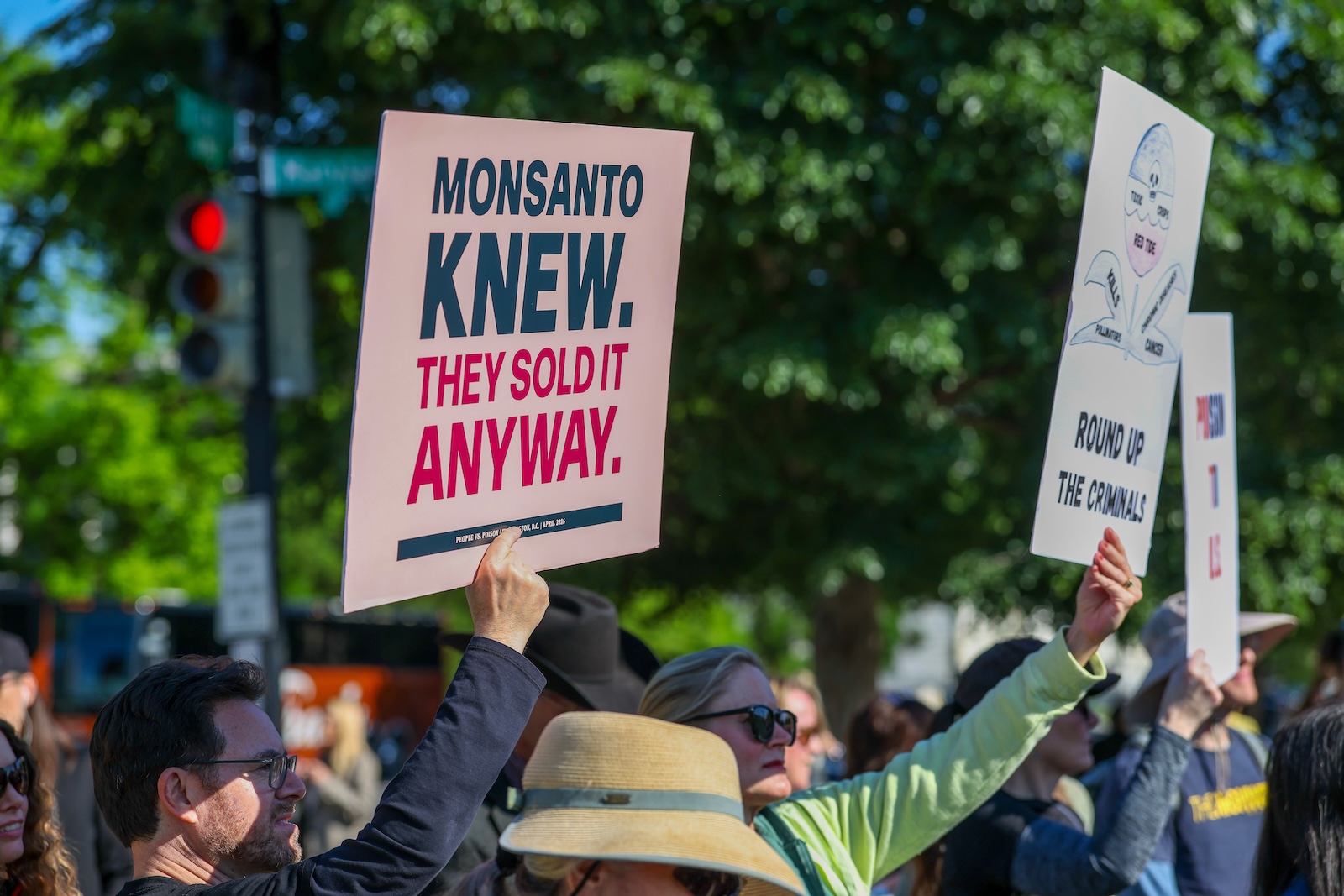
As justices heard oral arguments, a crowd of protesters gathered outside of the Supreme Court for what they called “The People vs. Poison” rally. At the same time, members of the U.S. House of Representatives debated provisions of the Farm Bill that would have blocked states from passing pesticide label requirements that differ from federal labels. Those provisions were stripped in a House amendment vote last Thursday, and the Senate is expected to vote in the coming weeks on the farm bill.
Kelly Ryerson, the prominent MAHA activist and founder of the website Glyphosate Facts who helped organize “The People vs. Poison” rally, said the Durnell case amounts to a litmus test for whether the administration is truly serious about the MAHA agenda.
A ruling that strips people’s ability to file state-level failure-to-warn claims would be “catastrophic for public health,” said Ryerson. “It would be entirely because of this administration, and it will be unforgivable.” The Supreme Court is expected to render its decision this summer, giving voters just months to reckon with the ruling before heading to the midterm polls.