
In July 1914 the twenty-four-year-old Walter Lippmann was traveling in Europe to celebrate the completion of his second book, Drift and Mastery, to recruit British writers for the magazine he was cofounding, TheNew Republic, and to spend two weeks walking through the Swiss Alps. But when Austria declared war on Serbia, his hopes for a hike, at least, were curtailed. He returned to London as the continent descended into conflict.
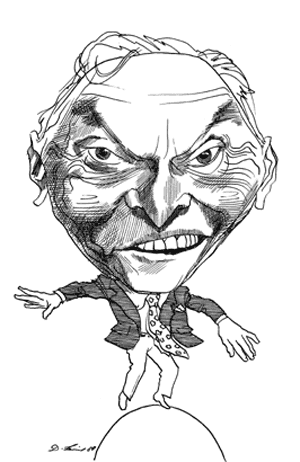
The sudden force of events and his powerlessness in the face of them made a deep impression on the young man. “Nothing can stop the awful disintegration now,” he wrote on August 2 to his friend Felix Frankfurter, the future Supreme Court justice, back in New York. “Nor is there any way of looking beyond it; ideas, books, seem too utterly trivial, and all the public opinion, democratic hope and what not, where is it today? Like a flower in the path of a plough.” The war was all-encompassing and yet impossible to experience except vicariously, through newspapers: “There is the worst event in the world hanging over our heads and all we can do is to read once in twenty-four hours a two-line Reuter telegram entirely surrounded by journalese.” He was, he wrote in his diary that night, “overcome with a general feeling of futility.” Two days later, however, he had recovered some sense of purpose: “My own part in this is to understand world politics, to be interested in national and military affairs, and to get away from the old liberalism which concentrates entirely on local problems.”
It is possible to see in these early wartime reflections many of the themes that established Lippmann as the most influential political commentator of his generation: his concern for the unstable promises of liberal democracy, popular sovereignty, and “public opinion”; his frustrated feeling that “politics” and “history” so often elude our direct experience; and his related drive not simply to understand world events but to be a part of them. Over the next half-century and more, he wrote compulsively, expansively, and not always coherently about the major issues of his day, in thousands of columns and some two dozen books, and became the patron saint of American liberalism.
Lippmann is an intimidating subject for scholars for several reasons. His corpus is vast and unwieldy. “His range and productivity,” Tom Arnold-Forster writes in Walter Lippmann: An Intellectual Biography, “are real problems for historians.” He also seemed from an early age to be on guard against posterity, shielding his interior life, covering his tracks, denying positions he’d held previously or providing implausible explanations for them. (In one of his most shameful columns, he wholeheartedly endorsed the call for the internment of Japanese Americans as “enemy aliens” during World War II, only to later claim that he wanted “to protect the Japanese-Americans from the hysterical mobs on the West Coast”—mobs that his column had helped to incite.) His first official biographer, Richard Rovere, gave up because Lippmann wanted to appoint “a board of arbitrators,” made up of three mutual friends, to adjudicate sensitive material. Then in 1980, six years after Lippmann’s death, Rovere’s chosen successor, Ronald Steel, delivered a masterpiece: Walter Lippmann and the American Century, justlyseen as one of the great political biographies. It is not an easy act to follow.
Lippmann was born in 1889, the only child of German Jewish parents living on the Upper East Side of Manhattan. It was a cultured household, and Lippmann was in a rush to reach the world of adults. His first memory, he claimed, was the financial crash of 1893. His boyhood obsession was Teddy Roosevelt, who was running for governor of New York when Lippmann was eight. He had a bust of Napoleon in his bedroom and believed—for much longer than he should have—that “wherever the American flag was planted, there tyranny must disappear.”
At Harvard, where Lippmann toyed with socialism, he stood out for his seriousness and his smarts. Whereas most of his fellow students went by informal nicknames—Joe, Dave, and the like—Walter was different. “Not even in his cradle days—if he had any—would anyone have dared to call him ‘Walt’ or ‘Wally,’” his Harvard friend Edward Hunt recalled. Instead, at Harvard and beyond, the nicknames and teasing quips were of a more elevated variety. Lippmann was “our all-unchallenged Chief,” “the future President of the United States,” and “Buddha” (a reference to his serene authority and round face). A friend who encountered an especially busy Lippmann in late 1914 reported that he seemed to have claimed “the responsibility of finishing up the incomplete work of the Creator.” Hunt referred to him as “a Manhattan Zeus…steady, massive, impassive, hurling his thunderbolts.”
The young Zeus was happier among Harvard’s professors than among his peers. William James hosted Lippmann at his house for weekly tea. The philosopher George Santayana brought him along to dinners in Boston. Graham Wallas, a visiting professor from England and an early member of the Fabians, treated Lippmann as his apprentice, invited him to stay at his home in London, and dedicated his book The Great Society (1914) to him. Together they instilled in Lippmann a sense that he was living and thinking in unprecedented times and that the enormous modern cities, factories, and newspapers were rewriting the rules of the world and calling all its old truths into question.
Wallas, whose influence Arnold-Forster is particularly strong on, was not satisfied with either of Lippmann’s first two books, A Preface to Politics (1913) and Drift and Mastery. He wanted something “more systematic” and “more definitely inventive” than these precocious yet ponderous reflections on modern politics. But Lippmann’s early work received plenty of praise from elsewhere. “A few years hence, academic discussions in political economy may be very generally punctuated with the explanatory clause: ‘as Lippmann says,’” a reviewer of A Preface to Politics noted. His idol Teddy Roosevelt, by then a former president, read Drift and Mastery and famously declared Lippmann the “most brilliant young man of his age in all the United States.” (Arnold-Forster cites the feminist Winnifred Harper Cooley’s more ambivalent assessment of Drift and Mastery: she found its chapter on feminism to be evidence that Lippmann was “nine-tenths on our side” and had “the extreme pigheadedness of men!”)
The demands of The New Republic and the war paused Lippmann’s authorial ambitions. The magazine published its first issue in the fall of 1914 and quickly earned a reputation for its patrician progressivism. “What a solemnity broods over the place!” reported a visitor to its editorial offices. “Walter Lippmann by the side of his colleagues is a knockabout comedian!” This solemn set endeared themselves to President Wilson, who invited Lippmann to dinner at the White House in December 1916—the first of many such invitations he received over the next fifty years—and soon appointed him to his team of advisers. Lippmann reveled in the attention. “This is the second time that I have put words into the mouth of the President!” he boasted to a friend in 1918, after he helped Wilson draft his Fourteen Points laying out his vision for peace after the war.
Lippmann’s thrill at influence pointed to an important tension between his desires to understand politics and to be a part of the action. The first required that he have a certain distance from power and an indifference to its entreaties: the second made him crave proximity and endearment. Steel is better on this tension’s significance than Arnold-Forster. Steel finds a revealing sketch that Lippmann wrote about Santayana in 1911, when he was twenty-one: “There is something of the pathetic loneliness of the spectator about him. You wish he would jump on the stage and take part in the show.” Then you realize, Lippmann wrote, that his genius lay in his distance. “For it is a fact that a man can’t see the play and be in it too.”
This remark, Steel notes, said at least as much “of the student as of the teacher.” To be in the audience and yet to have an audience, including among those on the stage—that would be his life’s ambition.
Lippmann’s time inside government increased his self-regard—“never lacking,” Arnold-Forster writes—and his doubts about democracy, a political system that seemed to him imperiled by both the sheer complexity of modern society and new methods of propaganda. In the 1920s he published two related books, Public Opinion (1922) and The Phantom Public (1925), that tried to cut through the exalted myths of democracy and put it on a surer footing. They affirmed his growing elitism and his abilities as a political commentator: his talent for sentences, his fluency in social psychology and political theory, his demiurgic confidence. The philosopher John Dewey described Public Opinion as “perhaps the most effective indictment of democracy as currently conceived ever penned.”
Democracy, Lippmann declared, asks too much of its citizens. It imagines that they know everything, or at least that they can or want to know everything, when in fact they know little, can only know little, and are happy with the little they know. “Man is no Aristotelian god contemplating all existence at one glance,” he wrote in Public Opinion, nor an “omnicompetent citizen” who has informed opinions on every important issue, he repeated in ThePhantom Public. In one of many theatrical analogies, Lippmann likened the typical voter to “a deaf spectator in the back row” who arrives “in the middle of the third act and will leave before the last curtain, having stayed just long enough perhaps to decide who is the hero and who the villain of the piece.”
The fact that no voter can know or understand everything could not be addressed by newspapers or education, Lippmann argued. The assumption that the average citizen simply needed the right information and the right intelligence—that “if only he could be taught more facts, if only he would take more interest, if only he would read more and better newspapers, if only he would listen to more lectures and read more reports,” the disappointing outcomes of democracy would disappear—was a fantasy. The press was important—Public Opinion, in particular, has been considered a founding text of media studies—but it was not a panacea. (The outsize attention on “misinformation,” “fake news,” and the need for “media literacy” after the 2016 election confirms this fantasy’s enduring appeal and the enduring relevance of Lippmann’s argument.)
The heroes of Lippmann’s democracy were neither the public nor the press but the experts: they alone could ensure that the right decisions were made. Lippmann was not imagining philosopher-kings—he knew that no expert is expert on everything. “That is why excellent automobile manufactures, literary critics and scientists often talk such nonsense about politics,” he wrote in The Phantom Public. Nor was Lippmann envisaging an impotent public. He thought elections and open debate should shape the direction of expertise—up to a point. In healthy democracies, he argued, new governments should only “slightly” alter “the management of affairs” because the differences between the major parties were “necessarily not profound.” His main wish, expressed in The Phantom Public, was “that each of us may live free of the trampling and the roar of a bewildered herd.”
Lippmann had always wanted to run with the rabbits and hunt with the hounds, but he tired of the former activity, or company, more quickly. In both books, his condescension toward the masses was palpable. “You have secured an authority with the more amenable of the conservatives which I like and yet I don’t like,” the jurist Learned Hand told him after Public Opinion. After The Phantom Public, he secured an authority with the less amenable ones as well. The reactionary and satirist H.L. Mencken, who had previously mocked Lippmann for indulging in the “mystical gurgle” of democracy, now praised him for accepting that “the masses are ignorant and unteachable.”
Today Lippmann is most likely to be remembered in one of three ways: for his involvement in the “Lippmann–Dewey debate” of the 1920s over the meaning of democracy, as an advocate of technocracy who championed rule by experts, or as a founding thinker of neoliberalism. All three legacies, Arnold-Forster argues, are misleading.
The first is easily disposed of because, as the work of Michael Schudson and Sue Curry Jansen has shown, the Lippmann–Dewey debate never happened. The notion emerged only in the 1980s, after its ostensible participants were dead. Dewey and Lippmann took part in related discussions about democracy, and though they differed in their faith in the public, they saw themselves as involved in a common project.
Arnold-Forster finds Lippmann’s reputation as a technocrat no less mythical, pointing out that he actually “attacked technocracy at many points in his career” and repeatedly warned against the idea that administrative problems could be treated apolitically. But Lippmann also preferred an empowered expert over an empowered voter—it isn’t hard to see how he earned his technocratic reputation. The best reason why this reputation is undeserved is only implicit in Arnold-Forster’s book: he was too inconsistent and contradictory to be a reliable advocate for anything, even if his imperious tone and constant air of conviction also made him a possible advocate for everything.
Lippmann’s oscillating convictions explain his third misleading legacy: his connection to neoliberalism. In the 1930s, at the peak of his powers as a columnist, Lippmann’s thunderbolts fired off in a dizzying number of directions. Within the space of a few years he proclaimed that Franklin D. Roosevelt should seize “dictatorial powers,” warned of America’s drift toward despotism, praised the New Deal as necessary, attacked it as dangerous, promoted the economics of John Maynard Keynes, and then, with the publication of The Good Society in 1937, accidentally helped to found the neoliberal movement.
TheGood Society was a muddled book: a polemic against the New Deal and all types of economic planning and a convoluted endorsement of many of its programs. But a small group of conservative economists in Europe seized on Lippmann’s antistate arguments, and in August 1938 they hosted the Colloque Walter Lippmann in Paris, an event widely regarded as the birthplace of neoliberalism. “Hayek & co. seem to think that Lippmann has provided them with a working political philosophy,” Harold Laski, a friend of Lippmann’s and a colleague of Friedrich Hayek’s at the London School of Economics, noted in 1938.
There was an affinity between Lippmann’s thought and neoliberalism. One of the few ideas that recurs consistently in Lippmann’s writing is that no one person can know everything. (He seems never to have recovered from this discovery.) A founding premise of neoliberalism was similar: because no one can know everything, economic planning is dangerous; therefore we should let what Hayek called “the spontaneous order” of the market decide. But really the neoliberals liked Lippmann less for his ideas than for his prestige. They wanted to be able to say “as Lippmann says” in their favor.
By the early 1940s Lippmann was on to other convictions, championing the power of the state. “Nothing will ever persuade the American people after this war…that a country which can produce such stupendous engines of destruction is too poor to abolish poverty,” he wrote in a column in 1942. In 1945 he declined to write a foreword for the US edition of Hayek’s The Road to Serfdom and, according to Hayek, “deliberately avoided” him on his book tour. Perhaps only a thinker such as Lippmann could help found an ideological movement he had no interest in joining.
By the 1930s, with his columns and books, Lippmann was more than a celebrity: he was an institution. When he joined the New York HeraldTribune, a Republican newspaper popular on Wall Street, in 1931, he was introduced as the “Spokesman of American Liberalism.” “Through syndication,” Arnold-Forster writes, “he reached a national audience of about ten million readers in around a hundred American newspapers.” A New Yorker cartoon from 1932 showed two women sitting with their newspapers over coffee, with the caption, “A cup of coffee and Walter Lippmann is all I need.”
After World War II, Lippmann was regarded as a spokesman of America. When he traveled abroad, he was feted as a head of state. “Saw the King, the prime minister, etc.—the usual people,” he noted in his diary during a visit to Greece in the mid-1950s. In 1961 one trip to Europe included a private audience with the pope, an exclusive interview with Nikita Khrushchev in Sochi, lunch with the British royals at Windsor Castle, and a tête-à-tête with Charles de Gaulle at the Élysée Palace. Lippmann had “the name that opened every door,” a colleague remarked, but just as frequently the powerful came to him. Steel recounts a guest at one of the Lippmanns’ coveted cocktail parties in Washington being struck by the police presence. “Why all the protection? Who’s in there?” he asked. “Mister,” the officer replied, “everybody’s in there.”
It is clear that Lippmann worried about his proximity to power, because he warned so often of its dangers to journalism. In Public Opinion, he wrote that the ruling class wielded two weapons: “the scepter of invitation” against other members of the elite and “propaganda” against “the far greater number who cannot be held by favors, the anonymous multitude.” Forty years later, in a speech in 1965, he cautioned that
the most important forms of corruption in the modern journalist’s world are the many guises and disguises of social climbing on the pyramids of power…. The temptations are many…. Only a constant awareness of them offers protection.
But Lippmann’s vigilance was not adequate protection. His relationship with authority—his desire to be a part of it, to be admired by it—consistently undermined his political analysis. Presidents realized that he tended to write more favorably about them when his counsel was sought and praised. A schmooze offensive from the Kennedy administration involved him in speeches and cabinet picks. Kennedy considered appointing him ambassador to France but decided, embarrassingly for Lippmann, that he was too useful as a journalist. Under Lyndon Johnson, an adviser explicitly referred to Lippmann’s “useful tendency to think the President himself is right.” Johnson declared at one press conference, “This man here is the greatest journalist in the world, and he’s a friend of mine!” Lippmann unwittingly spread their lies. On television, where he was billed as “the sage of Washington,” he suggested that there were no war hawks “at the top of the White House” and that American bombs “don’t…kill anybody.” The sage of Washington could also be its stooge.
Lippmann never tried to cut through the mystical gurgle of American foreign policy as he did with American democracy. Instead, in his extensive commentary on foreign affairs, he promoted its platitudes and, in Arnold-Forster’s words, “theorized and naturalized US imperialism as foreign policy realism.” He celebrated the US as “the successor of Rome and of Britain as the giver of peace.” It took Vietnam to finally shake this faith, and once he realized Johnson’s deception—“he misled me,” he said—he turned on the president and the war with the rage of the betrayed.
Steel describes Vietnam as Lippmann’s “finest hour.” Arnold-Forster is less willing to romanticize it. Steel still includes the more damning details: although Lippmann’s opposition to the war was total and influential, he found racist reasons for opposing the bombing, arguing that such a violent strategy could never work because the Vietnamese “do not value their material possessions, which are few, nor even their lives, which are short and unhappy.” And while he now warned against “the illusion that we have been appointed policemen to the human race,” he never reckoned “personally with his own role in American imperialism,” Arnold-Forster writes.
Neither Steel nor Arnold-Forster speculates on the source of Lippmann’s complicated attitude toward authority—his need for its respect, his desire to be included yet separate, his flashes of extreme naiveté and credulity—but his complicated relationship to his Jewishness was surely a part of it. At Harvard, Lippmann was formally excluded from elite clubs and the student newspaper, the Crimson. He never acknowledged it publicly, but we know he felt it from a single anecdote in Steel’s biography: at a Harvard reunion twenty-five years after graduating, “he told the widow of a classmate that her husband was one of the first Gentiles who had been kind to him.” As a journalist, when Lippmann continued to move in antisemitic circles, he rarely wrote about what he called “Jewish questions” except to blame Jews for the antisemitism they faced. In 1922 he identified “the rich and vulgar and pretentious Jews of our big American cities” as “the real fountain of anti-Semitism.” He craved a more complete assimilation and seemed to resent other Jews for standing in his way. Yet even the resentment did not come easily. Steel quotes from a ferocious critique of Zionism that Lippmann wrote in 1921, in which he clearly takes the idea that Jews belonged in Palestine as a personal insult. But he retracted the article days after sending it to the editor, and it was never published.
The connection between Lippmann’s faith in established authority and his internalized antisemitism was nowhere starker than in a column he wrote about Adolf Hitler in May 1933. The Nazis had already subjected Jews to legal discrimination and physical violence. But when Hitler gave a speech announcing his peaceful intentions in Europe, Lippmann offered his impassioned support. He praised Hitler as “the authentic voice of a genuinely civilized people.” He argued that to doubt Hitler because of Nazi antisemitism would be as prejudiced as judging Protestants by the Ku Klux Klan or “the Jews by their parvenus.” Any other assessment, he pompously declared, showed a “lack of moral wisdom, in this case the moral wisdom of religious insight into the dual nature of man.” His friend Felix Frankfurter was so shocked by the column that he cut off contact for three and a half years. Lippmann never wrote about “Jewish questions” again, even as evidence of the death camps came to light.
There are many parts of Arnold-Forster’s book that Lippmann would not like: the summaries of his writings are lucid, rich in context, but rarely flattering. Still, there is one aspect he would surely appreciate: how little it says about his inner life. Arnold-Forster argues that not only was Lippmann “comically incapable of genuine introspection,” there also wasn’t much to see:
The mundane reality is that he was usually at his desk, in a meeting, out to lunch, or travelling. To relax he walked, did carpentry, had dogs, played golf and tennis, and watched plays and movies.
When he tried to write a memoir in old age, he failed, “and we should perhaps be grateful.”
Arnold-Forster may be right about the memoir, but it seems hasty—and slightly odd for a biographer—to take Lippmann’s inability to introspect as evidence that there was nothing there. Steel’s extensive and unexpectedly moving biography suggests otherwise: that Lippmann’s cool façade and preternatural confidence concealed a far more complicated and unsettled character. One of the most mysterious moments in Steel’s book is when Lippmann, in his sixties, publishes The Public Philosophy, his most unashamedly conservative book, and then “the lukewarm early reception by his friends” puts him under such extreme pressure that he seems to have a nervous breakdown and spends almost three weeks in the hospital. “A great deal was riding on this book—more than he had been willing to admit fully to himself,” Steel writes inadequately. Lippmann’s explanation was also inadequate: he suggested to a friend that the strain of “trying to swim so long against the currents of public opinion” had finally exhausted him. He wondered if he would have been happier as a lawyer, a doctor, or a chemist—professions in which every problem seemed to have a factual solution. (A nice note from de Gaulle, one of the few people to like The Public Philosophy, eventually restored his self-esteem.)
Of all Lippmann’s mysteries, none was greater than his conflicting desires to see the play and to be in it, too. His column, through its frequency and reach, was an attempt to merge spectatorship and participation, to comment on the action and to be a part of it. And so he could not let the column go. Throughout his career, Lippmann expressed his desire to stop writing it, to be free of its “tyranny,” to be spared the need to have an opinion on everything “with unending regularity,” to dedicate himself to “more careful and more considered kinds of writing”—a biography of Tocqueville, perhaps, or a sequel to James Bryce’s American Commonwealth—but it seems that he needed his readers as much as they needed him. In 1933, at the height of his celebrity, he said he looked forward to writing less frequently after “this present boom subsides,” confident that he would not “feel like an old actor who can’t live without his audiences.” It’s possible that he was just that. He kept writing his column for the next thirty years.
Today Lippmann’s insights on democracy may remain relevant, but the man himself stands before us as a total anachronism, a monument to a lost media world. The most influential political commentator of our moment—the one who was held up as the kingmaker of the 2024 election—is probably Joe Rogan, a former commentator on the Ultimate Fighting Championship who interviews an eclectic range of guests, from President Trump to alien enthusiasts, on his podcast The Joe Rogan Experience. It reaches an average audience of 20 million people a week and has been the most popular podcast in the United States for six years running. Meanwhile, the person whom some on the far right and in the mainstream media herald as the sage of Washington is Curtis Yarvin, pen name Mencius Moldbug, an attention-seeking monarchist who frequently invokes Lippmann in barely coherent rants on social media. “The libtard gets the carrot—the lure of prestige. The coward gets the stick—the threat of cancellation,” he wrote in one recent Lippmann paraphrase.
The only Lippmann who remains vaguely relatable is the one briefly confounded by events in the summer of 1914: the world in the midst of an awful disintegration, books and ideas seeming too utterly trivial, democratic hopes like a flower in the path of a plow, and an all-encompassing horror, at home and abroad, that for so many can only be experienced vicariously. In his final years, Lippmann returned to that old feeling of futility. The Manhattan Zeus put his thunderbolts aside and preached a message of stoic acceptance. He died in 1974 at the age of eighty-five. His final, unfinished manuscript was titled “The Ungovernability of Man.”