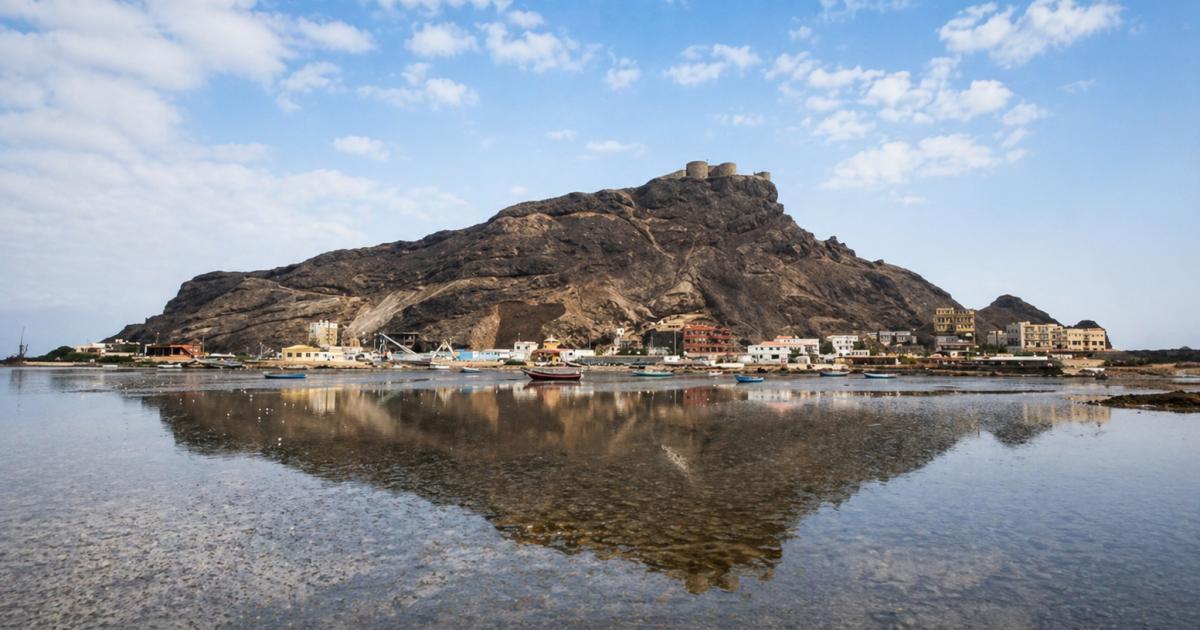
The city Aden, situated along the southern coast of Yemen where the Arabian Peninsula meets the Gulf of Aden, presents one of the most distinctive urban landscapes in the Middle East.
Aden is not merely a coastal settlement shaped by maritime trade and imperial history: it is fundamentally a city born from geological fire.
Its urban fabric rests within the remnants of an extinct volcanic caldera, a reality that has influenced its morphology, strategic importance, and environmental vulnerabilities across centuries.
Magma
Among the most significant monuments are Sira Castle and the Aden Cisterns (Sahareej al-Tawila), the oldest of which dates back to 1500-3000 B.C.
This article explores Aden’s volcanic formation, historical trajectory, imperial encounters including the memorable visit of Queen Elizabeth II and the contemporary environmental pressures confronting the city today.
Geologically, Aden lies within the Aden Volcanic Field, a complex structure associated with tectonic rifting between the African and Arabian plates.
Scientific studies indicate that the city occupies a collapsed volcanic caldera formed through explosive volcanic activity during the late Miocene and Pliocene epochs.
The Crater district the historic urban core is situated directly within this ancient volcanic basin, surrounded by steep basaltic ridges that mark the edges of the former magma chamber.
Plateaus
Reports from the Geological Society highlight that Aden’s volcanic structures consist primarily of basaltic lava flows, pyroclastic deposits, and intrusive igneous formations, confirming its origin as a shield-volcano complex.
Similarly, geological mapping by the United States Geological Survey identifies Aden as part of the broader Afro-Arabian rift system, where crustal extension facilitated volcanic eruptions and caldera collapse.
The circular topography of the Crater district, enclosed by volcanic peaks such as Shamsan, represents a classical caldera morphology.
Remote sensing analysis and satellite imagery interpreted by the NASA further demonstrate the structural continuity of volcanic cones and lava fields surrounding Aden’s urban area.
Collectively, these geological indicators ring faults, volcanic stratigraphy, and lava plateaus provide compelling scientific confirmation that Aden is indeed a city established within the remnants of a volcanic crater.
Despite its remarkable natural setting, Aden today confronts mounting environmental pressures.
Fortress
The volcanic terrain has profoundly shaped Aden’s urban development. The protective caldera walls historically offered natural defence against inland incursions while simultaneously constraining urban expansion.
Early settlements clustered within the crater basin, where freshwater catchments formed after seasonal rains accumulated in volcanic depressions.
These geological features enabled human habitation in an otherwise arid environment. At the same time, the rugged volcanic coastline created natural deep-water anchorages that would later underpin Aden’s global maritime significance.
The peninsula’s lava headlands and sheltered bays facilitated the emergence of a port city whose geography intertwined geological accident with commercial destiny.
The strategic value of Aden became globally evident in 1839 when the British Empire occupied the city to secure maritime routes to India. British colonial administrators quickly recognized Aden’s unique geographical advantages. Contemporary British accounts frequently described Aden as a “natural fortress,” emphasizing its volcanic enclosure and defensible harbor.
Twilight
Colonial officer Captain Stafford Haines reportedly characterized Aden as “Eye of the Yemen” recognising at the same time that the key to its security, stability and survival as a British base was to reach a peaceful rapprochement with its hinterland tribes.
British used Aden as a coaling station highlighting how geological formations facilitated imperial logistics during the age of steam navigation.
Historical documentation preserved within the British travellers archives reveals colonial observations describing Aden’s amphitheatre of volcanic hills and its “harbour carved by nature for empire Such descriptions reflect how imperial discourse framed Aden’s volcanic environment as both exotic and strategically indispensable.
A memorable episode in Aden’s modern history occurred in 1954 when Queen Elizabeth II visited the city during her Commonwealth tour.
The visit symbolized Aden’s continued importance within Britain’s imperial network during the twilight years of colonial rule. Contemporary media coverage highlighted ceremonial receptions and public gatherings that reflected Aden’s cosmopolitan character at the time.
Strategic
The Queen’s arrival also illustrated Aden’s role as a maritime crossroads linking Africa, Asia, and Europe. Archival photographs show the volcanic ridges of the Crater district forming a dramatic backdrop to royal processions, visually reinforcing the inseparability of Aden’s geological identity from its political history.
Central to Aden’s historical and contemporary relevance is the Port of Aden its maritime legacy and global connectivity, make it one of the world’s most naturally sheltered harbours.
Formed by volcanic peninsulas and lava headlands, the port offered safe anchorage long before modern engineering interventions.
During the mid-twentieth century, Aden ranked among the busiest bunkering ports globally, servicing vessels traversing the Suez–Indian Ocean route.
Studies by the UNCTAD emphasize the continuing economic significance of Aden’s port infrastructure despite conflict-related disruptions.
The port’s geographic position near the Bab al-Mandab strait ensures its enduring strategic relevance within global shipping networks.
Hazard
Thus, Aden’s maritime prominence cannot be understood independently of its volcanic morphology; the very geological processes that created the caldera simultaneously sculpted the harbour that sustained its economic vitality.
Despite its remarkable natural setting, Aden today confronts mounting environmental pressures.
Rapid urbanization has seen the city's population grow significantly, with estimates indicating Aden's urban agglomeration reaching approximately 1,012,000 in 2021 and projections suggesting around 1,194,160 by 2026, reflecting an annual growth rate of about 3.44 per cent in recent years.
Yemen's overall rate of urbanization was estimated at 3.71 per cent annual change for 2015-2020, while infrastructure degradation and climate-related hazards have intensified vulnerabilities within the caldera environment.
Flooding events, exacerbated by inadequate drainage systems and extreme rainfall patterns where floods constituted more than 50 per cent (around 56.67 per cent in some analyses) of Yemen's natural hazard occurrences from 1980 to 2020 periodically transform volcanic valleys into channels of destructive runoff, with notable incidents including major cyclones like Chapala (2015), Mekunu (2018), and Tej (2023), alongside recurrent flash floods since the conflict escalated in 2015 .
Warming
Reports identify coastal erosion, waste management deficiencies, and groundwater salinization as key environmental concerns affecting Aden’s sustainability.
For instance, in the MENA region, coastal erosion and related sea-level rise impacts are significant, with projections indicating that a 1-meter sea-level rise could affect coastal areas profoundly, though specific Yemen estimates highlight vulnerability in places like Aden where 0.60 m rise could cause $2 billion in property damage.
Meanwhile, conflict has led to substantial debris generation estimated at around a million tons in cities including Aden as of assessments around 2015–2019 overwhelming waste systems and leading to proliferating informal dumps.
Assessments by the World Bank underscore how conflict has constrained environmental governance and infrastructure investment, compounding ecological stressors, with damage to sectors in 16 cities (including Aden) estimated between $6.8 billion and $8.3 billion as of January 2020.
The caldera’s enclosed topography further intensifies urban heat accumulation and limits ventilation, contributing to localized climate discomfort amid regional warming in the MENA area, where trends show rates nearly twice the global average in many studies.
Eruption
Informal settlement expansion along volcanic slopes also raises landslide risks, particularly during heavy rainfall episodes, with Yemen facing high landslide susceptibility in mountainous and steep terrain areas, including those near Aden due to topography, geology, and rainfall.
In 2009, The Times reported that "Yemen could become the first nation to run out of water". This contributes to urban per capita water availability in Aden and Yemen dropping to around 85 m³ annually well below the 1,000 m³ water scarcity threshold.
Yet, Aden’s story is not solely one of vulnerability. The city’s history reveals enduring resilience shaped by its volcanic foundation.
From ancient trade networks to imperial maritime routes and contemporary recovery efforts, Aden has repeatedly adapted to shifting political, economic, and environmental landscapes.
Its volcanic geography once a source of eruption and destruction has paradoxically provided shelter, harbor, and identity. The crater that defines Aden’s physical form also embodies its symbolic narrative: a city forged in fire yet sustained by human persistence.
Symbolic
Still, Aden endures. Its streets, carved between volcanic ridges, carry memories of caravans and steamships, colonial encounters and independence struggles, prosperity and hardship.
The crater that once symbolized eruption now symbolizes continuity a geological scar transformed into a cradle of urban life.
To stand in Aden is to inhabit deep time: beneath every building lies magma-forged rock, and within every neighbourhood resides a history shaped by both nature’s violence and humanity’s persistence.
Ultimately, Aden’s story is one of transformation. A city born of volcanic upheaval became a crossroads of civilizations; a harbour formed by lava became a conduit of global exchange; a caldera shaped by collapse became a home for generations.
Recognizing Aden as “a city in the crater” is therefore not simply descriptive but profoundly symbolic. It reveals that even landscapes forged in destruction can nurture connection, memory, and hope and that Aden, despite all trials, continues to rise from its volcanic foundations with quiet resilience and enduring dignity.
This Author
Samar Azazi is a Yemeni scholar specialising in women, gender, development, and postcolonial studies in the Middle East. She is a research fellow under the Indian Council for Cultural Relations (ICCR) programme and is pursuing a PhD in Development Studies at the School of Gandhian Thought and Development Studies (SGTDS), Mahatma Gandhi University (MGU), Kottayam, Kerala, India.