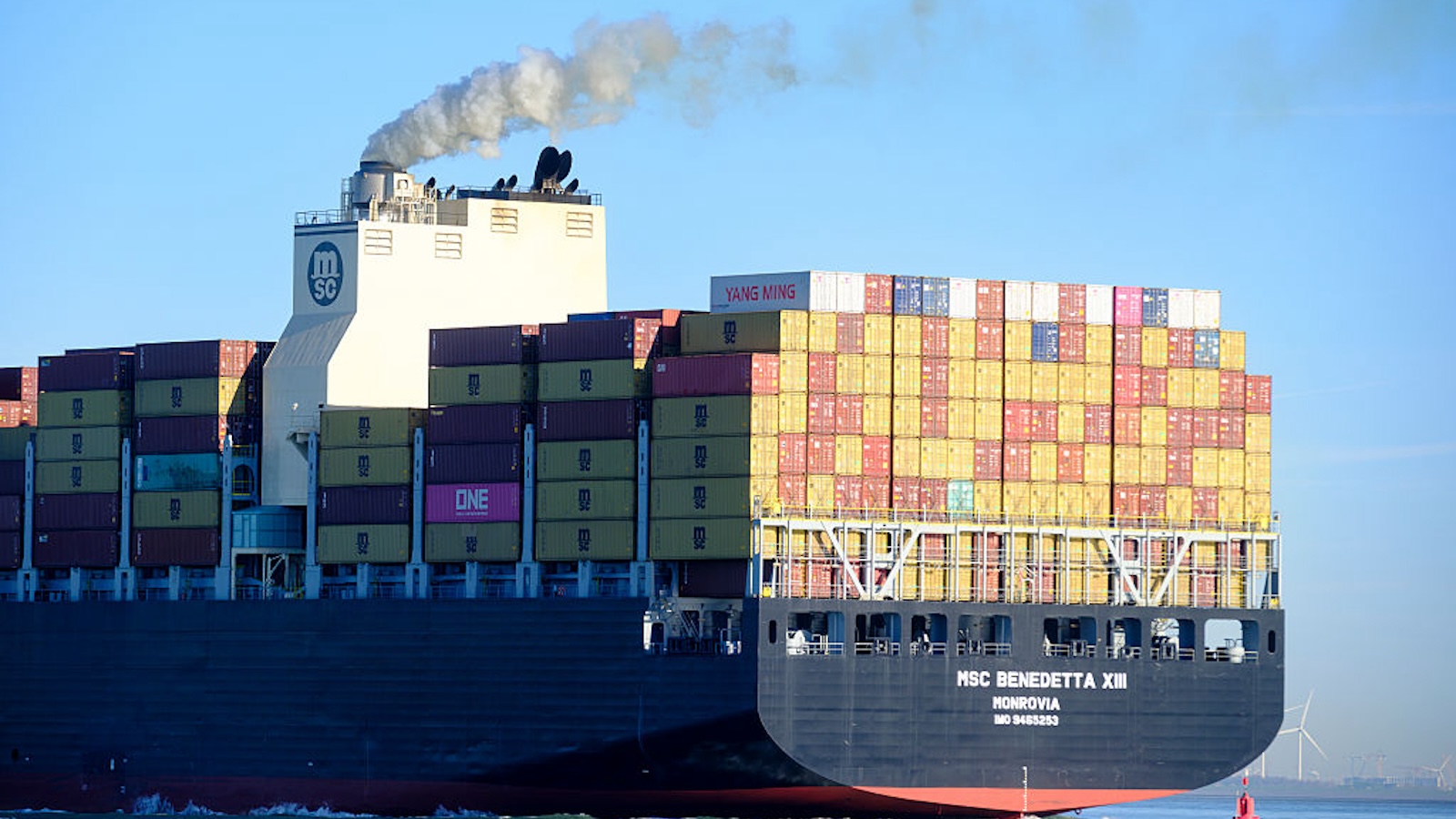
Ninety percent of global trade is conducted by giant ships that crisscross the globe, delivering containers of jet fuel, electronics, clothing, and many other goods every day of the week. Seafaring trade on this scale has brought the cost of many products down dramatically, but those ships have historically run on a very dirty fuel — essentially the sludge left over from refining crude oil — causing the shipping sector to contribute about 3 percent of total carbon emissions worldwide.
Last year, the International Maritime Organization, or IMO, the United Nations agency overseeing global shipping, was poised to adopt a plan to bring that down to zero. But that was before the Trump administration stepped in, threatening countries with visa restrictions, tariffs, and port fees if they supported the effort. As a result, the ambitious plan to decarbonize global shipping has been on the rocks for months. Alternate proposals that dispense with the core function of the original Net-Zero Framework, or NZF — a per-ton fee on greenhouse gas emissions above a certain threshold — seemed to be gaining traction, threatening climate progress in the sector.
But at a meeting of U.N. member countries last week, none of those watered-down proposals received much attention. Instead, a slim majority of countries expressed vocal support for the NZF, indicating that a narrow path to adopting the framework as originally intended still exists.
“A genuine spirit of collaboration and optimism pervaded the negotiations,” said Em Fenton, a senior director at the U.K.-based climate group Opportunity Green, who attended the meeting in London. “There were people who did not want to see progress, but a vast majority of delegates in the room were working together.”
The Trump administration opposes the NZF on the grounds that it would burden American consumers and businesses. In public documents submitted to the IMO, the administration has drawn a hard line at penalizing carbon-intensive fuel types and the inclusion of an “economic element,” such as a tax or levy, in the framework.
“The United States submits that the most appropriate path forward is to end consideration of the IMO Net-Zero Framework entirely,” it noted.
But supporters of the weaker alternative proposals — which were submitted by Japan, Liberia, Argentina, Panama, and others — did not entirely derail the majority’s push to advance the original NZF. The path to adopting the net-zero plan is a long one — and there’s still time for talks to fall apart. Opponents of the framework can tank it by gathering support from one-third of member countries, or from a smaller group of countries if that group controls half of the world’s shipping tonnage, per IMO rules.
Just four countries — Liberia, Panama, Bahamas, and the Marshall Islands — account for roughly half of the world’s registered ships. Ships can be owned by a company in one country, operated by another, and registered — or “flagged” — in a third, much like offshore banking for tax purposes. As a result, these so-called flag countries have extraordinary leverage during IMO negotiations. Since some of these flag states have already voiced their opposition to the NZF, Eveylne Williams, a research associate with the Center on Global Energy Policy at Columbia University, said that “you’re kind of already in that neighborhood of the 50 percent blocking threshold.”
However, “cautious optimism is reasonable” at this stage, she added. “[The NZF] hasn’t been abandoned, but it’s kind of sobering to look at the blocking arithmetic still available.”
While key countries oppose the Net-Zero Framework, the shipping industry itself — the companies that actually own and operate the ships and make their profits from the delivery of goods — has largely backed the effort in the hopes that a single uniform global tax will put every company on the same footing, no matter where they operate. Shippers are already navigating European carbon regulations and want to avoid a patchwork of rules by different countries.
“Our industry needs the IMO as our global regulator,” said David Loosley, CEO and secretary general of BIMCO, a trade organization representing shippers, on LinkedIn after the meeting last week ended. “To arrive at implementable regulations at a global level, we need the backing of all member states. Without consensus, global regulations will be ineffective and will fail to provide a level playing field for a truly global industry.”
At the meeting last week, U.S. delegates distributed leaflets laying out their projections of the country-by-country economic effects of the Net-Zero Framework. One handout, summarizing the effects on Peru, led to nearly $800 million in compliance costs. But experts who examined the figures said the analysis was misleading and utilized outdated assumptions.
“The data is a clear effort being made by a country acting in strong self-interest and using misinformation and exaggeration to the detriment of other countries’ interests,” said Fenton.
A spokesperson for the U.S. State Department did not respond to Grist’s request for comment.
Fenton expects countries to continue engaging in bilateral negotiations and technical discussions in the coming months. Several finer points — such as the distribution of funds collected as a result of the framework’s fee — are yet to be decided. After the U.S. intervention last year, a vote to adopt the framework was delayed by a year. As a result, the earliest countries can vote to adopt the framework is November. Talks are scheduled for that month to get the framework — or an alternate proposal — over the finish line.