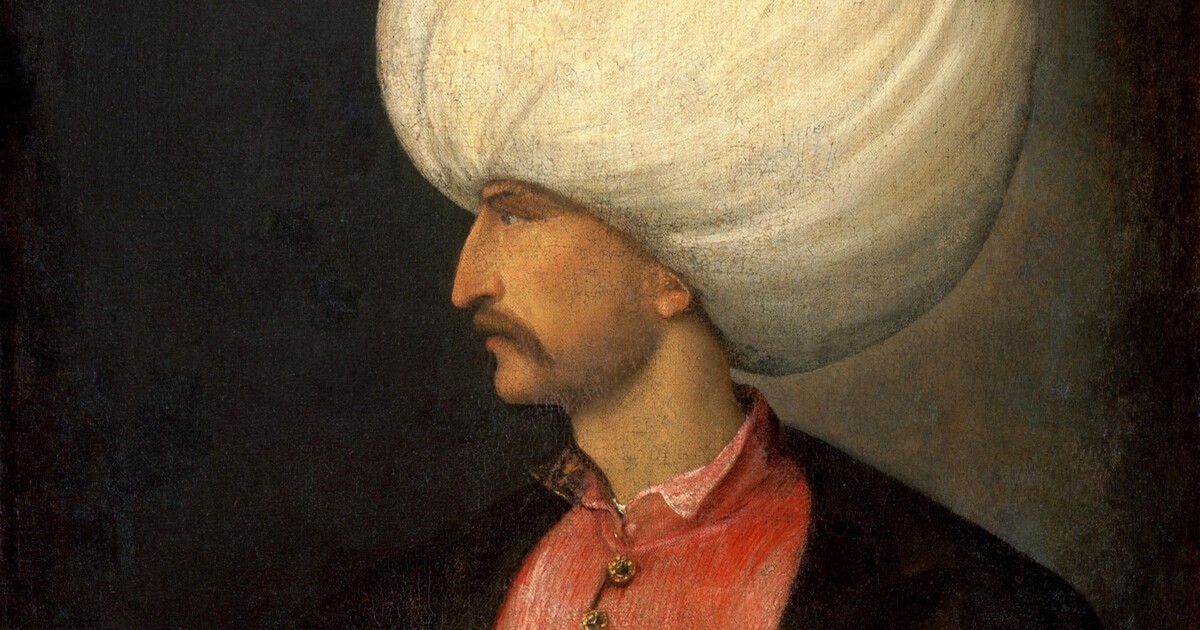
The life of the tenth Ottoman sultan, Suleyman, known in Europe as the Magnificent and in Turkey as the Lawgiver, has the trappings of a Greek tragedy or a soap opera. There is murder, sex, duplicity and betrayal, all taking place at the court of one of the richest and most powerful empires of the 16th century. Even before his death in 1566, dramas began to be written about Suleyman, and more recently the Turkish television series Magnificent Century was watched by 500 million people worldwide. Now there is The Golden Throne, the second volume in Christopher de Bellaigue’s novelesque historical trilogy about his life.
The book is a carnival of depravity in five acts. We meet enslaved Christians, deceitful pirates, conniving concubines and red-faced viziers. There are spectacular battles and ad-hoc executions. Above all, there is that brand of cleverness so admired by the British elite. No wonder one blurb declares: ‘I love history but recently my patience for history books has worn thin – the besetting sin is an excess of dates jostling with an army of names and a bloat of research. Reading The Golden Throne … has been a joy, though.’
De Bellaigue’s book offers an evocative view onto the past, of the sort that academic accounts rarely achieve. It’s the product of his reading in French, Italian, Turkish and Persian as well as English, and despite his panache, he stays within the limits of his sources. But when you strip away the metaphors – some of which are very pretty – you are left with a rather traditional account of the politics of the Ottoman house.
Suleyman came to the throne in 1520, when he was 26. That may sound young, but he was in good company: Francis I, king of France since 1515, had been born in the same year as him, and Henry VIII (crowned in 1509) was three years older. Charles V was installed as Holy Roman Emperor in 1519 at the age of nineteen. Still, Suleyman had large shoes to fill. His father, Selim, had doubled the size of the empire during his eight years in power, and commentators in Western Europe at first viewed Suleyman as the lamb to Selim’s lion. He was quick to prove them wrong. In 1521 his army took Belgrade, the Danubian gateway to Central Europe; in 1522 he conquered Rhodes, that nest of Christian pirates; in 1526 he captured much of Hungary. The conquests continued in the years that followed, but by the 1540s Suleyman’s health was starting to deteriorate. He suffered from gout and oedema so acute that at times he could barely walk. As news of this state of affairs spread, the question of a successor began to present itself.
Ottoman succession practices cast all male dynasts as legitimate pretenders to the throne. On the death of the reigning sultan, his sons would race to Istanbul from their provincial governorships. The one with the greatest cunning, the best advisers, the most popular support and, hence, the support of God would be the fastest, and therefore make the best sultan. But to avoid the instability wrought by the dispossessed siblings, a tradition emerged whereby the victorious claimant would hunt down and kill his surviving brothers and, often, their sons. (Selim is thought to have spared Suleyman this fate by removing the other pretenders to his throne himself.) Contemporaries were sometimes troubled by this violence, but believed it contributed to the greater good. An official tasked with eliminating one 15th-century prince explained: ‘Even if formally I committed treason, still in essence I remained loyal. If I had allowed it, these two [brothers] would have ravaged the entire country by their struggle. Harm to the royal family is preferable to harm to the public welfare.’
The system generally worked, producing a string of talented sultans with broad popular support. But it also produced sibling relations that were, to put it mildly, tense. To moderate this tension, the Ottomans came up with a ‘one mother, one son’ policy. By the late 14th century, sultans were propagating the dynasty exclusively with enslaved concubines, who entered the palace at a young age and renounced all prior familial attachments. With time, it became customary that after a concubine had given birth to a son she would cease sexual contact with the sultan (or employ contraception, which was widely accepted in Islamic societies). From that point on, she would be her son’s staunchest ally in his bid for the throne. So it was with Mahidevran, who gave birth to Suleyman’s first son, Mustafa, in 1515. If this meant that mothers did not have to choose between their sons, it also put some distance between royal half-brothers.
That is, until Hürrem. Known to Europeans as Roxelana, she was captured in Ruthenia (in what is now western Ukraine) and entered the Ottoman palace as a slave, where it seems she fell wildly – and requitedly – in love with Suleyman. In 1521, she gave birth to their first child, Mehmed. In 1522, Mihrimah, their only daughter, was born, and in defiance of Ottoman tradition, the next few years brought more sons: Selim, Abdullah, Bayezid and Cihangir.
Mustafa had the clear advantage. Not only was he the eldest, he was wise, generous and just, and was revered by the janissaries, the elite infantry troops who were known as kingmakers. In 1552, just as Suleyman decided not to lead the new campaign against the Safavids in Persia, Mustafa was nearing forty, an ideal age for a king to take his troops into battle. But Hürrem was keen to plant one of her own sons on the throne. Contemporaries accused her of scheming with Rüstem Pasha, Suleyman’s grand vizier. That winter, Suleyman received an urgent letter from Rüstem, who was heading east with the army. He begged Suleyman to come immediately: the janissaries were clamouring for Mustafa to take the throne, and while Mustafa had demurred, he had given them an audience and rewarded them with gold. Suleyman’s response, which contemporary historians recorded, was to insist on his son’s innocence, but the threat to imperial stability was obvious. Suleyman rushed to catch up with the troops and summoned Mustafa to his tent. As the prince approached, an arrow was shot at him bearing a letter that warned him to turn around and run. Ignoring it, he entered the tent, where he was killed instantly.
In an interview with the BBC after publishing The Lion House, the first instalment in the trilogy, de Bellaigue explained that his portrait of Suleyman depended on ‘looking very, very carefully at the sources and not being blinded by the secondary literature or subsequent historical revisionisms or re-revisionisms … What we really need to do is be very purist and go back to the sources and then see what the people who are most proximate to the sultan were saying at the time.’ To be purist and go back to the sources is a noble aim, to which Lutherans, Salafis and academics have all aspired. But of course, even the individuals closest to Suleyman had agendas that historians have taken decades to unpack and understand. The danger in sidestepping this work is being blinded by the sources.
Oriental despotism is one such blinding trope. With its roots in the work of Aristotle, the notion that Eastern monarchies were inherently oppressive was revived in 16th-century Europe to explain what some contemporaries understood to be the unchecked power of the Ottoman sultan. Whereas Western Christians exercised freedom, so the theory went, Ottoman subjects were kept in slave-like conditions, in a realm ruled not by law but by force. As Lucette Valensi observed nearly forty years ago, modern versions of the theory owe their origins in part to the Venetian ambassadorial reports on which de Bellaigue relies, and it shows. When Suleyman is not busy ‘bashing unbelievers’ in The Golden Throne, he is sacking people for rudeness or watching prisoners be trampled by elephants. On learning that the owner of a house he had temporarily commandeered had fumigated it after his departure, afraid he might contract an illness, Suleyman ordered the house razed and its owner put to death. If de Bellaigue’s Suleyman reveals the occasional spark of fairness, the men who serve him are all darkness, pillaging and decapitating with impunity. Justice is a commodity sold to the highest bidder or the most geriatric mullah.
The second trope that de Bellaigue resuscitates is even older: the evil woman who corrupts the great man. Blaming a woman was not only the bread and butter of Abrahamic misogyny, but the safest way to criticise the sultan, and some Ottomans began calling Hürrem ‘the witch’ as early as the mid-1530s. But it was her involvement in the death of Mustafa that blackened her name for ever. The female poet Nisayi, a friend of Mahidevran, wrote: ‘You allowed the words of a Russian witch into your ears/Deluded by tricks and deceit, you did the bidding of that spiteful hag.’
There is some truth to these readings. A peculiarity of 16th-century Ottoman rule was that most palace officials were, formally speaking, slaves. Although the master-slave relationship was subject to many legal restrictions, the sultan could issue summary punishments. And Hürrem was undoubtedly a shrewd politician who wielded immense influence in domestic and foreign affairs. Yet to portray the Ottoman legal and political establishment as unremittingly venal and capricious is to miss the centrality of justice to Ottoman (and wider Islamic) political thought and practice, in which the protection of subjects against abuses of power is the key guarantor of state stability. To hold Hürrem responsible for Suleyman’s decisions is to discount the larger political considerations that informed them. By the 1550s, the warrior-sultan type Mustafa represented was becoming obsolete. The legitimacy of the Ottoman house was so secure that dynastic contenders no longer had to prove themselves in battle. By ordering Mustafa’s execution, Suleyman not only safeguarded the authority of the ruling sultan but paved the way for more routine succession practices in the following centuries.
Erdoğan berated The Magnificent Century, which premiered in 2011, for depicting Turkish history as violent, debauched and mired in political intrigue. In the years that followed, the Turkish state broadcaster released several historical dramas more palatable to official sensibilities, featuring pious sultans fighting for justice and defending female honour. I don’t wish that de Bellaigue had presented this version of Suleyman’s life. But isn’t there a third way between sensationalism and hagiography? The historian Leslie Peirce narrates Hürrem and Suleyman’s relationship as ‘the Ottoman empire’s greatest love story’, though her account is less sentimental than that might sound. The Empress of the East (2017), her biography of Hürrem, is sober and astute, yet offers a more intimate look at the Ottoman court than The Golden Throne. This is because Peirce approaches her human subjects with respectful curiosity and sympathy rather than a view to the next punchline.
The Golden Throne ends with the grisly deaths of Mustafa and his son, setting up the last book in the trilogy to relate Suleyman’s death, the accession of his son Selim and the demise of a once great empire. We can only hope that de Bellaigue reads enough revisions and re-revisions to surprise us with something other than that tired old tale.