The British royal family traces its descent from the Norman Conquest; the numbering of monarchs dates from 1066. That Charles III’s great-uncle was the eighth King Edward, for instance, ignores Edward the Confessor, despite William the Conqueror claiming the throne as his kinsman as well as by his royal gift. From this perspective, the kingdom of England began in 1066. In other respects, it was already in existence. In the earlier Anglo-Saxon period, a king was determined by his people, not his territory. Physical boundaries, such as the Mercian frontier with Northumbria on the Mersey (‘boundary river’), were recognised but Bede’s Ecclesiastical History of the English People, completed in 731, refers only to kings of peoples, never land. And both kings and peoples might migrate, as the Gewisse tribe did from the Thames Valley to Winchester, becoming the West Saxons. The kingdom of England was a kingdom of the English.
The status of the English as a single people wasn’t unproblematic. Archaeological evidence shows immigration from many parts of Northern Europe, and Bede supposed that several Germanic tribes were involved, resulting in Saxon, Jutish and Anglian settlers. He considered them all English (Angles) in some sense, united by language and obedience to one archbishop at Canterbury (York was not permanently established until 735). Welsh and Gaelic writers similarly treated all Germanic incomers as one people, using the Latin Saxones (hence Saeson in Welsh, Sasunnach in Gaelic). This sense of a single people found occasional expression in diplomacy: the Kentish Æthelberht was addressed by Pope Gregory as ‘king of the English’ (c.600), and Oswiu of Northumbria by Pope Vitalian as ‘king of the Saxons’ (c.666).
Had those papal letters been our only evidence, we might have supposed a unified English kingdom existed in the seventh century, but diverse evidence reveals that the passage from competing regional kingships to a single king was neither speedy nor predictable. The earliest kings provided leadership for local groups of warrior farmers. The princely burials and great halls that appear in the archaeological record from around 600 mark the elevation of a small number of leading families to the status of regional kings. These kingships varied in scale. An enigmatic seventh-century document known as the ‘Tribal Hidage’ lists peoples by the estimated number of tribute-paying families, with totals varying from three hundred to a hundred thousand (the West Saxons). Over time, minor kingships were suppressed by more powerful neighbours, their kings relegated to the aristocracy or dispossessed in favour of externally appointed ealdormen or reeves. Looking back to the seventh century, and invoking the emperors of the Roman world, Bede referred to the apex of the kingly pyramid by the term imperium. The more powerful (such as Oswiu, king of the Northumbrians) also established their hegemony over the Welsh, Scottish and Pictish, seeing themselves as rulers of the entire island.
At the end of his Ecclesiastical History, Bede acknowledges the Mercian supremacy over southern England. That just two kings ruled Mercia for a total of eighty years (Æthelbald from 716 to 757, then Offa from 757 to 797) facilitated the consolidation of territory and the expansion of their direct rule into parts of Wessex and across the South-East. One of Æthelbald’s diplomas, dated 736, recorded a grant he had made as ‘king not only of the Mercians but also of all provinces which are called by the general name “South English”’. The historian Frank Stenton, writing in 1943, supposed that the Mercian kings made a ‘great advance towards the unity of England’, though scholarly opinion has since rowed back, seeing them as more interested in personal power than state-building. Even so, the archaeologist Max Adams argues that England might have formed around a dominant Mercia, had other factors not intervened. Charlemagne’s letter to Offa, written in 796, addressed him as merely ‘king of the Mercians’, but Offa’s Dyke surely reinforced a sense of England and Englishness by shutting out the Welsh.
Viking raids began in the 790s and increased in scale and intensity throughout the ninth century. Warfare was a royal responsibility, but only the Northumbrians, Mercians, West Saxons and East Angles had kings. Offa’s son and heir, Ecgfrith, died only a few months after his father, collapsing the Mercian dynasty (Offa had cleared away most potential rivals). The ensuing succession crisis allowed a West Saxon king, Ecgberht, to free himself of Mercian overlordship and establish his own supremacy, absorbing the small kingdoms of the South-East into a greater Wessex. For the first time, one dynasty controlled all England south of the Thames. But then, as the Anglo-Saxon Chronicle records, a ‘great heathen raiding-army’ arrived from Scandinavia in the mid-860s, destroying the East Anglian and Northumbrian kingships and repeatedly invading Wessex and Mercia. King Æthelred of Wessex and King Burhred of Mercia drew closer in the face of this threat, but after Æthelred’s premature death in 871, Alfred, his brother and heir, bribed the Danes to leave. It may have been the resulting pressure on the Mercians, as much as the temporary ending of West Saxon assistance, that led Burhred to flee to Rome in 874. Coins depicting his successor, Ceolwulf, and Alfred side by side (the so-called ‘Two Emperors’ style) imply that co-operation resumed, but the Vikings took over the wealthy and well-populated eastern Midlands (the Danelaw), leaving Ceolwulf in control of only western Mercia. His reign ended after five years.
That Ceolwulf was recognised as king is consistent with his issuing coins. London, where Mercian coins were minted, repeatedly fell to the Vikings, but Alfred recaptured it in 886 and passed it to Ceolwulf’s successor, Æthelred, whom he married to his eldest daughter, Æthelflæd. While Alfred’s son-in-law ruled western Mercia as if he were king, no coins were issued in his name, his diplomas employed only lower-status titles and the Anglo-Saxon Chronicle refers to him as ‘ealdorman’. New coins were issued with Alfred as sole king. His early diplomas depicted him as king of the West Saxons or Wessex, but from the 880s he was experimenting with such titles as king of ‘the Saxons’, ‘the Angles and the Saxons’ and ‘the Anglo-Saxons’. He claimed to rule all the English not under Danish lordship and made efforts to shore up God’s support for his people by founding new religious houses and reviving education and learning. He encouraged the translation of works from Latin into English (including Bede), which provided a chronicled English history (the Anglo-Saxon Chronicle) capable of validating his family’s rise to power. He also commissioned a biography of himself (modelled on that of Charlemagne) from Asser, the learned Welshman he appointed bishop of Sherborne.
While Alfred was undoubtedly less successful on the battlefield than his chroniclers claimed, his refusal to recognise Æthelred as king set in motion the slow process of national formation. The succession of his son, Edward the Elder, was initially challenged from within the family, but seems to have been acknowledged by Æthelred. Together, they brought the Danelaw to heel. After Æthelred died in 911, his widow, Æthelflæd, ruled as ‘Lady of the Mercians’ until her death in 918, by which point the Vikings had either surrendered or been forced back north of the Humber. Edward then took over Mercia, establishing his own direct rule there, a transition made easier by the lack of a male heir to the Mercian throne (Æthelflæd and Æthelred’s daughter was probably placed in a West Saxon nunnery) and the long-standing presence at the Mercian court of Æthelstan, Edward’s eldest son.
When Edward died in 924 his superiority had also been recognised, to some extent, by the rulers of the Welsh, Scots, Northumbrians and Irish Norse. Even so, there was no guarantee that the union of Wessex and Mercia would endure. Ælfweard, his eldest son by his second wife, took Wessex, while Æthelstan secured the Mercian kingdom where he had been raised. It was only Ælfweard’s death, weeks after his father, that allowed Æthelstan to rule over both kingdoms. The hostility he experienced at Winchester suggests his father had not intended this outcome. Opposition focused on Winchester, particularly around its bishop, and there are even hints that a coup might have been planned; if so, that came to nothing. Ælfweard’s only full brother, Edwin, died a few years later in circumstances which cast suspicion on Æthelstan. It may have been an attempt to heal rifts within the royal family that led Æthelstan not to marry: after his death in 939, the throne passed to Edmund, his much younger half-brother from his father’s third marriage.
Æthelstan’s reign is the focus of David Woodman’s excellent new monograph, The First King of England, which posits this period as the crux of England’s formation. Æthelstan’s reign was particularly significant for his takeover of Northumbria. As Stenton noted, this was the first time ‘a king supreme throughout southern England had come to rule in York.’ It was, however, somewhat fortuitous. A few months after he had united Wessex and Mercia, Æthelstan married his sister to the Norse leader Sihtric, previously the ruler of Dublin and at that time ‘king of the Northumbrians’ in York. The wedding took place at Tamworth, Mercia’s royal centre, which implies Æthelstan was the greater of the two, but Sihtric is not recorded as recognising Æthelstan as his superior. This was, therefore, a marital alliance between neighbours who were less than equal, but not critically so, offering peace in the short term and perhaps the prospect of Æthelstan’s nephew eventually attaining the Northumbrian throne. Sihtric died just a year later, at which point Æthelstan seized York (there are parallels with his father seizing Tamworth through right of his sister), faced down a challenge from the Irish Norse and made himself king there. A meeting took place at Eamont, near Penrith, on Northumbria’s north-west frontier, where the Welsh, the Scots and the English rulers of northern Northumbria recognised his supremacy. Thereafter, Æthelstan adopted the title ‘king of the English’ and his coins proclaimed him rex totius Brittaniae.
In 934, Æthelstan led a raiding army deep into Scotland, his fleet supposedly reaching as far as Sutherland. The Scottish king, Constantine, allied himself with the Irish Norse and launched a retaliatory raid into England in 937, only to be bloodily defeated by a West Saxon and Mercian army at Brunanburh (probably Bromborough, on the Wirral). This victory was celebrated in the Anglo-Saxon Chronicle with the rare incorporation of an Old English poem written to laud the success: ‘Never yet in this island/was there a greater slaughter/of people felled by the sword’s edges.’
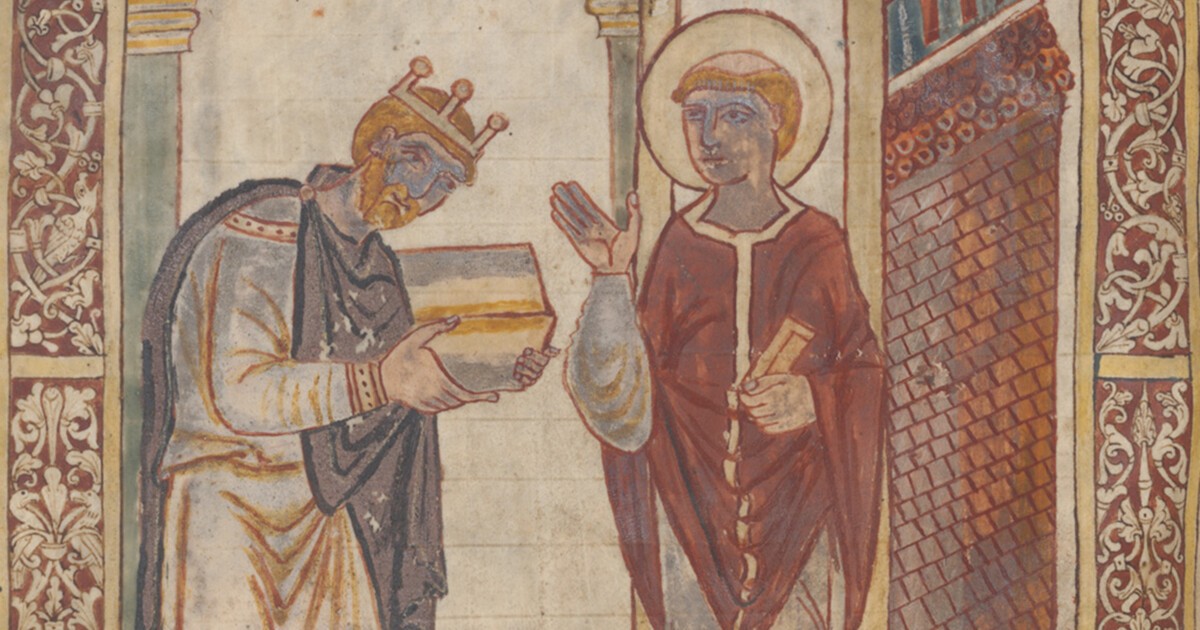
In the aftermath, Æthelstan tightened his grip on Britain’s peripheries. He required subordinate kings to attend royal assemblies deep inside southern England (hence their appearance on witness lists), demanded tribute from Wales and denied the Cornish the right to inhabit Exeter, pushing them beyond the Tamar. Such was Æthelstan’s stature that leading Continental families sought (and gained) alliance with him, establishing an unprecedented network of foster-sons and in-laws, from Scandinavia to the Alps. He was well known as a collector of relics and religious texts and as a generous patron of churches, clerics and monasteries. His is the first manuscript portrait of a ruler to survive in England, showing an offering he made to the shrine of St Cuthbert on his way to Scotland in 934. The expansion of his rule across England also seems to have prompted the development of a chancery, responsible for documenting grants, and his introduction of large assemblies drew the great and good from across the enlarged kingdom and beyond. All diplomas surviving from the period 928-35 were written by one hand; their novel use of language and the length of their witness lists suggest efforts had been made to adjust to the reality of wider rule. While his grandfather, Alfred, had revived the practice of issuing law codes, Æthelstan was by far the most industrious legislator his dynasty had produced, responsible for six in all.
Was Æthelstan the first true king of England? Support can be found in diverse places. Geoffrey of Monmouth’s imaginative History of the Kings of Britain (c.1135) ends with the Saxons controlling all England, ‘led by Æthelstan, who was the first of them to wear its crown’. His near contemporaries, William of Malmesbury, Henry of Huntingdon and Geoffrey Gaimar, were of a similar view – and have proved more reliable. But Æthelstan dropped from favour thereafter, with Alfred’s reputation out-performing other members of his family, in large part due to his prominence in the Anglo-Saxon Chronicle. Sellar and Yeatman’s 1066 and All That jumps from Alfred (mixed up with King Arthur) to Æthelred (Æthelstan’s great-nephew), omitting Æthelstan entirely. When Eric John surveyed the tenth century for The Anglo-Saxons (1982), he focused on Edgar, Æthelstan’s nephew. Since then, attention has shifted to Alfred’s achievements, and those of his son Edward the Elder, with Michael Wood alone making the case for Æthelstan. Only in the last two decades has Æthelstan come to the fore again, with monographs by Sarah Foot, in 2011, and now by Woodman, which focus on his reign, assess his record and examine his legacy.
England’s emergence is probably best seen as occurring over a period far longer than a single reign, with many different figures contributing to its formation. A kingship of the English was promoted by several West Saxon kings but there is no reason to think it universally popular. Norse rulers recovered York after Æthelstan’s death in 939 and also seized northern parts of the Danelaw. The last Viking ruler of York, Eric Bloodaxe, was killed in 954. The rule of Mercia was detached from Wessex from 957 to 959, and the same split occurred when Edmund Ironside divided England with Cnut in 1016. For several generations, the nascent English state was only a defeat away from disintegration, and that was the preferred outcome among many sections of the nobility. Partition was a normal means of managing inheritance, after all, allowing a king to separate out kingships for the benefit of several sons (as Edward the Elder probably intended). That England would ultimately become a single kingship must often have seemed unlikely; to some, it was also unwelcome.