In 1598, shortly before his death, the Japanese leader, Toyotomi Hideyoshi, established the Council of Five Elders, a group of daimyo (feudal lords) who would govern until his son Hideyori came of age. It took just two years for one of the five, Tokugawa Ieyasu, to oust the seven-year-old ruler and unify Japan under his own banner. The Tokugawa shogunate governed Japan for the next 250 years.
James Clavell’s novel Shōgun (1975) is set during the power struggle between the five daimyo and is based on the life of the navigator William Adams (renamed John Blackthorne in the book). Adams was the first Englishman to reach Japan, where he served in Ieyasu’s court. In both the novel and its recent TV adaptation, Blackthorne is a savvy operator, arriving in Japan at the right moment to revolutionise the shogun’s military tactics and challenge the counsel of the court’s Portuguese Catholic advisers. While Clavell may have overstated his historical significance, Adams was one of Ieyasu’s close confidants. He was made a samurai and given an estate in modern-day Yokosuka, south of Tokyo. In 1613, when an East India Company expedition arrived in Japan, Adams was sent to bring its captain, John Saris, to the court. Saris wrote in his diary that Adams had ‘gone native’, refusing to sleep on the ship and acting coldly towards his countrymen.
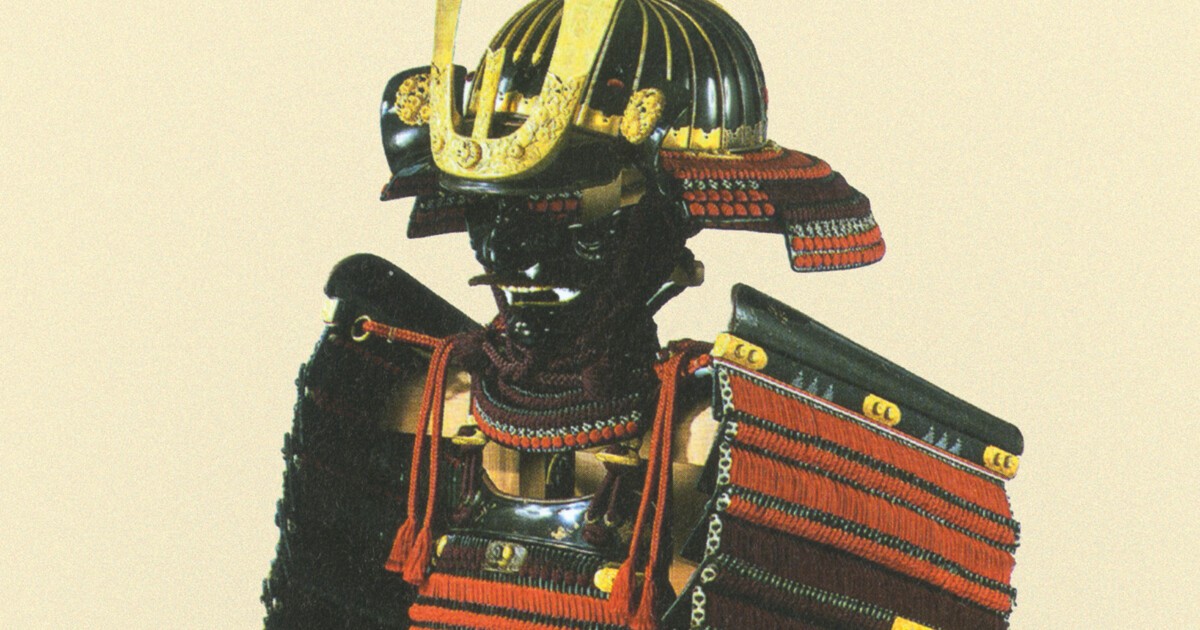
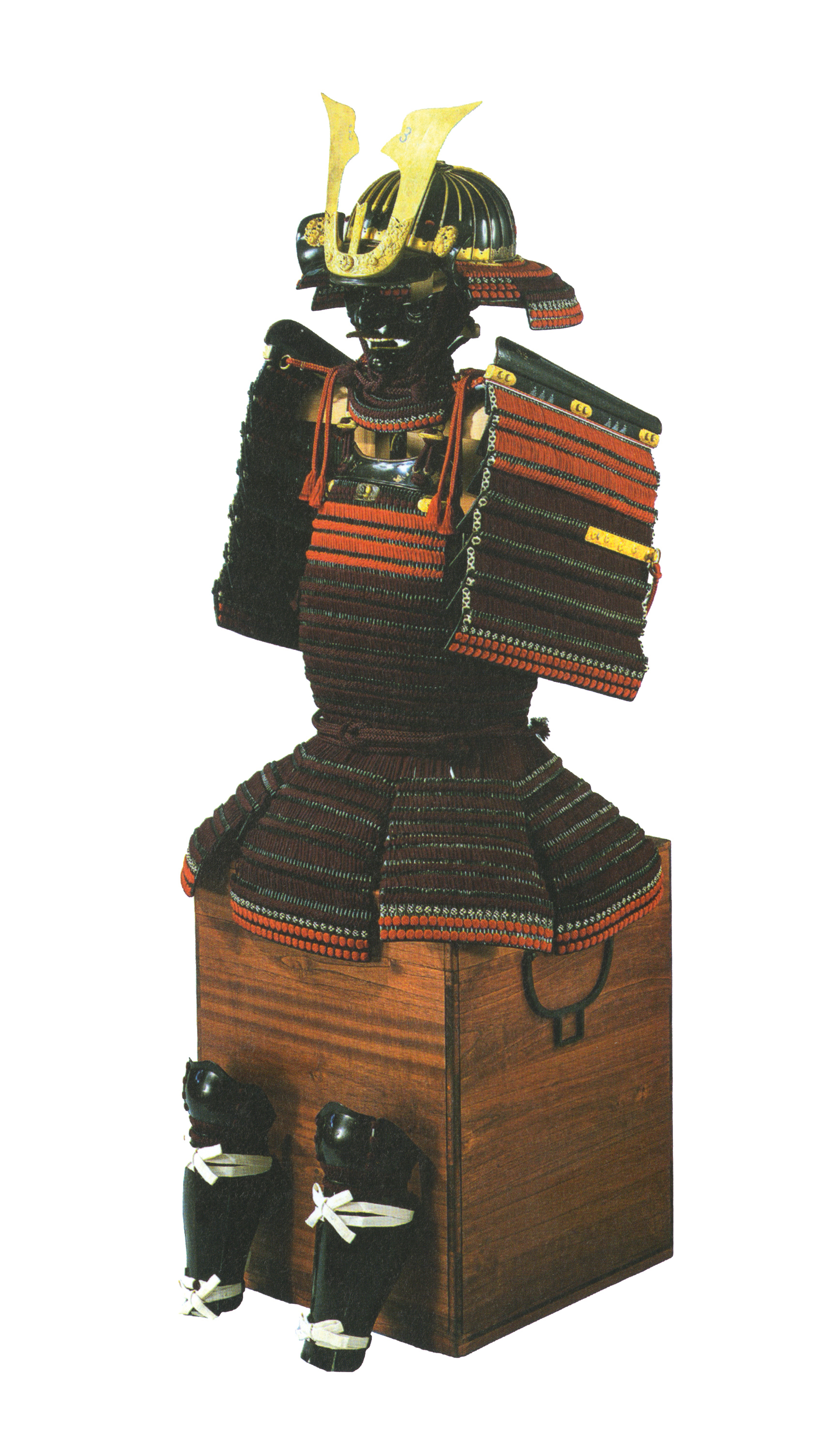
This suit of armour, which is held in the collection of the Royal Armouries and was recently on display at the British Museum as part of its exhibition Samurai, was one of two presented to Saris by the Tokugawa family as a gift for James VI and I. In return, Saris gave the shogun a telescope – only recently invented and never before seen in Japan. Early samurai were members of a professional warrior class who served under a daimyo; they fought with bow and arrow on horseback, in cumbersome box-like armour. This suit is in the lighter dōmaru (body-wrap) style. Originally worn by lower-rank samurai, it became increasingly common in the 16th century as warfare grew more mobile. Unlike the horseback armour, its cuirass is a single piece, made from lacquered iron and rawhide plates laced with red and purple silk, wound around the body and fastened on the right, making it easier to put on and remove. After Saris returned to England, the armour entered the royal collection and was placed on display at the Tower of London. Later in the century, it was miscatalogued as a gift ‘sent to his now Majesty, Charles II, by the great Mogull’, and was only re-identified as Japanese by the antiquarian John Hewitt in 1854.
In the early 2000s, Ian Bottomley, a curator at the Royal Armouries Museum in Leeds, discovered that while the suit is signed by Ieyasu’s chief armourer, Iwai Yozaemon, a badge in gold lacquer on the breastplate belongs to the Takeda clan, whose territory was conquered by Ieyasu. It’s likely that Yozaemon crafted this suit using recycled pieces, though the extent of the reworking is unclear. As Bottomley observes, several artefacts sent to Europe in this period appear to be the repurposed spoils of battle: helmets, cuirasses and whole suits reworked for diplomatic use. Two suits given to the Dutch, and one given to the Spanish, belonged to Toyotomi Hideyoshi. Repurposing cast-offs was quicker and cheaper than designing new suits, but Bottomley offers another theory. ‘One possibility is that the kami or spirit of a dead person was thought to be associated with his armour … by shipping them to Europe, the spirit of his old adversary was about as far removed from Japanese soil as it was possible to get.’
Within two decades of the Saris exchange, Japan closed its borders to Western trade. A series of legislative changes enforced by Ieyasu’s grandson Iemitsu, grouped under the term sakoku (locked country), meant that foreign contact was confined to strictly controlled channels. During the two centuries of domestic peace that followed, the samurai took on administrative rather than military roles in the shogunate. It wasn’t until the mid-19th century, when American warships forced the reopening of Japan’s ports, that new suits of armour made their way to the West – a flow that accelerated after 1868, when the Meiji restoration brought an end to Tokugawa rule and effectively abolished the samurai class. Many former officials were forced to sell family heirlooms to outsiders to make ends meet, and to comply with laws such as the Haitō edict, which prohibited the carrying of swords in public. By then armour and weapons were largely ceremonial, symbols of status and wealth rather than instruments of war.