In the late summer of 30 bce, months after defeating Antony and Cleopatra at the Battle of Actium, Octavian entered Alexandria, meeting little resistance. Like Caesar before him, he visited the tomb of Alexander the Great. The golden sarcophagus was opened and Octavian adorned the mummified corpse with flowers and a gold crown (according to one source, he accidentally broke off a piece of the nose). When he was asked whether he also wanted to see the tomb of the Ptolemies, Octavian replied: ‘I came to see a king, not corpses.’ He left Egypt in the hands of his general, Cornelius Gallus, and never returned.
The corpses belonged to members of Egypt’s longest-ruling dynasty. Its founder, Ptolemy I, had been Alexander’s general, boyhood friend and tutorial partner at the court of Philip II in Macedonia, where they were taught by Aristotle. In 331 bce, after Alexander’s conquest of Egypt, he and Ptolemy travelled across the desert to the oracle at the Siwa Oasis, who proclaimed Alexander the son of Amun, the Egyptian king of the gods. Over the next decade, Ptolemy fought beside Alexander as he conquered Mesopotamia and modern Iran, reaching as far as the Hydaspes River in India. Alexander’s death in Babylon in 323 bce set off a succession crisis. His lieutenants agreed to put the empire in the hands of his mentally disabled half-brother and the baby son born after his death, Alexander IV. Ptolemy saw to it that he was awarded control over Egypt.
Ptolemy and his family ruled Egypt for nearly three centuries, with fourteen monarchs bearing his name. Although it never matched the size of Alexander’s empire, or for that matter Octavian’s, theirs was the richest and, for a time, the most powerful state in the Mediterranean. Despite this, Octavian wasn’t alone in dismissing the Ptolemies. They came too late for many histories of Greece and Egypt and too early for Rome. Alexandria, their capital, has disappeared beneath the sea and the modern city. The grand temples that remain – at Edfu, Dendera, Kom Ombo and Philae – are all in Upper Egypt, an hour’s flight from Cairo. Their grandest monument, the Library of Alexandria, was destroyed at least twice in antiquity. Even among academics, this period of history has often been seen as secondary. Yet it was the Ptolemies who wrote Egyptian history as we know it. Manetho, a scholar-priest from Sebennytos, was commissioned by Ptolemy II to explain the history of Egypt’s kings in Greek; he was the first to divide the three millennia of pharaohs into dynasties. Eratosthenes measured the circumference of the Earth, Euclid invented geometry, and according to some accounts, the Septuagint, the Greek translation of the Torah, was completed in Alexandria under Ptolemaic patronage. The Ptolemies were also bureaucrats who proposed a leap year, introduced coinage and banking to Egypt, reformed its methods of tax collection, created state monopolies and filled (then emptied) the royal coffers. The Rosetta Stone was written for Ptolemy V in 196 bce.
Recent studies have been kinder to them. Cleopatra is back in vogue, as a handful of recent biographies attest, and now the rest of her dynasty has been given the same attention in three new accounts: Guy de la Bédoyère’s The Fall of Egypt and the Rise of Rome, Lloyd Llewellyn-Jones’s The Cleopatras and Toby Wilkinson’s The Last Dynasty. Bédoyère, the most conventional and conservative of the three (he is surprisingly chary of contemporaneous evidence), likens the story of the Ptolemies to Game of Thrones. By contrast, Llewellyn-Jones approaches Ptolemaic rule through its queens, though, like the queens themselves, he cannot entirely escape the influence of their husbands and the decline of Egypt’s power and prestige in the first century bce. Wilkinson, the only Egyptologist of the group, understands Ptolemaic history as one chapter in Egypt’s long history, a perspective that leads him to foreground the material that Bédoyère keeps at arm’s length. The result is not simply a dramatic tale of Ptolemaic rule, but a quieter, more unusual and therefore more valuable assessment of the age, which brings out not only the ways that the Ptolemaic regime blended Greek and Egyptian cultural conditions, but also the sometimes contentious relationship between Greek settlers and Egyptians.
Ptolemaic history is vast, convoluted and sometimes repetitive. Part of what makes the Ptolemies fascinating is that there is a profusion of evidence – papyrus documents, inscriptions, archaeological remains – but no single ancient narrative that pulls together the history of their regime. For almost three centuries, they ruled a territory to which they had no ancestral or military claim, during a turbulent and uncertain period (‘febrile’ is a favourite word of both Wilkinson and Bédoyère). They managed to adopt and govern in an idiom far removed from their own, and found in Egyptian religion and ideology potent metaphors for their own kingship. Their curiosity brought Egypt to the Greek-speaking world and, by extension, to scholars for generations to come.
The earliest years of Ptolemaic rule were a delicate balancing act. When Ptolemy became satrap of Egypt in 323 bce, he was the most recent in a succession of absentee foreign rulers. Alexander had displaced the Persians. Before them were the Assyrians, imprinted in the Egyptian consciousness in a series of heroic tales of resistance against their rule known as the Inaros-Petubastis Cycle. Ptolemy took a different approach. He was nominally subject to Alexander IV, but styled himself pharaoh. He introduced to Egypt – and by most accounts invented – a new god, Serapis, a hybrid between the Apis bull worshipped in Memphis and the anthropomorphic Greek divinities Zeus, Hades and Dionysus. Most important, he lived and died by the banks of the Nile.
In 321 bce he hijacked Alexander’s funeral procession and buried him in Memphis (his body was later moved to Alexandria). The implication was unmistakable: he was claiming Alexander’s authority and, at the same time, taking on the traditional role of an Egyptian pharaoh. His rivals weren’t pleased. Perdiccas, the Alexandrian empire’s regent, tried to take the body back by force, but his soldiers got caught in the Nile silt. Two thousand men died, many of them eaten by crocodiles. Ten years later, Ptolemy was both more careful and more assertive in an extraordinary document inscribed in black granite and known as the Satrap Stela. It was almost certainly composed by the priests of Buto, a city in the Nile Delta about 100 km east of Alexandria, but it reveals with remarkable clarity the workings of early Ptolemaic rule. Its layout follows the tradition of pharaonic inscriptions. At the top the king is depicted making offerings to the gods, protected by a pair of outstretched wings. Below are eighteen lines of text in carefully carved hieroglyphs, which strain to accommodate Alexander IV, the absent child-ruler, and Ptolemy, pharaoh in all but name. ‘His Majesty is in the midst of the Asiatics,’ the text reads, ‘while a great Prince is in Egypt, whose name is Ptolemy.’ The stela heaps praise on this prince in terms that assimilate him to a pharaoh. He is a ‘youthful man’ (he was 56), ‘effective of counsel, mighty of armies … who has no equal in the Two Lands or the foreign lands’. At one point, he is called ‘His Majesty’. The royal cartouches were left empty. The stela did not – or could not – say who was king.
Ptolemy ruled well into his eighties. It is said that he spent the last years of his life writing a biography of Alexander. He also began work on one of the seven wonders of the ancient world – the Pharos lighthouse, a gleaming white marble structure more than three hundred feet tall. All that remained was to find a successor. He married at least three women and had at least six children, two of whom were named Ptolemy. The elder, nicknamed ‘Thunderbolt’ for his impetuous behaviour, was the first designated heir. But it was his younger namesake that Ptolemy finally chose to succeed him. To ensure a smooth transition, he shared the throne with his son for the last years of his life.
He need not have worried. Ptolemy II was ruthless. He rapidly killed off his half-brothers. He implemented huge tariffs at the port of Alexandria. He mined gold by capturing territory that had belonged to the Kingdom of Kush in modern Sudan. He established an elephant-hunting operation on the Red Sea coast. He ordered the Great Lake of the Fayum to be drained to create more land for grain production (meaning more grain that could be taxed). The project was so ambitious that one of its chief engineers, a Macedonian immigrant called Kleon, seems to have been driven into retirement. ‘I am frightened, and badly so,’ his wife wrote from Alexandria, ‘as I wonder how things are going to turn out for you and for us. The hunters, who arrived here this morning, told me … that the king, on coming to the lake [and seeing the unfinished work], raked you over the coals.’
In 279-78 bce, to mark the inauguration of the Ptolemaieia, a festival in honour of his parents, Ptolemy II commissioned a lavish Dionysiac procession. It was more than just conspicuous consumption. Part of the aesthetic of Hellenistic monarchy was tryphē or luxury, a concept that translated easily to Egypt, where the king was believed to have a cosmic connection to the land’s prosperity. The choice of Dionysus was apt. He could be identified with Serapis and in Greek myth he had travelled to India and returned triumphant, making him a fitting symbol for a dynasty begun by Alexander the Great. Ptolemy sent invitations far and wide. On the island of Delos, a formal proclamation predicted that the festivities would be ‘equal in rank to the Olympic games’. This was a huge understatement.
At the centre of the procession was a fifteen-foot statue of the god, cloaked in purple and pouring wine from a golden goblet. The statue of his mother, Nysa, appeared to move of her own volition; she was an automaton, a spectacular example of the Ptolemaic interest in science and engineering. There were statues of Alexander and Ptolemy I wearing golden crowns, a working wine press and a gigantic wineskin that poured libations as it went. One float carried a 180-foot golden phallus, bound with golden fillets and tipped with a gold star nine feet in circumference. There was also a vast display of imperial power: human tributes from across the Ptolemaic territories and thousands of animals, including lions, two thousand identically coloured bulls, rhinoceroses, a large white bear and a giraffe. The whole affair cost 2239 talents and 50 minae, a quarter of the value of the state treasury when Ptolemy I arrived in Egypt.
Ptolemy II is infamous for marrying his sister, Arsinoe II (confusingly, his first wife was also an Arsinoe). Sibling marriage was not common in Egypt, but it was culturally acceptable for royalty and had a mythological antecedent in the gods Isis and Osiris. No such tradition existed in Macedon. Presumably part of what made this gesture powerful was that it was taboo, but not everyone was impressed. ‘You’re thrusting your prick into an unholy hole,’ the satirist Sotades wrote in a poem addressed to the king. Ptolemy had him imprisoned and, after he tried to escape, drowned in a lead casket. He named himself Ptolemy Philadelphus (‘sibling-lover’) and he and his new wife became ‘the sibling-loving gods’. He named a new settlement in the Fayum Philadelphia. When Arsinoe II died in July 270, she was deified and the nome (district) containing Philadelphia was named after her. A statue of her in a magnificent shrine on the harbour at Alexandria is said to have been suspended in mid-air through magnetism.
Nothing compared to Alexandria. For two and half millennia, Egypt’s capital had mostly toggled between Memphis, at the base of the Nile Delta, and Thebes, further south, at the Qena Bend of the Nile. Akhenaten, the revolutionary monotheistic pharaoh of the eighteenth dynasty, founded a new capital, Akhetaten, in the second millennium bce. It failed spectacularly. But Alexandria, founded by Alexander in 331 bce, soon eclipsed Athens and Pergamon as a centre of intellectual culture. It was a key trading post – ‘the greatest emporium of the inhabited earth’, according to Strabo – that linked the Mediterranean and the Red Sea via the Nile and the desert. It was built not in an accretive style but on a grid plan typical of Greek cities, mostly of marble. (One author declared that so little wood was used that it was nearly fireproof, a claim that would be proven wrong.) Yet, for all the superlatives, the Greek historian Polybius, who visited during the reign of Ptolemy VIII, was ‘disgusted with its condition’. Its denizens became famous for their unruly behaviour, riots and acts of mob justice. The city was divided into quarters, each identified with different populations: the Egyptian quarter; a public ceremonial quarter, which included temples to Serapis, a market, a theatre and a gymnasium; a residential quarter, inhabited by the city’s Greek population; and, finally, a Jewish quarter that housed one of the largest diasporas in the ancient Mediterranean. ‘It was impossible to decide which was the greatest,’ the Greek novelist Achilles Tatius wrote, ‘the size of the place or its beauty, the city itself or its inhabitants’.
Alexandria was the site of two hugely ambitious cultural projects: the Library of Alexandria and the Mouseion, both of which were built during the reigns of the first three Ptolemies. Mouseion is the origin of ‘museum’, but Timon of Phlius compared it to an aviary full of ‘countless cloistered papyrus-warblers … fattened in Egypt, quarrelling endlessly in the birdcage of the Muses’. Scholars in Alexandria discovered fundamental geometric principles, uncovered the workings of the human body, charted the solar system, found the cause of the Earth’s seasons, measured its circumference and developed the principles of fluid dynamics. Some of them – Euclid, Eratosthenes, Archimedes (if he did live in Alexandria) – remain famous. Zenodotus, the first head of the library, invented a classification system for books and produced editions of the Iliad and the Odyssey. Classicists often describe the literature produced during this period as ‘Hellenistic’, but much of it was distinctively Alexandrian. Its most famous proponent was Callimachus, who came to the city from Cyrene in Libya to be educated and remained there under the patronage of Ptolemy II. Apollonius of Rhodes wrote a mini-epic on Jason and the Argonauts, delighting in rare Homeric words whose meanings were debated by scholars in antiquity. Theocritus, who wrote pastoral idylls set on Sicily, called Ptolemy II a ‘friend of the Muses’. Under his son, Ptolemy III, the library grew even larger. Books were confiscated from any ships that docked in Alexandria. Sometimes he went further. He once forfeited a huge security deposit in order to keep hold of ‘original’ copies of the plays of Aeschylus, Sophocles and Euripides which he had borrowed from Athens. At its peak, the library may have contained as many as 750,000 volumes. A tiny fraction of them survive today.
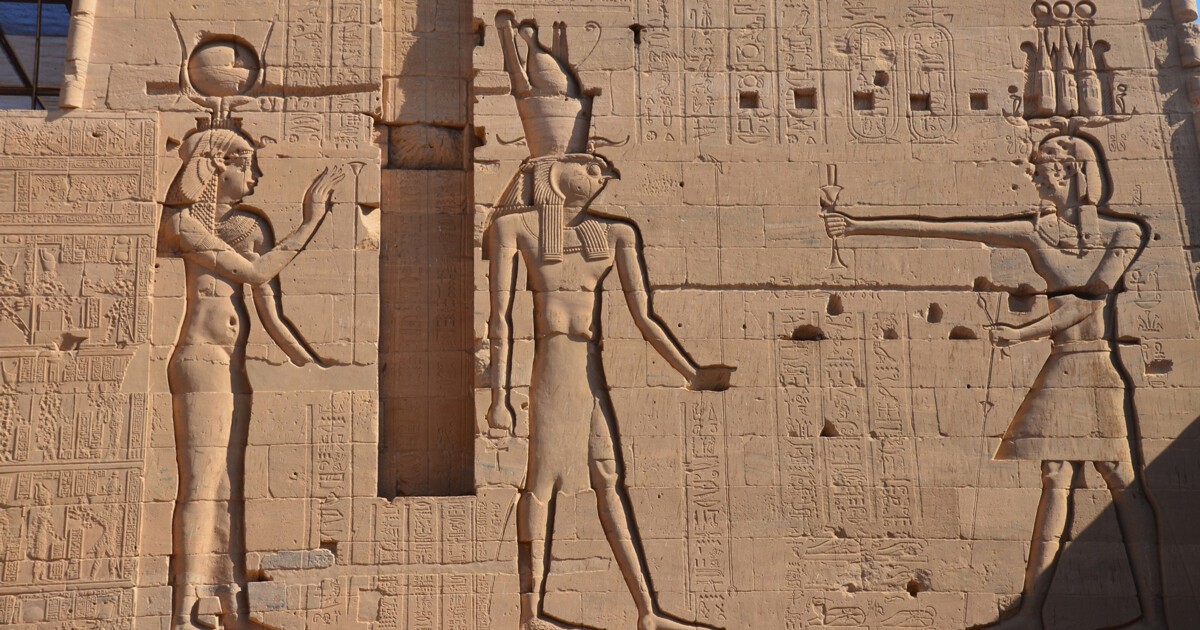
The first two Ptolemies established the Ptolemaic dynasty, but the third secured its legacy in this life and the next. In 238 bce, Ptolemy III and his wife, Berenike II, were celebrated by a synod of priests in a trilingual inscription now known as the Canopus Decree. Like the Satrap Stela, the decree, which was promulgated throughout Egypt, followed traditional pharaonic forms. At the top of the stone stela, the king was depicted among sixteen deities. Below was the priests’ decree inscribed in three linguistic registers: hieroglyphs, demotic Egyptian (a more contemporary version of the language written in a cursive script) and Greek. (This is the format that would be used by the Rosetta Stone; its top portion is now missing.) The Canopus Decree praised the royal family for their material benefits to the realm: the provision of food and the return of statues stolen by the Persian king Cambyses. In turn, it conveyed spiritual honours not only on the two ‘beneficent gods’, Ptolemy III and Berenike II, but also on their daughter, who had recently died. This was an innovation – she was declared a goddess not because of her actions but because of her royal blood. For all their lofty language, priestly decrees were fundamentally items of exchange. The priests got a good bargain: Ptolemy went on a building spree at Egypt’s holiest sites. His magnum opus, the temple to Horus at Edfu, took 180 years to complete (with a few interruptions). Today it is the most harmonious surviving Egyptian temple constructed in the pharaonic style. After two centuries of Ptolemaic rule, only a single Greek word, rendered in Egyptian script, made it onto the temple walls: aqur or ‘silver’.
It was all downhill from there. Bédoyère argues that the turning point was the battle of Raphia (near modern Rafah) in June 217 bce between Ptolemy IV and Antiochus III, ruler of the Seleucid Empire. Ptolemy won a decisive victory, but he allowed Antiochus to regroup and, later, to invade Egypt. Bédoyère’s analysis may be right – no Ptolemy would march to Asia again – but the forces that rocked the dynasty over the next two centuries were much larger. Ptolemy I created a buffer zone around Egypt, a pharaonic strategy that he adapted to an age of naval warfare, but no Ptolemy had been able to sustain any further substantial territorial gains. Even Ptolemy III’s rapid, rage-fuelled march through Mesopotamia in the 240s bce was undone just as quickly when the failure of the summer flooding of the Nile led to a famine and rebellion forced him to return home.
Biology was just as significant. When Ptolemy IV died at forty, he bequeathed Egypt to his six-year-old son – in effect leaving his empire in the hands of two manipulative and unreliable regents, Sosibius and Agathocles. Ptolemy V was styled a god – he was called the ‘Manifest One’ – but he was all too mortal. His coronation in 196 bce, celebrated on the Rosetta Stone, was an effort to put a good face on a bad situation, but it alludes to the challenges the new king faced: the attack from Antiochus III and the Great Revolt, an uprising in Upper Egypt that would last almost two decades. This wasn’t the first or the last rebellion in Ptolemaic Egypt, but it may have been the most significant. The rebel champion, Horwennefer, was proclaimed pharaoh and set up a rival government that collected its own taxes, harking back to the time before Upper and Lower Egypt were united. The causes of the revolt are hard to unravel – Polybius blamed Ptolemy V’s debauched lifestyle – but modern historians have looked for an economic motive. It is clear, though, that it was made possible by soldiers who had been trained for the fight at Raphia. The Ptolemies had no choice but to embark on a protracted struggle to regain control of their territory, even pausing work on their temples in Upper Egypt, including at Edfu. Meanwhile, Antiochus III took all the Egyptian territory in Asia Minor and the Levant. A year after Ptolemy V was crowned, the Romans mediated a peace treaty: he agreed to marry Antiochus’ daughter Cleopatra at Raphia. No doubt he also provided a hefty dowry.
When Ptolemy V was poisoned just before he turned thirty, Cleopatra became regent for their son. (St Jerome blames Ptolemy’s generals for the murder, but Llewellyn-Jones entertains the possibility that it was Cleopatra herself.) Cleopatra was not the first powerful queen – Ptolemy II had introduced Arsinoe II into the royal cult and the Egyptian term prꜥꜣ.t (peraat or ‘pharaohess’) had already been used for Berenike II during the reign of Ptolemy III – but she would go further, presumably modelling herself on figures like Sobekneferu, the first confirmed queen regnant, or Hatshepsut, who had depicted herself with the stereotypical traits of a male ruler in the middle of the second millennium. Cleopatra’s name appeared first on documents; she described herself as a ‘manifest divinity’ before her son obtained that title; she made peace with her half-brother, Seleucus IV; and she had coins minted with her own image.
Unfortunately for Egypt, she died four years later. Her ten-year-old son, his wife (and younger sister) and his younger brother became co-rulers as Ptolemy VI, Cleopatra II and Ptolemy VIII (there was no Ptolemy VII). Their combined age was under thirty. All three were routed by Antiochus IV, who marched on the Egyptian capital. They had to ask Rome for salvation. It arrived in the form of Gaius Popilius Laenas, who met Antiochus at Eleusis, just east of Alexandria. Tracing a line in the sand around Antiochus’ feet, he presented him with an ultimatum: ‘Before you step out of that circle, give me a reply to place before the Senate.’ Antiochus agreed to withdraw and Alexandria was saved, but the Day of Eleusis, as it is called, would live on in infamy.
When Ptolemy VI died in 145 bce, the Alexandrians opted for his brother rather than his sister. They would soon regret it. Ptolemy VIII wanted to be named Benefactor, but the Alexandrians called him Malefactor and Potbelly. Both were accurate. He was carried everywhere on a litter, a sign of his arrogance and gluttony. When he was visited by the Roman general Scipio Aemilianus, his sheer robes offended his guest. When he returned to Alexandria from exile, he allowed his soldiers to pillage the city and sent leading intellectuals to their deaths. He married his sister – his brother’s widow, Cleopatra II – and then her daughter Cleopatra III. When the double marriage descended into civil war, he sent Cleopatra II their son’s dismembered body on her birthday. After he regained control of Alexandria, he had her supporters rounded up and put in the gymnasium, which he set on fire. He ruled in one form or another for 52 years, longer than any other Ptolemy. For all that ancient sources delighted in narrating his cruelty and excess, he could be surprising. In the conflict with Cleopatra, he won the support of the native population; he was deeply learned and the author of scholarly treatises; he sponsored an expedition to India; once he had dispatched his sister, he was a generous patron of Egyptian temples; and during his years of exile, he wrote a will that promised his kingdom to Rome. It was a century after his death in 116 BCE before the Romans made good on his offer.
The next decades are a blur of marriage, murder and misbehaviour. Ptolemy IX was deposed by his brother and then regained his throne. Ptolemy X murdered his mother and, like his father, left Egypt to Rome. Berenike III ascended the throne as the first woman to exercise sole rule in the Ptolemaic dynasty, but was murdered by Ptolemy XI, whom she had married the following year. The Alexandrians then stormed the palace and tore him limb from limb. He had ruled for less than a month and was subsequently erased from the official record. Ptolemy XII, the ‘Flautist’, was said to have preferred performing music to governing and had to send hefty payments to Rome to ensure its continued support for Egyptian independence. When he (and the Egyptians) ran out of cash, he resorted to borrowing from Roman moneylenders. The Teaching of Ankhsheshonqy, a Demotic Egyptian wisdom text from this period, reflects on the dire condition of rural Egyptians. ‘A crocodile does not die of worry,’ one saying reads. ‘It dies of hunger.’
No member of the Ptolemaic dynasty was more famous than Cleopatra VII, the daughter of Ptolemy XII. Shakespeare made her a femme fatale, but it would be more accurate to describe her as a political operator. Her ascension was preceded by a partial solar eclipse. It was a fitting metaphor. She shared the throne with her brother and husband, Ptolemy XIII, but he never stood a chance. Cleopatra built temples, toured Egypt alone, excluded her brother from documents and artworks, and accepted the title ‘Ruler of the Two Lands’ in the masculine form, normally reserved for the king. (In one stela from the Fayum, she is depicted making offerings to Isis attired in pharaonic garb, with a bare, masculine torso.) She was also the first of the Ptolemies to speak Egyptian. One ancient author suggests that she could converse with Ethiopians, Arabs, Syrians and Medes.
Her brother waged a bitter war to regain power, dragging Cleopatra and their kingdom into the Roman civil wars by murdering Pompey off the coast of Pelousion. Cleopatra won protection from Julius Caesar (Plutarch suggests that she sneaked into Caesar’s rooms in a laundry bag) and in the ensuing conflict he accidentally set fire to the Library of Alexandria. Around 400,000 volumes were lost. Ptolemy XIII died while trying to escape the conflict, and his ship, full of his supporters, sank to the bottom of the Nile. He was replaced by his brother, the twelve-year-old Ptolemy XIV, but to all intents and purposes Cleopatra and Caesar were the ruling couple. They had a son, Caesarion, who was celebrated on the walls of the temple at Dendera, although Caesar never acknowledged paternity. When Ptolemy XIV was murdered a few years later, Cleopatra made Caesarion Ptolemy XV. He was the last of the Ptolemies to be king.
After Caesar’s assassination in 44 bce, a second triumvirate, led by Octavian, Marcus Lepidus and Mark Antony, formed to hunt the perpetrators. Yet again Cleopatra had to pick a side. She chose Antony. It is hard to separate romance from reality in ancient accounts, but whether Cleopatra really won Antony over with her dazzling entrance on the Ptolemaic superyacht – dressed as Aphrodite and attended by maids dressed as sea nymphs – or he simply made a shrewd political calculation, they were inseparable. They had twins called Alexander and Cleopatra. Caesar had returned Cyprus to Cleopatra’s control; Antony would do more. In short order, she regained almost every territory that had ever been part of the Ptolemaic empire. Antony even gave her the contents of the Pergamon library – 200,000 parchment rolls – to replace those that had been burned. In Rome, Caesar placed a life-sized statue of Cleopatra in the temple of Venus Genetrix, which he had built. With Antony, in Egypt, she identified herself with Isis, the sister and wife of Osiris, the mother of Horus and a patron of the Ptolemies. The enemy of Isis, Osiris and Horus was Seth, the Egyptian god of chaos and disorder.
One of the last official documents from Cleopatra’s reign granted exemptions from taxes, import duties and customs to a close associate of Antony. At the bottom the word ginesthōi (‘let it be done’) is written by a different hand, possibly Cleopatra’s. But she had picked the wrong side: Octavian entered Alexandria on 1 August 30 bce. That day, Antony fell on his sword and died in Cleopatra’s arms. About ten days later, Cleopatra killed herself. If the ancient accounts that she held out her arm for a cobra to bite are true, she ended her life and the Ptolemaic dynasty with a symbol of their power – the uraeus snake featured on the pharaoh’s crown. After her death, Octavian ordered the destruction of Antony’s statues, but hers were left untouched thanks to a donation of 2000 talents from a man called Archibios, known to us only as ‘a friend of the queen’. Wilkinson surmises that the money could only have come from Egypt’s temples: if so, the priests had remained faithful to their Macedonian queen to the very end. Caesarion – a threat to Octavian, Caesar’s adopted son – was killed, but Cleopatra’s children with Antony were spared. When, years later, Cleopatra Selene gave birth to a son, she called him Ptolemy.
‘The story of the Ptolemaic rulers of Egypt,’ Bédoyère writes, ‘is an allegory for all regimes including Rome, their nemesis.’ Rule over Egypt made the Ptolemies rich and powerful, but they were constrained by many of the limitations the pharaohs had faced. The battle of Raphia took place 250 miles south of Kadesh, the site of Rameses II’s famous ‘victory’ in the 13th century bce (in reality it was, at best, a draw). The Ptolemies’ empire was larger than that of Rameses, but not by much. Although they never managed Roman-style conquest – hemmed in by geography, revolt and circumstance – the Ptolemies and their citizens held on for three centuries. They were the last of the Hellenistic kingdoms to succumb to Rome.
For the Egyptians, who had already suffered a century and a half of absentee rule by the Persians, the Ptolemies were a mixed blessing. They provided stability. They respected and enlarged Egyptian religion. They continued to support Memphis. But they also embraced a hierarchical society – nothing new in Egypt – and in their later years began to extort farmers for taxes. Sometimes it was better to leave the land untilled than to face a high tax burden in a difficult year. For two decades, Upper Egypt was in the throes of the Great Revolt. A text known as the Oracle of the Potter, probably composed a few decades later, predicted that Alexandria would be destroyed (‘the stench of unburied bodies will reach the city’) and that Memphis would be restored as Egypt’s capital. The text only survives in Greek papyrus copies, but almost certainly represented another strain of resistance to Ptolemaic rule.
Suffering from gout and locked in his palace, Ptolemy II is said to have gazed with envy at the ordinary Egyptians lounging on the beach. From the beginning the Ptolemies deliberately and devotedly practised excess in their personal relationships, their dining, their quest for knowledge and their building schemes. Ptolemy II believed he had discovered the elixir of life, but not even immortality could soothe him. Yet Alexandria also nurtured a very different aesthetic. In the preface to Callimachus’ poem On the Origins of Things, he praises the small and claims to disparage the grand ambitions of epic. ‘Judge my skill by art, not the Persian chain,’ he commands. ‘Thundering is Zeus’ job, not mine.’ He concludes with a wish. ‘As for me, I would be small and winged – yes, even so, to sing with dew upon my lips, the food of morning culled from air divine, shedding the years that weigh on me.’