The story of the English printing press has no convenient beginning. It makes for inconsistent centennials; a quatercentenary celebration was held in 1877, two quincentenary exhibitions in 1975 and 1976, and now in 2026 an exhibition at Senate House to celebrate a 550th anniversary (until 1 July). Whenever we begin the story, it must involve William Caxton. He was the first Englishman to print, the first person to print an English book and the first to print in England, but these were three distinct events. Probably the first printed book he published, around 1472, was De Proprietatibus Rerum by Bartholomaeus Anglicus, a popular 13th-century encyclopedic text. Caxton printed it in Cologne, working with the type-cutter Johann Veldener and his apprentice, Wynkyn de Worde (who would one day take over Caxton’s shop), and the work was in Latin. Soon afterwards the three of them moved to Bruges, where Caxton had long been living as a merchant, and set up a new press. This produced the first book to be printed in English, The Recuyell of the Historyes of Troye, drawn from Caxton’s translation of a French text, which was also among the first to include a copper engraving in its pages. Caxton printed a few more texts in Bruges before moving back to England in 1476. He established a press in Westminster, at the sign of the Red Pale, and it was here that he published the first book to be printed in England, Chaucer’s Canterbury Tales, in 1476.
Caxton is lauded in the Senate House exhibition as the ‘father of English printing’. To the 18th-century antiquary Joseph Ames, he was ‘our venerable typographer’; William Blades, a printer and amateur historian who had helped to organise the 1877 exhibition, preferred the majestic, faintly cyberpunk ‘Prototypographer’. We have acquired very little new biographical information about Caxton since then – Blades was an assiduous collector of documentary sources – and yet assessments of his ingenuity have changed considerably. Norman Blake, a recent biographer, remarks bluntly that ‘he was no scholar and his interest in literature was probably superficial … he was a man of the late medieval period, not of the Renaissance.’ This is a little unfair. Caxton’s early interest in print was probably commercial rather than technical, that of a publisher rather than an inventor. But his interest in literature ran deep, not only as a reader but also as a translator of dozens of works. His printed output suggests a man who was earnestly committed to the promotion of English writing; in his edition of the Canterbury Tales he praises Chaucer for having ‘enbelysshyd, ornated and made faire our Englisshe’.
Caxton tells readers in the prologue to the Historyes of Troye that he was born in the Kentish Weald (he gives this as the reason his English may come across as particularly rude and simple, but he must also have spoken French, and probably Dutch and German too). He was apprenticed into the Mercers’ Company of London in 1438, and by 1450 he was in Bruges, dealing in pewter, cloth and wool. He settled permanently in the city and became leader of the English merchants there, a role that soon involved him in the complexities of trade and diplomacy between Edward IV and Charles, Duke of Burgundy. In 1471, after falling foul of English dynastic politics during the brief readeption of Henry VI, Caxton went to Cologne, a city with which he may have been familiar from his business connections. There had been a press there since 1464, when Ulrich Zell – who had worked with Gutenberg’s partner, Johann Fust – had brought it up the Rhine from Mainz. By this time, Caxton was already in the process of translating the Historyes of Troye from French. He seems to have quickly spied the potential of the new technology.
The idea of printing was not new. Every coin and wax seal in Europe had been ‘printed’ for centuries; woodblock printing was used to produce religious images and playing cards. But in the early 15th century, there emerged a range of new art forms made by replication: bronze medallions, ceramic plaquettes, copper engravings and glazed terracottas. All required sophisticated metal-carving techniques. The print historian Lotte Hellinga has written that ‘technically, Gutenberg’s invention was an advanced achievement in metallurgy.’ The true innovation was the idea of moveable type: individual letter stamps that could be endlessly recombined to produce multiple copies of a text at once. Each character was first cut in steel as a punch, which was hammered into a copper matrix to produce a mould, into which an alloy of tin and lead was poured. The result was a single piece of type, a small bar of metal with the letter on the end. About seventy ‘sorts’ of type – including capitals and minuscules, spaces, punctuation, symbols and, in English, the archaic letters thorn (þ) and yogh (ȝ) – were required to produce a complete ‘fount’, with each sort cast in several copies to allow for repeated letters.
The first step in printing was to ‘cast off’, marking up the copy to show how the text should be divided up into pages. Then compositors took the pieces of type required to make a single page, laid them out in rows and packed them on top of each other into rectangular blocks. These were tied tightly with string, placed into frames called ‘chases’ and further secured with wedges to hold everything still. For all except the largest books, printing was done on sheets that would subsequently be folded to make up booklets – once to make a folio format, twice to make a quarto. This process meant that some pernickety calculations were required: in a quire of four folded leaves (sixteen pages), the first page would be printed on the same side as the sixteenth, the second next to the fifteenth, and so on, until the middle of the book where eighth and ninth were printed opposite. Completed chases were thus placed into larger structures called ‘formes’ that combined the different pages of type in the correct order for folding, a process known as imposition.
The formes were then daubed with ink using leather balls shaped like plungers and laid face-up in the press, ready to receive the paper. Another 15th-century innovation necessary for printing was the oil-based paint developed by Flemish artists. The water-based solutions traditionally used for manuscripts would not adhere to the metal type, so printers’ ink was made from a sticky mixture of oil, soot, adhesives and albumen. One of Caxton’s early experiments, with the Historyes of Troye, was to use red ink for the dedication to his patroness, Margaret of York, in an apparent attempt to mimic the look of contemporary manuscript production. Using two colours was technically complicated, however, and he did not continue with it in Westminster, preferring instead to mark headings or other textual junctures with contrasting sizes and founts of type.
Although some early printing was done on vellum, the process was quickly adapted to paper for similar reasons: parchment was less absorbent and its malleable surface harder to impress. The sheets of paper had to be dampened to receive the ink. Once all the materials were prepared, the sheet was ready for pressing. The early press was like a great vertical vice, operated by a screw. This technology was centuries old, having been developed for the pressing of grapes to make wine. The sheet of paper was placed onto a canvas called a tympan, held in place with metal pins, and then covered with a thin frame called a frisket. The tympan was folded face-down so that the paper was poised just above the forme. Then the bar of the screw was pulled and the platen, or press, pushed the paper down onto the inked letters. But pressmen were still tinkering with the machinery, and in the 1470s printers in Rome found a way of adapting the apparatus to accommodate larger formes. This enabled a whole sheet of paper (up to four pages of a quarto book) to be printed at once, in two pulls of the press. Caxton, who not only printed but imported books from Europe throughout his career as a publisher, was soon abreast of these developments, and from 1480 his press was producing sheets with the two-pull method.
We tend to associate the printing press with the production of books, but in fact much early work was on smaller jobbing pieces. The first surviving dated piece from Caxton’s press in England is a papal indulgence of 1476, discovered in the Public Record Office in 1928. The indulgence, granted by Sixtus IV to fund the naval defence of Rhodes, was sold at Westminster Abbey, where Caxton rented his shop, and it seems that the abbot had a hand in the commission to produce the indulgence – a formulaic text that granted the purchaser the same remission of sin that would be obtained through a pilgrimage to Rome. In another ambiguous ‘first’ for English printing, the sheet was essentially a bureaucratic certificate, in which the place, date and name of the purchaser were left blank, to be written in by a scribe. A man called Henry Lanley and his wife, Katherine, will be forever remembered by typographical enthusiasts for having bought Caxton’s indulgence on 13 December 1476. With any luck they’ve made it out of purgatory by now.
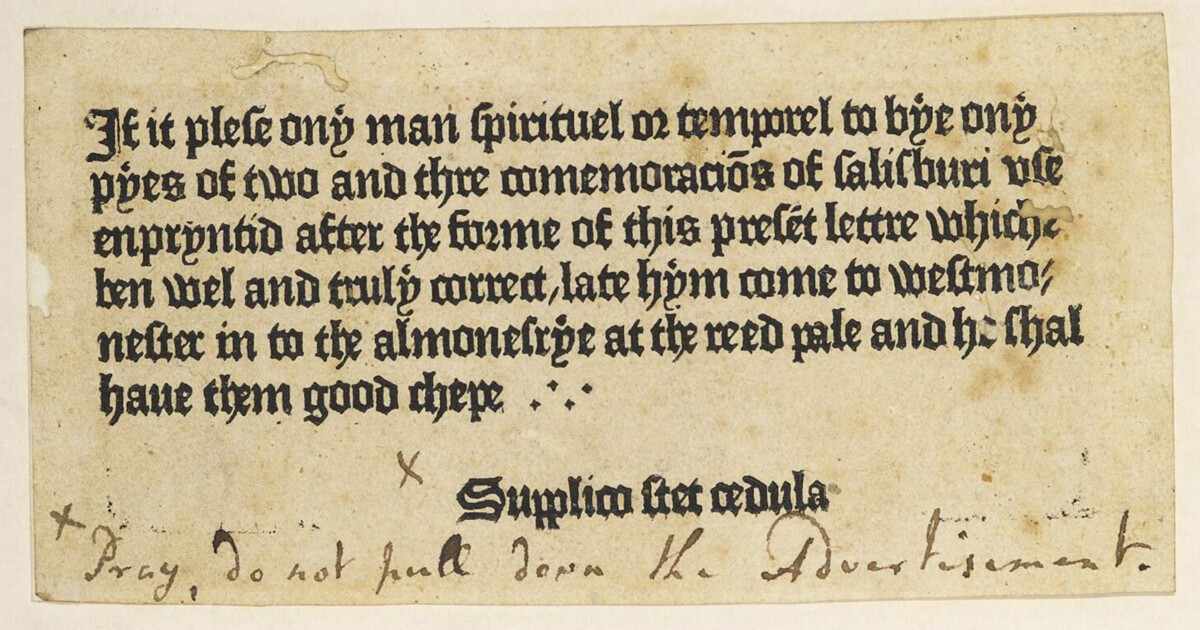
Soon afterwards Caxton was at work on the Sarum Ordinal, a liturgical text known as a pye that might have appealed to the clerks hurrying around the abbey precincts. It was for this book that he produced the first surviving printed English advertisement in 1477. A small sheet of paper, preserved in the Bodleian, declares that if anyone wants to buy a pye ‘enprynted after the forme of this present lettre, which ben wel and truly correct, late hym come to Westmonester … and he shal have them good chepe’. The advert must have been posted up on a board or wall somewhere, for underneath the English text was a Latin phrase, supplico stet cedula: ‘please leave this bill where it is.’ Posted bills had been common in England for a century or more, and the streets of the capital were full of them. But Caxton the Mercer understood his product. The sheet probably stood out for its neatness – he used a blackletter type that closely resembled the bookhand of contemporary manuscripts rather than the rough and speedy secretary script typically used for bills – and so ‘the forme of this present lettre’ would have drawn the eyes of new consumers.
The first book advertisement in the English language, printed by William Caxton (c.1476).
Caxton’s printed goods entered a well-established market for books. The London Stationers’ Company had formed in 1403, and the area around St Paul’s – where Wynkyn de Worde would set up shop in 1509 – was home to dozens of book artisans. There is little evidence in England for the existence of commercial scriptoria churning out texts for readers to purchase off the shelf; scribes usually worked on commission, copying out specific texts desired by their patrons, or according to what they could get their hands on. Caxton began making books with this older model of patronage in mind. The Historyes of Troye contains a lengthy preface and dedication to Margaret of York, who, Caxton claims, had asked him to complete the translation; in one surviving copy of the book there is an elaborate frontispiece – an early example of copper engraving, probably executed by one of the master manuscript miniaturists active at her court.
But printing reversed the economics of manuscript book production. Although commissions from fashionable aristocrats or penny-pinching churchmen could supply some work, publishers keen to keep their press occupied would also have to speculate in advance about the potential market for their productions. Alongside his book-length works and the single-sheet jobs, the early days of Caxton’s Westminster press were taken up with several quarto editions of shorter poems by Chaucer and Lydgate. These little booklets were exactly the kinds of text that middle-class Londoners asked scribes to copy out for them (or copied themselves), to be circulated in booklets among friends or bound into personal anthologies. Caxton’s readers quickly got the idea: a sammelband in the Cambridge University Library contains eight of these quarto texts, bound before the 1490s by a Westminster bookbinder who was closely associated with Caxton. It was for these kinds of text that the next generation of printers remembered him. In 1510, Robert Copland noted that he was ‘gladly folowynge the trace of my mayster Caxton/begynnyng wyth small storyes and pamfletes’.
The incunabula (‘swaddling-clothes’) period of printing, which refers to works printed before 1501, saw much interchange between manuscript and print. One of Caxton’s early productions, an English translation of the moral treatise The Game of Chess, was printed in Bruges in 1474; within a decade it had been copied out by hand for a gentlewoman, Margary Woodward. The press could not always keep up with demand, and so in 1482 Caxton reissued the text in a second edition – complete with a spate of woodcuts – from Westminster. A copy of this edition occupies the central case of the Senate House exhibition, open to an illustration in which a chess player smiles craftily as he arranges his pieces. Jobbing scribes worried at how fast the world was changing. A petition to the royal chancery made in the 1480s by the stationer Philip Wrenne complained that ‘the occupation ys almost destroyed by prynters of bokes.’ This was premature. Copying by hand was still cheap and for centuries it remained the easiest method for a reader to obtain their own copy of a text. Printing did not just meet existing demand for books, but helped to generate it, and the stationers were doing just fine from the trade. But it is undoubtedly true that the ecosystem of writing had been altered, and printers themselves – Caxton foremost among them – were keen to exploit this sense of impending change to market their wares.
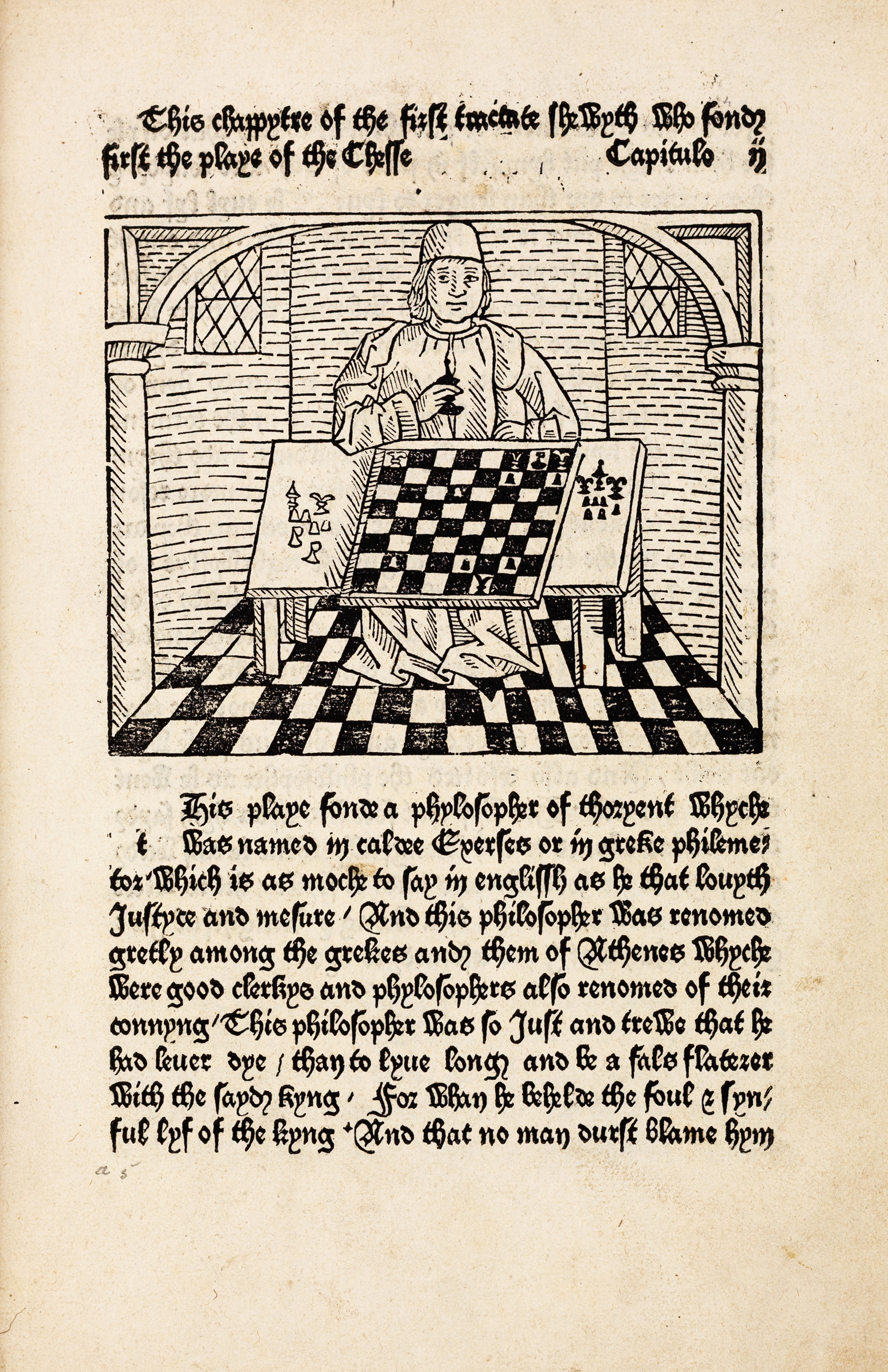
‘The Game of Chess’ (1474).
In his prologue to the Historyes of Troye, Caxton resorted to old tropes about the arduousness of scribal labour: ‘In the wrytyng of the same my penne is worn, myn hande wery and not stedfast, myn eyen dimmed with overmoche lokyng on the whit paper.’ He claimed he had made promises to friends and other ‘gentilmen’ that he would have the book ready as soon as possible. Therefore, to get the text out quickly, ‘I have practysed and lerned at my greate charge and dispense to ordeyne this said book in prynte.’ The development of English printing, in his own telling, was merely a writer’s struggle to meet a deadline. But Caxton, ever the marketeer, went on and on with his sales pitch: ‘It is not wreton with penne and ynke as other bokes ben.’ In fact, ladies and gentlemen, here in my hand, the Historyes of Troye, ‘thus enpryntid as ye here see were begonne in oon day and also fynysshid in oon day.’ The novelty, the speed, the marvel!
Historians have long understood printing as the cause of various ‘revolutions’: Elizabeth Eisenstein, in 1979, argued that we should understand the printing press as ‘an agent of change’. The Senate House exhibition uses other works in its collections to trace the familiar narratives: the Reformation, the nation-state, the scientific revolution. Certainly these revolutions had nice books. You can see a 1577 edition of Holinshed’s Chronicles, a beautifully illustrated botanical text, John Parkinson’s Theatrum Botanicum, and a 1719 copy of Robinson Crusoe, complete with foldout map. Whether we can convincingly trace these works back to Caxton, let alone the long-term social processes that they are supposed to represent, is much harder to say. As the historian Adrian Johns has argued, many of the qualities associated with print – uniformity, fixity, control – were not produced mechanically but culturally. The idea that a printed book is fixed or uniform is belied by the existence of multiple editions that produce the text in different ways. We want to see continuity in print, but it took a lot of actual and ideological work to make the printed word actually do the things that it came to stand for.
Still, it’s hard to resist a good origin story. Caxton liked beginnings too, or at least he understood that they had a popular appeal: he took readers back to the dawn of recorded history at Troy with his first English book, and to the foundations of modern English literature with Chaucer, the first book he published in England. In the last prologue he wrote for one of his editions, Eneydos (Virgil’s Aeneid) of 1490, just a couple of years before he died, he opens with a brief, poignant self-description ‘sittyng in my studye where as laye many dyuerse paunflettis and bookys’. A bibliophile who had done so much to help spread the craze in England, he still thought in terms apposite to the manuscript culture into which he had been born, inviting readers ‘to correcte, adde, or mynysshe where as he or they shall fynde faulte’, a conventional scribal plea, before going on to dedicate the text to a series of highborn patrons. Yet he was a visionary, in the same way that all successful ad men are visionaries. He was the first person in England to understand that he was selling not just print, but novelty. For my money, future centenaries should take place in years ending ’77, the year of his printed advert, in grudging celebration of one of the most enduringly successful marketing campaigns in history.