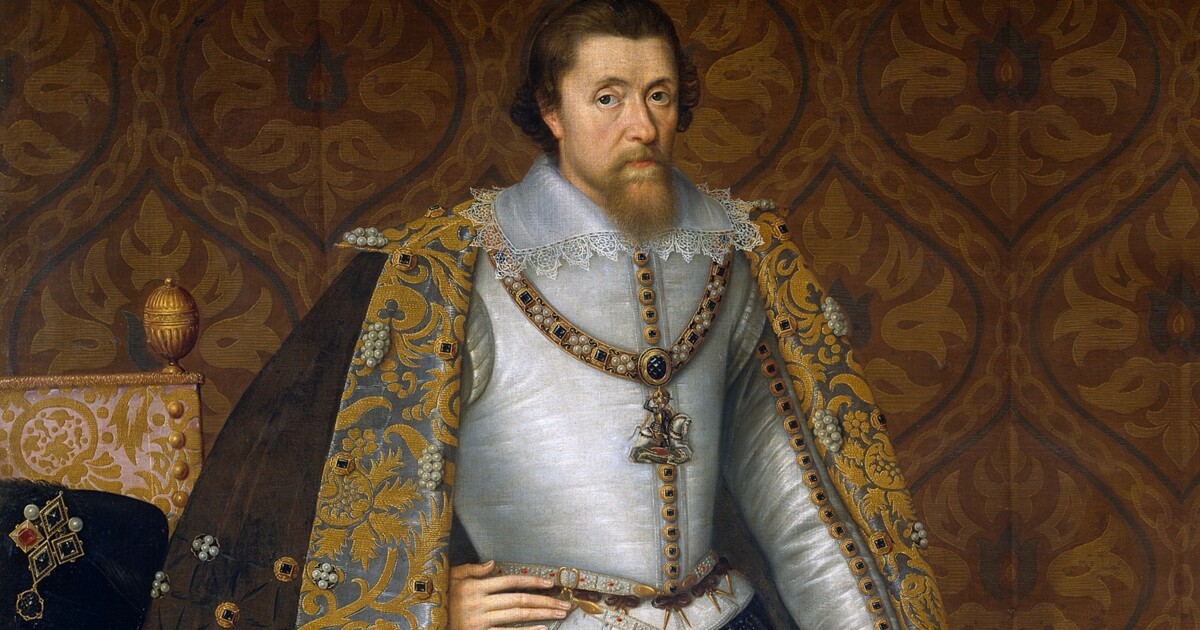
In his History of Great Britain, published in 1653, Arthur Wilson wrote: ‘I see no reason why princes (towering in the height of their own power) should think themselves so far above ordinary mortals, that their actions are to be incomprehensible. This is but a weakness, contracted in the high place they look down from.’ The execution of Charles I in Whitehall in 1649 prompted (in England, at least) a slew of critical histories of his father, James VI and I, and his decadent court. Anthony Weldon, who is assumed to be the grumpy courtier author of The Court and Character of King James (1650), thanked God the Stuart family had been ruined. His assessment of James as ‘the wisest fool in Christendom’ has stuck, as has his unflattering physical description: ‘his tongue too large for his mouth, which ever made him speak full in the mouth and made him drink very uncomely’; his ‘walk was ever circular, his fingers ever in that walk sidling about his codpiece’. Such attributes indicated moral failings. The diplomat Henry Wotton, by contrast, writing in 1602, had found James ‘of medium stature, of vigorous constitution, his shoulders broad … In his eyes and in the outward expression of his face, there appears a certain natural goodness verging on modesty.’
Three centuries later, in 1956, David Harris Willson’s biography took the hostile line. Scottish historians tended to be fairer, prompting Jenny Wormald to ask in 1983 whether James was ‘two kings or one?’, so different were his historical reputations north and south of the border. Wormald and other historians have done much to establish James’s political agility and challenge the homophobia and xenophobia that skewed interpretations of him alive and dead. But the caricature of a weak king drooling over his favourites has proved hard to expunge from the public imagination.
The 400th anniversary of James’s death has been marked by several new approaches to the reign that gave us the King James Bible, the Union Jack and Bonfire Night. ‘Four centuries is too long for anyone to remain in rehab,’ Clare Jackson writes in The Mirror of Great Britain. She sets out ‘neither to valorise nor to denigrate’ her subject, ‘but rather to restore appreciation of the sheer difficulty, intensity and complexity faced by James as ruler of late-16th-century Scotland and as the first British king’. Anna Whitelock’s The Sun Rising, also from this year, is not a conventional biography of James: favourites and hot-headed Protestants are replaced by busy merchants and diplomats in a narrative of the messy birth of the British Empire. Susan Doran’s From Tudor to Stuart: The Regime Change from Elizabeth I to James I looked at the first ten years of James’s reign to rethink the seismic dynastic shift. And as a reminder of James’s kingly experience, Alexander Courtney’s James VI, Britannic Prince concentrated on his 36-year reign as king of Scotland, before he succeeded Elizabeth; a second volume taking up the story from 1603 is promised. Meanwhile, Gareth Russell’s Queen James is an intimate biography of the ‘particular’ man, told through the men James loved. The result is a provocative study, if much less salacious than the title (taken from an anonymous joke of 1623) suggests.
Jackson and Russell both consider the entirety of James’s long reign: nearly 58 years as king of Scotland and 22 years as king of England and Ireland. Both move evenly between Scotland and England. James, who called himself a ‘cradle king’, was crowned at Stirling in 1567. He was thirteen months old. According to the French envoy Albert Fontenay, he had been ‘nurtured in fear’. When Mary Queen of Scots was pregnant with James, her unfaithful and estranged husband, Henry, Lord Darnley, burst into her room at Holyroodhouse with a band of armed men. After hurling an accusation of adultery at Mary and David Riccio, her Italian secretary, who was among the guests at dinner with her, the men ordered Riccio to accompany them. He cowered behind Mary. The conspirators surged, pushing over the supper table. One reached into Darnley’s scabbard, took his dagger, whistled it past Mary’s face and stabbed Riccio. Mary believed that it was her unborn child and heir that the men, including Darnley, had intended to target, through bringing about a shock-induced miscarriage. She feigned forgiveness to Darnley, who was, after all, the probable father. But the whiff of illegitimacy stayed with James all his life; he was sometimes called ‘son of David’, in mocking reference to his other biblical epithet, ‘Great Britain’s Solomon’, which paid tribute to his wisdom and scholarship.
Within the year Darnley, too, was dead, strangled in the gardens of the house at Kirk o’ Field as it exploded behind him. His murder has never been solved. Mary was not beyond suspicion; nor was Lord Bothwell, her soon-to-be husband. The rebellions that followed Darnley’s death saw Mary defeated and forced to abdicate. Bothwell later confessed to the murder, and to using witchcraft to seduce Mary, but his deathbed confession was unreliable: he had become insane after years of imprisonment in Denmark.
Mary had been queen of Scotland since she was six days old. A Catholic ruler in a Protestant kingdom, she faced a formidable Presbyterian Kirk and a forceful Scottish aristocracy. James inherited a country divided between those loyal to his Catholic mother, who had escaped into exile in England, and Presbyterian nobles who sought to control him. His uncle and first regent, James Stewart, earl of Moray, was shot in 1570, followed by his second regent, his grandfather Matthew Stewart, earl of Lennox, in 1571. A five-year-old James apparently saw him bleeding to death. When James was eleven, Stirling Castle was raided by Catholic rebels. At sixteen, he was kidnapped by William Ruthven, earl of Gowrie, and imprisoned for ten months. This plot, known as the Ruthven Raid, sought to remove James from the influence of his first favourite, his French and Catholic cousin, Esmé Stuart. After the Gunpowder Plot of 1605, James addressed his English Parliament: kings, he said, are ‘like the high Trees … most subject to the daily tempests of innumerable dangers; and I among all other Kings, have ever been subject unto them, not only ever since my birth, but even as I may justly say, before my birth, and while I was yet in my Mother’s belly.’ It is no wonder that this clever boy grew up to be watchful, or that he thanked God for his miraculous deliverances and chose to shore up monarchy, or that he learned to dissemble and feign acquiescence. In his pacification of Scotland and in his bid for the throne of England, these skills served him well.
The ‘mirror of Great Britain’ of Jackson’s title is the name of a brooch that James wore in his hat and which combined jewels from the English and Scottish royal collections – symbolising his vision of a united Britain. The clear mirror, itself a fairly new commodity, provided James with one of his favourite images of kingship: a king should be ‘a mirror’ to his people, and his royal authority respected lest ‘it fall or break (for glass is brittle)’. The mirror also serves as a metaphor for Jackson’s method. Her chapters are ‘thematic reflections’ on aspects of James’s life and rule, ranging from his childhood, copious writings, monarchical theory and love of hunting to his management of the Kirk and the House of Commons and his policies in Ireland and the fledgling colonies. Each chapter allows the shifting, multiple images, perspectives and distortions created by any long life to sit alongside one another.
Above all, Jackson presents James as a ‘king of words’. His own words fill the pages of her book, as do those of courtiers, ambassadors, politicians, fellow monarchs, critics, poets and playwrights. No king before or since has written so thoughtfully about the nature of kingship. His ‘manual on kingcraft’, Basilikon Doron (‘The King’s Gift’), became a bestseller. He exercised authority and displayed himself to his people through his words. George Herbert wrote that James ‘dost offer thyself to be gazed upon on paper’. He wrote religious meditations, a treatise on poetic theory and another against tobacco and a book about witchcraft, Daemonologie, written in dialogue form. While Daemonologie asserted James’s belief in ‘the fearful abounding at this time in this country [Scotland], of these detestable slaves of the devil’, he was, Jackson reminds us, ‘no rabidly obsessive witch-hunter’ and warned against gullibility. In James’s own words: ‘Judges ought indeed to beware whom they condemn.’
He loved language and rhetoric. When persuading the English Parliament to approve his vision of Great Britain, his speech turned on the marriage ceremony: ‘What God hath conjoined then, let no man separate. I am the husband, and all the whole isle is my lawful wife.’ He could swear like a sailor, but coined new words – Anglican, anorexia, Highlander – and is quoted more than 650 times in the OED. He wrote verses in Scots, a battle epic, poems to his wife, Anne (or Anna) of Denmark, and about the Armada. In 1617, he published his collected works in a grand folio volume, as would soon be done for Shakespeare, whom James patronised. Shakespeare’s ‘turbaned Turk’ from Othello was probably nicked from James, who had apparently already coined ‘turbaned’. In 1616, Ben Jonson hailed him as the ‘best of kings’ and ‘best of poets’.
Basilikon Doron diverged from the lessons on kingship James had received as a child from his humanist tutor George Buchanan, who beat and humiliated him. James’s intellect was often commented on – a post-mortem revealed that his head, when cracked open, was ‘so full of brains as they could not … keep them from spilling, a great mark of his infinite judgment’. He was fluent in Scots, English, French, Greek and Latin and excelled at debate. But Buchanan was a robust defender of popular sovereignty. He taught his young king about the sins of his mother. James learned about the brutality and the infidelities of the Scottish – specifically Stewart – monarchs. James VI came, Buchanan said, from ‘a bloody nest’. The perfect king, by contrast, would be a ‘lover of true piety’ and would ‘love peace, yet be ever ready for war … He must believe that as King he exists for his subjects and not for himself.’ In the right circumstances, a popular rebellion against an unfit king would be an act of virtue. James never accepted this. Instead, he believed that tyranny had to be suffered ‘without resistance, but by sobs and tears to God’, for rebellion was ‘monstrous’. After Buchanan’s death, James had his political works on limited monarchy suppressed.
James wrote Basilikon Doron in 1599, in secret (it was privately printed), for his son and heir, Henry, who died in 1612 before he could succeed. A public edition came out four days after Elizabeth I’s death in March 1603; up to sixteen thousand copies were in circulation by mid-April. It was also published in Latin and, abroad, in French, Dutch, German, Swedish and Hungarian editions. A prefatory sonnet by James presents his work as a ‘mirror’ wherein Henry may see ‘the shadow of a worthy king’. He tells his son about the ‘weighty’ burden of kingship and warns him to shun ‘the filthy vice of adultery’ and avoid the example of his grandfather, James V. The treatise also expounded James’s divine-right theory, whereby kings are made in the image of God and accountable only to God.
Basilikon Doron is required reading for anyone seeking to understand James – and the British monarchy – and so is Jackson’s chapter on it. She draws out the subtlety and sincerity of James’s position, articulated both in this and in his other work of political theory, The Trew Law of Free Monarchies. As well as demonstrating ‘the Scriptural warrant for royal power’, Jackson writes, ‘suffusing his directives regarding royal power was an emphasis on benevolent paternalism as James likened the selflessness of parenthood to a monarch’s responsibility for their subjects.’ The king as a father, whose care necessitated obedience, was a compelling and acceptable precept. We might see Cordelia’s rebellion against King Lear – defying not only her father but also her king – as heroic, but many early moderns would have considered it dangerously disobedient and a harbinger of chaos.
As the descendant of Henry VII on both his mother’s and father’s side, James’s claim to succeed the childless Elizabeth I in England was strong. Elizabeth never named him: she preferred to keep rival claimants in play to protect her own position and she needed to head off the legal claim that a foreigner could not inherit the throne of England. But James reminded her that she ‘shall never shake me off, by so many knots am I linked unto you’, and his determination to succeed to the throne saw him tolerate Elizabeth’s capricious behaviour – by turns hectoring and affectionate – and even restore relations after his mother was executed for treason in 1587. This was only shortly after the Anglo-Scottish peace treaty had been signed at Berwick. James’s reign in Scotland became the first in centuries during which neither England nor Scotland invaded the other. In the last two years of Elizabeth’s life, James began a secret correspondence with her chief minister, Robert Cecil. It was, Jackson writes, ‘precisely James’s skills as a dissembler and his success at subterfuge that assisted his accession as English king’ – and ensured a smooth succession.
To become a king of multiple territories was challenging, but not unusual. What was unusual, as Jackson points out, was that James chose to move to London, rather than rule his three kingdoms from Edinburgh. He reassured his Scottish subjects that he would return often (he didn’t) and that Scotland and England were, to his mind, ‘one people, brethren and members of one body’. In England, James’s more relaxed style was welcomed at first. He also came with a ready-made royal family: Anne and three children, Henry, Elizabeth and Charles. When Princess Mary was born in April 1605, she was the first royal baby England had welcomed in 68 years. There were celebrations. Anne was well-dressed and well-mannered, if extravagant. She commissioned England’s first classical building, the Queen’s House at Greenwich, from Inigo Jones, and masques from Ben Jonson – nicely summed up by Gareth Russell as ‘light on story and heavy on cost’. James was less enamoured of his new subjects. As he made his way down through England to take the throne, he became exasperated with all the crowds; people were used to cheering their monarch because, as one ambassador put it, ‘the English adore their Sovereigns.’ ‘By God’s wounds! I will pull down my breeches and they shall also see my arse!’ was James’s response.
James’s assumption that his vision of a union between the two countries would be unanimously welcomed proved ill-judged. He underestimated what Jackson calls England’s ‘barely veiled xenophobia’ towards the ‘beggarly Scots’. James later acknowledged his error: ‘I knew my own end, but not others’ fears.’ That James might be a new King Arthur who would rule over a reunited Britain had been proclaimed at his birth – much to Elizabeth I’s horror. But others were in favour. Cecil wrote to James anticipating a ‘glorious empire’ to be known as ‘Great Britain or Britannia Major’. In Scotland, the Presbyterian historian David Hume recommended a supreme council of Britannia. Two union flags were designed (one with the Scottish saltire on top of the St George’s Cross; another with it underneath). The English Parliament was obstructive, however, despite the efforts of English and Scottish commissioners, and despite James’s choice to style himself, as was his prerogative, king of Great Britain. He also renamed English ‘sovereign’ coins as ‘unites’. In 1654, Oliver Cromwell passed an ordinance for a union with Scotland, but it wasn’t until 1707 and the reign of Queen Anne that the Act of Union was passed and James’s vision realised – although it was not the complete constitutional union he had imagined.
In his Traditional Memoirs of 1658, the former courtier Francis Osborne blamed the civil wars and Charles I’s fall on James’s failures. And he took aim at James’s ‘love, or what else posterity will please to call it’, of his ‘favourites or minions, who like burning-glasses were daily interposed between him and the subject, multiplying the heat of oppressions in the general opinion’. His prominent displays of affection – ‘kissing them after so lascivious a mode, in public, and upon the theatre, as it were, of the world’ – encouraged speculation as to what was happening backstage. Jackson won’t be drawn on the subject. She hints at James’s queerness and refers to ‘the king’s sexuality’, but like many historians she avoids labelling or speculating. She allows James’s words to stand for themselves, such as these to Buckingham: ‘Begot man, never one loved another more than I do thee, and let God leave me when I leave thee.’ James’s words are more obviously compelling than his actions.
In Queen James, Gareth Russell rushes in where others fear to tread. To him, it is clear what kind of ‘love’ Osborne was referring to and he sets out his stall early on: ‘I do not believe that James VI was heterosexual.’ An appendix justifies his use of terms such as homosexual and gay, and he writes that, ‘if pushed, I think I would describe James as bisexual with a strong preference for his own gender.’ He also, as an aside, thinks James ‘probably’ had ADHD. His biography takes seriously James’s love for men, which was noted by contemporaries. The French envoy Albert Fontenay described James as loving ‘indiscreetly and obstinately’; one of Queen Anne’s chaplains wrote that ‘no man living did ever love an honest man more than he did.’ The men James admired are introduced in turn and in detail by Russell, sometimes amusingly so. Philip Herbert, 4th earl of Pembroke, was ‘handsome as Adonis and as stupid as a tree stump. Philip minded neither and acknowledged both.’ More specifically, Russell sifts through the comments, rumours and fragile evidence to identify, as far as he can, whom James slept with. ‘Of James VI and I’s fifteen named alleged sexual partners, there are three’, he writes, about whom he is ‘all but certain – Anne of Denmark, Robert Carr, 1st earl of Somerset, and George Villiers, 1st duke of Buckingham … Queen Anne did not likely find alternative fathers for her seven children and the intimate letters from James’s relationships with Somerset and Buckingham make sense only when read as romantic or erotic.’ He also thinks it very likely that James had sexual relationships with Patrick Gray, Alexander Lindsay and Anne Murray, countess of Kinghorne, but only possibly with George Gordon, marquess of Huntly, James Hay, 1st earl of Carlisle and Philip Herbert, 4th earl of Pembroke.
Russell’s method is to apply ‘common sense’ to words whose meaning stretches ‘the credibly platonic’. Gentlemen of the bedchamber did sometimes sleep in the king’s bedroom, often on a trestle bed; men did kiss each other; and courtiers and monarchs did use the language of love to express preferment or favour. Elizabeth I encouraged this among her courtiers. Walter Raleigh addressed his queen in a poem as ‘My world’s joy and my true fantasy’s mistress’, to which she fondly replied: ‘Ah, silly pug.’ Rumours and criticisms have to be understood in context: foreign favourites could be misidentified as lovers or sodomites on account of some perceived incongruity; others were slandered because they were Catholic or because their proximity to the monarch inspired envy. James had also written, in Basilikon Doron, that sodomy was a sin which ‘ye are bound in conscience never to forgive’. All of this Russell acknowledges. And yet ‘Sandy’ (Lindsay), with whom Russell says James first fell in love aged twenty, was observed to be the king’s ‘nightly bedfellow’. Russell argues that the ‘nightly’ is distinctive here, as bedfellows would commonly rotate. Of James’s relationship with his most famous favourite, Villiers, Russell sees both men playing with the courtly language of gratitude ‘to make obvious allusions to acts of intimacy’, such as Villiers thanking the king for using his ‘large bountiful hand’ to help him achieve ‘surfeit’. In another letter, Villiers asked if the king loved him more than on the occasion ‘at Farnham, where the bed’s head could not be found between the master and his dog’. This might suggest only that, on that night, Villiers left the truckle bed and climbed in with James, snuggling up to his master. In Forbidden Desire in Early Modern Europe: Male-Male Sexual Relations, 1400-1750 (2024), Noel Malcolm warns against misinterpreting evidence such as this: ‘It is simply unhistorical to suppose that when one man joined another in his bed … this must have been for sexual purposes.’ But it might also be unhistorical to suppose otherwise.
Russell’s colourful interpretation of the Gowrie Conspiracy of 5 August 1600 – one of ‘the great mysteries of Scottish history’ – is more circumstantial. While out hunting, Alexander Ruthven, a gentleman of the bedchamber, invited James to the house of his brother, the earl of Gowrie, to see his hoard of treasure. ‘After a dessert of strawberries’, and leaving the rest of the hunting party behind, Ruthven led James through the house, locking each door behind them, and up to a tower room, where, possibly, another man was waiting. Something then happened that caused James to fling open the window and shout ‘Treason! Treason! Treason!’ In the ensuing brawl, Alexander and his brother were killed. Reports of what happened in the turret are contradictory; the king’s own account was not fully believed by Kirk ministers. Jackson’s narration of this conspiracy is brisk and sober: it was ‘a premeditated plot or spontaneous brawl’, probably linked to the Gowries’ wish to revenge the execution of their father following the Ruthven Raid twenty years earlier. Russell, however, probes why James would have followed Alexander up to a tower, on his own, to see a ‘crock of gold’. He suggests that he did so because ‘they had established, or James thought they were about to establish, a physically intimate relationship.’
James propelled Carr and Villiers to positions of power far beyond any of his earlier favourites, and perceptions of their influence damaged him. According to the earl of Clarendon, the flaxen-haired Carr was ‘a new comet’ at court in 1607. Within a year of meeting James, he was knighted and made a gentleman of the bedchamber. A few years later he was ennobled as Viscount Rochester and Baron Winwick, which made him the first Scot to be given an English title. This was followed by a further elevation to earl of Somerset and the post of Lord Chamberlain. When, in 1616, Somerset fell from grace, he did so spectacularly; he and his wife, Frances Howard, were found guilty of poisoning their former friend Thomas Overbury in a scandal that gripped and appalled the public. It also, as Jackson notes, ‘tarnished the image of the Jacobean court’.
By now there was a new ‘blazing star’ at court, Villiers, who had been manoeuvred into the king’s orbit by Queen Anne and her faction. Described by a contemporary as ‘one of the handsomest men in the whole world’, Villiers was soon created duke of Buckingham – the first duke in nearly a century who was not related to the king. He accumulated enormous wealth and held great sway over patronage. Buckingham’s reign as James’s favourite was longer than that of any other and his effect on domestic and foreign policy greater. His hold over James was perceived to be dangerous and it was even rumoured after James’s death that Buckingham had poisoned the man he called his ‘dear dad and husband’.*
Not coincidentally these last years of James’s life saw his relationship with the English Parliament deteriorate, though he had attended more frequently than any of his Tudor predecessors. His long-standing pacifism meant he was reluctant to join the Thirty Years’ War, which had stripped his daughter Elizabeth and her husband, Elector Palatine Frederick V, of their recently acquired Bohemian titles. The decision not to intervene was perceived by many of James’s subjects and his increasingly Puritan Parliament as baffling, as well as weak and effeminate. When James did call a parliament to raise funds for Frederick, many of his MPs took the opportunity to levy their complaints about his financially and morally corrupt court, which they blamed on Buckingham. In 1622, the lawyer and diarist Simonds d’Ewes remarked that ‘the sin of sodomy’ was rife in ‘this wicked city’ of London; it was, he wrote, probably ‘a sin in our prince’ too.
Whether or not James bequeathed to his son a country on its way to civil war, and the extent to which he was to blame for this, are questions that will continue to be asked. That his son was found guilty of the sort of tyranny that Basilikon Doron had urged against is a black irony. James’s reign was a long one. After it, both Scotland and England had changed, politically, religiously and culturally. James sought union with Scotland and peace in Christendom; while he achieved neither, he invented Great Britain. Beyond its shores, as Whitelock shows in The Sun Rising, James slowly ‘laid the foundations for the future development of Britain’. In 1624, Virginia became England’s first crown colony. Diplomatic efforts were made to establish trading posts in India, Japan, Russia and Indonesia. Early modern Britain, and its first king, look different from a global perspective. In a chapter called ‘A New Britain in Another World’, Jackson quotes an official of the East India Company, who wrote that in Gujarat, the English were considered ‘a base people’ that ‘dwell in a little island’.
Jackson sums up her ‘king of words’ as ‘intelligent, resilient, idiosyncratic, irascible, guileful and witty’: ‘by far’ Britain’s ‘most interesting’ king. Russell finds him a flawed genius and a man capable of great love. Both authors allow for the contradictions and vulnerabilities that constitute a life, even one of a king who believed he sat on God’s throne and wielded his sceptre. John Donne, whom James I appointed as dean of St Paul’s, wrote: ‘A glass is not the less brittle, because a king’s face is represented in it; nor a king the less brittle, because God is represented in him.’