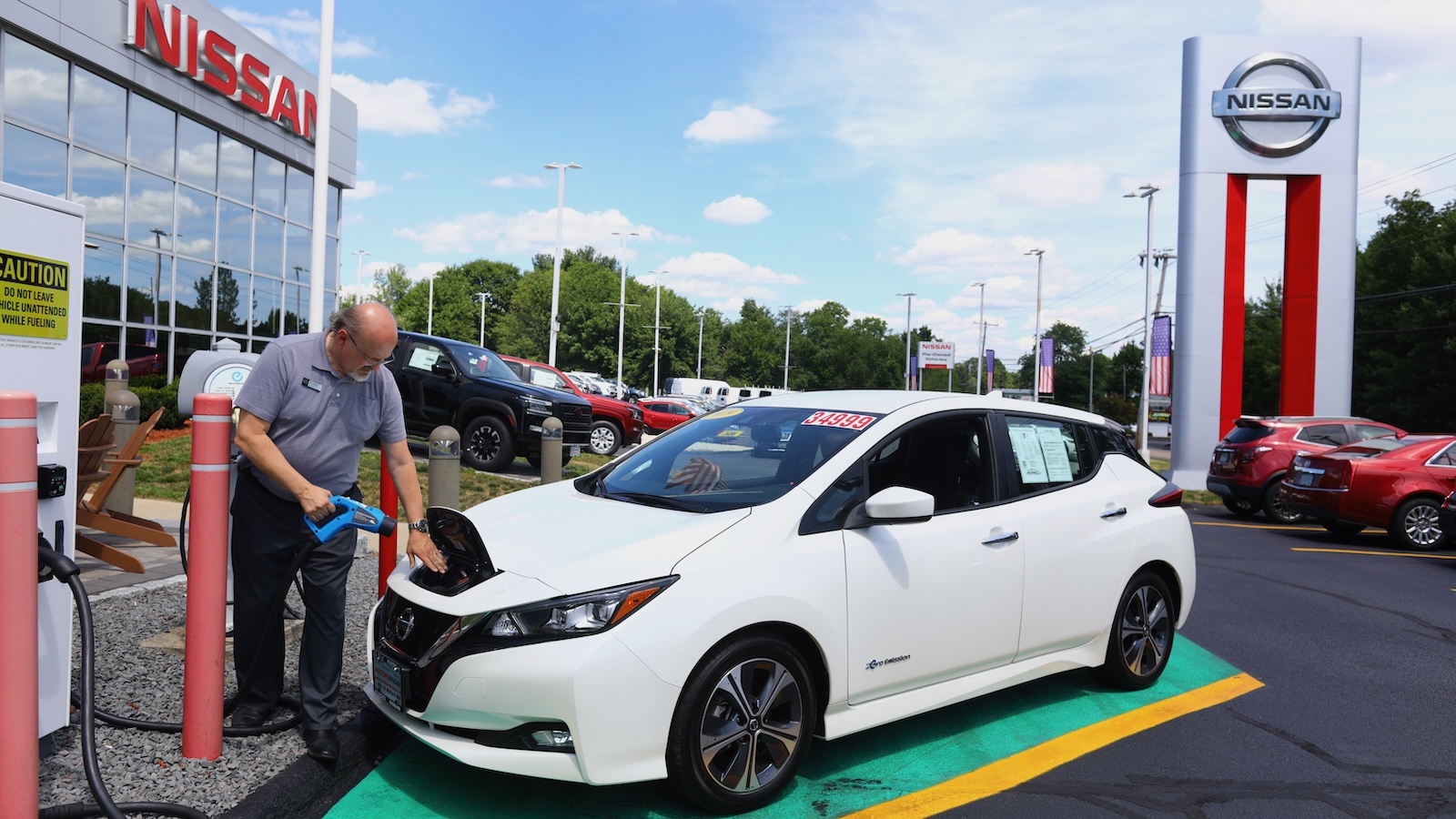
Even as gas prices continued to rise across the United States, sales of electric vehicles fell in April. That is in contrast to strong growth elsewhere in the world, such as Europe. But American drivers are gravitating toward at least one more efficient powertrain: hybrids.
Sales of new EVs fell roughly 18 percent from March to April, according to the latest data from Edmunds, an auto research firm. Another company, Cox Automotive, pegged the drop at closer to 6 percent. Either way, experts said it’s clear that high gas prices aren’t leading to a significant shift toward EVs.
“There was a lot of window shopping,” said Ivan Drury, director of insights at Edmunds, noting that searches for electrified vehicles on the company’s site were strong. “It did not translate to tire-kicking and purchases.”
Price remains the steepest barrier for most people, said Drury. While electric vehicles can be less expensive to operate over the long-term — especially when gas prices are high — the upfront costs remain significant. The average transaction price for an EV in April was $6,214 higher than for vehicles with internal combustion engines, Cox reported.
“It’s still a cost hurdle,” said Stephanie Brinley, a principal automotive analyst at S&P Global Mobility. “You don’t know how long it’s going to take to get that back.”
At Thursday’s average gas price of $4.56 per gallon, an EV buyer would have to drive more than 40,000 miles to make up the difference with a car that gets 30 mpg. Savings on maintenance, like oil changes, could accelerate that timeline, but factors such as higher insurance prices and having to install a home charger could make the payback period even longer. If fuel prices fall, the advantage of an EV also shrinks.
“It’s very difficult for people to wrap their head around, ‘Hey, if I spend this $55,000, I might over time save’,” said Drury. “It requires a bit more math than most people want to go through.”
The calculus is much simpler for hybrid vehicles, which utilize batteries that can improve fuel economy by 25 to 45 percent without needing to plug in. A Honda CR-V, for example, gets around 29 mpg while the hybrid version gets 37. More and more popular models are only available as hybrids, a strategy that Toyota has perhaps embraced most notably. Last year, it ditched the gas-only version of the Camry sedan. The 2026 RAV4 followed suit.
Overall, Edmunds data shows that sales of hybrids are up 20 percent year-over-year and nearly 50 percent since February, when the U.S.-Iran conflict began. Sales of gas-powered gas are up about 11 percent over those same two months.
“I think this is going to be a hybrid moment,” said Stephanie Valdez Streaty, director of industry insights at Cox Automotive. “There are a lot of options.”
Used EVs provided another somewhat bright spot, she said. The segment saw a 3 percent increase in sales from March to April and a price premium of only $1,096 over used internal combustion vehicles. Used EVs also sold faster than their used gas-powered counterparts. “They’re really selling efficiently,” said Valdez Streaty, who added that there should be a glut of EVs available throughout the year as leases end. “I don’t think the inventory will be an issue.”
With Iran maintaining its hold over the Strait of Hormuz and summer travel season looming, gas prices appear set to keep climbing — which would only make an EV more appealing. Other parts of the world have seen significant jumps in sales since the conflict began, with Europe experiencing a surge and China setting an export record in April, according to BloombergNEF.
In the United States, though, it seems that only people already in the market for EVs are making the leap. “Edge-case people,” as Brinley called them. Dramatic pump readings “might nudge them because they were already in that direction,” she said. “But what we’re unlikely to see is a shift in current [internal combustion car] owners just fundamentally making that change simply because of gas prices.”