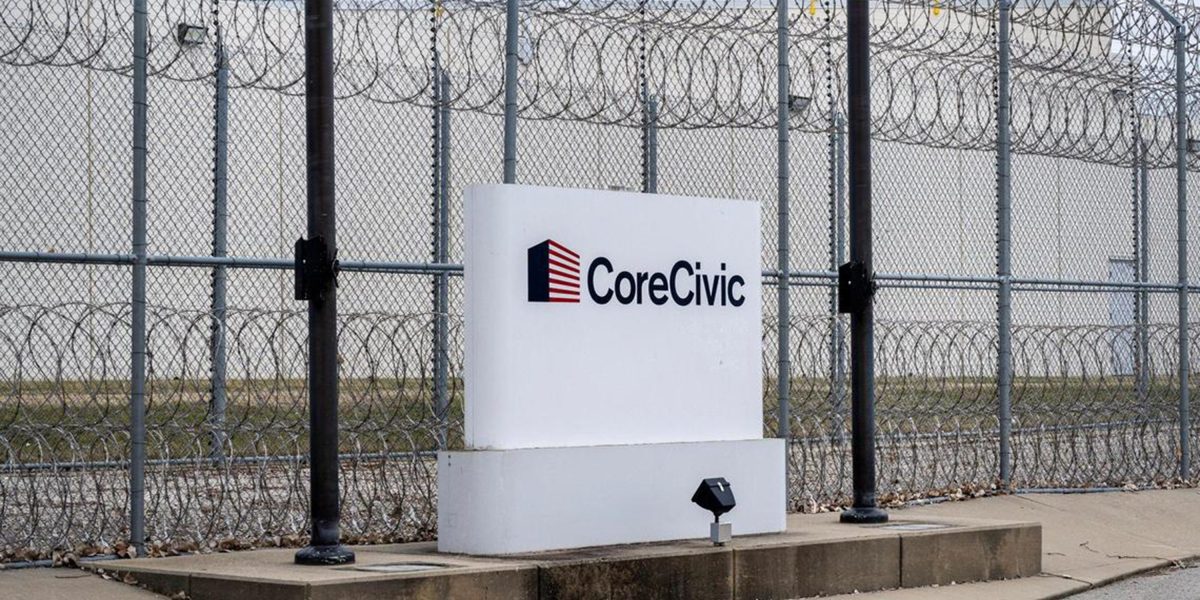
A judge Issued what appears to be the first-ever sanction against the private prison giant CoreCivic for destroying video evidence in a case alleging wrongful death of a man who died by suicide in U.S. Immigration and Customs Enforcement custody.
The sanction came shortly before a trial was slated to begin in January, but it never got underway. Instead, in March, the company reached an undisclosed settlement with the family of the detainee.
The judge ordered what is known as an adverse inference against the company in a December hearing. That means the jury could have presumed the missing evidence was unfavorable in an eventual trial and therefore effectively imposed a penalty against CoreCivic.
“CoreCivic is essentially used to getting away with it — to not getting called on it.”
The previously unreported sanction is the first known incident of a private prison corporation being held responsible in a wrongful death lawsuit for destroying video or other evidence related to immigration detainees dying in custody — despite there being cases of such behavior stretching back nearly a decade, experts said. (Neither CoreCivic nor ICE responded to requests for comment.)
Rebecca Sheff, senior staff attorney of ACLU New Mexico and part of plaintiffs’ legal team, told The Intercept that the judge’s sanction was an important response to prison companies’ propensity for overwriting video evidence. In court, destroying evidence is considered “spoliation,” the legal term for destroying, altering or failing to preserve evidence.
“It’s a practice we documented and unearthed: CoreCivic routinely lets video evidence be overwritten,” Sheff said, “even in this case, where they’ve been put on notice.”
“CoreCivic is essentially used to getting away with it — to not getting called on it,” Sheff added.
Immigration attorney Laboni Hoq, who was not involved in the CoreCivic case but has pursued similar sanctions in a wrongful death case involving the prison corporation GEO Group, said, “There has to be accountability when there are knowable consequences and prison corporations flout their responsibilities to preserve evidence.”
14 of 15 Cameras
The CoreCivic case revolved around the detention of Kesley Vial, a 23-year-old Brazilian asylum-seeker who died in a hospital on August 24, 2022, seven days after attempting suicide at the CoreCivic-owned Torrance County Detention Facility in Estancia, New Mexico.
Attorneys for Vial’s family sent CoreCivic a letter on the day he died, demanding preservation of all records relevant to his suicide attempt, including video footage taken in Vial’s cell, adjacent areas, rooms, and anywhere relevant to the incident. (Vial’s family declined to comment for this story.)
In the weeks that followed, a CoreCivic investigator produced a report featuring 49 stills taken from video footage, laying out a timeline supporting the company’s contention that it bore no responsibility for Vial’s death.
CoreCivic, however, never produced the actual video footage underlying 37 of the 49 photos, according to Sheff’s courtroom testimony. In fact, the company destroyed footage from 14 of 15 cameras in use that day, Sheff testified. The company claimed to have taped over the material.
“CoreCivic says that their staff had no way of knowing that Kesley Vial was on the verge of taking his own life on August 17th of 2022,” Sheff told Judge Francis J. Mathew during a December pre-trial hearing. “And when CoreCivic destroyed hours of video footage from that day, fully aware of the likelihood of litigation, they deprived the jury and all of us of the chance to see for ourselves.”
“More than three years later, we still have no convincing explanation for this destruction of evidence,” Sheff added.
The company pointed the judge to its 49-page timeline.
“More than three years later, we still have no convincing explanation for this destruction of evidence.”
“I know of no situation where opposing parties get to tell the opposed that what they have is the important information,” Mathew replied, according to an audio recording of the proceedings obtained by The Intercept.
The company’s attorney responded, “The jury will have all the evidence they need to determine whether or not CoreCivic fell below their duty.”
The judge said, “That’s a question I’m not sure we can answer without that video.”
In slightly less than an hour, Mathew made up his mind.
“I do believe that the spoliation of this evidence merits a sanction,” he said, “an adverse inference instruction to the jury.”
Within weeks of the judge’s decision, CoreCivic began settlement discussions with Vial’s family for an undisclosed amount. ACLU New Mexico announced the settlement March 19.
The judge’s order may have factored into the company’s decision to forgo a trial, which was set to start in January, said Eunice Cho, an immigration attorney with expertise in detention conditions.
“The fact defendants settled in the 11th hour made it clear they potentially didn’t want relevant facts to be tried – including the adverse inference,” Cho told The Intercept. “An adverse finding could lead the court to instruct the jury that the evidence contained unfavorable information and may damage the witness’s credibility.”
Hours Before the Suicide
In Vial’s case, the missing footage would have shown key events in the hours before he attempted to take his own life — “including him crying so hard that he was having trouble walking, punching the wall and collapsing to the floor,” according to a September plaintiff’s motion seeking sanctions against CoreCivic.
“There’s no substitute for seeing how he was behaving, how medical staff and officers were behaving, at Mental Health, in the hallway, in the cell – all these consequential, pivotal moments – and what could’ve been done to protect him,” Sheff told The Intercept.
Whereas Vial’s case came to a relatively quick end, lawsuits in which judges don’t intervene can become drawn out. Many families of loved ones who have died in immigration detention are stymied by the lack of video evidence and by the amount of time it can take to resolve a wrongful death lawsuit against an immigration detention corporation, said Jeremy Jong, immigration attorney for Al Otro Lado, a legal rights organization.
“They begin thinking, ‘We want justice,’” Jong said. “Years later, it’s more like, ‘We just want to give up.’”
Even when private prison firms are forced to pay out, the sums pale in comparison with the companies’ government contracts. Jong said the disparity creates “perverse incentives” to let poor detention conditions persist, with the settlements acting as “just part of their operating expenses.”
CoreCivic — which, alongside GEO Group, is one of the two largest prison corporations in the U.S. — received $2.2 billion in revenue last year, up from $2 billion the year before.
The issue will only become more important as the Trump administration pursues its mass deportation push, leading to more deaths in detention: 18 this year as of May 1, on track to reach a record high.
With the rising number of deaths, Hoq finds herself advising attorneys and families who contact her regarding wrongful death claims.
“The first piece of advice I give them is to send a letter to the corporation requesting them to immediately stop overwriting video,” she said. “The issue is more important than ever — to scrutinize whether ICE and prison corporations are following through on their obligation to preserve evidence.”