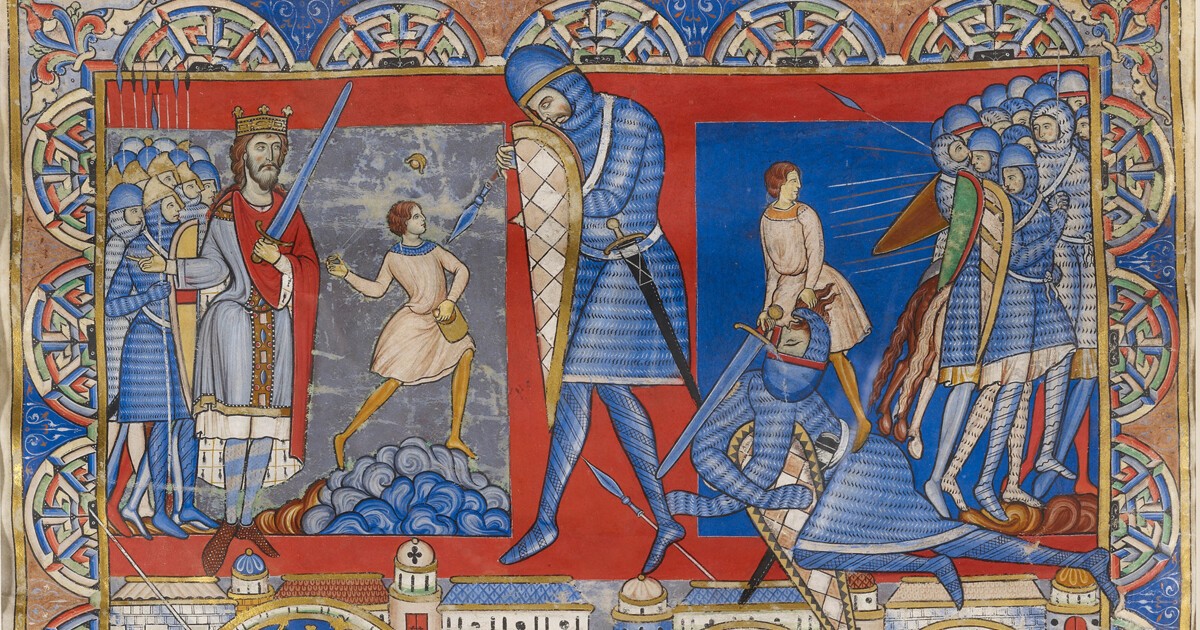

The Winchester Bible (c.1150-80).
‘Apsalm consoles the sad, restrains the joyful, tempers the angry, refreshes the poor and chides the rich man to know himself,’ wrote Niceta of Remesiana, a fourth-century bishop from what is now Serbia. His far better-known contemporary Augustine of Hippo praised the psalms in more flamboyant terms:
How loudly I cried out to you, my God, as I read the psalms of David, songs full of faith, outbursts of devotion with no room in them for the breath of pride! … How loudly I began to cry out to you in those psalms, how I was inflamed by them with love for you and fired to recite them to the whole world, were I able, as a remedy against human pride!
These comments show how important the Book of Psalms was to early Christian thinking. Sing a New Song is the catalogue of an exhibition held at the Morgan Library in New York last year which demonstrated that influence. The show, masterminded by Roger S. Wieck, the library’s head of medieval and Renaissance manuscripts until his death earlier this year, gathered together a dazzling array of psalters dating from the fourth century BCE to the 16th century. The earliest fragment, from Egypt, contains three hymns in Aramaic, one of which, a version of Psalm 20, is the oldest surviving version of any psalm. Among the more recent exhibits was Thomas More’s psalter, printed in Paris in 1522, with prayers written in the margins in Latin and English while he was in the Tower of London awaiting execution.
The Book of Psalms provided an impetus for the discussion of theological and philosophical questions. Augustine’s commentary, Enarrationes in psalmos, dwarfs even The City of God, taking up two volumes in the Patrologia Latina, a collection of the works of the Church Fathers published in the 19th century. An astonishing four hundred manuscript versions of Augustine’s commentary survive. To fit these commentaries, and later exegesis, notably by the 12th-century bishop of Paris Peter Lombard, onto the page in such a way that they could be studied alongside the psalms or other books of the Bible was a steep design challenge. The Morgan collection includes a vast four-volume glossa ordinaria – standard gloss – complete with chains and leather place-holders. A single volume could include as many as five or six separate commentaries, with multiple columns and Russian doll-like layers around and between the lines of the Bible text in the centre of the page. Sing a New Song is illustrated with indulgent lavishness. Close attention is paid to the material conditions of every artefact: size and weight; use of ink, paint, gilding; portability; the tactile qualities of parchment, papyrus, leather, wood and metal. We are being introduced first and foremost to the tangible matter of books.
The psalms seem deeply familiar, but the not particularly Christian anglophone might struggle actually to provide much detail about them. The Book of Psalms was first written in Hebrew, but like other parts of the modern Bible it came together in its current form over a long period, in this case over five hundred years, roughly from the tenth to the fourth or fifth century BCE, and consists of hymns composed by many different poets, with King David traditionally having 73 psalms attributed to him. The current tally of 150 psalms was derived in stages and, as Joshua O’Driscoll points out, through complex processes of translation wherever Jewish communities found themselves – Egypt, Babylon, Syria and Greece. This linguistic transferability is key to the psalms’ extraordinary durability. One of the finest illustrated French psalters, known as the Crusader Bible (c.1244-54), has inscriptions in Latin, Persian and Judeo-Persian dating from the 14th to the 18th century, which shows that readers’ engagement continued into the early modern period. It is also a reminder that the psalms are only belatedly Latin, European or English.
Jerome opened the floodgates for the psalms in Europe in the late fourth century with his Latin translations. Augustine didn’t know Hebrew, but Jerome taught himself and produced three separate translations, the third directly from Hebrew. The Psalter in the Vulgate, his Latin translation of the Bible, was derived from his so-called Gallican translation, from the Greek Septuagint, and made him a star. His portrait (usually with a lion at his feet) was almost as common as that of David in medieval biblical manuscripts.

The Windmill Psalter (c.1280-1300).
The life of David, which is mostly recounted in the Book of Samuel, though some of the psalms illustrate particular episodes in his life, provides irresistible subjects for illustration. King of Israel in the ninth or tenth century BCE, David was a poet, composer, singer and prophet. He was also a child giant-slayer; the grieving father of the beautiful long-haired Absalom; the enemy of Saul, the king he was prophesied to replace; the devoted friend of Jonathan; and the adulterous and murderous lover of the alluring Bathsheba. Medieval artists, urged on by hugely wealthy and sometimes spendthrift patrons, created remarkable vignettes of these scenes.
The exhibition showed leaves from the Crusader Bible, the Eadwine Psalter, the Tiptoft Missal and the Blickling Psalter, as well as the Lewis Psalter (from Philadelphia) and the Hebrew Sifrei Emet (Books of Truth) from Yale’s Beinecke Library, which also holds Thomas More’s psalter. Many of the Morgan’s acquisitions were single leaves – the banker J.P. Morgan, whose collection forms the basis of the library, tried to buy whole books where possible, but the fashion for dismembering illuminated manuscripts was rampant around the turn of the 20th century and hard to circumvent. Otto Ege, for example, a bookseller and lecturer, cut out pages from around fifty manuscripts to sell in newly compiled portfolios to customers all over the world. In 1911 Morgan bought two leaves belonging to the Eadwine Psalter, most of which (I had assumed all of it) is in the Wren Library at Trinity College, Cambridge, from the bookdealer Giuseppe Martini. These leaves were seen in this period chiefly as pieces of art to be bought on the market rather than as objects with religious significance.
The amount of gold on the leaves is astonishing. Used to indicate divine honour and majesty, worship and purity, gold leaf was applied with microscopic attention by medieval illuminators, from delicate single initials to the heavy gold ground of the 13th-century psalter crafted by William de Brailes, who lived in Oxford. The glistening reflection of the six leaves shown at the Morgan lit up the gallery. All through the show, and in the catalogue, earthly wealth, from the earliest to the most recent patrons, makes itself felt, along with a mixture of obsessive devotion and a desire for magnificent display.
The cover of Sing a New Song shows an illuminated letter ‘C’ from the Windmill Psalter (another 13th-century English production, perhaps made in London) with a fastidiously comic portrayal of four singing monks in front of a lectern. With typical medieval quirkiness, the lectern has a stand in the shape of a large blue-grey fish, its open mouth around the base of the stand that supports the padded cushion. The cantor (the choir director, who was often also the librarian) in his dark blue robes holds the music book on the lectern authoritatively, his mouth open in song. Three monks are lined up behind him: the first gazes upwards and is being pushed from behind by the second, also in mid-song, his hand grasping his fellow monk’s waist. At the back is a monk whose vivid red robe is not concealed by a brown cowl, as the others’ are. He is holding another book across his waist and grimacing, his hand pointing upwards in what looks like a gesture of frustration, or perhaps excitement. The three seem to be jostling for space, while the cantor is oblivious to the commotion behind him.

The Crusader Bible (c.1244-54).
Interpreting the facial expressions of medieval figures is always risky, but I disagree in one small respect with Frederica Law-Turner, who in her piece in the catalogue describes the monk at the back as having ‘his eyes closed but his mouth open in song’. His eyes are not closed; he is looking angrily ahead. It’s possible that he is merely singing with gusto, and gesticulating as singers do when they reach a high note or a moment of intensity. He is treading with one foot on his brother’s flowing robe; his other foot is in the air, projecting beyond the frame of the ‘C’. The artist has clearly taken pleasure in conveying these tiny details. Medieval customaries, which give guidelines for monastic conduct, cautioned against bad or lazy behaviour:
No one ought to make needless signs in the Quire, or needless conversation, or cut his nails, or write, or smile, or whittle, or throw one foot across the other, or stretch out his legs, or support himself on his elbows in his stall, or even sit with his legs wide apart … Those who come late to the Hours shall place themselves in the last stalls; if they come after the second psalm they shall not enter the Quire.
The monks of the Windmill Psalter might seem to fall foul of such rules of conduct.
Illuminators didn’t only show facial expressions in humans: in the Crusader Bible the sheep are listening intently to David playing his flute and bell; even the doghead finial of his discarded harp gazes up at him with rapt attention. David himself is often vividly rendered: a leaf from the 12th-century Winchester Bible with six compartments shows him in the bottom right section with his face buried in his cloak. He is leaning away from a group of men, one of whom points to the vignette on the left, which shows the fleeing Absalom: he is being dragged off his horse’s pummel by his trapped hair and has been stabbed in the back by a thin, elegant spear. The characteristic elongated and slender feet of the figures create a swaying visual pattern across the whole page that forms its own affective expression, implicitly leading the eye to David’s anguished posture.
The illuminators of the Crusader Bible have fun with the killing of Goliath and the rivalry between Saul and David. This time there are four sections: on the top left a massive Goliath, whose helmeted head, scabbard and right foot extend beyond the frame, towers over a boy half his size, whose right foot is out of frame as he runs in with his crook and sling; the panel to the right shows a pile of horse flesh, a felled giant body and a boy scrambling over it to cut off the head. The scabbard is now dangling well below the frame, while David struggles to wield the huge sword that was in it. Below, David, on the left, presents the severed head to an enthroned Saul and in the final scene, on the lower right, receives a cloak being taken off by a friendly Jonathan. He looks like a boy changing after a session in the gym.

Thomas More’s psalter (1522).
The same illuminator also depicts David after he has lost his childish, shepherd-boy roughness. In full aristocratic pose on horseback he looks back composedly at Saul, who is squatting in a cave, his robe pulled up to reveal his bare backside – complete with stylised scrolls of pubic hair – while he defecates. David has ordered his men, who unseen by Saul crowd into the cave, to spare Saul, but cuts off a piece of his cloak as a trophy. 1 Samuel 24:6 explains that David spares Saul to make the point that he will not stoop so low as to kill the Lord’s anointed. Once again, the eyes tell the story: David and his men are calm and impassive and Saul has the far-off meditative look of someone engrossed in bodily relief, but their horses snigger.
Deirdre Jackson, in her introductory chapter, notes that there are very few analogues for Saul’s posture in medieval art, but she could have mentioned the wintry February scene in the Château de Chantilly’s Les Très Riches Heures du duc de Berry, which shows a peasant family warming themselves in front of the fire without their underwear, which is hanging up to dry. Not only do the Limbourg brothers break the fourth wall in their portrayal of a domestic interior, but they appear to relish providing what a magnificent Chantilly catalogue calls the ‘détail réaliste et facétieux’ of the couple’s ‘impudique’ display of their genitals. Rather than using this image to affirm the common modern perception of the medieval as earthy and vulgar, we might note that it displays a precisely expressed tension between the exquisite and the bodily.

The Eadwine Psalter (c.1155-60).
Jackson writes that ‘the singing of psalms, preserved in Gregorian chants, is the soundtrack of medieval Europe.’ Wieck’s chapter in the catalogue gives a concise account of the role the psalms play at each stage of the Mass, and of the character and function of the separate books – breviary, antiphonary, missal and gradual – that contained the music and texts for those who performed the Divine Office. The contents of all of them were tailored to the particular owner or institution. A breviary would include most of the following: a calendar, psalter, temporale (order of major feast days), sanctorale (order of feasts for saints), commune sanctorum (list of saints without special feasts) and other materials for daily devotions, a Book of Hours, the Hours of the Virgin and the Office of the Dead. It was a portable set of tools for performing the whole set of daily worship rituals throughout the Church year. It sounds dry, but – once more – the illustrations to these breviaries were magnificent. Pope Leo X (whose grants of indulgences infuriated Martin Luther) ordered thirty portraits of himself to be scattered through his own sumptuous volume of the instructions for preparing to hold Mass, Praeparatio ad missam.
Groups of psalms were sung in the eight daily services, with the entire psalter being sung every week. The dominance of music in the practice of medieval Christianity can hardly be comprehended now. The image of David as a musician was taken in the medieval church as a command. The sheer amount of music that was composed for all of the many services was immense, and new music was regularly and lavishly introduced for major feast days, especially Christmas and Easter. Monks, nuns and clergy had a stream of music to learn and sing, in proliferating genres: hymns, sequences, antiphons, responsories and sung prayers based on devotional texts. Ecclesial life was so rich with sound in part because singing was intrinsic to learning to read: young children in monasteries, nunneries and cathedral schools were taught literacy through memorising the psalms, trained to utter complex thoughts and feelings through song.
The initial ‘C’ illustrated in the Windmill Psalter marks the beginning of Psalm 97, ‘Cantate domino canticum novum’ (‘O sing unto the Lord a new song’), from which this book takes its title. The line also occurs in five other psalms and in Isaiah 42. Filling the initial with singing monks was a fitting emblem for the magnificent task of humbly praising God, in the smallest local church as well as in the mighty institutions of the Christian West.