In 1971 Agnès Varda directed an advertisement for Tupperware called ‘Who’s that woman?’ The woman in question has a pixie cut and wears a safari suit; she skips along the pavement, shepherds her children into a Renault and slings an enormous naval bag over her shoulder. There are classic Varda flourishes – sumptuous colour, exuberant cuts synced to the music – and the whole sequence is sung as a jazzy little operetta: ‘Who’s that woman who leaves the dull housework behind? … Who works when she wants and never neglects her little dumplings?’ She turns out to be a Tupperware sales rep hosting a party for local housewives (the naval bag was full of samples). The advert is about what a woman gains from having a job and her own money. But there’s also a subtext, an eyebrow arched at the liberated housewife faced with new antagonisms: work versus kids versus husband versus other women. Beneath the whimsy and the wit, Varda’s films were motivated by contradiction and critique. She said she was always looking for ‘the cliché and what’s inside the cliché’.
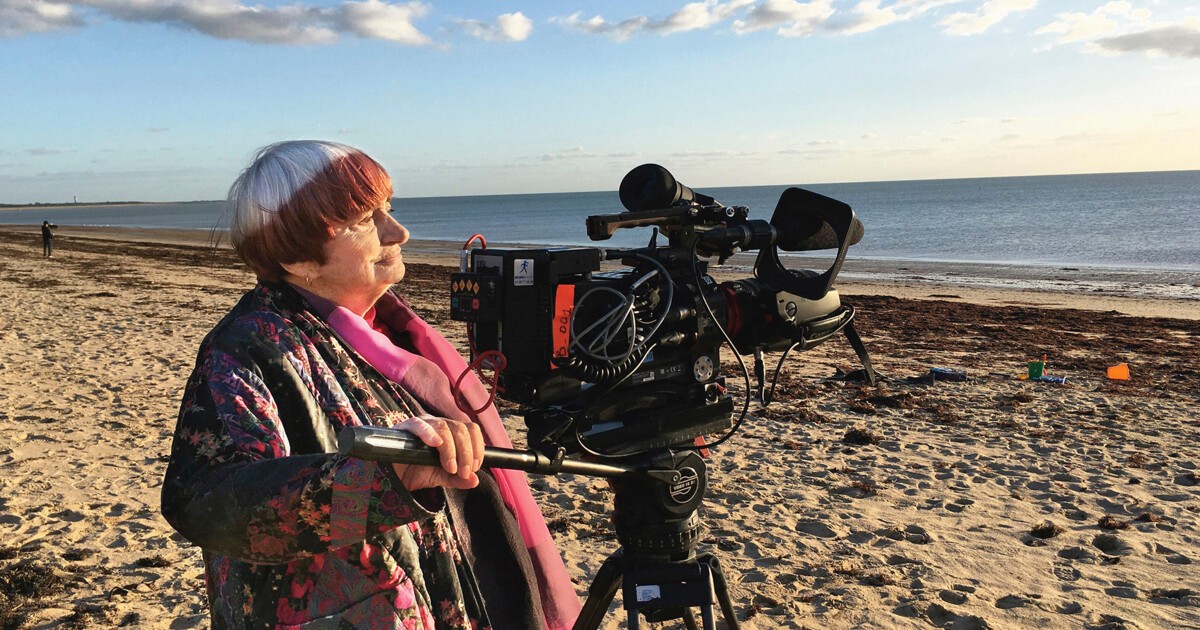
By the time she died in 2019, at the age of ninety, Varda had herself become a cliché, though this was something she cultivated. For years she wore an idiosyncratic costume: purple or polka dots, her white hair shorn into a burgundy dip-dyed bowl cut, ‘like an ice cream of chocolate and vanilla’. In interviews, she was asked again and again what it felt like to be known as ‘the grandmother of the New Wave’ – a role she accepted with amused resignation. In photographs, she was puckish and genial: Varda posing with her cat, Varda dressed as a potato, Varda doing jazz hands on the red carpet. In A Complicated Passion, Carrie Rickey coins the term ‘Vardolatry’ to describe the almost worshipful regard for her talent. Though recognition arrived belatedly, Varda was that rare thing: an unforgotten feminist filmmaker.
There have been several recent exhibitions and art books about Varda’s work as well as a complete retrospective at New York’s Film Forum. Rickey’s biography, the first to appear in English is a starry-eyed account of Varda’s extremely long career as a photographer, filmmaker and installation artist. She brings together sales figures, archival interviews, scholarship and anecdotes, but anything dark or disturbing is glossed over. We learn that Varda’s father, a habitual gambler, left his five children to make paper flowers on the beach while he played roulette – an activity that, Rickey suggests, may have sparked Varda’s preference for ‘the artisanal over the mass-produced’. Varda was an obsessive self-archivist (with a particular love of postcards), yet Rickey does not seem to have had access to any personal correspondence, diaries or scrapbooks. She draws much of her material from Varda’s memoir, Varda par Agnès (1994), which was later adapted into a film-essay. The memoir comprises printed matter and press clippings, family photographs and a brief autobiographical A to Z. The Varda who emerges is obstinate and evasive.
It may be that Varda’s real self was never on offer. She didn’t like to look back and claimed that her childhood was not an inspiration, that she never reread love letters and that writing autobiography was like trying to play a table top on which piano keys had been drawn. The closest we have to anything confessional is in her films, of which she made more than forty over 64 years.
Varda launched her revolt against femininity early. When she was ten, her mother took her to see Snow White and the Seven Dwarfs at the Métropole cinema in Brussels. Varda hated it: ‘Why does she take care of these little ones all the time?’ When the family fled Belgium for Sète in the South of France following the Nazi invasion, she learned to sail and started smoking. Her French mother was fretful and nervous; her father (who was Greek but pretended not to be) was conservative and ‘tyrannical’. Chafing at the girlishness of her name, Arlette, at eighteen, she changed it to Agnès.
In her studies, Varda couldn’t settle on a subject and was driven to master everything she tried: painting, art history, photography, philosophy, literature. She described never feeling ‘intellectual enough for the intellectuals’, but there was also a burning sense of ambition and the need for self-reliance. At some point she stopped seeing most of her family (and remained estranged from her siblings for much of her life). She read voraciously: Baudelaire, Joyce, the Surrealists, Virginia Woolf, all of Colette.
Valentine ‘Linou’ Schlegel introduced Varda to another way of life. The two met as girls in Sète, and later became lovers, though their relationship has been obscured by the usual euphemisms – an ‘almost-sister’, a ‘close friend’. Schlegel was a trained sculptor who wore a military jacket and drank pastis with mint syrup. It was Schlegel who taught Varda to really look at the material world, ‘from a piece of fruit cut open to the abstract paintings of Nicolas de Staël’. They lived and worked together for several years in Varda’s mews house on the rue Daguerre in Montparnasse, which was divided into two studios. In one, Schlegel made bulbous ceramic vases that looked like a woman’s slightly parted legs. In the other, Varda built a photography studio and lab. In her self-portraits from this time, she looks severe and androgynous, dressed in men’s tweed jackets, plaid shirts and black leather loafers.
Varda’s first jobs involved photographing trains for a railway company and taking pictures of children with Father Christmas at Galeries Lafayette. She was a talented portraitist and soon started shooting actors and artists for magazines: Alexander Calder on a child’s scooter; Delphine Seyrig leaning against two posters of herself; Salvador Dalí mid-fall in a leopard-print coat. Even then the formalism and parasitism of her approach was obvious; other people were objects with which she could produce works of drama and feeling.
What prompted Varda to make a film at 25 is something of a mystery. She was not a cinephile and claimed to have seen somewhere between five and twenty films when she made La Pointe Courte. Not knowing the terms of cinematic framing, she invented her own: close-ups were ‘face shots’ and shots of a character facing the camera, sphinx-like, were ‘Egyptian shots’. Photography was all a bit ‘sois belle et tais-toi’, and she ‘wanted words’, so when her father dropped dead in a Belgian casino in 1952, she funnelled her inheritance into the project. It was shot on the Étang du Thau, a lagoon in the fishing area of Sète that she had photographed many times. There was no money for synchronous sound-recording equipment or a cast of professional actors. The script drew on anecdotes told by the fishermen and their families, lifted from their own vernacular. This was where she found a brilliant line about reaching middle age: ‘We’ve already shitted out half our crap.’
The film’s structure was based on a William Faulkner novel she had read incorrectly. The Wild Palms interweaves two separate narratives, so Varda followed the even-numbered chapters, then went back and read the odd ones, before realising that the point was to invite allusion and association between them. La Pointe Courte overlaps images of the place – its privations and regional politics – with a story about a young Parisian couple in the throes of a crisis. One of the ongoing disputes in the film is that the woman says she loves to look, while the man claims there is nothing around them worth looking at. Varda was drawn to the geometry of fishing culture: the circles (water butts, wicker baskets) and the lines (stacked timber, netting, railway tracks). She shot the couple in deeply stylised profile poses inspired by Italian Renaissance paintings. Varda knew the result was ‘jerky’ and ‘difficult to watch’. It is now common to point out that the film’s realism and immediacy pre-empted the Nouvelle Vague, but without quite knowing it, Varda had also instinctively arrived at what André Bazin described as cinema’s aesthetics of ‘impurity’ – film as the bastard child of literature, painting, theatre, photography.
Varda coaxed Alain Resnais into editing the rushes, and she founded her own co-operative production company, CinéTamaris, to release the film. While Varda was still living with Schlegel, she and Resnais became lovers (though neither ever spoke about it publicly). He introduced her to Chinese food and the Cinémathèque Française; she lent him a Rolleiflex camera. It was at Resnais’s apartment, through a fog of cigarette smoke, that Varda first met the Cahiers du cinéma boys: Claude Chabrol, Jean-Claude Brialy, François Truffaut, Jean-Luc Godard and Éric Rohmer. They spoke in a dense web of cinematic references that made Varda feel like ‘an anomaly’.
Without proper distribution, La Pointe Courte could only be screened privately but there were a handful of favourable reviews and a profile of Varda in the French Communist Party journal, Lettres françaises (‘She looks like a little blackened chimney sweep – shy yet aggressive’). Marguerite Duras, Nathalie Sarraute and Chris Marker went to screenings. Truffaut claimed not to have understood it. Later, when he asked her to write for Cahiers, she politely refused: a minute writing for him would be a minute not making films. She and Resnais were among those who joined the Groupe des Trente in 1953, a collective whose aim was to promote short films (of under thirty minutes) as a distinct art form worthy of state funding from the Centre national du cinéma. In the group’s manifesto they argued that just as the novel needed poetry, cinema needed shorts as a kind of ‘greenhouse’ or ‘life blood’.
Varda was pregnant when she set to work on L’Opéra-Mouffe in 1958. (The father was Antoine Bourseiller, an actor with whom she had fallen suddenly and completely in love.) The short followed a series of commercial commissions that had earned her a bit of a reputation, but which made her feel stifled. Every day over the winter, she carried a 16 mm camera to the rue Mouffetard, known for its poverty and pungent smell. From a folding chair, she trained her camera on the people below, their bodies and faces in various states of anguish and defeat. She had no truck with cinéma vérité, speaking instead of ‘ciné souvenir’, ‘the fact of having filmed living people in a living frame’.
Varda made the edit herself, combining peopled scenes with dreamlike Duchampian sequences of pregnant bodies and young lovers in rapture. Some of the film’s more desolate images suggest that the pregnancy disturbed Varda: an enormous expectant belly cuts to a large pumpkin split down the middle with a knife; a pigeon is trapped in a glass orb; a pregnant woman gorges on the petals of a flower. By the time her daughter, Rosalie, was born, she had left Bourseiller and decided to raise the child alone.
Cléo de 5 à 7 (1962) was not the feature Varda wanted to make next, though it became her masterpiece. She dreamed of shooting a colour feature in Venice with Monica Vitti, but her producer Georges de Beauregard (still high off the success of Godard’s shoestring À bout de souffle) wouldn’t give her more than 32 million francs. Rather than surrender, Varda made whiteness a leitmotif, ‘a sign of [Cléo’s] dissolution into nothingness, a pale death, a white death, like in a hospital’. Cléo (Corinne Marchand) is a radiant pop star with a swirl of peroxide hair, who wanders Paris in near real-time while she waits for the results of a test for stomach cancer. In the Parc Montsouris she meets a soldier on leave from the war in Algeria and history suddenly seeps in. Varda filmed the scenes there at sunrise so the grass would blaze like snow.
Once, when asked whether she identified with Cléo, Varda replied: ‘I am neither tall, nor blonde, nor cancerous.’ But the severity of the themes suggests an intimacy with Cléo’s anxious interiority. In an interview in 1975, Varda fed the feminist film scholars their argument: the whole film centres on the moment Cléo switches from being ‘the looked-at subject’ to become ‘the looking subject’. Cléo sees Paris as the teenage Varda did, its ‘menace’ and threat. A street performer piercing his arm with a dagger. A bullet shattering a brasserie window. A thicket of strangers staring at her.
Shortly after finishing filming, Varda went to Cuba. She had been invited by the Cuban Institute of Cinematographic Art and Industry, which was established after the revolution. Sartre, Beauvoir and Marker had already visited – Marker’s ¡Cuba Sí! (1961) had already been banned in France as a dangerous ‘apologia’. Varda met Fidel Castro in a little restaurant by the sea, where she asked him to sit in front of a rock that made it look like he had the wings of an angel. She was assisted by Sara Gómez, a trained ethnographer destined to become the first Cuban woman director. Working from a banc-titre – an animation stand with a mounted camera that held the lens perfectly still – Varda took more than four thousand photographs.
She spliced fifteen hundred of them together into Salut les Cubains (1963), timing the transitions to music so that the images danced. Varda then set the whole thing against her own voiceover – her first attempt – which is intimate and conversational. Drawn to the revolution of everyday life, she was transfixed by chicken co-operatives, female security guards, a black girl carrying a white doll and the armies of volunteer teachers (alfabetizadores) dispatched to teach rural communities to read. (Less comfortable is the sequence about Cuban women’s ‘melodic’ bodies, which are compared to the letter ‘S’.)
There is little of the ideologue in Varda despite her choice of subject matter. Elsa la rose (1965) is an experimental filmic portrait of her close friends Louis Aragon and his wife, the novelist Elsa Triolet. Varda has Michel Piccoli recite Aragon’s indulgent love poems to Triolet over a re-enactment of their first meeting at the Café Coupole in 1928. The scene keeps repeating, jump-cut and looped as the poetry reading accelerates to the point of absurdity. Varda interviews Triolet who quietly dismantles the romantic carapace Aragon has built around her: ‘Aragon always says he’s the shadow at your feet.’ ‘He’s wrong.’ Embedded in Varda’s strike against the silent feminine muse is another suggestion: that we can never really know what keeps a couple together.
Varda was superstitious. She believed in numerology, tarot and fortune-telling. She met Jacques Demy at the Festival de Tours in late 1958, where he was presenting his short Le Bel Indifférent (1957). Their fathers shared the same birthday, as did their mothers – surely a sign. Demy had grown up in Nantes, the son of a garage mechanic and a hairdresser, and had educated himself out of this background via film school.
Varda once described her relationship with Demy as ‘loving and arguing’. They were ambivalent about marriage, but went through with it anyway in 1962 in a tiny ceremony with Marker as witness. Varda kept her surname. Clearly there were imbalances, jealousies, resentments. How could there not be? Their careers sometimes moved in opposite rhythms; when one soared, the other would flail. Varda wrote constantly, at all hours, jumping between projects and barging out of meetings with funders. ‘Brusque’ was the word she used to describe herself; others said she was ‘authoritarian’. Demy couldn’t always bear her sharpness. During post-production for his musical Les Parapluies de Cherbourg (1964), he asked Varda for her opinion on the mixing. She felt the soundtrack was unbalanced, more like a concert than a film. For Demy this was confirmation that she had never liked his work: ‘C’est un cas de divorce.’ A few days later, he remixed the whole thing.
The drama of marriage courses through Varda’s work. Le Bonheur (1965) is a lustrous, disturbing film about a young couple with two children and a comfortable house. They picnic in fields of flaxen grass and have sex on crisp white sheets. Then the husband takes a mistress and tells his loving wife that he feels even happier, like finding a tree outside an orchard: ‘More apples! More flowers!’ She goes along with it, since her whole life is about pleasing him. But when she then drowns in a lake, it’s unclear whether it’s an accident or suicide. By the film’s end, it is autumn, the sunflowers are going to seed and the mistress has replaced the wife.
Critics were puzzled by the film’s sexual politics, but conceded that Varda had made something beautiful. A large CNC advance meant that she could finally shoot in colour. The film has the blurred softness of an Impressionist painting and the garish palette of a fruit salad. (She found it amusing that her cinematographer was called Claude Beausoleil.) But Le Bonheur’s beauty was also a kind of cover: there is a mania and sickliness to the scenes of domestic life, which she set to Mozart’s Clarinet Quintet K.581. She shot the wife and the mistress in the same light, tracking their similar gestures in two long takes of five or six minutes each; the point was to make them interchangeable.
In 1966 Varda and Demy moved to California, where they drove around in matching white convertibles. As emissaries of French auteurism, they assumed a certain star status, surrounded by a loose circle of expat filmmakers, actors and hangers-on: Bernardo Bertolucci, Ingrid Bergman, Simone Signoret, Jack Lemmon, Jim Morrison, Sharon Tate, Harrison Ford and Gregory Peck (‘boring as rain’). Demy had long wanted to make a Hollywood movie and Columbia Pictures fronted the money for Model Shop (1969), a desolate portrait of a directionless Angelino facing the Vietnam draft. It had a New Wave slackness superimposed onto the lonely sprawl of LA and was a commercial disaster. Demy called it his ‘model flop’.
Varda loved the kitsch and falsity of Hollywood: the crudité parties, the kidney-shaped swimming pools, ‘the palm trees, the heat … the wallpaper that looked like bricks’. In Sausalito, north of San Francisco, she discovered a long-lost cousin, Jean Varda, known as ‘Yanco’. He lived in a houseboat, which he moored among a floating enclave of hippies. He was the father she ‘had always dreamed of’, drawn, like her, to bricolage and bohemia. Within three days she had finished a short film, Uncle Yanco (1967). The colours are incandescent, drunk on California light, but beneath the portrait is something less joyful, the shadow of paternal abandonment.
Nausicaa (1970) is Varda’s remembrance of her father. It’s an unfinished and unreleased account of the Greek military coup in 1967. Within a fictional narrative about an art history student called Agnès, Varda gathered testimonies of exiled Greek immigrants who speak about their lives in France and their longing for home. In the voiceover, there’s a suggestion of Varda’s feelings about her own rootlessness: ‘I tried to be Greek by being tragic and young by being shocking. I didn’t know how to become a woman.’
Though Varda missed May 1968, she was drawn towards another eruption. Black Panthers (1968) is a short documentary shot at an Oakland rally for Huey P. Newton, who had just been imprisoned on a manslaughter charge for killing a policeman. She gives the Panthers the frame, running their speeches uninterrupted: ‘The United States has declared war on black people. She did that when she took the first black man from Africa.’ The camera pans and dollies in pursuit of significant details that could ‘light the scene’: a pin on a lapel, an infant asleep against a shoulder, a blue Panther flag in the wind. For Varda, the ‘talent of the documentarist’ was ‘to be forgotten’ – a noble ambition, but one she regularly ignored. In Black Panthers, her voiceover betrays a cool, steely contempt for the police, the ‘embodiment of the aggressor, the coloniser and the racist, commonly called “pigs”’.
In television appearances, Varda was at her most mordant and confrontational. In one, from 1966, she cut in to correct the interviewer when he gets her filmography wrong; when he suggests she has an aggressive character, she attributes it to her wide eyebrows. While promoting her next feature, Lions’ Love, a languid, sunlit bit of metafiction about Hollywood in the late 1960s, she appeared on the show Camera Three alongside Susan Sontag, who was there to discuss her new film, Duet for Cannibals (1969). The presenter strains to impose a line of questioning that both women deflect with frowns and smirks. No, Varda’s characters are not ‘grotesque’; many people live complex romantic lives. No, Sontag’s film is not ‘strange’ or about politicians, but about vice and desire. With each other they are warm and admiring: Varda calls Sontag ‘Suzanne’; Sontag helps Varda with her English pronunciation. About the present – the student movement, the assassinations, Vietnam – Varda is blunt: ‘There’s a smell of disaster.’ Sontag agrees.
On returning to France in 1969, both Varda and Demy struggled to find funding. (This was the time of the Tupperware ad.) Varda was writing constantly but was no longer the ‘darling of state-funded films’. In America, she’d read Kate Millett, Shulamith Firestone, Germaine Greer. A more ardent feminism crossed into many of her unrealised projects from this time. She wrote a screenplay for a television short, ‘La Célébration de l’oeuf’ (1971), about the reality and mythology of eggs, that was judged ‘too provocative’ for the public. Then there was a shelved anthology film, Plaisir d’amour (1975), for which she sketched a segment about the sexual fantasies of women told through the story of a couple whose foreplay is interrupted by one of their children.
Varda wouldn’t have called herself ‘committed’. She ‘went to demonstrations when they needed bodies’ and she ‘shouted at Bobigny’ in support of four women on trial for arranging an illegal abortion. For a period, she allowed her studio to be used for backstreet abortions but found the whole thing too distressing and logistically complex. In 1976, she made L’Une chante, l’autre pas, a feminist folk musical about two women who join the movement to legalise abortion. Varda wrote the screenplay while pregnant with her second child, Mathieu, and the film is at its most unguarded on the topic of maternity: ‘Birth is so violent and savage. It feels like the baby’s you.’ The songs, however, were less successful, their arguments too visible:
Friedrich Engels l’avait dit
Dans la famille aujourd’hui
L’homme est le bourgeois
Et la femme (est) le prolétariat.
The critical reception was mixed. Some feminists felt the film was cloying and simplistic. Varda admitted it was not a ‘milestone’ in her career but she also felt bruised: ‘Why come to me and say, “What about women’s unemployment? What about lesbians? What about women not looking good? What about old age?” A film is not a basket to put everything into.’ She said her biggest struggle, when directing, was not her sex but that she was ‘thirty centimetres shorter than anyone else’. She didn’t like women’s film festivals because ‘women can be as wrong as men about women, and some men can be better.’ And, much later, she said she didn’t like #BalanceTonPorc, France’s version of #MeToo, because she hated ‘balance’.
Varda nevertheless found that maternity affected her work. She called Daguerréotypes (1975) her ‘stay-at-home-mom film’. The constraints of taking care of Mathieu were so claustrophobic that she invented a new one: she would film the shopkeepers and residents of rue Daguerre, but only those within an eighty-metre reach of her own house (the length of the camera’s power cable). The result is a social portrait of ‘a certain way of life in a certain year in a certain cluster of houses’. There’s the clockmaker who dreams of clocks that are difficult to mend. The butcher who pares fat with the deftness of a painter at a canvas. And the owners of Le Chardon Bleu: a perfumer called Léance, and his wife, Marcelle, who once handled the hosiery but now has dementia. Varda is particularly interested in Marcelle, who potters quietly about the shop. Every evening at sundown, she is compelled to go out onto the street, but she never gets beyond the front step. ‘Some inner force induces her to go out,’ Léance says. ‘Not to go out, but to want to go out.’
After Cléo, Varda gave up photography, but it still seeped into her films. This was an ancient urge, she said, ‘to plant a fixed image inside a moving one’. In Daguerréotypes, the stillness of the photograph becomes a way of thinking about immobility and stasis, a whole population for whom political change could feel like a threat. Varda shot the shopkeepers as a photographer might, positioning each within their shop, composing the frames like formal 19th-century portraits. When the film was nominated for an Oscar, Marcelle became a kind of star ‘like Marilyn’. And yet Varda felt the film had failed, fallen victim to the ‘invisible stubbornness’ of her subjects. She held a special screening for her neighbours but was annoyed they didn’t want to discuss what they had seen: ‘Not one of them had any desire to learn anything whatsoever about themselves.’
During the fallow period of the 1970s, Varda revived Ciné-Tamaris, the production company she had created for La Pointe Courte. She was, by her own account, an impatient person and producing her own films was a way to set projects in motion at speed. She borrowed money and made do, sometimes squeezing out a second film from the budget of the first. She would start writing a script by assigning it a start date – a way of conjuring a film into being by sheer force of will. She worked with tiny crews and became an expert at lighting and editing. ‘She could do everyone’s role on set,’ one of her assistants said. Collaborators weren’t always paid well and when Varda worked in the US, she would warn technicians that they were making ‘a French film, so the prices [would] be French as well’. Once, when filming on a balcony in Hollywood, a cameraman told her: ‘Watching you shooting so simply with just two lights like that, I thought it was a porn film!’
When Demy left Varda after 21 years, she allowed herself a rare moment of despair. They had both returned to Los Angeles in 1979 to work on features that would end up spiked. Demy took male lovers. According to Rickey, they included Gerald Ayres, the Columbia producer, and David Bombyk, a young Warner Brothers story editor. Varda appears to have quietly accommodated this; in her photobiography, Laure Adler writes that Varda granted Demy ‘his own bedroom’ at rue Daguerre. In America, though, Demy insisted on a more formal separation and moved into his own place on Venice Beach with Bombyk.
Documenteur (1981) is about a newly single French mother and her insomniac young son as they drift through Venice Beach looking for a place to live. The title, a play on ‘documentary’ and ‘menteur’, described another graft of the ‘real’ onto a fictional narrative, though it also contains the taint of betrayal. Varda couldn’t imagine using actors and so she had her editor, Sabine Mamou, play Émilie, the mother, while eight-year-old Mathieu played the son, Martin. Varda kept deferring the shoot and became fixated on filming in an apartment she once rented which was not available. Then she lost the only copy of the script. She was propelled, it seems, by two opposite forces: the need to say what happened exactly as she lived it and the need to never speak of it again. The film has all the flatness of depression. She kept the shooting to overcast days to create a ‘blue, grey, mauve’ light. Documenteur was to be the ‘shadow’ of Mur Murs (1981), a bright and sparky documentary about the murals of LA that was made at the same time. It opens with a five-minute incantation in which Varda free-associates on the ineffability of her suffering through the voice of Delphine Seyrig (‘Desire, death, disgust, or pain, pang, panic’). It is perhaps the closest we ever come to hearing Varda’s private dissatisfaction.
Documenteur is full of ominous symbols and signs: a fish with a hook in its gullet, homeless people scavenging in rubbish bins, a man shoving a woman out of her apartment. Yet Émilie keeps up the work of maternal duty, finds somewhere for them to live and helps Martin conjugate French verbs. ‘Make breakfast. Make coffee. Make and unmake… Make both ends meet. Make love.’ Émilie misses the body of her ex-husband and he appears suddenly like a mirage, prone and naked. The camera tracks slowly in towards his penis – a voluptuous, erotic gesture for Varda, who felt that zooms were an ‘atrocity’. One of the problems of cinema, she argued, was conveying unrequited desire, which could only be represented through ‘an emptiness which has a form, like Henry Moore’s sculptures’. Later, it is Émilie who is alone and naked on a bed, bisecting her own reflection at the meeting point of two mirror panels. The film scholar Emma Wilson has described this as a ‘self-absenting’ gesture, the creation of ‘a blind spot’.
When Varda returned to France, she had a slump. She was in debt, exhausted, ‘out of gas’, embittered and tired of sorting out the logistical aspects of production herself. Despite the success of Mur Murs at Cannes, Varda felt like Cléo: admired and celebrated, but abandoned. ‘Everyone loves me, but no one wants me!’ She dreamed of having a producer like Marcel Berbert who did everything for Truffaut, someone to always be with – a presence.
She distilled all the rage and refusal into Sans toit ni loi (1985), which begins with the discovery of a corpse in a ditch and ends with a fall into the void. The body belongs to Mona (Sandrine Bonnaire), a young wayward woman drifting through the winter countryside of the Gard. Varda devised the film in negativo: it would not be sentimental, overly scripted or rehearsed, it would not be a road movie and it would not offer explanations or motivations for Mona’s destitution. She structured the narrative around twelve tracking shots in which Mona walks and walks and walks, ploughing a line between herself and others. Her brief encounters with squatters, Maghrebin migrant workers and the rural poor are a way for Varda to thread in some sociologism, but Mona quickly detaches from them. ‘No plans, no goals, no wishes, no wants’ – only againstness.
Mona was partly based on a real person, a young Kabyle woman called Setina Arhab, whom Varda picked up while hitchhiking in the South. She was transfixed by Arhab’s enormous backpack, her ‘stench’, her eyes, her mass of curly hair. Varda found Arhab ‘alluring’ and invited her to work on the production, doing odd jobs for the crew but the work didn’t suit her. A point of pride for Varda was that she had never shot in a studio or made a film about rich people, but she worried, intermittently, about the ethics of working so closely with real life – whether the documentary method was comparable to hunting, or ‘a form of rape’. At other times she was defensive, retreating into the alibi that everything she made was a fiction. From the other side, things sometimes felt different: Bourseiller described being photographed by Varda as ‘ego-theft’, each click ‘like the bark of a nasty dog’, and Varda’s children insisted they were given no choice but to act in her films. When she made Kung-Fu Master (1988), an overlooked Oedipal drama starring Jane Birkin, Varda had the teenage Mathieu play Birkin’s 14-year-old lover. Mathieu said he had ‘mixed feelings’ about the role.
The first film Demy dedicated ‘to Agnès V.’ would also be his last: Trois Places pour le 26 (1988). He had lived for a period with Bombyk on the rue Daguerre in an all-white apartment with marble everywhere. But at some point there was a rekindling of relations with Varda, which was, in her words, ‘soft and surprising’. His HIV diagnosis arrived sometime in the late 1980s. Varda inserted into Kung-Fu Master a television sketch by Stephen Fry and Hugh Laurie, which the characters watch on screen: a doctor tells a patient with comic bluntness that he has Aids, then asks whether he can be left the patient’s stereo. We see the HIV virus under a microscope, shifting and swallowing.
Demy died in 1990, but it wasn’t until 2008 that the cause was made public, in Varda’s autobiographical film-essay Les Plages d’Agnès. Her silence, Varda said, was an ‘affectionate one’ that he strictly demanded of her. Others have not been so forgiving of the secrecy. There had been rumours: Têtu reported that the family had called the press the day after Demy’s death, asking them not to disclose the truth. Le Monde said it was a stroke; the New York Times, leukaemia. (Mathieu, it also seems, did not know the truth until 1997.) According to Ayres, Demy was always anxious about the way his sexuality might be perceived, afraid of becoming ‘like Jean Cocteau’ who ‘was laughed at by serious thinkers in France’ and ‘never elected to the Académie Française’.
In Jacquot de Nantes (1991), Varda films Demy’s ageing skin in close-ups, concentrating on his greying hair and milky eyes. She needed these shots, she said, to capture him as ‘Jacques dying but Jacques still alive’. She circles round him in a further two films: Les Demoiselles ont eu 25 ans (1993) and L’Univers de Jacques Demy (1995). They combine interviews with footage from his films: the colour, the choreography, the baroque wallpaper. And yet, Varda’s eulogy is also a partial one, angled towards his most accomplished films, as though to shield Demy from his own disappointments, what he called his ‘weakness’, his ‘blockages’. (Demy’s biographer, Jean-Pierre Berthomé, has intimated that the family has omitted certain films from restoration; others have suggested Varda’s films about Demy leave out the sexual strangeness of his work.) A line from a piece Varda wrote for Cahiers shortly after Demy’s death reads: ‘My memory oscillates between fervour and error.’
Ageing is one of the many strands in Varda’s later films. On a trip to Japan in 1999 she bought her first digital camera and was amazed by its lightness. She could hold it in one hand and film the other, its papery texture, its liver spots – a ‘cinémature’. Then, she turned her gaze outwards to those figures stooped over at her neighbourhood market, gleaning discarded produce too bruised or rotten to sell. It was the return of a familiar impulse: to trace the jagged edges of the world.
Les Glaneurs et la glaneuse (2000) is composed of Varda’s own gleanings. She travels across France to find a group of unemployed truckers who collect up misshapen potatoes, a lawyer who explains gleaning rights and a group of young drifters prosecuted for raiding supermarket bins. Again, Varda seems to be asking herself whether documentaries steal from their subjects. At one point, the psychoanalyst and winemaker Jean Laplanche beams at the camera and recites a line from a 16th-century poem about gleaning. His presence in the film is unexplained until Varda draws on his particular contribution to psychoanalysis: how the self is made and unmade by others.
With The Gleaners, Varda achieved something like fame. (Rickey tallies the figures: $150,000 in the US, 120,000 admissions in France, forty awards.) But Varda was already moving on: short films, a brief follow-up to Les Glaneurs and then a series of video works and exhibitions. She liked to say this was a new career – ‘a third life’ – and yet the installations were stubbornly self-referential, sutured to the filmmaking she had left behind. For the Venice Biennale in 2003, Varda made a video installation, Patatutopia, about the potatoes she had gathered and stored to sprout curlicued, sculptural roots. On the floor of the exhibition space she deposited more than 600 kilograms of potatoes that she hoped would decay to emit a sweet, musty tang. She claimed the potato as an object of identification – as it aged it evolved.
As Varda’s eyesight started to deteriorate, Rickey writes, ‘Rosalie gave up her career as a costumer to become her mother’s eyes.’ In her late autobiographical films – Faces, Places (2017), Varda par Agnès (2019) – Varda appears on screen as an archivist and critic of her own cinema. It was a way to direct the spectator, to coax them towards the correct readings of her films, the way she wanted to be seen. Even the wind ceded to her. At one point in Les Plages d’Agnès, a gust throws up her scarf so that it covers her face. ‘I’m doing this scarf thing on purpose,’ she says. ‘This is my idea of a self-portrait.’