Credits
Nathan Gardels is the editor-in-chief of Noema Magazine. He is also the co-founder of and a senior adviser to the Berggruen Institute.
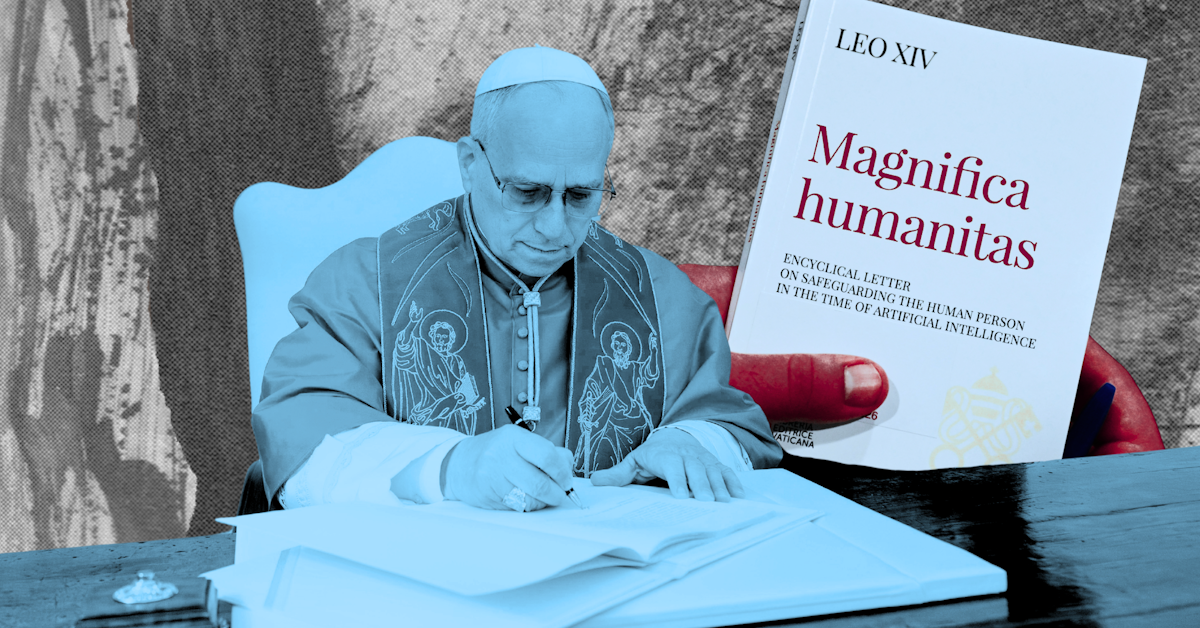
This week, Pope Leo XIV issued his highly anticipated encyclical, “Magnifica Humanitas,” on maintaining and promoting human rights, dignity, autonomy and distributive justice in the Age of AI. It follows in the stead of his namesake’s 1891 encyclical “Rerum Novarum” on the welfare of workers as the Industrial Revolution was unfolding.
The pontiff introduced the document at a news conference alongside Chris Olah, a co-founder of Anthropic — an unprecedented move that underscored the power of private technology companies in shaping society. Smartly, this also ensures the Vatican’s message will be heard among the tech titans competing to dominate the course of innovation.
The encyclical covers a broad range of issues, calling not only for “transparency, accountability and accessibility” of AIs, but for their “disarmament,” which Pope Leo defines as putting human spiritual needs and the common good above the dehumanizing race for efficiency and rank profitability. In the encyclical’s biblical references, he pits the defiant hubris of the Tower of Babel against the building of the “City of God.”
The Universal Destination Of Goods
Of particular interest to the Berggruen Institute and Noema is Pope Leo’s discussion of distributional justice in the Age of AI. Last October, we participated in a deliberation on the subject at the Vatican’s Pontifical Academy of Social Sciences.
In our presentation, we focused on updating the notion that “policies should induce as many as possible of the people to become owners of capital,” expressed in Rerum Novarum for the Industrial Age, to the realities of today.
Here is a short video of that contribution:
The issues we discussed then are reflected in several ways in Magnifica Humanitas (MH).
MH draws on earlier church teachings that place the values of “solidarity, subsidiarity and the universal destination of goods” as pillars of its social outlook. “Where the wealth of nations depends increasingly on knowledge and technology, when these goods remain concentrated in the hands of a few, without adequate forms of sharing and access, a new imbalance is created that contradicts the universal destination of goods,” the encyclical reads. “In turn, it widens the gap between the included and the excluded, between those who can participate in the digital revolution and those who remain on the margins.”
The MH articulates the idea of pre-distribution of wealth through universal basic capital, calling for “the just distribution of the benefits of innovation.” It reads: “Instead of waiting for the benefits of growth to reach the poor eventually, decisions need to be taken to ensure that growth becomes inclusive from the outset. The experience of recent decades shows that in economic and financial crises, it is always the poor who pay the highest price, while the theories that promise automatic general prosperity often prove to be illusory.”
The document continues: “Just laws and methods of redistribution are certainly necessary for correcting imbalances, including tax systems that lighten the burden on the weakest and ask for more from those with greater resources. However, the pursuit of social justice should not be considered a separate issue that follows only after the production of wealth, as if the economy existed solely to create wealth, with politicians only intervening afterwards in order to distribute it. Indeed, justice concerns every phase of economic activity, from resource acquisition to financing, and from production to consumption; every choice has moral consequences.”
The aspect of the encyclical on distributional justice concludes by making the key point that applies to the entire AI phenomenon: “Measures to ensure equity [such as] taxation, social protection and industrial policies must correct the imbalances created by the concentration of wealth and power. Indeed, these criteria do not constitute a curb on innovation; instead they make it civilized and humane.”
The overall thrust of Magnifica Humanitas was fairly well anticipated and placed in the context of Western philosophy in a previous Noema essay, titled “Only God Can Save Us,” which we published after the Pontifical Academy meeting late last year.