For Rimsky-Korsakov, the key of A was clear pink; for Scriabin, it was green. Duke Ellington read the flight patterns of birds as musical phrases and saw the D notes of his baritone saxophonist, Harry Carney, as dark blue hessian. Adam Faith’s last words were ‘Channel 5 is all shit, isn’t it?’
There are nuggets, visual and verbal, at every turn of The Madman’s Orchestra. Yet Edward Brooke-Hitching’s new book (Simon & Schuster, £30), the third in a wonderfully illustrated series, is no gallimaufry. The Madman’s Library asked if a work of literature written on a shirt could be called a book; The Madman’s Gallery featured luminous work made from desiccated corpses. Brooke-Hitching now investigates what counts as music by showing what has not counted.
Chapters include ‘Some Musical Unappreciation’, ‘Experimental Oddities’ and ‘The Horned Section; or, The Devil in Music’, which takes in Hildegard of Bingen and Jimi Hendrix. The inventions of the 17th-century German scholar Athanasius Kircher are detailed under ‘Curious Instruments’. He devised a mechanical ‘musical ark’ on which even an amateur could produce four-part liturgical hymns (one was given to Samuel Pepys) and, in what looks like an improvement on much 21st-century performance art, worked out how to pipe street talk into the mouths of statues; less enticingly, he made a collection of vomiting statues. Some enhancements have yet to reach the 21st century. The sense of smell is still barely used onstage: the only whiffy play I remember in nearly thirty years is Jerusalem, which projected a tang of petrol into the stalls. Yet in 1922, Joseph H. Kraus pointed a way forward. He proposed the idea of a perfume organ, in which a touch on the keyboard would release scents ranging from sandalwood (bass) up to tonka bean and violet.
An early contributor to the London Review of Books wins a golden place among ‘Musical Hoaxes’. Hans Keller, who died in 1985, wrote with needling acumen on Stravinsky’s correspondence and ‘the paradisal aspects of the 1982 World Cup’. Described by Brooke-Hitching as a BBC presenter, which makes him sound like Selina Scott, he was an influential producer, writer and speaker who could come on like Rumpelstiltskin with spellbinding demolitions yet was lit up by principles as well as ideas. In 1961, he set out to test what he considered critical indulgence towards the avant-garde. He invented a composer, Piotr Zak, ‘who is of Polish extraction but lives in Germany’, and transmitted one of Zak’s pieces. In fact, ‘Mobile for Tape and Percussion’ was created by Keller and a colleague walking around a studio striking a collection of musical instruments at random (though I wonder whether the psychoanalytically inclined Keller fully believed in the random). As a wheeze it was a mixed success.
None of the despised critics praised Zak’s composition: Donald Mitchell described it as ‘wholly unrewarding’. Yet no one identified it as a hoax. Would it have been possible to do so without uncovering the plot? It was, after all, neither a forgery (provable) nor a parody (demonstrable). It was not a skit, unlike the work described by Brooke-Hitching as the ‘most sarcastic piece in the history of music’: in 1948, Rued Langgaard, enraged by what he considered the inflated reputation of his compatriot Carl Nielsen, composed a piece for choir and orchestra in which the choir were obliged to repeat – preferably ‘for all eternity’– ‘Carl Nielsen, vor store komponist’. Keller described the Zak event as an inquiry into ‘how far a non-work could be taken for a work’. But surely neither its dismal quality nor the intent behind it stops it being a work? I’m glad I don’t have to argue the point with him.
Another question is suggested – though not actually posed – by vivid paragraphs on the life of Adolphe Sax, which show that his power of innovation (as well as the obvious, he created a clarinette-bourdon and a trumpet with thirteen bells) was matched by an ornate capacity for having accidents: he drank a bowl of acidic water when he was three, fell onto a cast-iron frying pan, was knocked out with a cobblestone, burned by a gunpowder explosion and asphyxiated when he slept in a room where varnish was drying. Has anyone studied the relation between being accident-prone and inventive?
The Madman’s Orchestra does not altogether avoid the chortle factor, what with the leek violin, the hog harmonium (or piganino) and the ice didgeridoo. In 1993, Paul Lyons was issued a patent for his ‘force-sensitive, sound-playing condom’, though he elegantly said he wouldn’t ‘want to go around telling everyone I’ve succeeded in this area’. Brooke-Hitching siphons off facetiousness by putting the condom description in a caption. The diagrams for Lyons’s instrument look like a polytunnel and a mousetrap.
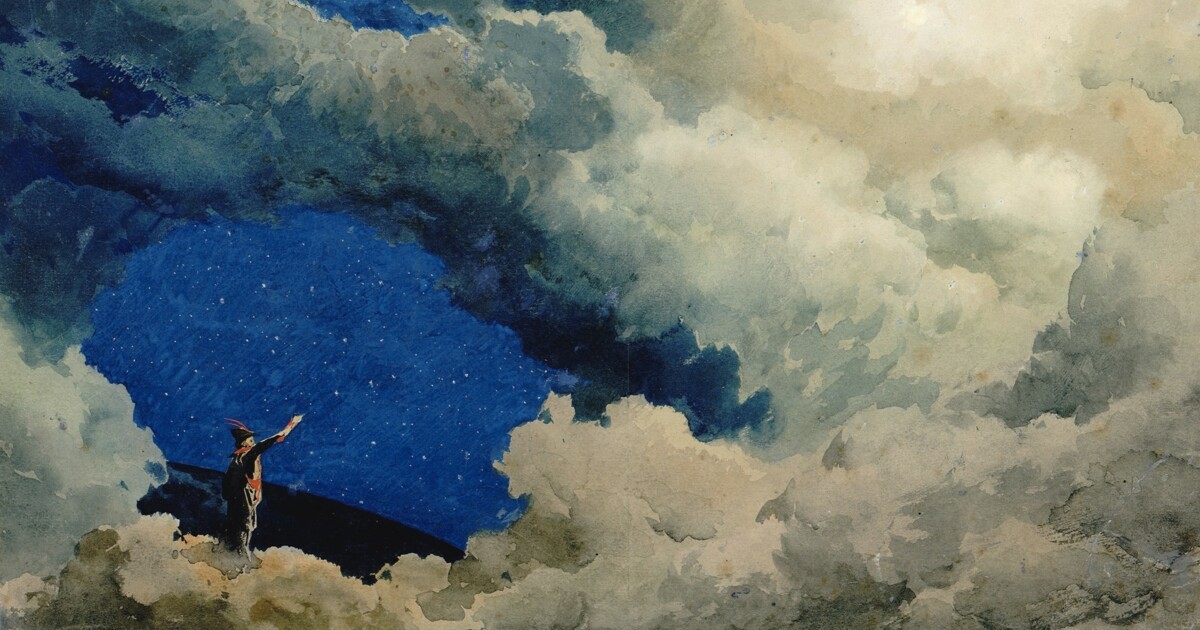
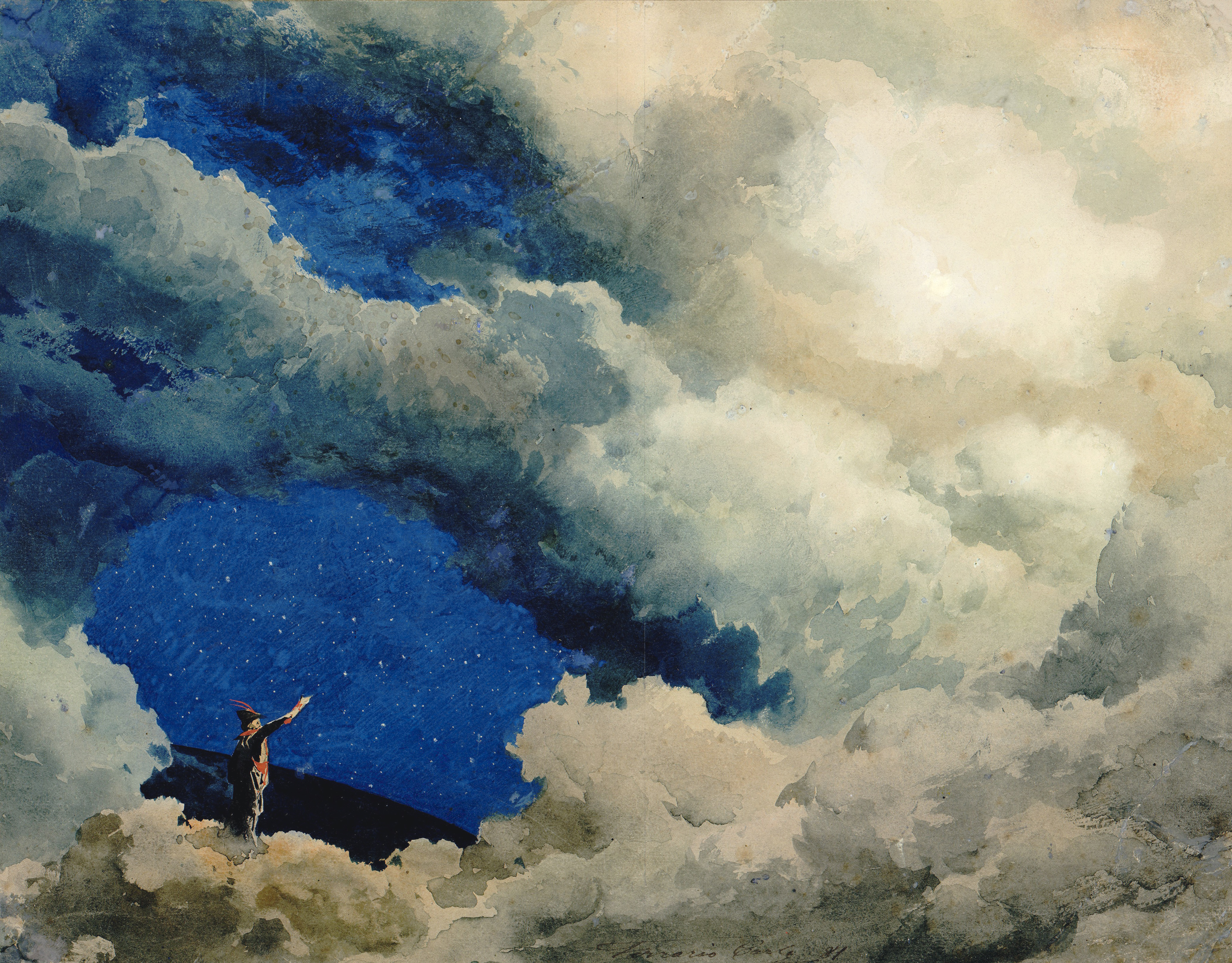
Elsewhere illustrations are radiantly varied. A tiny but crystal-clear reproduction of Carlo Ferrario’s vaulting set designs for the 1881 production of Arrigo Boito’s opera Mefistofele shows a spindly figure in a cavern of clouds (above). The ‘Voice Figures’ created by Megan Watts Hughes with an eidophone (an instrument of her own invention) look like underwater vegetation. Robert Johnson’s extraordinarily long, extraordinarily gifted fingers (perhaps indicating Marfan syndrome) seem to span half of his blues guitar. The only omission is a picture of the creature that in 1650 Kircher announced sang in perfect hexachords: the American sloth.