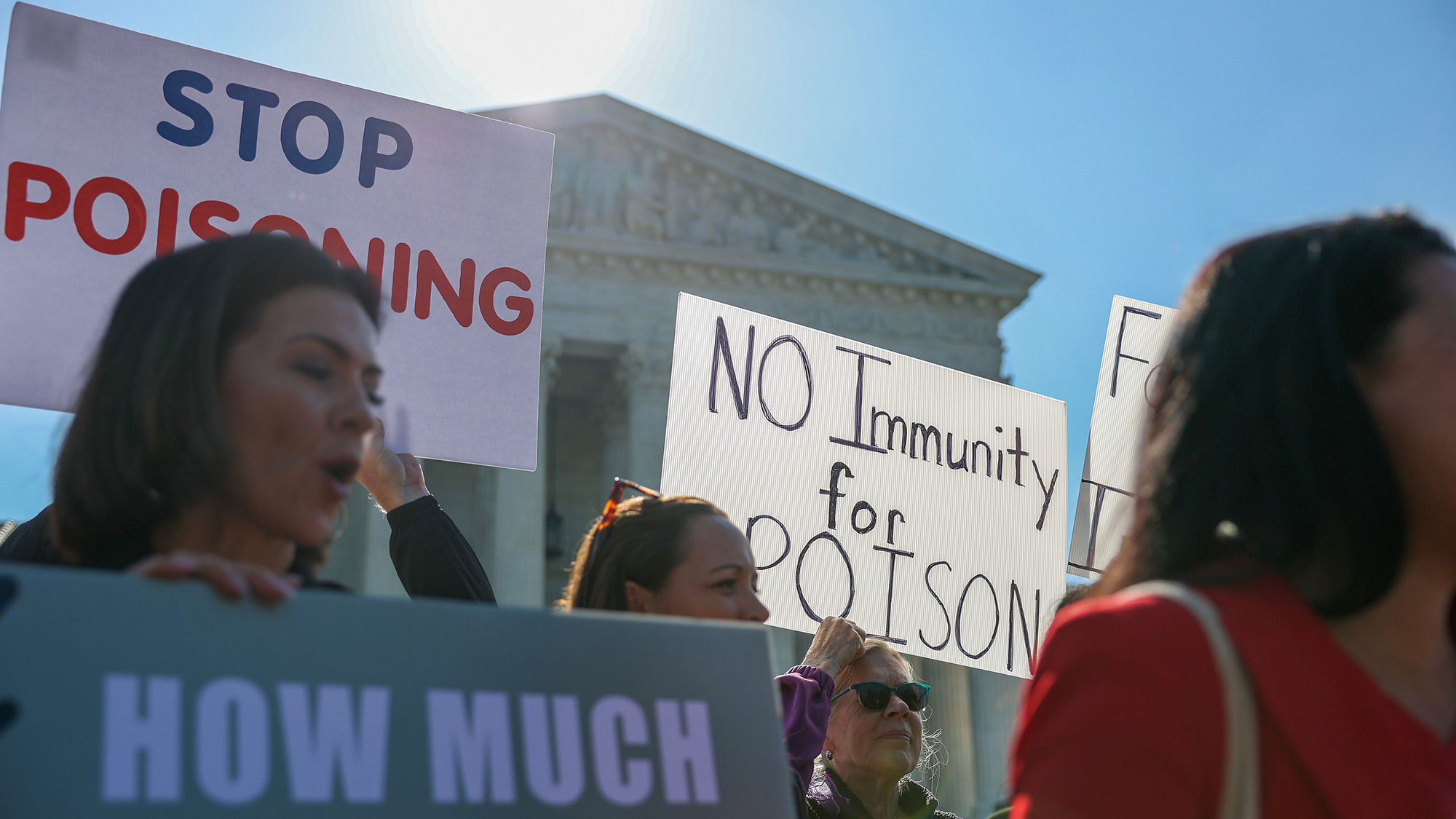
In April 2026, California farmer Terri McCall stood on the steps of the Supreme Court at a rally protesting pesticide use, telling the story of how her husband and dog both died of non-Hodgkin’s lymphoma, a disease she believes was caused by pesticides. Her husband, Jack, had used Roundup for more than three decades on their 20-acre ranch before dying of cancer in 2016.
Over 57,000 pesticide products are currently registered for use in the United States, ranging from powerful chemicals used in conventional agriculture, to common insect repellents approved for use on children. Scientific evidence is accumulating that some of them are linked to illnesses ranging from cancer to Parkinson’s disease.
But beginning in 2024, a powerful coalition of chemical manufacturers and industry groups launched a coordinated national effort to pass “immunity laws,” bills designed to shield companies from potential legal claims tied to harms from their pesticide products. Over the past three years alone, industry lobbyists attempted to pass pesticide immunity legislation in 15 different states.
The battle over ‘failure to warn’
At the center of the industry’s lobbying effort is a key legal question: What responsibility do pesticide companies have to warn users and consumers about potential health risks from their products? In many states, individuals can currently bring “failure to warn” claims if they believe a company withheld information about harms associated with a pesticide.
The chemical makers advocating for pesticide immunity laws argue that companies should be protected from those lawsuits as long as they use labels approved by the Environmental Protection Agency (EPA). But opponents say that standard is dangerously inadequate.
There are longstanding concerns about the EPA’s pesticide review process. For example, the official EPA labels for glyphosate still do not carry a cancer warning, despite mounting evidence that it may cause cancer and other groups like the World Health Organization calling it “probably carcinogenic.”
“The science is pretty clear,” said Daniel Hinkle, the senior counsel for policy and state affairs at the American Association for Justice. “The evidence continues to accumulate, and the pesticide makers continue to lose in the courtroom.”
Meanwhile, a growing body of research links a broad range of health harms to commonly used pesticides, including neurodevelopmental impacts, respiratory problems and reduced IQ in children, health problems like liver and metabolic diseases, and cancer.
The pesticide lobbyist’s playbook
Several landmark court cases have found chemical makers responsible for illnesses like cancers and neurological diseases, resulting in billions of dollars in payments from pesticide makers. Bayer alone has paid over $11 billion in cancer settlements linked to its products. In response, the chemical industry has poured millions of dollars into lobbying for pesticide immunity laws at the state and federal levels, and in the courts. “It’s very clear that this is a coordinated campaign by the industry to absolve themselves of legal liability for health harms from these chemicals,” said Hinkle.
In the last three years, advocates fought against proposed immunity bills in 15 different states. While defeated in a dozen states, the bills passed in Georgia, North Dakota and Kentucky. “The states where these bills are passing have some of the highest cancer rates in the nation,” said Joy Reeves, the director of policy and strategic development at the Rachel Carson Council. “The reality now is, if you’re a farmer and get sick, you have fewer options to hold the pesticide companies accountable.”
Environmental and legal advocates say the campaign behind the pesticide immunity laws is both sophisticated and well-funded. Hinkle says a central driver of the effort is the Modern Ag Alliance (MAA), a lobbying and public relations group founded by Bayer, the maker of Roundup, in 2024.
While many states do not make lobbying expenditures easy to track, those that do show huge sums are being spent on pesticide immunity legislation. According to public filings, MAA spent roughly $1.6M lobbying in Tennessee in 2025. Reporting by the Idaho Sun found that MAA was the top outside spender in Idaho politics that same year.
What pesticide immunity could mean for families
As industry groups push for legal protections around pesticide injury, there are growing concerns about what these bills could mean for public health, accountability, and local input.
In 2012, on a warm July afternoon in Iowa, organic farmer Rob Faux was working in his poultry yard. He heard an airplane roar overhead, and then droplets began raining over him and his chickens and turkeys. A crop duster kept the sprayer on as it passed over Faux’s farm twice, covering them with fungicides and insecticides.
Subsequently, Faux was diagnosed with cancer. Recent data shows that Iowa, which has one of the highest rates of pesticide use in the country — in 2025, 53 million pounds of pesticides were used in the state — also has the second-highest cancer rate in the nation.
Faux is now the communications manager and resident farm expert for the Pesticide Action & Agroecology Network (PAN). He says that many products that people use every day, from ant bait to mosquito repellent, will similarly fall under the scope of the new immunity laws.
“If these laws pass, and someone sells a mosquito repellent for children that makes them sick, for example, these pesticide immunity bills will eliminate pathways for families to hold the makers accountable,” he said.
He also points to the loss of local control as a key concern. “If I live in a town where the drinking water comes from a local lake, but pesticide applicators are using chemicals that are getting into the water, the community should be able to protect people,” he said. Many of the proposed immunity bills would prevent that, because local or state governments wouldn’t be allowed to set pesticide rules that are stricter than federal standards.
A pivotal moment in the pesticide immunity fight
These concerns brought together a broad coalition spanning left-leaning environmental advocates and members of the Make America Healthy Again network. Protestors gathered outside the Supreme Court for a rally the last week of April as the justices inside heard opening arguments in Monsanto v. Durnell. The closely-watched case could reshape the future of pesticide litigation nationwide.
The case centers on whether federal pesticide labeling laws and EPA labels override state-level failure-to-warn lawsuits. A ruling in Monsanto’s favor could dramatically weaken legal pathways for people alleging harm from pesticide exposure. “This is a case that is largely about states’ rights,” said Reeves. “It will affect states’ ability to regulate pesticides.”
Just a few days later, federal lawmakers overwhelmingly rejected an effort to insert pesticide immunity language into the Farm Bill. Seventy-three Republicans joined Democrats in opposing the pesticide immunity provision.
“It was a pretty astounding defeat,” said Max Sano, a senior policy and coalitions associate with Beyond Pesticides who helps organize a national coalition of farmers, farmworkers, scientists, and advocacy groups. “But these bills are still popping up everywhere [on a state level], so we can’t afford to slow down.” His organization is currently monitoring newly proposed pesticide immunity legislation in 10 states.
The rise of a new pesticide reform movement
As momentum grows against pesticide immunity laws, Reeves described the current moment as “today’s Silent Spring movement,” referencing Rachel Carson’s landmark 1962 book that helped ignite the modern environmental movement. “Today, the pesticide reform movement is diverse,” Reeves said. “It’s cross-partisan. It’s far-reaching.”
Advocates like Reeves, Sano, and Hinkle are taking a multi-pronged approach to fighting pesticide immunity laws: organizing national coalition calls, educating lawmakers, tracking bills across states, mobilizing grassroots campaigns, and coordinating legal and public awareness efforts.
And individuals can have a deep impact on the fight, too, Hinkle said. “It is incredibly important to be in communication with your lawmaker,” he said. “Every single call or email matters. Concerned constituents and grassroots organizing have really been the decisive forces in holding off this onslaught.”
Reeves echoes him, saying, “If you care about your family and your community, you should engage on this issue. It affects us all.”
The Rachel Carson Council (RCC), founded in 1965, is the national environmental organization envisioned by Rachel Carson to carry on her work after her death. We promote Carson’s ecological ethic that combines scientific concern for the environment and human health with a sense of wonder and reverence for all forms of life in order to build a more sustainable, just, and peaceful future. The Rachel Carson Council is a nonpartisan 501(c)(3) nonprofit organization.