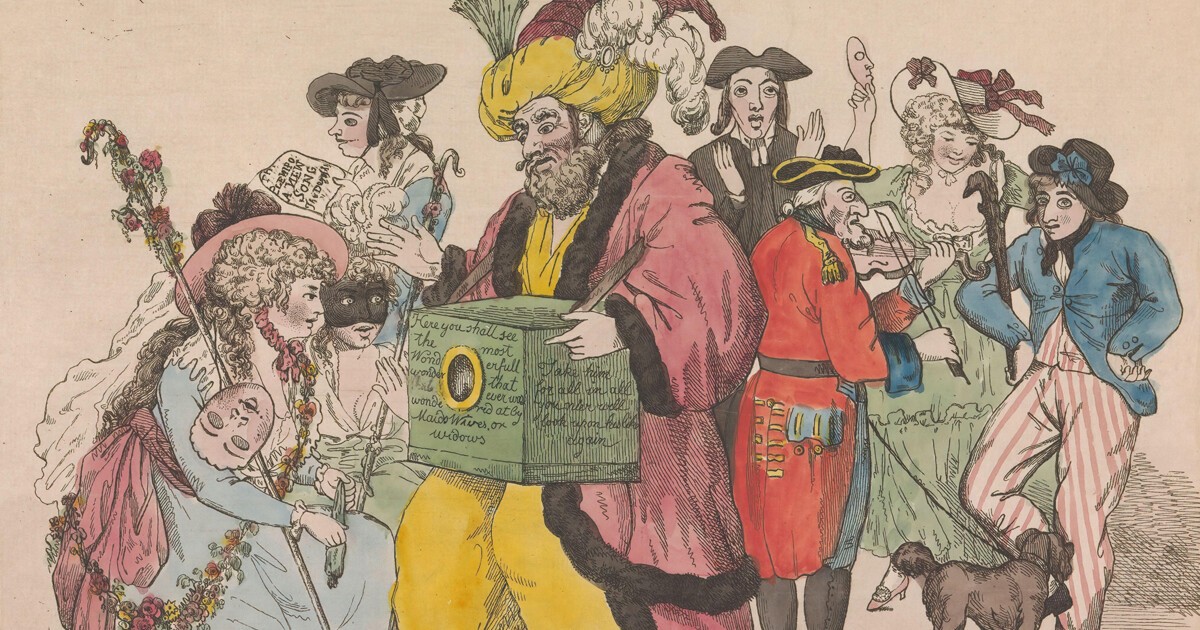
Early in the first notebook of Jane Austen’s teenage writings is a work entitled ‘Jack and Alice: a novel’; it runs to a little over 5500 words and was probably written between 1789 and 1791. The story is a gleeful demolition of adult nonsense, on most prominent display at a masquerade:
Such was the party assembled in the elegant Drawing Room of Johnson Court, amongst which the pleasing figure of a Sultana was the most remarkable of the female Masks. Of the Males a Mask representing the Sun was the most universally admired. The Beams that darted from his Eyes were like those of that glorious Luminary tho’ infinitely superior. So strong were they that no one dared venture within half a mile of them; he had therefore the best part of the Room to himself, its size not amounting to more than 3 quarters of a mile in length & half a one in breadth.
As the masquerade progresses, the wearing of a mask that keeps all other revellers half a mile away becomes both exhausting and logistically complicated. At the end of the evening, Austen writes, ‘the whole party … were carried home, Dead Drunk.’
For most of the 18th century, the masquerade – a ticketed entertainment at which revellers were disguised either by elaborate masks and fancy-dress costumes or by simpler cloaks known as dominoes – was one of the chief ways smart society chose to entertain itself. In its excesses of costume, consumption and display it became synonymous with an emergent capitalist economy and with the marketisation of individual whims and pleasures. The British Empire put itself on display with outfits ranging from Indian rajahs to chimney sweeps, which collapsed boundaries of gender, class and race. The growth and decline of the masquerade tells a number of interlinked stories about Britain in the 18th century, some of which are obvious amid the glitter and dazzle; others require a little more scholarly excavation in order to shine.
‘Jack and Alice’ takes the already fantastical elements of the masquerade to absurdist extremes. It also reveals a teenage Austen pillorying for the enjoyment of her brothers and sisters the world as it appeared in novels and in the society columns of newspapers. A masquerade in a mature Austen novel is unthinkable, not least because those novels postdate its demise by several years. But it isn’t surprising that Austen as an adolescent, at the tail end of the rackety 18th century, should have alighted on the comic possibilities of an entertainment in which disguise and misrule are the order of the evening. What could be more enjoyable for the precocious daughter of a Hampshire clergyman, with her nose pressed against the glass of grown-up metropolitan life, than to skewer such a scene, making fools of its participants and spectators alike?
The social world of ‘extravagance and intrigue’ that Meghan Kobza explores in her new book has already been richly chronicled by Terry Castle in Masquerade and Civilisation (1986). In his monumental study of 18th-century identity, The Making of the Modern Self (2004), Dror Wahrman argues that ‘it is hard to overestimate – though easy to forget – the cultural significance of the masquerade.’ Devotees of Bridgerton might quibble with ‘easy to forget’: in the TV series the masquerade is a kind of shorthand for an imagined (long) 18th century, just as in Austen’s writing it’s a symbol for all that is ridiculous about the adult world beyond the parlour. Unlike Castle, Kobza is less interested in literary representations of the masquerade than in its material traces: costume bills, tickets, advertisements and trade manifests for a plethora of masquerade-adjacent businesses. The story she relates is as strange as some of the outfits worn by the revellers, and merits its 21st-century retelling.
The masquerade first appeared in London around 1713, following the arrival in the capital of a Swiss opera impresario, Johann Jakob Heidegger. In 1711 he took on the management of the Queen’s Theatre in the Haymarket, but by the season of 1712-13 it was obvious that crowds were failing to flock to his programme of foreign opera. To diversify his income he decided to stage an entertainment that would reframe earlier European traditions of masque and carnival for a new age. Tickets were priced at an exorbitant two guineas, ensuring both high profits and social cachet, and guests were instructed to come in extravagant disguises. Heidegger installed musicians in the pit, cleared the stage of scenery to allow dancing and served lavish refreshments from the boxes. The attendees rose to the occasion. One nameless aristocrat appeared as Adam, his dignity apparently preserved only by some tactically placed fig leaves. As a contemporary report revealed, however, on closer inspection it became clear that he ‘had on a flesh colour sarsinet gown so tight about his Body … no one but those that came So nigh as to touch him Could think it any thing else but Skin.’
Heidegger reigned supreme for the first half of the century; his masquerades became part of the fabric of aristocratic London. George II appointed him Master of the Revels, ignoring the lamentations of churchmen horrified by the amorality of the entertainment. Although the bishop of London briefly succeeded in banning masquerades between 1721 and 1723, helped in part by an outbreak of plague in Marseille that spooked the authorities, religious homilies couldn’t stop the cultural juggernaut, which within a few years had brought in its wake an entire economy of supportive businesses. Heidegger’s guests could buy their costumes at one of several masquerade warehouses and patronise any number of domino and wig-makers; and they could hire places near the Queen’s Theatre to change into costumes too capacious for carriages or sedan chairs.
Heidegger became a legendary figure, not least because he was famously ugly and would never allow himself to be drawn or painted, though that didn’t deter Henry Fielding from writing about him in his poem ‘The Masquerade’ (1728):
As Mulciber was driv’n
Headlong, for’s ugliness, from heav’n;
So, for his ugliness more fell,
Was H-d-g-r toss’d out of hell,
And, in return, by Satan made
First minister of’s masquerade.
Kobza tells of a reveller who succeeded in getting Heidegger so ‘Dead Drunk’, in Austen’s phrase, that he remained unconscious while a mask-maker made a wax impression of his face. The partygoer appeared at a subsequent masquerade in the guise of the master of ceremonies, apparently baffling the musicians who found themselves called on to obey the commands of two masters. The episode was memorialised in satirical prints and gossip rags. Those without the money or social cachet to attend Heidegger’s events could read about them in the ‘Masquerade Intelligence’ columns of daily newspapers: the growth of the masquerade coincided with the development of a raucous print culture, which transmitted scandalous tales of exclusive parties beyond the theatre and aristocratic salons into coffee houses and domestic drawing rooms.
By mid-century, masquerades were not restricted to the Queen’s Theatre. There were rival offerings at the pleasure gardens at Ranelagh and Vauxhall, as speculators rushed to claim a share of the market Heidegger had created. The masquerade has long been seen in the context of the wider commercialisation of leisure, as market dynamics brought ticket prices down and opened up the parties to a wider variety of clients. But as masquerades grew in popularity and cultural significance, hosts and attendees had to work harder to make an impression. In May 1749, Lady Elizabeth Chudleigh, maid of honour to the Princess of Wales, appeared at the Ranelagh Gardens masquerade in the character of Iphigenia, wearing from the waist up only a see-through gauze covering. She had been the subject of scandal before, with reports of an illicit marriage and bitter separation. Her supporters chose to read her costume as a defiant gesture by a figure who had seen her life anatomised in the press; her detractors viewed it as a degraded display by an immoral woman courting controversy. At the masquerade itself, the Princess of Wales threw a shawl around Iphigenia’s shoulders, only for Chudleigh to rebuff the gesture. The bluestocking Elizabeth Montagu was reluctantly impressed by Chudleigh’s chutzpah: the outfit rendered her ‘so naked, the High Priest might easily inspect the entrails of the victim’. Decades later, when Chudleigh’s past caught up with her and she was forced to stand trial at Westminster Hall for bigamy, caricaturists gleefully and pruriently returned to the spectacle she had created as Iphigenia in order to strip her reputation afresh.
British clerics who believed masquerades to be a sign of debased morals made much of the Lisbon earthquake of 1755: should the entertainments continue unabated, they thundered, divine retribution would fall on London as it had on another cultured European city. ‘We were to have had a masquerade tonight,’ Horace Walpole mourned, ‘but the bishops, who you know have always persisted in God’s hating dominoes, have made an earthquake point of it, and postponed it till after the fast.’
When masquerades resumed it was with a new generation of impresarios in charge. Chief among them was Teresa Cornelys, who, like Heidegger before her, turned away from a career in the theatre to open a masquerade business. As a young woman, she had earned her living as a singer in Venice, where she had an affair with Casanova and attended the carnival. She arrived in London in 1759, posing as a widow to protect the reputation of her illegitimate daughter. The pleasure gardens of the capital struck her as dowdy and unimpressive after the splendours of Venice. The court, too, had become dull and provincial under George II. With aristocratic and financial backing, Cornelys installed herself at Carlisle House in Soho Square and brought the masquerade back in full pomp. Because the mansion was on the corner of the square, hundreds of carriages could wait for their owners and filter out into the West End unhindered. Cornelys draped the ballroom in yellow, blue and gold silk, and understood the importance of catering on a grand scale. She also knew how to capitalise on the value of a well-placed newspaper puff. Throughout the 1760s she dominated the scene and was known in ‘Masquerade Intelligence’ columns as the Empress of Pleasure. In the end, however, the economics of conspicuous consumption undid her. Other operators undercut her and in 1772 Cornelys was arrested for debt. She was in and out of debtors’ prison for the rest of her life. During the Gordon Riots of 1780 she was among those to escape when the rioters attacked central London jails, though she was rearrested a few months later.
Cornelys built up her business by selling the promise of exclusivity: her events were for the elite, with access controlled by high prices and subscription schemes. Elsewhere, masquerades in the later decades of the 18th century were increasingly middle-class affairs, as different promoters offered variable price-points, ranging from cheap spectator-only tickets to private supper booths. An event that had once seemed glamorous and exceptional began to appear ordinary, even seedy. In Frances Burney’s 1782 novel Cecilia there is a long masquerade scene (Austen names one of the characters in ‘Jack and Alice’ after Burney’s heroine). At first Cecilia enjoys the spectacle, as ‘Spaniards, chimney-sweepers, Turks, watchmen, conjurers … shepherdesses, orange girls, Circassians, gipsies, haymakers and sultanas’ pass before her, but she quickly finds herself the subject of unwanted attention from a man dressed as the devil. Cecilia has no choice but to prefer ‘captivity to resistance’. In Bridgerton a gentleman may encounter a maid disguised as a lady at a masquerade (only four decades or so out of date) and tell her: ‘Tonight we can be anyone we want.’ But as earlier fictional representations of that licence make clear, there were considerable dangers for women in a world in which disguised partygoers could lay aside conventional proprieties and take on devilish identities.
Amid the spectacle, other kinds of darkness lurk. Kobza opens her study with an apology: ‘The Author wishes to respectfully inform the reader that this book holds a history laced with extravagance and intrigue, but also one of oppression and empire.’ Despite the playfulness of the address, the point is earnestly made: ‘Within the walls of theatres, pleasure gardens, country seats and townhouses, the hierarchies, systemic violence and stereotypes of empire came to life through masquerade habits that were donned by the beneficiaries of colonisation and denigrated the colonised.’ Through a series of careful readings of individual costumes, Kobza explores the relationship between masquerade and empire. In the late 1760s, Isaac Bickerstaffe’s comic opera The Padlock provided masqueraders with a new character to dress up as: an enslaved West Indian called Mungo, the performance of whom required blackface and a caricatured accent. By contrast, when Julius Soubise, an Afro-Caribbean high-ranking servant of the Duchess of Queensberry, attended a masquerade in whiteface, dressed as a sultan, his costume was criticised as the epitome of bad taste.
Kobza’s work on the racial politics and the economics of masquerading means that she reads the spectacle as less blurring of boundaries than her predecessors have done. High ticket prices and high associated costs – costume and mask hire, transport, food – combined, she argues, to set ‘financial boundaries that would help maintain the masquerade’s prolonged exclusivity’. In Kobza’s account, the masquerade is less part of a landscape of 18th-century carnivalesque than an articulation of power by a group of privileged people prepared to pay handsomely for the frisson of dressing up to play with ideas of class, gender and race.
By the early 1790s, the masquerade had fallen out of fashion. Wahrman links its decline to a broader shift in the understanding of the self that rendered its playfulness and gender-bending propensities out of date, as ideas about sexual and gender identity calcified. Castle attributes its fall to the spread of Evangelical moral values, which saw a range of 18th-century vices (duelling, gambling, whoring, cock-fighting) fall foul of newly censorious social mores. Kobza suggests that it lost its shine once it became affordable; faced with the onslaught of the middle classes, aristocratic tastemakers looked elsewhere for their pleasures.
Kobza’s meticulous archival pursuit of the masquerade gives insights into the mechanics of ticketing, advertising and transport, and offers a vibrant display of material culture. The book includes images of ornate subscriptions tickets (admitting ‘one gentleman or two ladies’) and detailed briefs for costume makers, including a handwritten specification for a ‘coffin masquerade habit’ from 1771. To read Kobza’s transcriptions of warehouse catalogues is to enter a colourful world of feathers, silks and trims. It’s a shame that her prose is overdressed with adjectives. Throughout The Masquerade, prelates are persistent, princes are profligate, tassels are lustrous, habits are frilled and fanciful. This may be in imitation of 18th-century verbosity, but the result is a book that appears to have been trussed up in a linguistic costume to sparkle in the masquerade world of trade publishing, disguising hard-won archival findings behind a shimmering literary domino.
Do these eccentric and long-gone gatherings still matter? Castle offers one answer when she notes that ‘the history of human pleasures – of festivity, games, jokes and amusements – has seldom met with the same dignified attention accorded the history of human suffering.’ The masquerade is also a staple of later popular representations of the 18th century, from the novels of Georgette Heyer to those by Julia Quinn. But the masquerade also holds up a mirror to our own preoccupations, not least in its experimentation with the mutable nature of the self. It reveals anxieties and curiosities about gender identity and the objectification of certain kinds of body that continue to reverberate. Satirical prints of Chudleigh as Iphigenia are no more or less prurient than newspaper spreads and photographs devoted to the acceptability or not of diaphanous breast coverings worn by movie stars on the red carpet. And certain royal fancy-dress costumes of the past few decades, along with the column inches devoted to them, suggest that our vice-ridden Georgian forebears do not hold a monopoly on dressing up in poor taste.