The World Cup , launched in 1930, is the most popular sporting event on the planet: one of Fifa’s less implausible recent claims is that 1.5 billion people watched the 2022 final in Doha. Football, as Jonathan Wilson has done as much as any football writer to demonstrate, matters in multiple dimensions, but the World Cup has a magnetism all its own, drawing in millions who don’t otherwise watch much football. Observing its rites and rituals sustains the cycle: we all fill in the wallchart and collect the stickers. In this year’s edition in the United States, Canada and Mexico an unprecedented 48 teams will play an unprecedented 104 games, and millions of fans will already have diarised all of them, often in anticipation of delicate domestic negotiations. (‘Sorry, could you do the school run tomorrow? I’ll be knackered: it’s DR Congo v. Uzbekistan at 12.30 a.m., which could well be decisive.’) It is a global soap opera with a cast of geographically varying heroes and villains and imperishable stereotypes, and we check back in confident of picking up where we left off: ah, those samba Brazilians, possessional Spaniards, disciplined Germans, elite French not considered French by many French, joyous Senegalese, inexhaustible South Koreans, tragic Dutch, hapless English, even more hapless Scots and inexplicably absent Italians. The stakes are so high that the spectacle is compelling even if much of the actual football is not. We will bear witness to sporting immortality but also sporting infamy: the fluffed shots, missed penalties and red cards that in a nanosecond condemn men of inestimable talent, accomplishment and wealth to the status of eternal losers.

Demonstrations in Paris against the World Cup in Argentina (1978).
There have been storied tournaments, such as Mexico 1970, lit up by Brazil’s brilliance, and more brightly embossed in the memory since it was the first to be televised in colour. There have been epic games, such as Italy v. Brazil in 1982, about whose intersecting characters Piero Trellini wrote a 500-page book, La Partita. Many have even generated their own nickname: the Maracanazo (Brazil’s catastrophic defeat at home in 1950 to Uruguay in the Maracanã stadium); the Battle of Bern (the notorious 1954 quarter-final between Hungary and Brazil, with three players sent off and fighting continuing in the dressing rooms); the Battle of Santiago (hosts Chile against Italy in 1962, characterised by the BBC’s David Coleman as ‘the most stupid, appalling, disgusting and disgraceful exhibition of football in the history of the game’); die Wasserschlacht (the water battle) of 1974, when West Germany, the hosts, beat Poland on a waterlogged pitch that nullified the pacy Polish wingers; and el Robo del Siglo (the robbery of the century), Argentina’s ref-attributed defeat to England in the 1966 quarter-final.
There have been immortal goals, such as Carlos Alberto’s in the 1970 final against Italy, for many, as Wilson writes, ‘the greatest goal scored by perhaps the greatest team in the greatest World Cup, a glorious synthesis of team play and individual technical excellence’; Diego Maradona’s ‘Goal of the Century’, a slaloming second around England’s falling nine-pins in Mexico 1986; or Saeed al-Owairan’s solo run from his own half against Belgium in USA 1994 to put Saudi Arabia into the knockout phase.
And a gallery of timeless images serves as the World Cup’s wallpaper, scrolling from blurry monochrome to UHD: the one-armed Héctor Castro (El manco) shooting past the airborne Joan Botasso (Uruguay 1930); Mário Zagallo’s tears after Brazil’s consecutive tournament victories (Chile 1962); Bobby Moore borne aloft by Geoff Hurst and Ray Wilson (England 1966); Gordon Banks’s ‘Save of the Century’, and Moore and Pelé swapping shirts (Brazil 1970); the Cruyff turn (West Germany 1974); Maradona about to take on six petrified Belgians, and Marco Tardelli’s primal scream (Spain 1982); Maradona’s ‘Hand of God’ leap over Peter Shilton (Mexico 1986); Frank Rijkaard’s fleck of gob caught mid-parabola towards Rudi Völler’s perm, and Gazza’s tears, and Maradona’s tears (Italy 1990); Roberto Baggio’s penalty soaring over the bar (USA 1994); Zinedine Zidane walking past the trophy, head bowed, having been sent off for headbutting Marco Materazzi (Germany 2006); Nigel de Jong’s kung-fu reducer on Xabi Alonso (South Africa 2010); a deranged Brazilian fan eating his own shredded shirt after watching Germany’s 7-1 demolition (Brazil 2014); Iceland’s wall of synchronised fans generating the Viking Thunder Clap (Russia 2018); Lionel Messi redemptively getting to kiss the World Cup (Qatar 2022).
Wilson’s new history of the World Cup appeared only a few months after the death of his fellow World Soccer columnist Brian Glanville, so there is a sense of the baton being passed. Glanville started issuing surveys with the title Soccer round the Globe in the late 1950s, wrote the screenplay and indeed did the stentorian voiceover for Goal!, the famous film of the 1966 World Cup, and first published what would become his serially updated Story of the World Cup in 1973, establishing him as the pre-eminent anglophone writer on world football. But Wilson is running in more lanes than his predecessor. He says that his ‘is a book about the World Cup, about great players and great goals and great matches, but it is also about football as a tool for self-projection and for influence-peddling, about the role it has played in nation-building and about the role it increasingly plays as countries negotiate their positions in a globalised world’. West Germany’s half-apologetic victory in 1954, for example, was a decisive affirmation of its international rehabilitation, and unified Germany’s tournament in 2006 – the Sommermärchen – was its first major sporting event since the 1936 Olympics, with the schwarz-rot-gold flag newly ubiquitous. A World Cup qualifier in 1969 ignited political tensions between El Salvador and Honduras, in an episode made famous by Ryszard Kapuściński’s more-magic-than-realist masterpiece The Soccer War (1978). Maradona’s ‘Hand of God’, Wilson insists, determines English feelings about Argentina at least as much as the Falklands War. Progress all the way to the semi-finals in 1998 vindicated the new Croatia’s existence. From ‘Herbert Zimmermann’s West German commentary at the end of the 1954 World Cup final to Papa Bouba Diop’s dance after scoring for Senegal against France in 2002, from Pelé’s volley in 1958 to al-Owairan’s remarkable goal against Belgium in 1994, from France’s sweat-sodden defeat in Seville in 1982 to North Korea’s improbable victory in Middlesbrough in 1966’, the World Cup has become an indelible part of countless national stories.
It is the recovery of these contexts that gives Wilson’s history its latitude as well as salience. He not only has the technical football cred – Inverting the Pyramid (2008) is a sacred text for tactics geeks – but has written histories of the Argentinian, Spanish and Eastern European game. Any football hipster with Duolingo can tell you what catenaccio is, but Wilson will see that and raise you a rioplatense (the football between Uruguay and Argentina), a roligan (a passionate, drunk, but benign, Danish fan), or an Ochsenspieß (a skewer of ox-meat, coined by Bild to describe Germany’s static line of four central defenders, before the tactical Reboot that led to its victory in 2014). Colette’s 1930 description of Uruguay’s players as a ‘strange combination of civilisation and barbarism’ is traced through the use of the phrase by the Unitarian Party during the Argentinian Civil War (1814-53) and in Domingo Faustino Sarmiento’s Facundo o Civilización y Barbarie (1845) which, as Wilson patiently explains, would have been conveyed to French audiences via Dumas’s novel Montevideo, ou une nouvelle Troie (1850). Der Spiegel’s call to ‘hang the treacherous coach [Sepp] Herberger from a sour apple tree’ after West Germany’s 8-3 loss to Hungary in the group stage in 1954 is explicated via the theologian Martin Schloemann’s hypothesis that the saying derives not as commonly assumed from a remark of Luther’s, but rather from a 19th-century woodcut depiction of Luther that became a common symbol of reconstruction after the Second World War. There are footnotes on the traces of Comtean positivism in 19th-century South American politics; on the links between Brazilian and African cultures via Oshosi, the Yoruba spirit of the hunt rendered in Portuguese as ‘Oxóssi’ and syncretised with St Sebastian, the patron saint of Rio de Janeiro; and on the utility of the cultural anthropologist Ernest Becker’s work The Denial of Death in understanding Zidane’s red card in 2006 as a symbolic variant of suicide in response to the dissolution of the ego. Glanville, magisterial and polyglot though he was, was not telling you this.
Fifa was founded in 1904 as an alliance of national football associations. Its third and longest serving president (1921-54), and the architect of the World Cup, was Jules Rimet. A devout Catholic who had been influenced by Pope Leo XIII’s 1891 encyclical, Rerum Novarum, on the ‘Rights and Duties of Capital and Labour’, in 1897 Rimet founded Red Star Club Français in Paris, where class distinctions were repudiated, poetry readings organised to help educate players and amateurism presciently condemned as ‘the antisocial pretension of a privileged oligarchy’. It is not hard to intuit Rimet’s vision for Fifa as football’s League of Nations, though it was a foretaste of decades of British footballing and political self-delusion that the UK’s associations remained aloof. England had codified association football in 1863, England and Scotland played the first recognised international in 1872, British administrators and traders had encouraged leagues and established teams all over the world – Herbert Kilpin’s AC Milan, the Genoa Cricket and Football Club, Athletic Bilbao, Royal Antwerp FC, Newell’s Old Boys are only the most famous – and Britain won Olympic football gold in 1900, 1908 and 1912. Uruguay – the inaugural World Cup host – had been founded in 1830, with British assistance, as a buffer state between Argentina and Brazil. The first official match in June 1881 between Montevideo Cricket Club and Montevideo Rowing was refereed by the British consul general. The assumption that the game belonged to Britain bred a ruinous complacency. England having the same voting rights in Fifa as the likes of Uruguay (who were to win the World Cup in 1930 and 1950) or Brazil (five and counting), the league official Charles Sutcliffe told an FA meeting in 1919, would be ‘magnifying the midget’. As Wilson nicely observes, their footballing isolationism allowed the British to be untroubled by Uruguay’s wins at the Olympics in 1924 and 1928 or in the inaugural World Cup:
There was a sense that Uruguay had not merely overcome the anxiety of European influence but reversed it, returning the European game to the metropole in more sophisticated form. If there was not quite the same Oedipal frisson as would be suffered by, say, Spanish literature in the face of Latin American modernism, it was only because the game’s true parents in Britain had absented themselves [from the possibility of defeat].
English football had been professional since 1885, and by the mid-1920s Austria, Hungary, Italy and the US had salaried players who were ineligible for the Olympics, so the case for a separate Fifa competition was clear. With its postwar Olympic wins and the year 1930 marking the country’s centenary, Uruguay was the obvious choice as host, but the competition’s beginnings were friable. Rimet organised a French side, but the coach and some players declined to travel. Italy’s plans fell through when the leader of its Olympic Committee, the journalist and fascist Augusto Turati, resigned after revelations that he frequented an S&M brothel. Romania sent a team only because the newly crowned King Carol II insisted and picked the squad. There were meant to be a nicely symmetrical as well as regionally representative sixteen teams, but the two Asian invitees, Japan and Siam, withdrew, and Egypt (who had reached the Olympic semis in 1928) literally missed the boat, prevented by a storm from making their connection in Marseille. Montevideo’s remarkable Estadio Centenario was the first stadium in the world built in reinforced concrete, but the 1929 economic crash and adverse weather delayed construction, establishing a familiar World Cup theme of infrastructural brinkmanship and overspending.
On the pitch, much was amateurish: penalty spots were painted in the wrong place, some games finished ahead of time, and the identity of some of the goalscorers remains unknown. Argentina’s captain, Manuel Ferreira, left halfway through to sit his law exams, and the US midfielder Andy Auld was temporarily blinded when a physio spilled a bottle of chloroform while treating his split lip. Some teams played in an assortment of colours, and Juan Evaristo, Argentina’s right-half, in a beret. The threshold for disciplinary action would encourage those who think the game has gone soft: Plácido Galindo of Peru became the first player in World Cup history to be sent off, for breaking the Romanian Adalbert Steiner’s leg. One match had an attendance of 300, the lowest to date, though by the time Trump’s border agents and ICE are done that record might be in peril. The Uruguay-Argentina final was already the 111th rioplatense derby. The teams couldn’t agree on the match ball, so the first half was played with one favoured by Argentina (made in Scotland) and the second with one favoured by Uruguay (made in England). The Belgian referee, John Langenus (who, Wilson somehow resists adding, had failed his first refereeing exam when unable to answer the question ‘What is the correct procedure if the ball strikes a low-flying plane?’), was so concerned for his own safety that he arranged a final-whistle escape route to a ship moored in Montevideo harbour. The Argentina captain, Luis Monti, nearly didn’t play after a death threat and was a shadow of himself (Monti was ordinarily so brutal that a later manager wrote a letter of apology to an opponent). Uruguay won 4-2, and its embassy in Buenos Aires was attacked. It hadn’t taken long for football to turn Rimet’s ideals inside out and break them. Argentina’s El Gráfico commented that the World Cup had proved to be a vehicle for ‘a lack of culture, for violent behaviour, passion and insults’. As Wilson observes, ‘the pattern was set.’
No sport matters more to the world than football, and as Wilson serially demonstrates, no football matters more to the world than the World Cup. In 1966 the Brazilian playwright Nelson Rodrigues wrote that ‘everywhere has its irremediable national catastrophe, something like a Hiroshima. Our catastrophe, our Hiroshima, was the defeat to Uruguay in 1950.’ Brazil lost that de facto final before a home crowd of officially 173,850 but possibly more than 200,000; it is one of the highest attendances at any football match ever played. The hosts were understandably cocky: they were the 1949 Campeonato Sudamericano champions, winning six of their seven games and scoring 39 goals. After Uruguay came back from a goal down to win 2-1, the planned presentation was simply abandoned; Brazil couldn’t bear to play another game for nearly two years. In Anatomia de uma derrota (Anatomy of a Defeat) Paulo Perdigão wrote of the Maracanazo: ‘It is a Waterloo of the tropics, and its history our Götterdämmerung.’ Roberto Muylaert wrote in his biography of the Brazil goalkeeper Moacir Barbosa that the footage of Uruguay’s Alcides Ghiggia advancing into his box to score the winner was the equivalent of the Zapruder footage of the Kennedy assassination: ‘the same movement, rhythm … the same inevitable trajectory’. Barbosa, who let the shot in at the near post, walked into a shop twenty years later and heard a woman say to her son: ‘He’s the man who made all of Brazil cry.’ When the BBC tried to take him to the Brazil camp before the 1994 World Cup, he was turned away in case his misfortune proved contagious.
In the other direction, West Germany’s triumph in Switzerland in 1954 (das Wunder von Bern), coming back from 0-2 down against a storied Hungary side, became a metaphor for the country’s postwar recovery. ‘We’ve shown the world what we’re worth, we’re back, losers no more,’ Günter Grass wrote; ‘Wir sind wieder wir!’ – ‘We’re somebody again’ – became a popular expression. Herbert Zimmermann’s famous radio commentary is Germany’s ‘They think it’s all over’ soundbite: ‘Tor für Deutschland! Drei zu zwei führt Deutschland. Halten Sie mich für verrückt, halten Sie mich für übergeschnappt!’ (‘Goal for Germany! Germany lead 3-2. Call me mad, call me crazy!’). These were, as Wilson puts it, ‘the words that consecrated the new federal republic’. Football had furnished a space in which it seemed ‘vaguely acceptable to celebrate being German’ again, but inevitably there was much soul-searching among Germans about just how far to go. When the national anthem was played at the final, the crowd lustily ignored official instructions not to sing the first verse – ‘Deutschland, Deutschland über alles’ – and some overseas radio stations immediately ended the broadcast. At an official reception for the team in a Munich Bierkeller (uh-oh), the head of the DFB (the German FA), Peco Bauwens (who, according to his own son, may have killed his Jewish wife), ‘invoked Wotan, the supreme Germanic deity whose spirit underpinned the more mystical aspects of Nazism, before speaking of the importance of Führerprinzip’. Bavarian radio cut away from the proceedings and lost the tapes. Germany’s new establishment preferred to construe 1954 in terms of Kameradschaft rather than Völkism; in England in 1966, West Germany were managed by Helmut Schön, a survivor of the Dresden fire-bombing who was anxious that his team should conduct themselves ambassadorially. On the 50th anniversary of the final, Gerhard Schröder described Bern as a national memorial to stand alongside Weimar and the Berlin Wall.
It is no easy task to navigate the footballing nationalities showcased in the World Cup without bumping up against the stereotypes which it tickles us to find in the game. Certainly, it is gratifying when people behave as we expect them to. England’s Jeff Astle drank so much to calm his nerves on a turbulent flight from Ecuador to Mexico in 1970 that he had to be carried off the plane, Esto publishing the photo with the caption ‘a team of drunkards’. A drunk Bryan Robson, England’s captain, was ruled out of Italy 1990 when he aggravated shoulder and heel injuries dropping a bed on his foot while trying to evict from it a drunk Paul Gascoigne, England’s most important player. At Spain 1982 the Argentine manager César Menotti spent most of his time with a German model and missed morning training sessions, so the team exhausted itself in the heat of the afternoons; the full-back Alberto Tarantini had a row with his fashion-model wife on the beach and she loudly threatened to sleep with another man in revenge. At South Africa 2010 a malcontent French squad simply went on strike. In Italy before the 1982 tournament, which they won, Enzo Bearzot’s selection of Paolo Rossi after a two-year ban due to the Totonero match-fixing scandal, and the non-selection of various other players, was hugely contentious.
A Roma fan spat on Bearzot and he slapped a 22-year-old Inter fan called Anna Ceci when she called him a ‘bastard ape’ for leaving out her favourite, Evaristo Beccalossi. When he then apologised and explained his reasoning, she burst into tears and accepted he was right. They hugged, exchanged addresses and became such good friends that Bearzot later attended her wedding.
This may be the most Italian thing I have ever heard (and I am Italian, via marriage).
We can’t of course go very far without shading through caricature and Orientalism and its variants into essentialism or worse: from the early joke that Uruguayan players’ famous dribbling ability came from chasing chickens as toddlers to all the noble-savage representations of players from emerging nations. Mindful of this, Wilson has a protocol by which we can find utility rather than whimsy in notions of ‘national character’: that is, where it has been self-created, a sporting signifier in invented communities. ‘Show me how you play,’ the Uruguayan writer Eduardo Galeano said, ‘and I will tell you who you are.’ In Argentina, for example:
What, after all, connected communities from the jungles of Tucumán in the north to the blasted tundra of Tierra del Fuego in the south, from the Atlantic littoral to the heights of the Andes? The only activity they all really had in common was listening to the radio, and what they were listening to was broadcasts from the tango halls and football stadiums. Support for the national team was one of the very few things that connected all Argentinians, no matter what their background.
The way the Argentina team played was regarded as an expression of national character, and of course that was framed in contradistinction to the British, the decisive repudiation of whose informal empire was Juan Perón’s asset nationalisations in 1948. As Argentina urbanised and modernised, the old personification of the solitary gaucho lost its traction in favour of the pibe, or street urchin, who became central to its self-mythology:
In 1928, Borocotó set out his theory that the pibe, playing on the potreros, the vacant lots of the burgeoning city, on small uneven pitches, had to learn both tight technical skill and a sense of cunning or streetwiseness to look after himself, had to demonstrate that same blend of virtuosity and self-reliance that characterised the gaucho. And, like the gaucho, there was a sense that the pibe existed in opposition to the British; the game of the pibe was far removed from the running game based in stamina that was practised on the great grassy pitches of British schools; on the potreros there was no teacher with a whistle waiting to intervene if matters got out of hand.
But in World Cup tournaments there was a whistle. At England 1966 Argentina were outraged by European refereeing, which let European physicality go while penalising South American chicanery. In the quarter-finals an English ref sent off two Uruguayans, while in their own clash with England, in the notorious episode that motivated Fifa’s Ken Aston to introduce yellow and red cards in the succeeding tournament, a German referee sent off Argentina’s captain, Antonio Rattín, for dissent. Rattín refused to leave the pitch until dislodged by several policemen, and then sat pointedly on the red carpet in front of the royal box before making his way slowly round the touchline under a hail of missiles, fingering the Union Jack corner flag as a parting gesture. After the game, which England won via a Hurst header, Alf Ramsey attempted to prevent the usual shirt-swap and then uttered the comment that would caption England’s relationship with South American sides for decades: ‘Our best football will come against the right type of opposition – a team who come to play football, and not act as animals.’
These differences in outlook endure. Argentina’s current goalkeeper, Emiliano Martínez, was widely criticised in Europe for his disruptive antics before the penalties that decided the last World Cup final, against France in Qatar. ‘Making a fool of myself in goal, rattling my opponent and crossing the line. I just can’t do that. I’m too rational and honest a man to go that way. I don’t know how to win like that,’ his lugubrious opposite number, Hugo Lloris, observed. Argentinians laughed derisively at such old-world pearl clutching: it worked, France missed twice, and Argentina won. At Italy 1990 Argentina knocked Brazil out by a single late goal, scored shortly after, it later emerged, the Argentine physio Miguel di Lorenzo lobbed a drinks bottle spiked with tranquilliser to Brazil’s left-back, Branco. Diego Maradona was, of course, el pibe de oro, his two goals in the 1986 quarter-final rematch capturing
the twin faces of the pibe. First, as he nudged Steve Hodge’s sliced clearance past Peter Shilton with his hand, there was the cunning, the ethical code that says right is whatever you can get away with. Then came the virtuosity, spinning in his own half and slaloming through England defenders to score ‘the goal you dream of as a kid … in the potrero’.
Argentine reverence for Maradona endured because and not in spite of his anti-Corinthian ethos, up to and beyond the point in 1991 that he failed a drugs test when unable to deploy his habitual expedient of squirting someone else’s urine through a prosthetic penis. The penis was later displayed in a Buenos Aires museum as a quasi-religious relic (before being stolen). There is nothing even quasi about the fact that in Argentina he is known simply as ‘D10s’, a hybrid of his shirt number and the Spanish word for God.
Brazil furnishes another rich example of football as cultural self-image. The influential sociologist and anthropologist Gilberto Freyre, who coined the term futebol arte for its aesthetic, wrote in Correio da Manhã the day before the 1938 semi-final against Italy: ‘Our style of football seems to contrast with the European style because of a set of characteristics such as surprise, craftiness, shrewdness, readiness … individual brilliance and spontaneity, all of which express our “mulattoism”.’ Freyre’s 1933 work of cultural anthropology Casa-Grande e Senzala (The Masters and the Slaves) had made him the high-priest of ‘lusotropicalism’, the notion that Brazilian culture’s defining characteristic was its ‘energetic infusion of Moorish and Negro blood’, an idea that was hugely to influence the country’s self-perception and self-projection. The idealism of this construction was obvious: it sought to efface Brazil’s slavery legacies and the racial tensions which re-emerged whenever the team lost. For all the beach-to-pitch typecasting of Brazilian football, its World Cup victories were often premised on a technocratic attention to off-pitch detail. For its first win in 1958, the federation brought in an army of scouts, doctors and trainers, looked at 25 sites before alighting on its training base, and had all 28 female members of staff replaced by men in order to avert distraction. But the great Brazilian journalist Mário Filho (after whom the Maracanã stadium is officially named), in works such as his 1947 O Negro no futebol brasileiro (The Negro in Brazilian Football), popularised the notion that ‘mulattoism’ explained the unique qualities of a style of play that was to secure Brazil permanent possession of the Jules Rimet trophy after their third win in 1970. Just as Argentine identity was a repudiation of its British cultural legacies, so Brazil’s reification of lusotropicalism was a repudiation of largely European assumptions about the negative consequences of miscegenation.
With three and five World Cup wins respectively, Argentina and Brazil are obvious case studies of footballing culture. But one of the great merits of Wilson’s history is that it doesn’t neglect teams that have never lifted the trophy. Hungary’s 6-3 defeat of England at Wembley in 1953 is a game of mythic status, but it should not have been a shock: Hungary had been runners-up at the France 1938 World Cup, and its Aranycsapat (‘golden squad’), with Ferenc Puskás at its core, had won Olympic gold in Helsinki in 1952. The Mighty Magyars’ 1953 demolition job was the first time any team other than Scotland had won at Wembley and, as Wilson observes, ‘the symbolism seemed clear: vigorous, modern socialist Hungary had gone to the Empire Stadium, as Wembley was still known, the design of which explicitly evoked Lutyens’s work in New Delhi, the jewel of empire, and had exposed the conservatism of lumbering old hidebound England.’ The standard construction of this match is that it was the moment England’s great power delusions were exposed, its footballing Suez, provoking the tactical revolution that propelled it to World Cup victory in 1966 under Alf Ramsey, who had seen Hungarian fluidity and athleticism up close in 1953 when playing as a headspun right-back in his last international.
I used to wonder if it was Anglocentric to denominate this game the ‘match of the century’, but when I visited Budapest every barman’s few words of English included ‘6-3 – sorry!’ If anything the English are lucky that it’s the 1953 game which is mythologised: the following year a recast England side went to Budapest looking for revenge and lost 7-1. But it is anachronistic to reduce Hungary’s footballing past to its role as spark-plug for 1966: as Wilson demonstrates, ‘in the years between the wars, Hungary was the most influential football nation in the world, turning out high-class players and innovative coaches in sufficient numbers to sustain an extremely high domestic standard while also shaping the game in Italy, Germany, Scandinavia, France, Yugoslavia and South America.’ It was therefore one of football’s authentic tragedies that Hungary lost to West Germany in the 1954 final in Bern. The deleterious consequences first of Miklós Horthy’s collaboration with the Nazis and then of the communist nationalisation of its clubs in 1949 had not yet been felt, and Hungary were unbeaten in 32 games over four years. They had defeated West Germany 8-3 earlier in the tournament and were 2-0 up in the final after eight minutes. But a saturated pitch inhibited the Hungarian passing game, while Adidas had equipped the Germans with special screw-in studs. West Germany came back to win 3-2; Hungary hit the bar twice, and Puskás, playing with a hairline fracture, scored an equaliser that was questionably ruled offside. The Hungarians always suspected German doping, and a 2013 study by Humboldt University and the University of Münster suggested that the West German players had been injected with pervitin, a methamphetamine administered to Nazi troops in the war. After the tournament the Hungarian players’ flats were attacked, and Puskás was booed wherever he went. West Germany lost nine of their next twelve games; Hungary went unbeaten for eighteen, so over a period of almost six years they lost only one game out of 51 – the 1954 final. After the 1956 rising, Puskás, Kocsis, Czibor and the entire under-21 squad defected. It was the end of the Aranycsapat. ‘Bern, which could have been its apotheosis,’ Wilson writes, ‘stands as the final doomed spasm of the golden age of Hungarian football.’
The other influential but trophy-poor footballing culture belongs to the Dutch. The Netherlands hadn’t even entered a postwar World Cup until 1958, and before the 1970 tournament the only teams they’d beaten in qualifying were Luxembourg and Albania. Yet they were finalists in 1974, 1978 and 2010. Of the first of those Wilson writes: ‘No side has ever had such an influence as the Netherlands of 1974, no postwar coach such a following as Rinus Michels.’ If the basic principles of ‘total football’ – positional fluidity, a repudiation of fixed on-field roles, high-percentage possession by players with the requisite intelligence, technique and mobility – are sometimes associated with teams such as the Austrian Wunderteam of the 1930s or the Hungarian Aranycsapat, it was the innovative, European Cup-dominating Ajax side of the early 1970s, managed initially by Michels, and with Johan Cruyff at its epicentre, which canonised the term. Wilson is very good at rooting totaalvoetbal in its Dutch contexts, showing that the semantics derive from Dutch architectural theory, with modernists such as Jaap Bakema writing about total urbanisation, total environment and total energy: total football ‘was similarly predicated on players understanding their relationship to other players within the system, and negotiating their own roles accordingly’. More broadly, a kind of anti-establishment canal intellectualism explains the traction of its tactical principles: ‘a basic rejection of authority and willingness to question everything, a love of paradox and a sense that play was something to be taken seriously; pressing, defending by running forwards, was characteristically counterintuitive.’
Dutch defeat in all three of their World Cup finals transcends even the melancholy surrounding the Mighty Magyars. In 1974 the squad was rattled by press reports of a naked pool party at their hotel, and seemed more interested in dispensing a football lesson to the hosts, West Germany, than in winning: ‘We forgot to score the second goal,’ the winger Johnny Rep said. In 1978 they were missing Cruyff, whose family had been the victim of a violent robbery in Barcelona, and were beaten by Argentina – the hosts – who had been reconstructed in their image after their manager, César Menotti, was moved to repudiate the anti-fútbol of earlier Argentinian sides by defeat to the Netherlands four years earlier. By 2010 the Dutch had ceased to find consolation in inspiring the rest of the world. A Nike ad that ran in the Netherlands before the tournament read: ‘Football is not total without victory … A beautiful defeat is still a defeat.’ The final was brutal, with an arguably restrained fourteen yellow cards and the Dutch defender John Heitinga sent off. In an affirmation of the old, purist principles, Cruyff, by then 63, was less devastated by this third defeat than by the manner of it. ‘I thought my country would never dare to play like this and would never give up its own way of playing,’ he said. It was ‘nasty, vulgar, hard, closed … barely football any more’.
By then, Cruyff’s principles had migrated to the Netherlands’ 2010 opponents, Spain, totaalvoetbal translated into juego de posición. In 1971 Michels had moved from Ajax to Barcelona, where he was joined by Cruyff in 1973. Cruyff himself became Barcelona manager in 1988, later followed by the Dutchmen Louis van Gaal and Frank Rijkaard, and the rest is living football history: the all-conquering Barcelona and Spain sides of the early 21st century; the La Masia academy production line, Busquets, Xavi, Iniesta, Fàbregas; tiki-taka and Guardiolismo (‘Cruyff built the cathedral, our job is simply to maintain it’); pundit homilies on the geometry of space; high full-backs, midfielders in defence, ball-playing keepers and false nines; total football belatedly getting its tournament dues, Stroopwafel with a World Cup cherry on top. But Wilson gives us a much more sophisticated explanation for the relocation of total football from the Netherlands to Spain than the easy, prosopographical one. A fundamental point was the changed conditions in which the game was being played. ‘Pitch and kit technology had reached a point whereby players could trust their first touch, and so could focus far earlier on the next passes in the sequence rather than having to worry about a bobble that could cost them possession.’ Changes to the offside law enlarged the playing area, and a crackdown on ‘intimidatory tackling’ protected creative players who had hitherto often been kicked off the pitch (such as Puskás in 1954, Pelé in 1966 and Maradona incessantly). In particular, as he shows, this footballing revolution was not so much Spanish as Catalan. From the 1970s, the emigration and elevation of Spanish players, and the superannuation of an older, cruder Spanish football (la furia roja) by a progressive foreign philosophy were sporting manifestations of post-Franco Spain opening up to the world. Vicente del Bosque, who managed Spain in 2010, was a former trade union organiser whose father had spent three years in prison during the Civil War for storing pro-democracy leaflets. As Wilson adds, ‘it’s no coincidence that that style, building on the foundations laid by Rinus Michels and Johan Cruyff in the 1970s, developed in Barcelona, in a region that self-consciously sets itself in opposition to the orthodoxies of Spain’s establishment.’
If it didn’t take long for football itself to subvert Rimet’s founding idealism, politics was quick to put the other boot in. When the tournament was awarded to Italy for 1934, the president of the FIGC, Giorgio Vaccaro, declared it an opportunity to demonstrate ‘the organisational efficiency of fascist sport in general and football in particular, highlighting, in times of so-called “crisis”, our infinite national resources’. Souvenirs and match tickets were festooned with fasces and Mussolini – who made much of paying for his own seats – commissioned a Coppa del Duce, six times taller than the World Cup trophy, as a supplementary prize for the winner. That winner was Italy: victory, the Florentine weekly Il Bargello said, was ‘the affirmation of an entire people, an indication of its virile and moral strength’. This was two years before the more notorious, Riefenstahl-curated 1936 Berlin Olympics (where Hitler was to attend the only football match of his life, Germany’s 2-0 defeat to, phew, Norway). The second World Cup was therefore an early advertisement of the tournament’s potential service to politically repressive hosts. Even the sentimentalised 1970 World Cup, Wilson reminds us, ‘once you peer beyond the brilliance of Brazil’s football, becomes a much more sinister event. Mexico’s governing PRI was repressive and capable of extreme violence,’ as it had demonstrated when killing around four hundred anti-Olympics protesters two years earlier not least pour encourager les autres at the World Cup, while in Brazil victory was presented as part of the military dictator General Emilio Médici’s ‘Brazilian miracle’.
General Jorge Videla was in power in Argentina from 1976 to 1981. During the Dirty War, which continued until 1983, an estimated thirty thousand people were killed – los desaparecidos, ‘the disappeared’ – and thousands more were kidnapped, imprisoned and tortured. Two years after the US-endorsed military coup, Argentina hosted the World Cup. So desperate was the regime for validation that it spent $700 million on infrastructure and renovating stadiums, more than ten times the initial estimate, including a concrete wall built alongside the motorway from Ezeiza to the centre of Buenos Aires in order to hide the villas miserias from the view of the visitors who largely failed to come. During the street celebrations that followed home victories political prisoners were driven around to point out fellow dissidents. Amnesty International exhorted the foreign press to report beyond the football, but few did. Frits Barend of Vrij Nederland was a noble exception: using his press pass, he went to Plaza de Mayo to watch the weekly gathering of the mothers of the disappeared, and interviewed dissidents and the disaffected. Using the Dutch defender Wim Rijsbergen’s identity card, Barend even gained access to the post-tournament banquet and asked a nonplussed Videla about the disappeared (he mumbled a response about the cuisine). The general had said that his players ‘were obliged to demonstrate the quality of the Argentinian man’, a phrase that with a racial toggle could have come directly from Mussolini in 1934 or Hitler in 1936. ‘It is impossible,’ as Wilson says, ‘to look at the footage of a grinning Videla, neatly parted hair gleaming in the floodlights, handing the trophy to Daniel Passarella without a sense of nausea.’ The Argentinian Commission for Human Rights estimated that 48 dissidents were murdered during the 1978 tournament. Anyone who thinks that the sportswashing which stains the contemporary game is a recent development might be grimly consoled by its precedents.
Football’s perviousness to politics has never been confined to the jingoistic grandstanding of its hosts. In late March 1938, just after the Anschluss and around ten weeks before the first French World Cup was to begin, Fifa received a telegram from the Austrian football federation. ‘Sorry to cancel World Cup enrolment,’ it read. ‘Austrian football federation is gone.’ This was only the most overt intrusion of the changing world order into the 1938 tournament. France had been chosen as host because Fifa thought it less likely to exploit the tournament than one of the fascist powers. Spain didn’t enter because of the civil war. Japan withdrew following its invasion of China. Anti-fascist exiles protested at the arrival of the Italian team and abused its players throughout games. Germany’s Anschluss XI was, tellingly, divided: the great captain of the Austrian Wunderteam, Walter Nausch, had been offered a coaching role if he divorced his Jewish wife, and so fled to Switzerland. Italy beat the fancied Hungary 4-2 in the final, with some questionable team selections begetting the rumour that the Hungarians had thrown the match in order to curry Italian goodwill over revising the Treaty of Trianon. This was the last World Cup before 1950, when the tournament migrated (as had many war criminals) to Brazil. Ottorino Barassi, an Italian sports official who had helped co-ordinate the 1934 World Cup, had undertaken to look after the Jules Rimet trophy, and after Germany invaded Italy in September 1943 smuggled it to relatives in Foggia, who kept it hidden for two years in a barrel containing extra-virgin olive oil. When the Brazilian federation asked for his organisational counsel in 1950, he was able to hand it over.
West Germany in 1974 was, inevitably, a site of multiple Cold War skirmishes, with East Germany qualifying for the only time in their history, but the USSR absent because they had refused on ideological grounds to take part in a play-off. The game had been due to be held at the Estadio Nacional in Santiago in November 1973, two months after Pinochet’s military coup. In the weeks that followed, thousands of political prisoners were housed at the stadium. Many were tortured, and up to three hundred killed. With a disregard for human rights of which modern Fifa would approve, its fact-finding report observed: ‘The people in there are not prisoners but only detainees whose identity is yet to be established,’ adding that, more pertinently, ‘the grass on the pitch is in perfect condition.’ The Soviet football federation telegrammed Fifa to affirm that its sportsmen would not play at a ‘stadium stained with the blood of Chilean patriots’, but the Fifa president, Stanley Rous, insisted on the game’s location. In late November, the ‘detainees’ having been shifted to a camp in the Atacama desert, the match kicked off with the Chileans walking the ball into an empty net; they were awarded a 2-0 victory. As Wilson puts it: ‘There was the sense that not since the 1930s had geopolitics been quite so present at a World Cup as it was in 1974, a time of CIA coups, communist moles and domestic terrorism.’ At the Munich Olympics two years earlier, the militant group Black September had killed eleven members of the Israeli team, and called for the release not just of Palestinian prisoners held by Israel but of Andreas Baader and Ulrike Meinhof of the Red Army Faction in West Germany. Chancellor Willy Brandt resigned a month before the 1974 tournament began, after the arrest of one of his personal assistants as an East German spy. At the 1972 Olympics the West German state had taken a low profile in order to avoid any echoes of Hitler’s 1936 games, but in 1974 it was conspicuous.
In 1978, in their final group game, Argentina needed to put at least four goals past Peru and to win by at least three in order to finish above Brazil and progress in the tournament. They won 6-0. Before kick-off General Videla and Henry Kissinger had visited the away dressing room and in the unmistakeably ironic manner of mob bosses wished the unnerved Peruvians luck. The game is thought to have been thrown as part of Operation Condor, a CIA-backed agreement between South American dictatorships to collaborate against dissidents; Videla had agreed with the Peruvian military leader, Francisco Morales Bermúdez, that Argentina would torture thirteen Peruvian dissidents if they got the required result. Four years later its players were less well served by realpolitik. In April 1982, Argentina invaded the Falkland Islands. The UK lobbied to have the country banned from that summer’s World Cup, but because of the UK’s position on Gibraltar the hosts, Spain, refused to back a UN resolution declaring Argentina the aggressor. There was talk of a boycott, but Margaret Thatcher, knowing little of football or the home associations’ tournament records, calculated that their performances would improve troop morale; in the event Scotland went out in the first group phase and England and Northern Ireland in the second. For Argentina, football and the war were indissoluble. The midfielder Osvaldo Ardiles’s cousin José Leónidas Ardiles, a 28-year-old air force pilot, was shot down and killed in May. Argentine state TV interspersed footage from other battles, used to suggest they were winning, with clips from the triumphal 1978 tournament. Before they set off for Spain the squad posed with a banner saying ‘Las Malvinas son Argentinas,’ while their coach, Menotti, commented that ‘each man has a part in the struggle … In these moments there is national unity against British colonialism and imperialism.’ In Europe, the players saw news reports that exposed the junta’s fabrications. On the opening day, Argentina lost to Belgium; the following day Port Stanley fell and Argentina surrendered. (They were eliminated in the second round.)
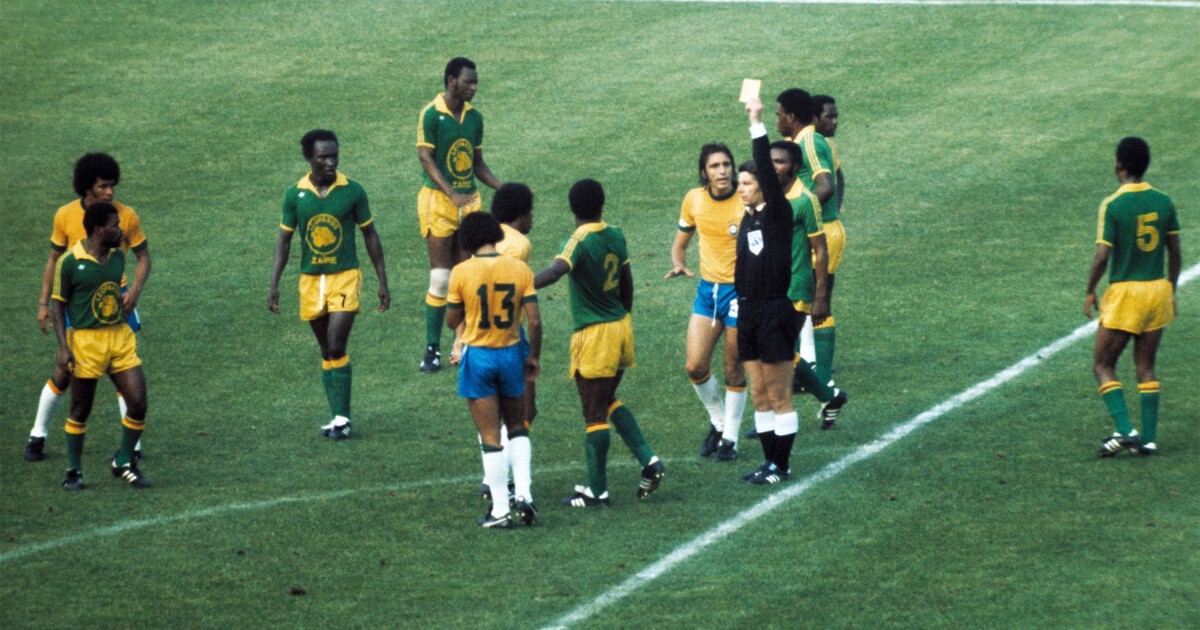
Players themselves have sometimes been the most immediate victims of political circumstance. At West Germany in 1974, just as Brazil’s Rivellino was about to take a free kick, the Zaire defender Mwepu Ilunga broke from the defensive wall and launched the ball to the other end of the pitch. ‘What on earth did he do that for?’ asked the BBC commentator John Motson in adenoidal bewilderment, before ascribing it with the condescension routinely extended to emerging football nations as ‘a bizarre moment of African innocence’. Much has been made, via Norman Mailer’s book The Fight (1975) and Leon Gast’s documentary film When We Were Kings (1996), of President Mobutu’s self-promotion via the Rumble in the Jungle, the 1974 heavyweight title fight between George Foreman and Muhammad Ali in Kinshasa. Mobutu, who was always more interested in football’s potential to enhance his regime, trumpeted the fact that Zaire was the first Black African nation to qualify for a World Cup, and even helped design their kit. But the houses, cars and bonus money promised to the players didn’t materialise, and after a defeat to Scotland and then 9-0 to Yugoslavia, government officials warned them that if they conceded more than three goals in the final group game against Brazil they would never see their families again. For their part Brazil knew that a win by three goals would guarantee qualification, and were 3-0 up when the free kick was awarded in the 79th minute. ‘I panicked,’ Ilunga recalled. ‘I thought I could waste some time if I kicked the ball away … I felt foolish because the crowd started to laugh and so did the Brazilian players.’ But, he explained, ‘we were playing for our lives.’ The ball was retrieved and with, who knows, perhaps a few vital seconds knocked off the clock, the game finished 3-0. Brazil went through, and Zaire’s players were not executed. Iraq’s first World Cup was Mexico 1986; the president of the Iraqi football association was Uday Hussein, son of Saddam, who changed the national team colours to those of his own team, Al-Rasheed, and kept a torture scorecard with instructions on how many times each player should be beaten on the basis of his performance. Before the USA 1994 World Cup, the Colombian players were taken blindfold to a luxury finca in the mountains where they discussed bonuses with the Cali cartel. In their second game the US beat them 2-1 after an own goal by Andrés Escobar. Ten days later he was shot dead in a car park outside Medellín. In these contexts, Bill Shankly’s already tired aphorism about the relative importance of life, death and football feels wretchedly provincial.

The Zaire defender Mwepu Ilunga is shown a yellow card during the World Cup in West Germany (1974).
There have of course been many moments when something like innocent joy breaks out. Italia 90 is perhaps the best example of the disconnect between the actual football and its surrounding spectacle. Goals per game were the lowest ever at 2.21; in only two matches did teams come from behind to win; a third of the games finished 1-0. (All this would induce Fifa to change the offside law and to outlaw the back pass.) But the average attendance, at 48,368, was the highest ever, and the global TV audience doubled from Mexico 1986 to 26.6 billion. Wilson observes: ‘That the football was largely dreadful, perhaps the worst of any World Cup finals, was almost an irrelevance. Soundtracked by Pavarotti, Italia 90 was the most emotionally fraught, the most melodramatic World Cup there has ever been.’
Wilson’s book does due and inevitable diligence to that summer’s vicissitudes for England fans, but overlays it with a class analysis demonstrating that the game was moving upmarket after the horrors of Heysel and Hillsborough, Thatcherite reactions to hooliganism and the breaking of the English working class, but also the celebratory humour of fanzines and the culture of acid house. The 1990 Taylor Report mandated all-seater stadiums for the top two divisions. All of this, Wilson argues, ‘suited the newer, more gentrified audience drawn by Italia 90 with its opera, classical backdrop and emotion’; the FA’s 1991 Blueprint for the Future of Football duly positioned the game ‘to move upmarket so as to follow the affluent middle-class consumer’. Paul Gascoigne was, Wilson says, ‘catnip’ to this demographic, citing Ian Hamilton’s writing in Granta and Karl Miller’s celebrated paean in the LRB (29 July 1990): ‘fierce and comic, formidable and vulnerable, urchin-like and waif-like, a strong head and torso with comparatively frail-looking breakable legs, strange-eyed, pink-faced, fair-haired, tense and upright, a priapic monolith in the Mediterranean sun’. Without Hamilton and Miller, no Wilson (or, you suspect, the journalists Barney Ronay and Jonathan Liew).
A broader but much less acknowledged demonstration of football’s generational power lay across the Irish Sea. Ireland had never qualified for a World Cup but England 1966’s Jack Charlton took them to Italy in 1990, and Mary Robinson appealed directly to the mood of optimism and internationalism this generated when she was elected later that year. It was a big deal to appoint an Englishman as manager given the historical importance of the Gaelic Athletic Association, which promoted hurling and Gaelic football; soccer was the ‘garrison game’. The Catholic Church had endorsed the GAA to the extent that it proscribed soccer on church property, and the Christian Brothers had beaten the future internationals Ray Treacy and Eoin Hand for playing it. Irish participation at Italia 90, Wilson shows, allowed younger Irish people to feel connected with a global event in a way that Gaelic sports did not. The Irish columnist Declan Lynch wrote that what Charlton achieved was a liberation ‘from all that bullshit of ours about the great poets and the great patriots and the great saints’. When Niall Quinn equalised against the Netherlands, Roddy Doyle recalled: ‘I was glad I was Irish. I’d never felt that way before.’ Ireland made it to the quarter-finals, where they lost to the hosts: by then, buses in Dublin had stopped bothering to run during games, and concerts by Mick Jagger and Prince at Lansdowne Road had been cancelled. A quarter of a million people turned out in Dublin to receive the squad. It helped that Charlton – cloth-capped, with a fishing rod in one hand and a pint in the other – was a very different Englishman from those memorialised in the Irish rebel songbook. As Lynch put it, ‘this was the sort of Englishman we could take orders from.’
Italy’s victory in Spain in 1982 also dispensed a collective Prozac after the first decade of the Years of Lead. Most notably, in 1978 the former prime minister Aldo Moro had been kidnapped and executed by the Red Brigades, and in 1980 the Bologna massacre, a far-right terrorist bombing at the railway station, had killed 85, but there was a clear sense that regionalism and factionalism were subdued by the tournament win, with 95 per cent of the TV viewing public tuning in and huge street parties. Umberto Eco, in the calcio equivalent of William Cobbett’s ‘I defy you to agitate any fellow with a full stomach,’ had asked in 1978: ‘Is it possible to have a revolution on a football Sunday?’ Sandro Pertini, who had fought in the First World War and as a partisan in the Second, became president of Italy in 1978 at the age of 81, a unifying figure respected for his humility. He flew to Spain for the final, and was photographed celebrating Alessandro Altobelli’s third goal and then playing cards with the team, the World Cup alongside them, on the flight home. Though Wilson doesn’t pursue this, the moment didn’t last. The Red Brigades continued to attack targets throughout Italy until 1988.
World Cup success yields domestic dividends, but they are generally short-lived. Nowhere demonstrates this better than France. French football had always been elevated by immigrants for whom the parlous nature of the professional game was worth the economic risk – most players were amateurs with other careers. The great Raymond Kopa(szewski), part of a legendary Real Madrid team and pivotal to France’s emergence in the 1950s, was the son of Polish immigrants. Just Fontaine, whose thirteen goals at Sweden 1958 remains the record for a single tournament, was born in Marrakesh to a Spanish mother, while Roger Piantoni was of Italian descent (as was Michel Platini). The victory of France’s ethnically diverse squad in 1998 generated a swell of integrationist optimism: 26 million French people watched the final (3-0 v. Brazil), and the million-plus who took to the Champs-Élysées was the biggest crowd there since the Liberation. The coach, Aimé Jacquet, was transformed from ‘dull bumpkin into an avatar of la France profonde’; this was a victory of the black-blanc-beur. While Jean-Marie Le Pen attacked its ‘artificiality’, L’Express proclaimed that ‘French people, all French people, were able to identify with this team because it was a multi-racial team.’ In an editorial in Libération, Laurent Joffrin was a discordant voice in calling France’s new-found sense of racial harmony an ‘illusion utile’, but it is a conclusion Wilson endorses: ‘France had won a World Cup and, while that did change French football, it did not change France.’
At the 2010 World Cup, the French squad downed boots at the decision of the FFF to expel the Black striker Nicolas Anelka for disciplinary reasons. Domestic denunciation of the players was distinctly racialised, their indiscipline associated with the problem of the immigrant banlieues from which so many had emerged; Nicolas Sarkozy, as minister of the interior, had notoriously responded to the 2005 riots by pledging to clean out the racaille (rabble), and in the Assemblée Nationale white politicians spoke of the players as caïds (big shots), a word of North African origin. France were eliminated without winning a game. ‘When France fail to win,’ Anelka remarked, ‘people start talking straight away about the players’ skin colour and religious beliefs.’ The black-blanc-beur moment had evaporated. It was striking that when France won their second World Cup in Russia in 2018 there was none of the multiracial charivari of two decades previously: the Black Muslim Benjamin Mendy responded to a viral social media post that listed 19 of the 23 squad names alongside the flags of their families’ origins with the names alongside 19 tricolores. Plus ça change: in 1958, after France’s performance in Sweden, where they lost to the eventual winners, Brazil, in the semis, and he won a Ballon d’Or, Raymond Kopa was held by the French press to be emblematic of the ‘good immigrant’. In 1954, when France didn’t make it out of the group stage, there’d been crowd chants of ‘Kopa, go back to the mine.’
The first World Cup held outside Europe or the Americas was the 2002 tournament, hosted by Japan and South Korea, which Wilson sees as ‘a festival of globalisation’:
Almost everywhere, it felt, the complexities of nationhood in the 21st century were on display. When Senegal beat France in the tournament’s opening game, their starting XI were all based in France, while only one of the France side was. Ten of the Brazil squad that won the tournament played outside the country, while Germany (although they reached the final) blamed their poor form on the influx of non-Germans to their league. Only six of the 32 competing nations did not have a player who played in the Premier League. Japan and Tunisia had players who were born in Brazil … Poland a centre-forward who was born in Nigeria … and Nigeria came very close to selecting a centre-forward who had been born in Uzbekistan … Even England had a foreign manager.
The globalisation of football, of which this was a World Cup portent, is the new normal. With player migration, private equity, petrostate capital and transnational media shaping the sport, it no longer seems strange, as Wilson writes, ‘that an American should own a club in, say, West London and employ an Italian coach to oversee a squad comprising players from France, Ukraine, Senegal and Ecuador, nor that that club should be followed passionately in India, Australia and West Africa’. What’s striking is how far the exploitation of emerging markets became a determinant of Fifa’s governance long before it was conspicuous in the game itself. When the Brazilian João Havelange ran to be president of Fifa in 1974, he did so as the first non-European (sort of – he was the son of a Belgian arms dealer) and by pushing a postcolonial line. Supported by Horst Dassler, the chairman (and ‘das’) of Adidas, he toured the world, lingering in Africa, with Pelé as his celebrity endorser, promising to expand the World Cup and particularly African participation. So began an enduring paradox, whereby Fifa’s irrefragable goals of expansion and inclusion became the very premises of its structural corruption and unaccountability. Havelange offered to pay the expenses of delegates from poorer nations, which was plainly defensible in terms of representativeness, but he also dangled bountiful allowances. Unprecedentedly, all 37 African delegates turned up at the 1974 Congress in Frankfurt, and witnesses reported that Havelange’s associates were passing envelopes to delegates before the vote. It was never wholly clear where the money was coming from, but the likeliest source was Orwec, Havelange’s waste disposal and chemicals firm, believed to have operated as a laundry for the millions of dollars stolen by Portuguese politicians taking flight after the death of Salazar. Thereafter Havelange’s power was absolute. Mexico, for example, got the 1986 tournament principally because he didn’t want his son-in-law’s rival in the Brazilian federation to get the credit for landing it. At the Fifa Congress vote in Stockholm in May 1983, Mexico’s favoured bid presentation lasted eight minutes. Making the competing case for the US’s first tournament, Henry Kissinger was into the second hour of his pitch ‘when he realised the Mexicans were already celebrating downstairs’. Reflecting ruefully on the chicanery of Fifa politics, he remarked: ‘It made me nostalgic for the Middle East.’
Ever since the fiefdoms of Havelange and his successor, Sepp Blatter, Fifa’s conjuring trick has been to justify a boundless cupidity in terms of its service to growing the game. When lobbying to succeed Havelange in 1998, Blatter toured the world in a private jet. One African delegate reported that he had been offered $100,000 by an enlisted Somali diplomat; at least eighteen African countries are thought to have sold their votes. With the ballot, against the Swede Lennart Johansson, looking tight, delegates in Paris were approached by smartly dressed men speaking Arabic and offering briefcases containing $50,000 in cash in exchange for a vote for Blatter. He won, and then announced that in addition to their ‘already lavish expenses’, Executive Committee (ExCo) members would receive a $50,000 salary – ‘the clientelism of the Havelange years’, as Wilson nicely puts it, ‘enhanced for a new era’. Thereafter Blatter littered Africa with his Goal Project, a ‘development and assistance programme’ for national associations. Its first recipient was Charles Taylor’s Liberia. Taylor’s son-in-law was president of the Liberian FA, and received $50,000 so that he could study sports management in the US; at home the team was so under-resourced that when it qualified for the Cup of Nations in Mali in 2002 its star player, George Weah, had to pay for the kit. A year later, Taylor was indicted by a UN special court ‘on charges of murder, mass rape, amputation and mutilation, taking slaves, forcing children to act as soldiers, attacking humanitarian workers and the theft of an estimated $100m from his own country’.
In the index of Wilson’s book, the two most populous sub-entries under ‘Fifa’ are ‘bribes’ and ‘corruption’. Chuck Blazer – which is a name Ian Fleming might have given to a US sports administrator – was general secretary of Concacaf (the football association of North and Central America and the Caribbean) from 1990 to 2011 and a Fifa ExCo member from 1996 to 2013. He had two apartments in Trump Tower (and so it begins), one for himself and one for his cats. In 2011, when the FBI and IRS started to investigate fraud in Concacaf and by extension Fifa, Blazer was turned and agreed to wear a wire to meetings. In May 2015, on the basis of the evidence he procured for the FBI, Swiss police raided the Baur au Lac hotel in Zurich and arrested seven Fifa officials; Blazer pleaded guilty to racketeering, wire fraud, income tax evasion and money laundering. The 353-page report produced for Fifa by the American lawyer Michael J. Garcia and his Swiss assistant, Cornel Borbély, in 2014, as Blatter sought frantically to wriggle free of a tightening net, was a grim inventory of Fifa’s systemic corruption, exposing ‘a culture of expectation and entitlement’ and endemic bribery. England had tried to play the game in its tournament bids but it was risibly, and somehow reassuringly, underpowered: the FA distributed handbags to delegates’ wives and floated a few friendlies, whereas for his vote the Paraguayan ExCo member Nicolás Leoz stipulated a knighthood, an invitation to William and Kate’s wedding and the renaming of the FA Cup. The Garcia Report was delivered to Fifa in 2014, but its adjudicatory committee suppressed it, issuing only a 42-page summary which Garcia regarded as so misleading he resigned. It wasn’t published until three years later, after Bild obtained a copy; by then, Blatter had been banned from football for eight years. His successor, Gianni Infantino, ran as the clean-up candidate, but these things are relative: within months of assuming office he was interviewed by the investigatory chamber of Fifa’s ethics committee (don’t laugh) on suspicion of breaches of the Fifa code of ethics (don’t laugh) for multiple expenses abuses. Having been re-elected unopposed in 2019 and 2023, Infantino has just announced his intention to stand again. His victory seems a formality – both CAF, the Confederation of African Football, and Conmebol, South America’s governing body, have already backed him. Last year he was paid more than $6 million.
Fifa presidents’ constitutional reliance on football’s emerging nations has served its executive class better than the emerging nations. Wilson is persuasively cynical in his characterisation of the vulture-capitalist caravan that is the 21st-century World Cup, seeing South Africa 2010 as ‘the first of a new era of tournaments in which the World Cup landed in a country, contributed very little and left again a few weeks later having made itself a fortune, leaving the hosts to pick up the bill’. Fifa had hitherto shared broadcast, sponsorship, licensing and ticketing revenues with the host, but from 2010 it not only took 100 per cent but demanded tax relief on it. After the tournament, the South African president, Jacob Zuma, admitted that at $2.1 billion, ‘an estimated $765 million of which was the result of price-fixing and corruption within the construction industry’, the World Cup had cost ten times more and delivered ten times less benefit than anticipated; white elephant stadiums were its most conspicuous legacy, as in Brazil four years later. For all of Fifa’s self-congratulation at delivering the first African World Cup, there was little for its populace to cheer. The authorities used the tournament as a pretext to clear informal housing, displacing around 20,000 people in Cape Town. Only 3 per cent of tickets were made available to South Africans, at a cost and via mechanisms beyond the reach of most. Fifa’s corporate model excluded local traders from stadiums, and Black fans who overcame these hurdles had the sense of the World Cup ‘as a non-space, a sterilised Fifa zone into which local quirks could not intrude’. The official song, ‘Waka Waka’, was performed by Shakira, a Colombian, the continent of Africa presumably not thought to have any singers of its own. There was an ambient African sound, lent by the vuvuzelas, the plastic horns familiar in South African football, but many audiences found them so irritating that TV networks dampened the noise. (Having at the time persuaded the University Club in Oxford to ban vuvuzelas at their screenings of games, because I lived close by and the random blasts were waking my infant children, I read this with a wince of shame.)
Wilson construes what should have been a celebration of African football and culture as an act of neocolonial exploitation, ‘a sterile, globalised vehicle that happened to park itself in Africa for a time … The world, once again, had come to Africa, left an array of problems and made off with the loot.’ The successor tournament was awarded to Brazil even though, similarly, it had no stadium up to Fifa standards, which generated similarly grotesque overspends: $11 billion, of which only 15 per cent was from private sources. Within a year of the World Cup the Estadio Mané Garrincha in Brasilia, the second most expensive in history when it was rebuilt for $900 million, was being used as a bus depot. As in South Africa, the project became a pretext for forcible displacement – thought to have affected around 200,000 people – as well as a counter-terrorism bill criticised by the UN for having a ‘potential for deliberate misuse’: on the day of the Confederations Cup final rubber bullets were fired into crowds protesting at the cost of the World Cup.
With Fifa taking all tournament revenue, and the event increasingly dependent on enormous subsidies from the host nation, the question arose: who would want it? The locations of the 2018 and 2022 World Cups furnish the answer. The scale of the sportswashing in Qatar 2022 diminished even that of Russia 2018, but the tournaments were in some ways conjoined. When Germany secured the 2006 tournament it did so by being more, well, efficient in its understanding of Fifa’s bidding processes than anyone else. Since Saudi Arabia and Thailand both had delegates on its ExCo, Germany sent a shipment of rocket-propelled grenades to the former, and Bayer invested in the latter. Daimler put together a €100 million package to aid Hyundai, the family firm of the South Korean Fifa vice-president, Chung Mong-joon. Since Thailand, Malta, Trinidad and Tobago and Tunisia all had votes, Kirch, the German media company backing the bid, arranged for Bayern Munich to play friendlies in all four countries, and paid their local federations $300,000 for the privilege. The CEO of Adidas, Robert Louis-Dreyfus, loaned the DFB €6.7 million, which was used to help secure the four Asian votes; this only came to light when he was later repaid via a Fifa account.
As ever, Vladimir Putin was watching. In 2010, in advance of the bids for the 2018 and 2022 tournaments, the Russians drew up a dossier on each of the ExCo members, identifying who was most susceptible to which type of bribery; the Belgian Michel d’Hooghe, who switched his vote to Russia, later admitted that he had accepted ‘a small painting’ from the Russian state collection. There was also collusion with another state whose aspirations to be sole host were initially thought preposterous – Qatar. Before the vote a Russian delegation visited Qatar to discuss a major gas contract, and the Qatari emir, Sheikh Hamad bin Khalifa Al Thani, met Putin personally to discuss broader cooperation. Fifa’s evaluation had classified every bid to host 2018 and 2022 as ‘low-risk’, except Russia (‘medium’) and Qatar (‘high’).
Putin became president of Russia in 2000. He ordered the invasion of Georgia in 2008 and of Crimea and the Donbas in 2014. In 2012, having secured the 2018 tournament, he embarked on what Human Rights Watch called ‘the worst political crackdown in Russia’s post-Soviet history’. He maintained Bashar al-Assad in Syria after 2015 and expanded the Wagner Group’s footprint in Africa from 2017. The dissident Alexander Litvinenko was murdered in London in 2006, and three months before Russia hosted the 2018 World Cup the Skripals were poisoned with Novichok in Salisbury. In 2017 the Norwegian investigative journalist Håvard Melnæs found more than a hundred North Korean workers building the St Petersburg stadium on terms that met the UN designation for forced labour, and at least 21 deaths were reported on stadium sites. The ID apps introduced for stadium entry at the tournament were then extended to domestic matches and used by Russia’s communications ministry to monitor dissidents. Infantino’s by now characteristic reaction to all this was to denominate 2018 the ‘best World Cup ever’, and to accept the Order of Friendship from Putin in a lavish event at the Kremlin in which he spoke of ‘bonds of friendship [that] will never be broken’.
Worse was to come . Qatar, which became independent from Britain in 1971, is one of the world’s wealthiest countries thanks to its natural gas and oil reserves. Its success alongside Russia’s in the 2010 vote was an even greater shock to those not paying attention. In 2010, Michel Platini was president of UEFA and a member of Fifa’s ExCo. He was known to be hostile to the Qatari bid, on the self-evident grounds that it had neither the football tradition nor the stadium infrastructure to merit it. In November that year, ten days before the vote, Platini attended a lunch at the Élysée Palace with President Sarkozy; the heir to the emir of Qatar, Sheikh Tamim; the country’s prime minister, Sheikh Hamad bin Jassim Al Thani; and Sébastien Bazin of Colony Capital, the US fund that owned 98 per cent of the struggling Paris Saint-Germain. After the lunch, Sarkozy pressed Platini to support the bid, and he did. As Wilson records, ‘seven months after he had cast his vote, Qatar Sports Investment bought a majority stake in PSG. Five months after that, beIN SPORTS was launched by [Qatari-owned] Al Jazeera, challenging Canal+, which was disliked by Sarkozy. By 2018, Qatar had ordered 36 Rafale fighter jets from France at a cost of around $10 billion.’ Platini has always denied that the lunch had anything to do with his sudden moment of clarity. Less covertly, Qatar lobbed an emir’s ransom at Zidane as well as the game’s most selective moral commentator, Pep Guardiola, to enrol as ambassadors for its bid.
The other arm of the Qatari strategy was straight out of the Havelange-Blatter emerging-football-nation clientelist playbook. In 2005, Qatar launched the £1 billion Aspire Academy and its attendant Football Dreams project, an Al Jazeera reality TV show that followed football trials across Africa and Asia in search of young talent which could be naturalised in Qatar – the state was trying to buy even its own team. (‘As Aspire were not a professional club,’ Wilson diligently notes, ‘Fifa’s regulations on moving juveniles across national borders did not apply.’) The scheme came to nothing, but of the fifteen Aspire outreach programmes that were established, five (Cameroon, Guatemala, Nigeria, Paraguay and Thailand) were in the countries of members of Fifa’s ExCo. The Garcia Report would show that Football Dreams paid £2 million to a bank account in the name of the ten-year-old daughter of Brazil’s ExCo member (and, not coincidentally, Havelange’s former son-in-law), Ricardo Teixeira, who was banned for life in 2019. The investigative reporter Nick Harris has estimated that ten of the 22 members of ExCo who voted on the deal have since been banned for ethics violations, and four have been either indicted or convicted of criminal corruption.
‘There were,’ Wilson comments, ‘two World Cups in Qatar in 2022’:
There was the World Cup of Lionel Messi and Argentina, and there was the World Cup of Abdullah Ibhais and all the others jailed or abused in the name of the tournament. Some of the football in Qatar was spectacular, the final was thrilling and the core narrative of Messi’s success, after so many failures, was one of the greatest in sporting history, but the cost was incalculable: countless deaths, thousands forced to work in inhumane conditions and routinely mistreated, the normalisation of prejudice in direct contravention of Fifa’s own statutes.
The lengths to which Fifa was prepared to go to accommodate Qatar’s bid had become clear when the tournament was unprecedentedly shifted from a summer to a winter slot to avoid average temperatures of 41°C, which entailed rearranging the global football calendar for two years. Fifa’s own evaluation acknowledged that since Qatar did not have a single stadium of the required standard, its labour laws would have to be suspended in order to build them. We don’t know exactly how many migrant workers died in Qatar, but Wilson is magnificent in his refusal to put their story below Messi’s. ‘Death was everywhere in Doha,’ he writes. ‘Every building, every apartment block, every hotel, every mall, every stadium was a monument to human suffering.’ In February 2021, it was reported that at least 6500 people from India, Bangladesh, Pakistan, Sri Lanka and Nepal had died in Qatar since 2010, when it was awarded the World Cup, and those figures did not include the many African and Filipino workers. In 2022, Nepal estimated that around two hundred of its citizens had committed suicide in Qatar in the preceding decade. Immigrant workers were employed under the kafala system, bound to contracts and unable to change jobs, and their passports were often confiscated. Reports of three-hour sleep shifts, arbitrarily docked pay and inhumane living conditions were legion. In 2013, Anti-Slavery International reported ‘clear proof of the use of systematic forced labour’. When Abdullah Ibhais, a Jordanian media manager for the Supreme Committee for Delivery and Legacy, raised concerns about workers who had no access to drinking water and had not been paid for several months, he was jailed for three years.
Qatar is known to have spent more than £200 billion on the tournament itself, simultaneously confirming its status as the second-highest CO2 emitter per capita in the world. This included importing its own fans, mostly from Lebanon; by the end of Qatar’s first game the stadium was half-empty (Qatar were knocked out after three straight defeats with easily the worst record of any host). Seven European teams said that their captains would wear ‘One Love’ armbands in support of LGBTQ+ rights until ‘One World’ Fifa warned that any player who did so would be booked; hats and shirts bearing the rainbow symbol were confiscated, along with shirts worn by Iranian fans commemorating the death in custody of Mahsa Amini, a 22-year-old arrested by the Iranian morality police for not wearing a hijab. After the captivating final in Lusail, in which Argentina beat France on penalties, and as the world tried to focus for a transcendent moment on the football, Sheikh Tamim, Platini’s lunch companion in Paris twelve years earlier and, since 2013, the emir, approached Messi and draped him in a bisht – the national colours of the winning captain literally smothered by Qatar.
On the eve of the tournament, an exasperated Infantino delivered a stupefying 57-minute monologue at a press conference called by Fifa to defend the event from its critics. This was premised on the basis that the West, having done Very Bad Things in the past, had no right to criticise Qatar, Infantino not seeming to appreciate that this was to concede the worldwide verdict that Qatar was doing Very Bad Things in the present. Its intended coup de théâtre was a statement of empathy with those whose interests were being asserted by human rights groups:
Today I have very strong feelings … Today I feel Qatari. Today I feel Arab. Today I feel African. Today I feel gay. Today I feel disabled. Today I feel a migrant worker … I feel like them because I know what it means to be discriminated, to be bullied as a foreigner in a foreign country. As a child at school I was bullied because I had red hair and freckles, plus I was Italian, so imagine.
(When it was pointed out that he had omitted half the world’s population he spontaneously added: ‘I feel like a woman too.’) It’s hard to know where to start in anatomising the piss-boiling offensiveness of this formula: it’s partly its crassness, given that Infantino was neither imprisoned nor driven to his death for his red hair and freckles; it’s partly its tick-box nature, as if he and a PR guy had spitballed as many categories as they could in order briskly to affirm Fifa’s affinity with them; and it’s partly its ephemeral ‘today’ element, as if having discharged his conscience Infantino was at liberty to revert tomorrow to being a vastly wealthy, privileged white man free from the danger of being persecuted or enslaved.
We might want to console ourselves that nothing could be as bad as the murderous vulgarity of Qatar, but at the centre of this year’s World Cup the increasingly nihilistic presence of Trump 2.0 threatens to turn everything to shit. For all the expansion of soccer in the US in recent years the game remains niche, sustained by the immigrant communities routinely denominated ‘garbage’ by the second-generation immigrant president and now threatened by ICE raids targeting undocumented fans at World Cup venues. When the US first hosted, in 1994, it had played in only two World Cups since 1945 and had had no domestic professional league for a decade. Many Americans were as unhappy as everyone else: USA Today assured its readers that it was legitimate not to give two hoots about the World Cup of the biggest sport in ‘Cameroon, Uruguay and Madagascar’, and the columnist Tom Weir wrote that ‘hating soccer is more American than mom’s apple pie.’ Writing in the New York Times, George Vecsey nailed it: ‘The United States was chosen because of all the money to be made here, not because of any soccer prowess. Our country has been rented out as a giant stadium and hotel and television studio.’ The opening ceremony at Soldier Field in Chicago was predictably unrestrained, but it seemed symbolic of national awkwardness that Oprah Winfrey fell off the stage and injured her ankle, while Diana Ross missed an open goal from three yards. The ensuing game was a boring 1-0 between Germany and Bolivia, with the whole day’s entertainment surpassed by the LAPD’s televised pursuit of O.J. Simpson. Two years later, however, Major League Soccer had its first season; by 2025 it was the ninth biggest sports league in the world as measured by – what else? – revenue. Wilson crisply traces the administrative process from which it emerged:
MLS, a private company headed by Alan Rothenberg, received $500,000 from World Cup USA, chaired by Alan Rothenberg, to present its business plan to the US soccer federation, whose president was Alan Rothenberg. USSF, whose president was Alan Rothenberg, then opted for MLS, headed by Alan Rothenberg, for which it received $3.5m from World Cup USA, chaired by Alan Rothenberg.
Rothenberg, known as ‘Rothenweiler’, was a commercial lawyer with no previous interest in soccer before recognising, as he was to put it, ‘a great opportunity’.
Last summer’s Infantino-inflated men’s Club World Cup, held in the US, was in some ways a foretaste of the Fifa-MAGA pageant. Resisted by players’ unions, resented by many teams and derided by many fans, it was largely meaningless as a barometer of club excellence in world football. But that wasn’t the point of the exercise, which was first an Infantino vanity project – Fifa commissioned a blingy 24-carat-gold trophy from Tiffany’s on which his name was engraved as ‘founding president’ – and second an aphrodisiac for US stakeholders. Attempts to develop hybrid grass surfaces in NFL stadiums with artificial turf were a resounding failure; the PSG coach, Luis Enrique, was only the most poetic in complaining that ‘the ball bounces … like a rabbit,’ while some games were played in blistering heat and others only after severe weather delays, with squads travelling thousands of miles between matches. There were banks of empty seats, dynamic pricing went the way its authors never intend, and the tournament broke even only because Saudi Arabia’s Public Investment Fund (PIF) excreted a quick-fix $1bn into DAZN, which DAZN then passed to Fifa for TV rights despite there being no other bidders. Hmm.
The finances will be dramatically different for the World Cup, but the surrounding optics will be the same, with Infantino, in his designer suit and turkey-teeth trainers, dancing attendance on POTUS. Infantino paraded the CWC trophy at a meeting in the Oval Office before the tournament, but Trump affected to presume that it was a present and kept it – it certainly harmonised with the décor – compelling Fifa hurriedly to commission a copy. On his way to the podium after the final, Trump was caught on camera pocketing one of the winners’ medals he was supposed to hand out; in a moment symbolic of their relationship, Infantino glanced round, smiled awkwardly and gave Trump a thumbs-up. Dependably breaching all sporting protocol, Trump then remained on the podium and posed front and centre with the winning Chelsea players while they celebrated (Cole Palmer captured their reaction to his photobombing with a WTF? glare that went viral on social media). If the US get out of their World Cup group this summer there will no doubt be further Trump grandstanding; if they don’t, watch out for MAGA-nativist denigration of ‘soccer’ as foreign and effeminate.
This World Cup, unlike Russia 2018, is hosted by democratic nations, and unlike Qatar 2022 the walkways to its stadiums are not paved with bones. But it will forever be associated with newly obscene levels of fan exploitation, with Fifa’s remorseless commodification of the people’s game set to result in a gated tournament confined to those few with the requisite income, visa status and social media history. At previous World Cups resale prices were capped at face value, but for 2026 Fifa has lifted that restriction and introduced dynamic pricing on the pretext of ‘market norms’ in North America. Simultaneously it has waded into the secondary market, launching a resale platform that pockets 15 per cent commission from the seller and 15 per cent from the buyer and therefore an eye-watering third of every listing, self-incentivising multiple resales; only Fifa could make Ticketmaster and StubHub look philanthropic. One $2030 ticket for the final – the lowest bracket – was relisted the following day for $25,000; the cheapest at the time of writing is $8970, and the most expensive $11,499,998.85 (priced, it seems, to ensnare that casual buyer who might balk at $11,500,000). Responding to worldwide condemnation even from fans inured to corporate contempt, Infantino declared at a sports summit in – where else? – Dubai that ‘without Fifa, there would be no football in 150 countries in the world. There is football because, and thanks to, these revenues we generate with and from the World Cup,’ as if Homo sapiens spontaneously kicking a rolling object would never have occurred unless Fifa had franchised it. Despite its protestations that it is just going with the commercial flow, Fifa is squarely responsible for this late capitalist cacotopia: Taylor Swift, the Cure, Neil Young, Iron Maiden and even Oasis – Oasis! – have refused to employ dynamic pricing on their recent North American tours, and in Mexico Fifa was required by the government to honour face-value resales on a localised platform. The price-gouging is therefore an affront vastly larger than Fifa’s non-profit, redistributive fig leaf can cover. Trump himself recently expressed shock when he was told that the cheapest tickets for the US opener against Paraguay were set at $1120 – ‘I wouldn’t pay it either, to be honest’ – but of course, unlike Mussolini, he won’t have to: Infantino has already publicly presented him with a metre-wide ticket to the final, ‘row 1, seat 1, ticket no. 45/47’.
Infantino, who once pronounced that ‘it’s very clear that politics should stay out of football and football should stay out of politics,’ has enabled and endorsed every act of vanity, self-interest and political trespass on the tournament by the Trump administration. He was in Washington DC at Trump’s inauguration in January 2025, chuckling when the new president announced that he intended to change the name of the Gulf of Mexico to the Gulf of America. So much for the US’s co-host. He was in the Oval Office in March, smiling, when Trump announced that he would chair a World Cup task force and that international tensions over tariffs would only make the tournament ‘more exciting’, before parading the trophy at a White House cryptocurrency summit. He was in the White House again in May, at the first meeting of the task force, smirking as J.D. Vance joked about visiting fans being arrested if they overstayed their visas. A week later he was with Trump in the Middle East, visiting officials from Saudi Arabia and Qatar alongside the president, which caused him to be so late for Fifa’s annual congress in Paraguay that eight members of the Fifa Council walked out in protest, accusing him of prioritising ‘private political interests’. He was in New York City in July, beaming as he announced that Fifa was opening an office in Trump Tower, an event attended by Eric Trump, executive vice president of the Trump Organisation. He was back in the Oval Office in August, grinning alongside Trump, who was wearing a hat bearing the slogan ‘TRUMP WAS RIGHT ABOUT EVERYTHING’ and announcing that the World Cup draw would be moved from Las Vegas to the Kennedy Center, of which Trump had installed himself as chair and which was shortly afterwards renamed the Trump-Kennedy Center. He was photographed at Trump’s Gaza peace talks in October. He appeared with Trump at the America Business Forum in Miami in early November, commenting that ‘we should all support what he’s doing because I think it’s looking pretty good.’ He was back in the Oval Office again later that month, nodding as Trump threatened to remove games from Democrat-run cities such as Seattle ‘where you have a very, very liberal-slash-communist mayor’.
Through his highly visible conduct in Qatar and now the US, Infantino has become the embodiment of Fifa’s invertebrate greed. It doesn’t help that he looks like a fantasy villain out of central casting, the Hood for those who remember Thunderbirds, or Dr Evil from the Austin Powers movies, his abnormally high, bald dome looking like it might slide open at any point to disgorge a gold-plated bauble for some passing oligarch. But just because it’s easy to demonise Infantino doesn’t mean that we shouldn’t. The nadir of his sycophancy is the Fifa Peace Prize. In October 2025, to Trump’s transparent displeasure, the Nobel Peace Prize was awarded to Venezuela’s María Corina Machado. Three weeks later Fifa announced its own peace prize, plainly so that it could be given to Trump during the World Cup draw in Washington DC in December. Human Rights Watch wrote to Fifa to request a list of the judges, the criteria and the nominees for the prize, but received no response. FairSquare then filed a formal complaint to Fifa’s ethics committee over Infantino’s ‘repeated breaches’ of its rules on neutrality; articles 15 and 23 of Fifa’s statutes stipulate that the organisation and its confederations must ‘be neutral in matters of politics and religion’ and be ‘independent and avoid any form of political interference’. Responding to global criticism, Fifa issued a perfunctory statement in January which stated that ‘Fifa notes the 2025 Nobel Peace Prize recipient has given her medal to President Trump’ – the Nobel Committee was wrong, that is, and Infantino was right.
Tom Lehrer commented that when Kissinger was awarded the Nobel Peace Prize, political satire became obsolete. In his instrumentalism and amorality, Infantino was purpose-built to navigate Fifa in a post-satire, post-truth world. But in doing so he has reversed the polarity between the organisation and its political suitors. Havelange and Blatter had a vivid sense of the importance of the fifadom they had built: ‘I can talk to any president, but they will be talking to a president too,’ Havelange said in 1997. ‘They’ve got their power and I’ve got mine: the power of football, which is the greatest power there is.’ But Infantino, with his Order of Friendship from Putin, children schooled in Qatar and installation as White House poodle, has been lamentably deferential to harder power. Trump has hitherto looked faintly amused during Fifa’s golden showers, but with his poll ratings at an all-time low he may need Infantino.
Infantino said in November that ‘I consider him a really close friend,’ insisting that Trump deserved the inaugural peace prize ‘for his tireless efforts to promote peace’. In the few months since then Trump has launched airstrikes across Venezuela, threatened to invade Greenland and bombed Iran, threatening to exterminate ‘a whole civilisation’. The only previous co-hosted World Cup, in Japan and South Korea, afforded a rare moment of Rimetiste détente: Japan occupied Korea between 1910 and 1945, and South Korea’s opening ceremony ignored Japan, but polls showed that both peoples felt friendlier to the other after the tournament. It’s hard to see US-Mexico-Canada having the same diplomatic consequences, with Trump constantly threatening ‘strikes’ against Mexico if it does not do more to prevent drug trafficking, the annexation of Canada and withdrawal from the United States-Mexico-Canada Agreement (which replaced Nafta in 2020).
If the interaction of geopolitics with a Trump World Cup was not sufficiently combustible, there is the issue of Iran’s qualification. The Iranian case problematises the easy assumption that regimes benefit from sporting success: when Iran qualified for France 1998 street celebrations attended by six million morphed into anti-government protests with men and (bare-headed) women mixing freely; a nervous regime delayed the team’s return from the match. At the tournament, three years after President Clinton had imposed a complete embargo on Iran, the US and Iran met in an elimination game. Ali Khamenei instructed the Iranian players not to walk towards the US team to shake hands, but they presented the American players with white roses. Iran won 2-1: ‘Tonight, again,’ Khamenei told the players on TV in totalitarian burlesque, ‘the strong and arrogant opponents once again felt the bitter taste of defeat at your hands,’ before street celebrations again turned into protests. There was guilty excitement this year in Italy, which failed to qualify, at the suggestion that the Azzurri might replace Iran at the World Cup, which emanated with the Trump administration’s customary regard for procedural propriety from the unblushing Italian-American US special envoy, Paolo Zampolli. The propaganda dangers for Iran of participation are obvious, with two female Iranian footballers granted asylum in Australia after the AFC Women’s Asian Cup in March this year, and the prospect of the Iranian flag and national anthem being loudly booed by US and Iranian-dissident crowds, before Rimet’s unquiet ghost. Khamenei himself was assassinated in the February airstrikes on Tehran. But the dangers are plainly not confined to Iran. FEMA has already allocated $625 million to security costs for the tournament, and the FBI is widely reported to be alarmed at the counter-terrorism challenge presented by 78 matches played over six weeks, along with countless watch parties. If the US and Iran both finish second in their groups they will play each other in a World Cup eliminator again. Only this time, it will be on the eve of the Fourth of July. In Texas.
The beautiful game has never looked more beautiful on the pitch, or more ugly off it. We strain for the sake of our consciences to sequester the two, but Infantino’s Fifa has made that impossible. On 13 November 2025 Portugal’s Cristiano Ronaldo was sent off for elbowing Ireland’s Dara O’Shea in a World Cup qualifier in Dublin. The tariff for violent conduct is a three-match ban, which meant Ronaldo would miss the final qualifier and then the first two games of the World Cup. On 16 November he inconsequentially sat out the first of those, Portugal’s 9-1 stroll v. Armenia. On 18 November, Ronaldo attended a black-tie dinner at the White House alongside Trump, Infantino, the Saudi crown prince Mohammad (‘things happen’) bin Salman, Elon Musk and Apple’s CEO, Tim Cook, and was pictured with a beaming Trump, who announced that Saudi Arabia was investing $1 trillion in the US and told guests, probably moments after having been briefed on who he was: ‘My son is a big fan of Ronaldo.’ It was Ronaldo’s first visit to the US since the 2017 leaking of a rape allegation in Las Vegas, which he resolved via a financial settlement and a confidentiality agreement. It was bin Salman’s first visit to the US since being accused by the CIA of complicity in the dismemberment of the journalist Jamal Khashoggi in 2018. In 2023 brand ‘CR7’ had relocated to Saudi Arabia, becoming the rictus-grin face of the Saudi Pro League and the captain of Al-Nassr, the club owned by the PIF sovereign wealth fund chaired by bin Salman, on a salary of more than half a million dollars a day (since increased). On 25 November, to collective outrage within the game, Fifa announced that Ronaldo’s ban had discretionarily been reduced to one match – so its marquee player, Trump fluffer and Saudi stooge was free to take top billing this summer. The centenary World Cup in 2030 is on the face of it an oddly contrived as well as environmentally reckless affair, with opening games in South America and the remainder in Spain, Portugal and Morocco. With the major footballing continents of South America and Europe glancingly recognised in a single tournament, Fifa felt at liberty to place it in neither for the succeeding one. The 2034 World Cup will be hosted by Saudi Arabia.