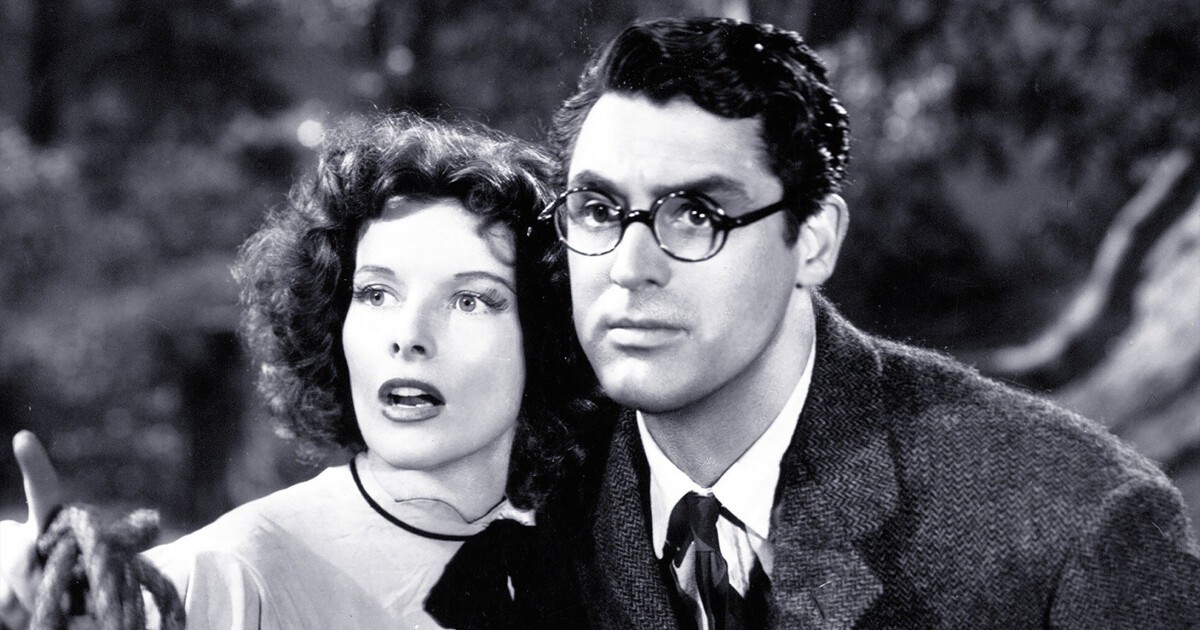
In an interview with Peter Bogdanovich, Howard Hawks said there was a ‘great fault’ with Bringing Up Baby (1938): ‘There were no normal people in it. Everyone you met was a screwball.’ At the helm of these crazies, with Cary Grant’s palaeontologist in tow, is Katharine Hepburn’s Susan, except is she really crazy? Her dialogue has the stamp of the Marx Brothers’ best lines – mad-sounding but strangely logical – and for all her daffiness, her relentless speed, her loopy Bryn Mawr voice, she’s often telling the truth: there really is a leopard, and it really does love the song ‘I Can’t Give You Anything but Love, Baby’. So what’s screwy in screwball comedy, the world it depicts or the people in it?

The Garden Cinema in Holborn is showing seventeen films in its ‘Screwball Summer’ (until 18 August). They include nearly all the classics of the genre, among them the first, the fastest and the truest: It Happened One Night (1934), His Girl Friday (1940), The Awful Truth (1937). Not all of the choices fit in – Arsenic and Old Lace (1944) is a black comedy, but is it a screwball? – but then you end up quibbling about the Broadway farce v. the populist comedy v. the Lubitsch picture, and it’s not long before you begin to sound like Gary Cooper’s po-faced grammarian in Ball of Fire (1941), a grade-A hair-splitter. Screwball was impure from the start, born out of silent slapstick, early genre pictures and theatrical hits. It wasn’t associated with any one studio, and many of its stars were vaudevillians, singers, stuntmen, Ziegfeld girls or farceurs from Mack Sennett’s two-reelers. Its hallmarks are fast talk, eccentric characters and an oddball couple. There might be a reversal or a misdirection (‘screwball’ comes from a baseball pitch with a twist), but its ironies are reassuringly proleptic: the gold-digger will end up with the strapped cab driver, just as the divorced couple will marry again; opposites, interminably, attract.
The earliest films in the season were made before the enforcement of the Hays Code in 1934. She Done Him Wrong (1933) plays less like an antecedent to screwball than like a reminder of what the code drove underground, into subtext: bawdiness, tough comedy, moral discretion. A young Cary Grant is there, but it’s a Mae West picture; she’s a saloon singer, swaggering about in crystals like the capo dei capi of the Bowery. ‘I’m sorry you think more of your diamonds than you do of your soul,’ Grant – playing against type as a man of the law – says. ‘I’m sorry you think more of my soul than you do of my diamonds,’ she replies. They get together anyway (after he almost arrests her). West made eroticism funny, or simply off-kilter: she’s the matriarch vamp, a parody of the male libertine, and unlike the divine Garbo she belongs to this world, the world of comedy. (When West is described as ‘lascivious’ or ‘suggestive’ it’s a way of admitting that she was witty, but also of denying the kind of Cartesian comedy that separates body from mind.) The code got rid of her mode of double entendre, along with anything else that might lower ‘the moral standards of those who see it’. Was the effect to spiritualise comedy? Or to taint everything else, in that very American way, with the possibility of sin?
In screwball proper, desire is masked as conflict. Frank Capra’s It Happened One Night introduced an early version of the clashing couple, with Clark Gable’s reporter falling for Claudette Colbert’s runaway heiress. He’s a rogue who’s not all that roguish, and she’s mad but not all that mad. He admits he’s in love, then barks: ‘Don’t hold that against me! I’m a little screwy myself!’ A few months later, William Powell and Myrna Loy appeared in W.S. Van Dyke’s The Thin Man (1934) as Nick and Nora Charles, a high-society couple who solve a murder together. Powell is an exaggerated Gable (sleepier eyes, twitchier mouth), so droll and fluid he makes Gable seem tense; Loy would look a bit fey if it weren’t for those highly arched eyebrows, which give her a coolness, a natural irony. Capra’s film better anticipated future configurations of the couple, but Nick and Nora – in their glossier MGM picture – are the leisured model to which all others aspire, a reminder that the main pair must be the best company and that the contingencies of life are best sublimated as parlour game.
Sometimes the screwball couple is no longer a couple. In Pursuits of Happiness (1981), Stanley Cavell writes about ‘comedies of remarriage’ in which a divorced pair must find their way back together again (all seven of his examples are in the season; he twists the rules for most of them, but that’s in the spirit). They take place in a Shakespearean romance world – aka Connecticut – ‘in which perspective and renewal are to be achieved’. The couple must accept, as one character says, that there’s ‘something between’ us no divorce can come between. One suggestion here is that happiness and knowledge (which is only ever the appearance of knowledge), like comedy and philosophy, are not incompatible. It’s so well put, and seems so right; and yet whenever I return to Pursuits of Happiness I get caught up in the philosophising, in barrelling from Nietzsche to Shakespeare to Kant, and the casual charm of the comedies slips away, just as when I rewatch the films, I forget to think.
But there’s room for seriousness in screwball. Take all the men who are researching something, seriously – slang in Ball of Fire, snakes in The Lady Eve (1941), dinosaurs in Bringing Up Baby, the igneous ‘tambula’ in What’s Up, Doc? (1972). It’s a way of joking about value, about what is being overvalued or undervalued as they futz around with rocks and bones. There are other screwball characters with their priorities out of order: overbearing fathers, joyless blue bloods, pestering fiancées, a range of stooges. These aren’t just people who don’t get the joke; they don’t think there’s a joke to get. The couple are often the only characters who do any thinking – it gives them their appeal. Colbert is the best onscreen thinker; she can’t keep it off her round winsome face. In Midnight (1939) she’s disarming as a fluffy-haired American showgirl pretending to be a baroness. She has a habit – like Grant, like Barbara Stanwyck – of delivering one-liners to herself, as though she’s the only person worth entertaining.
Women in screwballs are either brains or scatterbrains. There’s Rosalind Russell, the sharpest comedienne, as Hildy Johnson in His Girl Friday (1940). Russell said she didn’t want to be a ‘clothes horse’, but Hildy’s pinstriped shoulder-padded suit is what makes her: it allies her with the film’s mise-en-scène, the newsroom’s sharp lines of desks, dividers and typewriters, and gives her ownership of it. Irene Dunne, in The Awful Truth, has a more subtle braininess. Her finest moment comes when she tries to break up Grant’s relationship with an heiress by pretending to be his slovenly, ditzy ‘sister’ (‘I’ve seen your pictures in the paper,’ she begins, ‘and I wondered what you looked like’). It’s a brilliant performance of bad manners, but she does it with such precision – see: the routine with the handkerchief – that she appears well judged even when she’s acting crazy. On the side of the scatterbrains, you have Hepburn, Barbra Streisand in What’s Up, Doc? and Carole Lombard in My Man Godfrey (1936), who are for unrestraint what Dunne is for reining it in.
Screwball actors work with and against our impressions of them. The Lady Eve may be the slyest of these films because it’s about the ways in which conforming to type condemns you. Henry Fonda appears as a naive herpetologist who has no chance against Stanwyck’s slippery con artist. The expected scenes of humiliation – like Grant in his negligee in Bringing Up Baby, or Cooper going ‘goofy, bim-buggy’ in Ball of Fire, or Spencer Tracy losing his head in court in Adam’s Rib (1949) – are funnier because there’s a quality in Fonda (a softness? A credulity?) that makes him what Grant, Cooper and Tracy never are: embarrassable. His pratfalling over sofas and Stanwyck’s leg is a joke about his character’s apparent uprightness, but also the preternatural decency signified by ‘Henry Fonda’. He hasn’t done much to deserve this embarrassment, but that’s the screwball logic. He’s embarrassed precisely because he’s the type of innocent who can be embarrassed.
There’s a tautology here: it’s what Cavell is getting at when he says that, in these films, ‘only those can genuinely marry who are already married.’ Screwball has a back-to-frontness about it. In Ernst Lubitsch’s To Be or Not to Be (1942), in which a Warsaw theatre troupe stages a play about the Nazis, impersonations come before the people who are being impersonated. In Bringing Up Baby the leopard doesn’t arrive until after Hepburn has said there’s a leopard; when it pootles into frame, the joke is that she isn’t lying – and yet we’re also left with the suggestion that the world bends to her word. It comes back to fast-talking and the idea behind it: that if you’re quick enough, you can out-talk the truth.
The amorality of the films keeps them from being cute. Grant is their best amoral agent, the one who (Cavell suggests) has an improviser’s disregard for consequences. He’s allowed the distance of reaction – to pop his eyes, double-take – and so he can get by in the darkest of comic worlds, whether they’re enjoyably creepy (Peter Lorre glooming around Arsenic and Old Lace) or plainly corrupt (His Girl Friday). Sometimes it’s a cruel world. The Philadelphia Story (1940) is the only film here in which the camera pauses on Hepburn’s cool beauty, and her character is chastised for it, hectored by everyone from her infidel father to her ex-husband (Grant) for being aloof, inhuman, too good for everyone – for being Katharine Hepburn.
Screwball suffers when moralising lumbers in. It’s the point you think Preston Sturges is going to make in Sullivan’s Travels (1941), his film about a director who abandons silly comedies to make a Message Movie, only the conclusion he reaches – that actually ‘there’s a lot to be said for making people laugh. Did you know that that’s all some people have?’ – is exactly the kind of Capra-esque sermon it seems to be sending up. The problem is that screwball isn’t a democratic genre. The films indulge the spoiled rich while also laughing at them – none guiltier than Sturges, in his affectionate Palm Beach Story (1942) – and their jokes aren’t a shared language. Not everybody is in on them, just as not everybody can be Cary Grant, not even Tony Curtis. Wit, beauty, wealth, leisure, happiness – these are unequally distributed; only craziness is common.
So what accounts for the genre’s likeability? It can’t just be that it’s funny to watch pratfalls or slaphappy sophisticates or couples sparring – to laugh, that is, at the gap between what people are and what they pretend to be. I’ve never liked the ending of Adam’s Rib, when Hepburn concedes to Tracy that there is ‘a little difference’ between men and women and he replies ‘Vive la différence!’ – at least not when it’s taken straight. It misses what’s funny about comic difference, which is that, for all we’re told or shown it’s there, it never seems sufficiently real to enforce itself. Some Like It Hot (1959) doesn’t work just because Tony Curtis and Jack Lemmon are men pretending to be women (though they’re always funny about it) but because nobody notices or cares. Lies and truth have indistinguishable effects, so what’s the fuss? Screwballs aren’t miserabilist-humanist comedies about learning to revel in imperfection; they’re comedies of fantasy and will. With enough conviction, craziness starts to make sense. Think about Grant giving in to Hepburn’s madness in Bringing Up Baby, or Streisand triumphing over Ryan O’Neal in What’s Up, Doc?, or Lombard – the screwiest of screwballs, for whom the term was first used – saying at the end of My Man Godfrey: ‘There’s no sense in struggling against a thing when it’s got you. It’s got you and that’s all there is to it – it’s got you!’