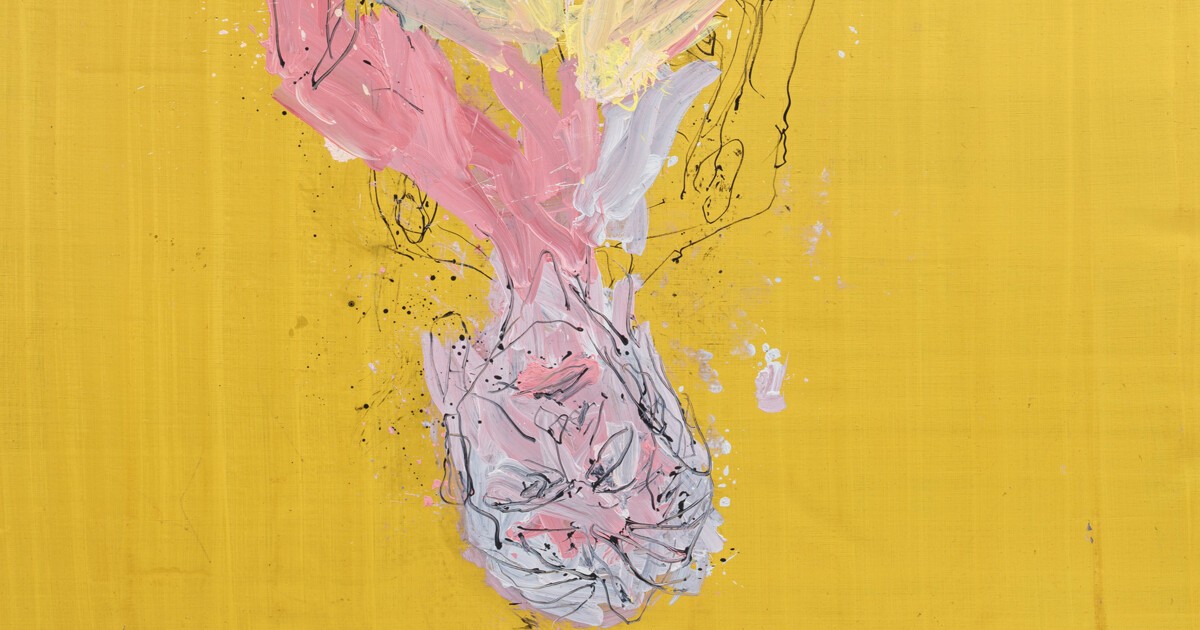
Eroi d’Oro , an exhibition at the Fondazione Giorgio Cini in Venice (until 27 September), contains Georg Baselitz’s final works. He died six days before the show opened, at the age of 88. Sixteen monumental paintings are displayed in two large rooms lined with black fabric; the building adjoins the church of San Giorgio Maggiore, famous for its great late works by Tintoretto, the Last Supper and The Israelites in the Desert. Most of the paintings are close to five metres tall and each portrays a single inverted figure drawn with a fine, searching black line on a shimmering golden ground. All but one depict Elke Kretzschmar, Baselitz’s wife.
They are portraits of a marriage, but also images of a body approaching the extremes of old age. Flesh folds around a thickened abdomen; limbs are attenuated. Ankles become brittle; legs worry about giving out, unable to support the torso to which they are attached. The body seems to be collapsing into itself. A smaller canvas (still around three metres high) depicts Baselitz himself. He is shown seated – upside down of course – his hands crossed, head lifted to draw the dry skin around his neck, the loose flesh sagging upwards. The body, like the line that draws it, is thinned, spluttering, vulnerable. It looks like the self-portrait Hokusai drew in old age, which Baselitz knew of and admired. ‘Until the age of seventy,’ Hokusai said, ‘nothing that I drew was worthy of notice.’

The sense that Eroi d’Oro is a memorial exhibition is heightened by the eerie presence of Baselitz’s voice in a short film accompanying the show. And yet the mood is upbeat – the work doesn’t announce itself as drawing to a conclusion. Patchwork flurries of coloured paint, like crumpled rainbows, appear on some of the figures: an afterthought, Baselitz tells us, that just felt right. They are an echo of Willem de Kooning’s abstract gestures, a memory of paintings Baselitz saw in West Berlin in the late 1950s and which cast their spell over his work for decades. His rainbows are painted with hooked, directionless marks, a little like the ‘crab’s claw’ brushstrokes of traditional Chinese painting. And then there are de Kooning’s ‘Woman’ paintings of the 1950s, clearly part of Baselitz’s personal pantheon, though he rejects de Kooning’s violence, or any claim for the authenticity of expressive gestures. The scumbles of colour are more like floating fig leaves, a form of protection: the rose, cobalt and sienna daubs compensate for the thinness of the aged bodies, giving them back some life, like fruit growing on an old tree. Baselitz’s voice echoes around the gallery: ‘I wanted to construct my connection to the world, to myself and to my wife. The means for this should be as simple and as ordinary as possible.’
The golden Elkes are the summation of Baselitz’s life as a painter, and he said as much: ‘If you were to show these works to an art historian, I think they could just as well draw a line and determine the conclusion.’ They have a remarkably measured sense of freedom. There is none of the desperation that marked Picasso’s late paintings. When you think of Picasso’s howl of decrepitude and unassuaged lust, condensed into images of jarring violence, and then look again at late Baselitz, you realise how faithful he remained to an ideal of painting that had at its core a single purpose. Baselitz said that while painting the golden Elkes, his studio floor was strewn with photographs, though he hardly needed them, having painted his wife for sixty years and solitary figures floating in cosmic space for at least a decade. They are all in some way an elaboration of the series of paintings, drawings and prints he made between 1965 and 1966, showing figures – shepherds, soldiers, painters – wandering alone through war-torn landscapes, surrounded by strange and perplexing symbols. These are the ‘Hero’ works that arose from the vision of Red Army soldiers and Wehrmacht stragglers in the blasted landscape of postwar Germany. Baselitz was forging a new language for painting at a time when that language seemed to have shattered.

The golden Elkes also take us back to the earliest period of Baselitz’s work, when he was making figure paintings against both socialist realism and abstraction. His work took on a mannered look, deliberately laboured and ugly, unnaturalistic, deformed and morally ambiguous. Die Große Nacht im Eimer, a painting of a grim stunted figure who appears to be masturbating, caused a scandal when it was shown at the Werner & Katze Galerie in West Berlin in 1963. When Baselitz and his dealer, Michael Werner, appealed against their prosecution for obscenity, the public prosecutor petitioned (unsuccessfully) for the painting to be destroyed – an astonishing move, considering the Nazi destruction of modern art just two decades earlier.
This was the history that counted: the Nazi attack on ‘degenerate’ art before the war, and the continued presence of this anti-modernist impulse in the postwar era. Baselitz staged a leap into what he called ‘pure’ painting; it was also a leap into the past. ‘The most important thing for me,’ he said in one interview, ‘was to feel a sense of the avant-garde, the destruction of pictures of the past.’ He picked up Hans Prinzhorn’s study Bildnerei der Geisteskranken (Artistry of the Mentally Ill), documenting a collection of what was later called outsider art, formed while Prinzhorn was working at the psychiatric clinic of Heidelberg University. It was a book especially hated by the Nazis, and a vade-mecum for those who wanted to know what un-German, degenerate art looked like. Baselitz also found a historical anchor in Mannerist painting, with its physical distortions and heightened palettes – ‘a tangle of tendrils and artifices, coldness and devotion’, as he put it in a 1961 manifesto written with the painter Eugen Schönebeck.
Baselitz did not make overtly political art. He felt that what mattered in painting existed on a deeper level than subject or style. His ‘degenerate’ work was not only a means of compensating for the paintings that were confiscated, pilloried and destroyed by the Third Reich, but a way of returning dignity to ordinary bodies, bodies that age and sag and look nothing like the heroic forms of antiquity or Nazi racial theory. The golden Elkes confirm that Baselitz devoted himself to showing the body – obdurately, directly, entertainingly – being reshaped by the catastrophe of ageing. In so doing, he staged one of the most sustained protests in the history of art.