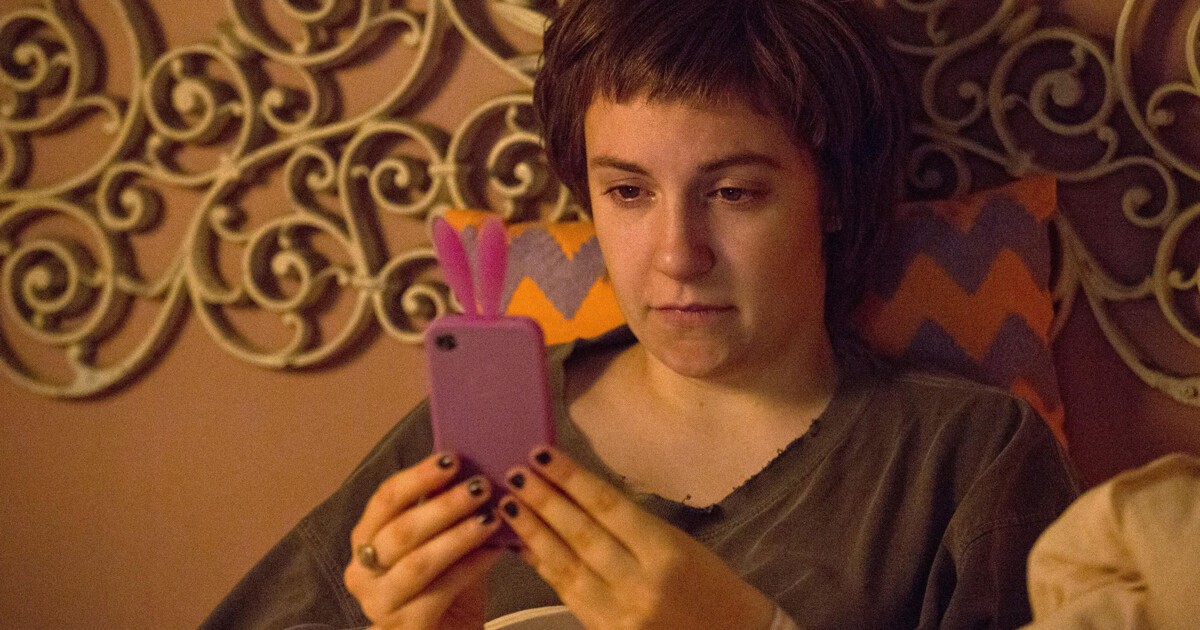
When Lena Dunham became famous in 2012, at 26, for creating, writing, directing and acting in the HBO series Girls, one of the most commented-on aspects of her performance was the fact that she allowed her naked, normal form to be seen on screen. Her body became an argument about Millennial snowflakery, feminist critiques of porn culture and white privilege. It was a time when people said they couldn’t tell whether a young woman was writing a diary entry or making art in shows like Girls, novels like Sheila Heti’s How Should a Person Be? or songs like Taylor Swift’s ‘All Too Well’. Nearly fifteen years later, the way Dunham embodied the character of Hannah Horvath doesn’t seem like a confession, an outrage or a gimmick, but an articulation of girlhood. Through her, we saw a young woman’s power, vulnerability, clumsiness, poignancy, publicness, humour, glory.
Because we saw so much of Dunham’s unvarnished body, we thought we knew it. But we were theorising on a body that was sick, and becoming sicker as we made it more famous. When Dunham told her mother that she planned to write the story of ‘my body turning on me many years before it was meant to and right in sync with the public’, her mother said: ‘Oh Lena. It just sounds so sad.’ Famesick, the resulting memoir, isn’t sad, because it is so honest about sadness. It didn’t have to be honest – look at any of the celebrity memoirs published recently – but it is. ‘I no longer necessarily think that this is the most radical art form and that it’s going to change and shift the world,’ Dunham said of confessional writing in an interview with the New Yorker in 2024, ‘but I do think that it has the most power to change and shift the inner landscape of the person who’s doing it.’ And in memoir, it’s that shift to the inner landscape that matters most, as the narrator starts to sense that the story being told isn’t the real story at all.
This year Dunham turned forty. It’s clear, looking back now, what a strange story we told ourselves about her. (I remember being dazzled, even dazed, by her first movie: how had someone made art out of the horrible stuff of our mid-twenties?) One of the stories we told about her went like this: nepo baby of artist parents who grew up in Tribeca makes a confessional, sexually degrading film about herself which leads to a deal for Girls, in which she continues to tell us about herself and her privileged, whiny friends. In becoming famous, the story continued, she became the archetypal Millennial mess, the scapegoat for a generation, then disappeared and moved to England, where she made work that has sometimes reached the bar of Girls and sometimes has not.
Famesick allows Dunham to return to the story some of its specificity, its nuance. It zooms past childhood straight to the indie film circuit of the 2010s, the first time Dunham felt like someone worth knowing. After graduating from Oberlin, she gathered some of the experiences she would use in her work, earning money as a babysitter, a restaurant hostess and in an accountant’s office, while living at home so that she could pay for a studio in a building in Tribeca where the Safdie brothers, whom she’d met at a film festival, were also renting space. Last year’s Oscar-nominated Marty Supreme was directed by Josh Safdie and co-written by Ronald Bronstein, whom Dunham also knew from her time on Lower Broadway. She would not get the chance they did to ramp into the profession. ‘This was, looking back, a very innocent time,’ she writes, when she would run lines with her studio neighbour, Greta Gerwig, and the film boys would help her pour bags of sand into her mother’s studio to create a faux desert to film in (she forgot to clean it up). And while she did have parents who could ask their friends to raise the $20,000 budget for Dunham’s breakthrough film, Tiny Furniture (2010), she was shocked when it won Best Narrative Feature at South by Southwest because she ‘wasn’t sure – in the film shot in my house, mother as co-star – I had been acting at all’.
When she pitched a show to HBO executives in LA off the back of that success, she had no idea what the ‘blind pilot deal’ she was given would entail. All she knew was what she knew: ‘We’re the first generation that can’t reasonably expect more than our parents had. We all grew up on Ritalin and AOL Instant Messenger. We’re having sex fuelled by the availability of porn, and we’re feminists who don’t know how to live our politics. I want to see my friends on TV.’ Dunham could write a first draft, but she didn’t know how to redraft, edit or perfect the script, just as her character in Tiny Furniture, Aura, took much of the movie to work out that the phrase her crush rolls out in response to almost everything – ‘same shit, different day’ – wasn’t something he had come up with on his own.
In short, she was a girl. And girls need parents. HBO matched Dunham with a fortysomething TV veteran, Jenni Konner, who played that role. Konner knew how to be a bestie, how to pull a pilot apart and reshape it, but she didn’t know how to look out for her star. For Dunham the first betrayal came when Konner relayed a note that Dunham looked ‘too pretty’ and told her the real problem was that she was ‘too thin’, which made the jokes in the show less funny. Konner told her to eat: ‘It’s not that hard.’ It was the first intimation that Dunham – who wasn’t eating because of the anxiety of writing, directing and acting in a $3 million per episode TV show – had become a resource for others, a meal ticket, a ‘rocket that was going to deliver’ Konner to the ‘next stratosphere’. Now, having had the experience of being older on set, Dunham says: ‘You couldn’t pay me enough to demand that of someone so young, so unformed.’
That line echoes one in Episode 2 of Girls, when Hannah goes to the ob-gyn and says she’d like to contract Aids and have a serious problem instead of all her petty ones. ‘You couldn’t pay me enough to be 24 again,’ her doctor says. With a disappearing smile, Hannah replies: ‘Well, they’re not paying me at all.’ Famesick reveals that much of Dunham’s life was integrated into Girls, but not always the parts we guessed. Hannah’s comic self-absorption was regularly assigned to Dunham by lazy critics; no one guessed that the taciturn, violent side of Hannah’s love interest, Adam, played by Adam Driver, was also drawn from life. As the show went on into six seasons and Dunham/Horvath became an avatar for the cluelessness of the internet generation, criticisms of Girls began to appear in the mouths of the other characters, usually directed at Hannah. She was selfish, childish, messy; she made everything about her. After reading Famesick, I watched the show again and this time found the moralism exhausting. I could understand the puzzled Gen Z viewers who have asked: why does everybody hate Hannah? She’s so young, of course she fucks up – but show me someone who is funnier while doing it. Dunham’s answer might be that she hated herself at that point, and thought herself worthy only of boyfriends who didn’t text back and days of work that didn’t end.
You don’t have to like Girls to be glad about the stories that were possible in its wake: onscreen there is Fleabag, Lady Bird, Hacks, Sorry, Baby, Insecure, Shiva Baby; on the page there is Sally Rooney, Raven Leilani, Jia Tolentino; in music there is Charli XCX, Phoebe Bridgers, Mitski. A commercial vein was opened in which it’s OK to be a girl, to mess around with your life in your art, to eroticise friendship as much as romance. It earned media corporations money but it might also have changed them a little: in her recent investigation of 2010s anti-feminism, Girl on Girl, Sophie Gilbert connected the valorisation of female experience in Girls to the narrative outpouring of the #MeToo movement.* You can’t have political change until women are able to tell their stories in all their ugliness – just as you can’t control the backlash when women’s liberation is thought once again to be too much for society. Dunham doesn’t make this argument about her work in Famesick, but she does show the cost of riding that shift in the culture. (Famesick is dedicated to the women who did not survive it, from Caroline Flack to Whitney Houston; the cover shows Dunham’s legs in white tights and black Mary Janes, Alice tumbling down the garden steps into Wonderland.)
Dunham was sick during the first season of Girls, and got much sicker as the show went on. In its final season her anxiety peaked with days-long periods of dissociation; her periods would not stop; she didn’t eat; she fainted at the Met Gala after a string of uterine surgeries. By the time she was diagnosed with endometriosis and Ehlers-Danlos syndrome, she was addicted to Klonopin to lessen anxiety and Percocet to muffle pain. ‘Getting sick is not that different than getting more famous,’ Dunham writes. ‘It has a maddening circularity, and it’s also very hard to explain, even to those people closest to you.’ Her fame removed her from her generation even as she became its flawed spokesperson: she didn’t get invited to parties any more, but was asked for favours; after she wrote about looking at her brother’s genitals in her first book, Not That Kind of Girl (2014), it took years for their relationship to be restored; even her parents, the heroes of this book, found that their daughter’s fame interfered with their own ‘highly specific public identities, niche as they were’. Her boyfriend at the time, the songwriter and producer Jack Antonoff, was always on tour, and seemingly unable to admit to himself that he didn’t want to take care of a mysteriously and constantly sick girlfriend. HBO grew tired of her hospital stays too: when they asked for a second opinion on her condition, their doctor pierced a cyst. (‘A single tear rolled down my cheek,’ Dunham writes coolly. ‘If I’d been on camera it would have been perfection.’) That doctor began the medical crisis that ended in a hysterectomy, the removal of an ovary and the loss of her fertility. One of her finest scenes in Girls, Hannah’s final break-up with Adam over split pea soup at Kellogg’s Diner in Williamsburg, was played with a broken elbow because the production couldn’t wait for Dunham to see a doctor. Her tears were real and not real at once. ‘Maybe I was crying for the show, my actual first love.’
In Famesick, Dunham says that the thesis of Girls is that you are thrust into adult life long before you know how to live it. The question that often comes to my mind when I watch it is: who’s the adult here? The show is full of people who are playing at being grown-ups, from teachers to bosses to parents, and it ends with each of the main female characters declaring themselves mature: because they are a mother, because they are supporting a mother, because they can leave behind toxic friendships, because they can let friends be toxic and not condemn them. It’s a question that ran through Dunham’s life too: was the twentysomething running the show grown-up or was the grown-up her supervisor, who was enforcing the conventions of the small screen? Elaine Blair described one of the characters in Girls as ‘a young woman deep under the influence of coarse categories’ in the form of dictatorial dating advice; in the show’s comic play on the category of adulthood, the behaviours of all the supposedly fully grown characters are put under pressure. In Hollywood, in America, characters are supposed to haul themselves through a narrative arc and come to understand something new about themselves. But in the last episode of Girls, Hannah is just as absurd as in the first, now the mother to a baby who doesn’t want to breastfeed. The episode, ‘Latching’, seems to show her accepting her sacrificial role as mother and being rewarded by her baby’s decision to take the nipple finally. Sometimes it’s not the growing up that matters but the simple act of trying again.
After the health crisis that followed the finale of Girls, Dunham took some time off. She and Antonoff broke up at last. She careened into a new relationship and checked herself into rehab. It was becoming clear that ‘illness wasn’t just a town I was passing through, but a city I was going to pay taxes in.’ Invited to England to direct some episodes of a new HBO show, Industry, she found she could write there, at a quieter pace. In her work since Girls, her themes appear in new formations: The C Word (2019) is a podcast in which Dunham and Alissa Bennett redescribe the lives of women, from Mary Shelley to Anna Nicole Smith, who were once called crazy; Sharp Stick (2022) is a rom-com about a menopausal teenager who discovers the glory of sex; Catherine Called Birdy (2022; my favourite) is an adaptation of a YA novel about a rebellious pre-adolescent in medieval England, who comes to see that ‘knowing your own story will be your salvation’; Too Much (2025) is a TV series on the model of Girls, about an American woman falling in love in London, as Dunham herself did when she was set up with the musician Luis Felber. Dressed in metallic blue ruffles and bows, Jessica Salmon in Too Much has the ‘girlish exuberance’ that is the ‘characteristic bearing’ of the ‘American upper-middle-class young women’ whom Blair saw in Hannah Horvath, but she is less punishing to herself. When Jessica’s boho boyfriend confesses an infidelity, she simply asks him to leave, something Hannah could never bring herself to do.
Dunham herself seems calmer, and less in need of the world’s approval. No longer a ‘bad purchase’, she doesn’t pretend she’s a finished product either: ‘I yelled at my parents when they suggested I go for a walk. I apologised from my gut … I got married, but it didn’t heal me. I made art again, and people were kinder, but still I ached … I stopped being invited to the Met Gala, but people started inviting me to their weddings again.’ The arc is that there is no arc: we will be adultish and childish until the day we die.
I ended my fortieth birthday, four summers ago now, watching my favourite episode of Girls. ‘One Man’s Trash’ is a bubble episode from Season Two, a single story uninterrupted by other narrative strands. A handsome fortyish man comes to the coffee shop Hannah works in to complain. Someone has been leaving the café’s rubbish in his bins. Hannah stands nearby as the complaint turns into an argument between the man and her manager, and then walks out of her shift. Next we see her ring the doorbell of a brownstone. The man who complained opens the door; she says she has something to tell him. He invites her in for a lemonade: the house has a grand piano, white curtains, black stone countertops in the kitchen. She confesses that she has been leaving the café’s trash in his bins. He appears puzzled by her behaviour, and then beguiled by the prolixity of her explanation. As she hands back her glass of lemonade, she kisses him. After a moment, he kisses her back, lifting her onto the stone countertop, where they discover, as they make out, that Joshua is 42 and Hannah is 24. While getting dressed after sex, as Hannah attempts to leave a second time, he tells her he’s recently separated from his wife and asks if she likes steak. Attempting to leave for a third time, she asks him to beg her to stay. For a couple of days, they lend each other what they don’t have: Hannah plays ping-pong topless with him, and the game ends with sex on the table; he hands her a cashmere sweater, feeds her properly and strokes her hair when she faints in his luxuriantly steamy shower. She cannot show herself any care; he cannot believe in a joyous, playful future. I was headed towards 42, I had been 24. You don’t so much grow up as try not to leave your past selves behind.