
One day in 1982, when I was fourteen years old, I went to the Mitchell Library in Glasgow to look at old newspapers. The room was empty. I checked the indexes and tried to locate a copy of an American paper from twenty years before, 6 August 1962, two days after Marilyn Monroe died in Los Angeles. My parents’ marriage had ended brutally in 1981, I wanted to get my life together and I had begun to over-invest in the idea of this beautiful woman, a person abandoned by her parents who went on to invent herself. Now I can see that her movie star image was a sort of objective correlative, a source of light, and there was something obsessive-compulsive in my sense of her perfection. So, when eventually I landed the front page – ‘Marilyn Monroe Found Dead’ – I suffered the one and only panic attack I’ve ever had. Something was too real. I couldn’t breathe and went to the nearest bathroom cubicle and lay down on the floor.
Forty-odd years later, I can still tell, at a glance, which year or film or occasion gave rise to a particular photograph. I try to leave Marilyn behind, because the edge of darkness around her can still affect me, but after a while she is there again, as indelible and as light-giving as the star we want her to be. I say ‘we’, because I’ve long since given up on the notion that my relationship with Marilyn is in any way special. I wrote a novel about her, or about her dog, but just as Marilyn kept running into ‘people’s unconscious’, a great many of us keep running into her presence and her absence, asking for news of mortality. Her image, after Warhol, is still encoded with a vulnerability we instantly recognise, which makes us want to save her or explain her all over again. The real Marilyn has been dust for a long time, but her image has only grown stronger, as if flesh and blood were the illusion all along.
‘People had a habit of looking at me as if I were some kind of mirror instead of a person,’ Marilyn said, a half-century before social media. From room to room at the National Portrait Gallery show (until 6 September), and from one photographer to another, we zero in on her manifest stardom while looking for signs of the person who is really behind the effort, imagining it might be us. She loved photographers and made friends with a number of them – André de Dienes, Sam Shaw, Milton Greene – but there was little doubt among any of them that Marilyn was a self-portraitist working in collaboration. When the compositional duties fall to a painter, the result is often stunning but bereft: Marilyn isn’t there. Willem de Kooning’s 1954 oil on canvas, with its swooshes of yellow, is in the show, but the soul of the actress is missing from the portrait because the medium isn’t hers. In one of Bruno Bernard’s promotional stills for the 1953 film Niagara, Marilyn literally forms the image. It is her creation in a way that none of the oils or montages ever was. She had a sense of where the light would fall and how the fantasy would be instilled. Even in her famous nude calendar shot, shown here, you see a young woman mastering her force. She was soon part of the studio system, but the system at work in these portraits is her nervous one.
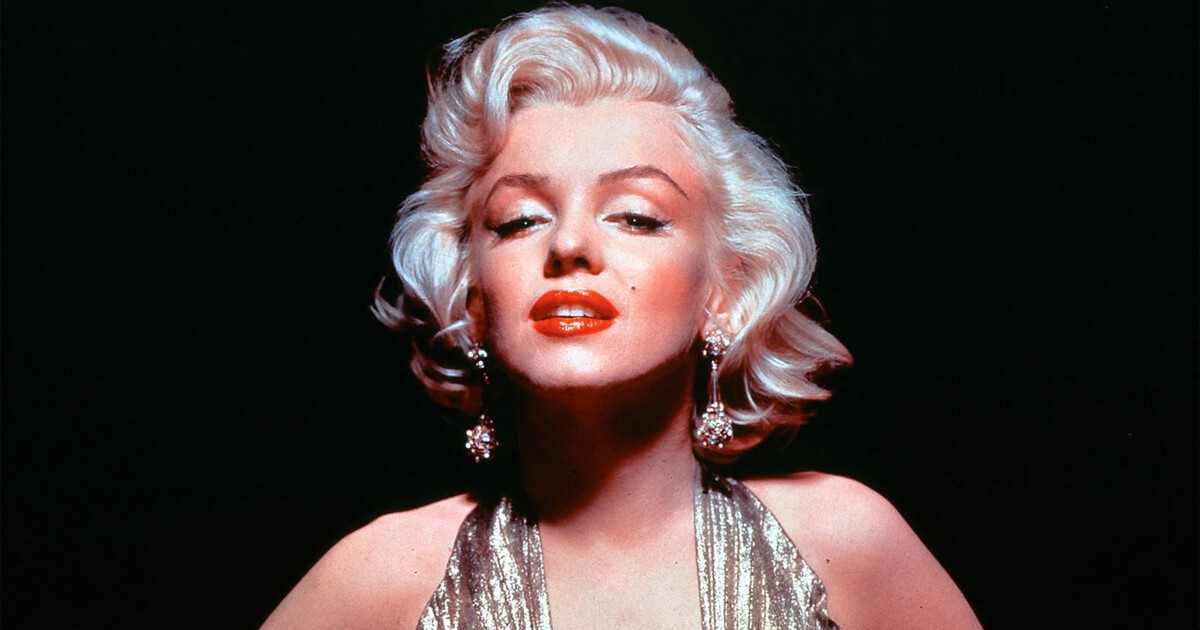
In that sense, the greatest sequences in this show demonstrate Marilyn as a new kind of subject and a new kind of artist, fully alive to the process. The one that stands out for me is by Gene Korman, a publicity still from around the time of Gentlemen Prefer Blondes (above). This is the kind of shot that could easily be mistaken for cheesecake – the plunging gold lamé dress caused Joan Crawford to reach for the smelling salts – but it’s actually one of the last great movie star portraits of Hollywood’s golden era. It could be Garbo or Jean Harlow, but because it’s Marilyn, a postwar sense of ease about sex radiates from the picture. People might be turned on by the portrait, but she is turned on, too: her red lips parted, her eyes half shut, the gloss of her platinum hair, the dress gold against black, all of it working together to create a mutually assertive vision of desire. Marilyn’s characters could be giggly, they could play dumb, but there’s nothing dumb about her here. This is an image of a 20th-century woman in control of the means of production, with flashbulb intelligence, projecting control over the audience’s idea of her.
The Cecil Beaton portraits I find a little cluttered. Too much texture around Marilyn always takes away from her (she is too much texture herself). But one of his, showing her clutching a carnation to her breast and relaxing her gaze, was among Marilyn’s own favourites and it shows her experimenting with more natural ways of distilling herself. This was around the time she was attending the Actors Studio in New York, and just as you can see the effect of that study on her films (Bus Stop, The Prince and the Showgirl), you can see it in the portraits. With Sam Shaw at the beach in Amagansett, she looks pensive, sometimes worried, allowing the camera to see her uncertainty. The greatest of the portraits from this period, and one of the best in the show, was taken by Richard Avedon. Sometimes called ‘Sad Marilyn’ and claimed as a candid shot between more posed ones, I don’t believe it is anything but a piece of method acting by Marilyn. She is caught in thought, but very deliberately, as if the mind’s construction could swiftly show in the face. She could do that most delicately, which is the reason she was a better actor than most of those around her. Laurence Olivier, hamming it up in The Prince and the Showgirl, didn’t notice she was acting him off the screen, not realising that she understood much more about the camera than he did. As director on the film, he earned her hatred by commanding that she ‘Be sexy!’ She thought he was an idiot, but that production, shot in Britain, gave rise to one of the greatest portraits of her, taken by the film’s cinematographer Jack Cardiff, capturing her as a blurred, diaphanous heroine out of Renoir. When you see it here, you think: she painted this.
I have an autograph of Marilyn and Arthur Miller. They signed it to somebody outside a theatre, I guess, perhaps on that trip to London. ‘Marilyn Monroe Miller’. It has the vitality that autographs have – a living person made this mark – and when I glance up at it from my desk of an afternoon I feel glad to have known her, even though I never met her and everyone has a claim of their own. The low points in the show come when journalism robs her of her power, as when Anthony Summers, a conspiracy theorist, decided to print a picture of her on the mortuary slab in his book Goddess. Bleak reality will have its role in any account of a life in portraits, but the thing about the slab pictures, or paintings based on them, or Peter Blake’s collage which included her corpse, is that the intelligence that made her a star of her own formation is missing. On a good day, what Marilyn brings is a sense of aliveness that time can’t touch.